Your new post is loading...

|
Scooped by
Trevor Lee @ TravConsult
February 8, 12:36 AM
|
Discover why China's rapidly aging population is creating a massive new consumer market and how businesses can adapt to harness this growth engine.
|
|
Scooped by
Trevor Lee @ TravConsult
February 4, 7:51 PM
|
The China Cultural Center Budapest invites visitors to a festive, afternoon-long celebration titled “Happy Chinese New Year 2026 – Galloping into the Year of the Horse.”
|
|
Scooped by
Trevor Lee @ TravConsult
February 4, 7:04 PM
|
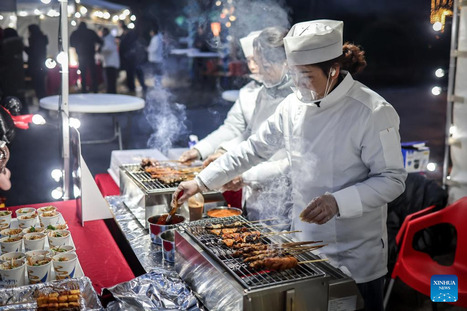
Exchange-style dining spread to 10+ Chinese cities in months. Equipment costs hit 400K RMB. Price fluctuations cap at 3 RMB. Repeat visits are already falling.
|
|
Scooped by
Trevor Lee @ TravConsult
February 3, 6:26 AM
|
Pop Mart, the maker of the famous Labubu doll, named London for its new regional headquarters, and said it would open seven more UK stores, as British Prime Minister Keir Starmer secured the 'ugly-cute' investment on his trip to China.
|
|
Scooped by
Trevor Lee @ TravConsult
February 2, 4:49 AM
|
Chinese heritage grows in popularity thanks to cultural tourism offers.
|
|
Scooped by
Trevor Lee @ TravConsult
January 25, 8:28 PM
|
From embracing an “Are you dead yet?” app to rewriting Lunar New Year customs, here’s how a rising generation of young adults in China is coping with social isolation and economic hardship.
|
|
Scooped by
Trevor Lee @ TravConsult
January 22, 9:27 PM
|
瑞雪兆丰年 (ruì xuě zhào fēng nián) - “a fall of seasonal snow gives promise of a fruitful year.” It’s timely for us at the Skinny, as the first winter snowfall fell this week in Shanghai, following earlier falls across much of the northern and western parts of the country.
|
|
Scooped by
Trevor Lee @ TravConsult
January 22, 9:04 PM
|
South Korea emerges as the top New Year destination for Chinese travelers, with Seoul bookings rising while Japan loses its place in the top 10.
|
|
Scooped by
Trevor Lee @ TravConsult
January 21, 9:20 PM
|
|
|
Scooped by
Trevor Lee @ TravConsult
January 18, 4:10 PM
|
In 2025, China mandated that all AI-generated content be clearly labeled as a direct response to the surge in online fraud fueled by generative AI. The biggest culprits are AI-generated faulty product images and reviews. Both shoppers and sellers are exploiting these tools: consumers to falsely claim defective items for free refunds, and sellers to boost credibility with AI-generated listings and reviews to make a quick profit.
According to Wired, global refund claims that utilize AI-manipulated images have jumped over 15% since early 2025, and the trend is accelerating as tools become more powerful and accessible.
In a major shift, several Chinese e-commerce giants eliminated the “refund only” option in April 2025, signaling a rebalancing of power in favor of brand protection. This means that products need to be returned and verified before refunds are processed.
For brands, the risks are real: financial losses, reputational damage, and potential policy violations. But here’s what brands can do in 2026 to stay ahead of the curve in the ever-evolving landscape of e-commerce:
✅ Comply with AI-labeling regulations (Notably China’s Cyberspace Administration rules).
✅ Deploy AI-powered fraud detection tools to analyze image metadata, review patterns, and purchase behavior.
✅ Strict review verification that requires verified purchase badges or video proof for damage claims, especially for high-value items.
As AI scams evolve and have already started to include hyper-realistic deepfaked videos, as opposed to just faulty product images, brands must fight AI with AI while building genuine trust with loyal customers.
|
|
Scooped by
Trevor Lee @ TravConsult
January 15, 8:38 PM
|
Foreign airlines have deployed more capacity than Chinese carriers on the Shanghai Pudong–Incheon route.
|
|
Scooped by
Trevor Lee @ TravConsult
January 11, 5:56 PM
|
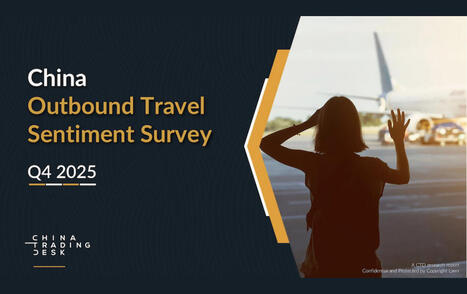
“Airport travel retail is no longer a demand question, it’s an execution question,” says China Trading Desk Founder & CEO Subramania Bhatt.
|
|
Scooped by
Trevor Lee @ TravConsult
January 11, 5:32 PM
|
More than a month after China's Ministry of Culture and Tourism advised Chinese nationals to avoid traveling to Japan, Japanese businesses that rely on Chinese tourists are struggling during what should be their peak travel season.
|
|
|
Scooped by
Trevor Lee @ TravConsult
February 5, 3:42 AM
|
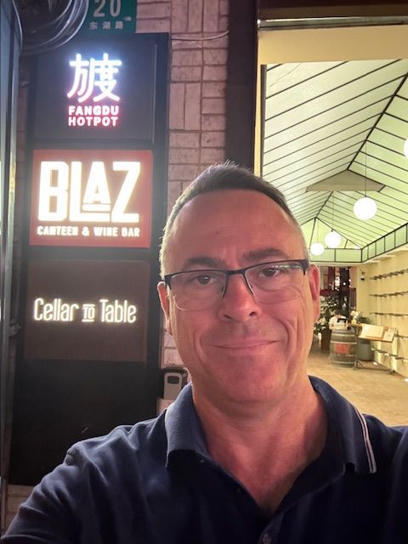
Have you noticed that the more pervasive AI becomes, the more consumers crave human connection? It's happening in China too.
Chinese consumers are craving human connection and real insights now more than ever.
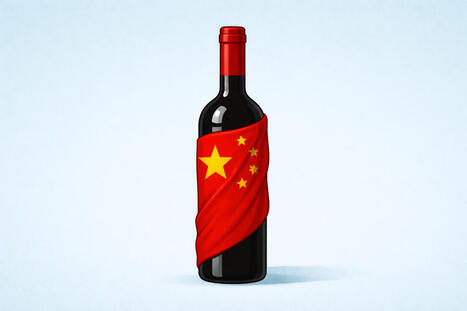
As China's wine market gets more digitised, consumers are demanding more human touch.
Counterintuitive? Absolutely.
Surprising? Not if you've been paying attention.
We're seeing AI-powered wine apps that can identify labels, suggest pairings, and predict your preferences with scary accuracy.
Tmall's using algorithms to push personalised recommendations.
JD's got virtual sommeliers.
It's brilliant tech.
But the data is actually telling us something interesting
The more AI enters the conversation, the more Chinese wine buyers crave authenticity.
They're seeking out:
🍷 Winemaker stories, not just tasting notes
🥂 Physical experiences at wine bars, wine schools and tastings
🍾 Real relationships with merchants who know them
🍇 Direct connections to vineyards and vintners.
It's the same phenomenon we see over and over in other segments such as skincare, lifestyle and clean beauty.
Technology can curate, but it can't create trust. AI can recommend, but it can't build relationships.
The smartest wine brands in China are using AI for efficiency (inventory, logistics, targeting) but doubling down on human moments that matter.
The WeChat group with the passionate merchant. The vineyard video call with the winemaker. The handwritten note with the delivery.
Because here's the truth.
In a market where authenticity is currency and counterfeits are everywhere, algorithms can't replace the look in someone's eye when they tell you what they loved about a wine and who they were drinking it with.
The paradox isn't a problem. It's a roadmap.
What are you seeing? Are consumers pulling toward or away from automated experiences?
🐼 I'm Iain Langridge 毅安 and I help international brands navigate the beautiful complexity of the China market.
Follow or DM me to find out more.
#chinamarket #chinabusiness #wine #wineindustry #ai #consumerinsights #premium #brands #marketinsights In2Asia Export
|
|
Scooped by
Trevor Lee @ TravConsult
February 4, 7:49 PM
|
Chinese food nights promotes cultural exchange in Budapest-
|
|
Scooped by
Trevor Lee @ TravConsult
February 4, 6:11 PM
|
For much of the past two years, commentary on China’s wine market has been dominated
|
|
Scooped by
Trevor Lee @ TravConsult
February 3, 3:28 AM
|
SHANGHAI—January 29, 2026—The mainland China personal luxury goods market contracted by 3%–5% in 2025, a significant moderation compared with the sharp decline seen in 2024, according to Bain & Company’s China Personal Luxury Report.
|
|
Scooped by
Trevor Lee @ TravConsult
January 31, 12:39 AM
|
5 spending trends spotted in the Chinese market today 🌏
Follow for clear China market insights.
#ChinaBusiness #MarketTrends #DigitalChina #ConsumerBehavior
|
|
Scooped by
Trevor Lee @ TravConsult
January 24, 8:58 PM
|
Chinese visitor numbers have increased but are still below pre-pandemic levels, with economists warning ongoing economic uncertainty in China could dampen long-haul travel.
|
|
Scooped by
Trevor Lee @ TravConsult
January 22, 9:23 PM
|
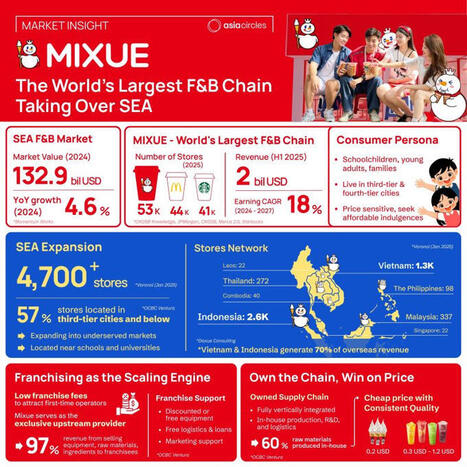
🍦 MIXUE - The World’s Largest F&B Chain Taking Over Southeast Asia
In the first half of 2025, Mixue recorded a revenue of US$2 billion and a net profit of US$381 million, representing a 44.1% YoY increase.
The Chinese ice cream & tea brand has now become the world's largest F&B chain, surpassing McDonald's and Starbucks, with 53,000 stores worldwide.
With such fast growth inevitably comes challenges in franchise management, store clustering, & the refining through closure of underperforming stores.
By the beginning of 2025, Mixue had established over 4,700 stores in Southeast Asia, 57% of those in third-tier cities and below, areas which are still largely ignored by many global brands.
💪 How Mixue is winning in Southeast Asia
🔶Franchising, engineered for speed
More than 99% of stores are franchised with entry costs kept deliberately low.
Unlike typical franchise models, only ~2.4% of revenue comes from franchise fees. Nearly 97% comes from selling equipment, ingredients, and supplies to franchisees.
🔶Owning the supply chain
Mixue runs a closed-loop system with its own factories, R&D, and logistics.
That brings procurement costs 10–20% lower than competitors on key inputs like milk powder and lemons.
🔶Cheap, but consistent
By controlling raw materials in-house, Mixue keeps prices low without sacrificing quality - a formula that resonates strongly with price-sensitive, small-town youth seeking affordable indulgence.
👉 To scale in Southeast Asia, it's crucial to understand the "development cycle".
The game will not belong to high-end brands, it belongs to those who have control over the supply chain.
Source: Mixue Group, CKGSB Knowledge, JPMorgan Research, OCBC Ventura, Mordor Intelligence, Voronoi, Daxue Consulting, Eccellenze d’Impresa, Reuters, Nikkei Asia, McDonald’s Corporation, Starbucks Corporation
*While information from Asia Circles is publicly accessible and derived from third-party sources, its verification and validity are not guaranteed.
#SEAMarket #Foodservice #MarketInsight #ConsumerInsight #AsiaGrowth | 17 comments on LinkedIn
|
|
Scooped by
Trevor Lee @ TravConsult
January 22, 8:57 PM
|
HONG KONG — Chinese tourist numbers are recovering across Asia after a COVID-19 pandemic-era contraction, buoyed by the expansion of visa-fre
|
|
Scooped by
Trevor Lee @ TravConsult
January 21, 8:44 PM
|
"Chinese travelers no longer only visit during peak seasons or rush to popular attractions. They are starting to avoid crowds, seek hidden gems, and are more eager to experience local lifestyles," Gabor Kelemen, head of Asia for the VisitHungary National Tourism Organization, said.
|
|
Scooped by
Trevor Lee @ TravConsult
January 15, 8:39 PM
|
The Shanghai Hongqiao–Shenzhen route has emerged as the dark horse of the year, thanks to its high capacity and low fares.
|
|
Scooped by
Trevor Lee @ TravConsult
January 11, 6:22 PM
|
In 2025, tourists from the Chinese mainland comprised the largest segment of international visitors to Vietnam, making up 25 percent of total foreign arrivals
|
|
Scooped by
Trevor Lee @ TravConsult
January 11, 5:33 PM
|
South Korea will keep its C-3-2 visa-fee waiver for Chinese tour and business groups until 30 June 2026, trimming travel budgets and spurring new charter flights from China’s regional cities. Corporates can save hundreds of dollars per group but must ensure travellers remain with accredited itineraries to retain the benefit.
|


 Scoop.it!