Your new post is loading...

|
Scooped by
Trevor Lee @ TravConsult
January 31, 12:39 AM
|
5 spending trends spotted in the Chinese market today 🌏
Follow for clear China market insights.
#ChinaBusiness #MarketTrends #DigitalChina #ConsumerBehavior
|
|
Scooped by
Trevor Lee @ TravConsult
January 24, 8:58 PM
|
Chinese visitor numbers have increased but are still below pre-pandemic levels, with economists warning ongoing economic uncertainty in China could dampen long-haul travel.
|
|
Scooped by
Trevor Lee @ TravConsult
January 22, 9:23 PM
|
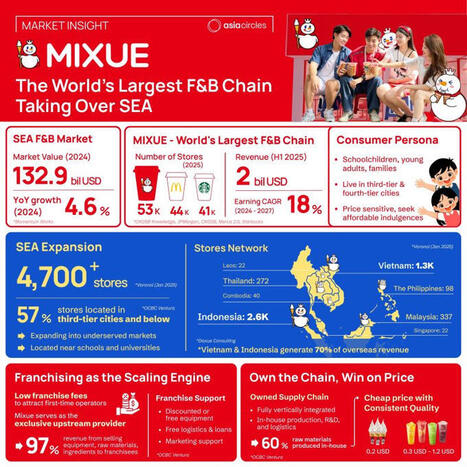
🍦 MIXUE - The World’s Largest F&B Chain Taking Over Southeast Asia
In the first half of 2025, Mixue recorded a revenue of US$2 billion and a net profit of US$381 million, representing a 44.1% YoY increase.
The Chinese ice cream & tea brand has now become the world's largest F&B chain, surpassing McDonald's and Starbucks, with 53,000 stores worldwide.
With such fast growth inevitably comes challenges in franchise management, store clustering, & the refining through closure of underperforming stores.
By the beginning of 2025, Mixue had established over 4,700 stores in Southeast Asia, 57% of those in third-tier cities and below, areas which are still largely ignored by many global brands.
💪 How Mixue is winning in Southeast Asia
🔶Franchising, engineered for speed
More than 99% of stores are franchised with entry costs kept deliberately low.
Unlike typical franchise models, only ~2.4% of revenue comes from franchise fees. Nearly 97% comes from selling equipment, ingredients, and supplies to franchisees.
🔶Owning the supply chain
Mixue runs a closed-loop system with its own factories, R&D, and logistics.
That brings procurement costs 10–20% lower than competitors on key inputs like milk powder and lemons.
🔶Cheap, but consistent
By controlling raw materials in-house, Mixue keeps prices low without sacrificing quality - a formula that resonates strongly with price-sensitive, small-town youth seeking affordable indulgence.
👉 To scale in Southeast Asia, it's crucial to understand the "development cycle".
The game will not belong to high-end brands, it belongs to those who have control over the supply chain.
Source: Mixue Group, CKGSB Knowledge, JPMorgan Research, OCBC Ventura, Mordor Intelligence, Voronoi, Daxue Consulting, Eccellenze d’Impresa, Reuters, Nikkei Asia, McDonald’s Corporation, Starbucks Corporation
*While information from Asia Circles is publicly accessible and derived from third-party sources, its verification and validity are not guaranteed.
#SEAMarket #Foodservice #MarketInsight #ConsumerInsight #AsiaGrowth | 17 comments on LinkedIn
|
|
Scooped by
Trevor Lee @ TravConsult
January 22, 8:57 PM
|
HONG KONG — Chinese tourist numbers are recovering across Asia after a COVID-19 pandemic-era contraction, buoyed by the expansion of visa-fre
|
|
Scooped by
Trevor Lee @ TravConsult
January 21, 8:44 PM
|
"Chinese travelers no longer only visit during peak seasons or rush to popular attractions. They are starting to avoid crowds, seek hidden gems, and are more eager to experience local lifestyles," Gabor Kelemen, head of Asia for the VisitHungary National Tourism Organization, said.
|
|
Scooped by
Trevor Lee @ TravConsult
January 15, 8:39 PM
|
The Shanghai Hongqiao–Shenzhen route has emerged as the dark horse of the year, thanks to its high capacity and low fares.
|
|
Scooped by
Trevor Lee @ TravConsult
January 11, 6:22 PM
|
In 2025, tourists from the Chinese mainland comprised the largest segment of international visitors to Vietnam, making up 25 percent of total foreign arrivals
|
|
Scooped by
Trevor Lee @ TravConsult
January 11, 5:33 PM
|
South Korea will keep its C-3-2 visa-fee waiver for Chinese tour and business groups until 30 June 2026, trimming travel budgets and spurring new charter flights from China’s regional cities. Corporates can save hundreds of dollars per group but must ensure travellers remain with accredited itineraries to retain the benefit.
|
|
Scooped by
Trevor Lee @ TravConsult
January 11, 5:30 PM
|
Immigration data shows 659,090 mainland visitors entered Hong Kong between New Year’s Eve and Saturday, accounting for 79 per cent of tourist arrivals.
|
|
Scooped by
Trevor Lee @ TravConsult
January 11, 5:15 PM
|
A 2019 catchphrase about flying pointed to an income problem. Seven years on, how much of his fix has been tried?
|
|
Scooped by
Trevor Lee @ TravConsult
January 7, 7:33 PM
|
A 13-store retailer in Henan just taught China's biggest supermarkets how to survive. Yonghui saw 10x sales jumps. Walmart is studying it. Revenue: $3.24B with 38% growth.
|
|
Scooped by
Trevor Lee @ TravConsult
January 5, 8:40 PM
|
The grey market problem in China you didn't see coming until it was too late
A premium international brand spent 18 months building their China strategy.
Secured the right distribution partners. Invested in KOL partnerships. Launched on Tmall with beautiful brand storytelling and premium positioning.
Then they discovered their products were already selling on Taobao for 40% less.
Welcome to the grey market. It will kill your China strategy faster than anything else.
So how does it happen?
Daigou and parallel importers are already buying your product from official websites or retail outlets in your home country, or even another market in Asia.
They're shipping them to China and undercutting your official pricing, right under your nose.
If left unchecked, this "minor" problem will grow.
Everyone purchasing online can see your genuine product selling at well below China RRP.
This will drag the market price down. Pretty soon your flagship store sales will sag, and you'll be chasing your tail.
It gets worse.
Your official distributors won't be able to compete either.
Why would a Chinese consumer pay ¥800 on Tmall when they can get the "same product" for ¥480 on Taobao?
Your distributor's margins evaporate. Your premium positioning is destroyed.
You've spent months crafting a luxury brand narrative. The grey market has turned you into a discount commodity.
Good luck repositioning.
And guess what? It's not illegal. These are often genuine products, purchased legitimately, maybe from your own wholesale channel.
So what do you do?
1. Don't pretend the grey market doesn't exist. It does. Build your strategy knowing it's there.
2. Work to actively control your China RRP from day 1.
3. Control supply at the source by limiting who can buy large quantities.
4. You might need to create China specific packaging and formulations to make grey market products easier to identify.
5. Price strategically and sensibly. If your official China price is 3x your domestic RRP, you're creating a massive arbitrage opportunity.
6. Build value beyond the product Exclusive access, loyalty programs, authentic guarantees, genuine branded gifts, 10/10 customer service, education.
Give consumers compelling reasons to buy through official channels.
6. Move fast. The longer you delay, the more time grey market sellers have to establish themselves and define your brand positioning for you.
I've watched premium brands lose millions in potential China revenue because they underestimated the grey market and the damage it can do.
Some have had to close their flagship stores and even exit the market.
Don't let parallel imports write your brand story in China before you do.
Already got a problem with grey channels in China?
Let's talk.
-------------------------------------------------------------
I'm Iain Langridge 毅安 and I use my experience in China to launch, grow, and manage premium consumer brands.
#chinamarket #greymarket In2Asia Advisory
|
|
Scooped by
Trevor Lee @ TravConsult
January 5, 3:10 AM
|
|
|
|
Scooped by
Trevor Lee @ TravConsult
January 25, 8:28 PM
|
From embracing an “Are you dead yet?” app to rewriting Lunar New Year customs, here’s how a rising generation of young adults in China is coping with social isolation and economic hardship.
|
|
Scooped by
Trevor Lee @ TravConsult
January 22, 9:27 PM
|
瑞雪兆丰年 (ruì xuě zhào fēng nián) - “a fall of seasonal snow gives promise of a fruitful year.” It’s timely for us at the Skinny, as the first winter snowfall fell this week in Shanghai, following earlier falls across much of the northern and western parts of the country.
|
|
Scooped by
Trevor Lee @ TravConsult
January 22, 9:04 PM
|
South Korea emerges as the top New Year destination for Chinese travelers, with Seoul bookings rising while Japan loses its place in the top 10.
|
|
Scooped by
Trevor Lee @ TravConsult
January 21, 9:20 PM
|
|
|
Scooped by
Trevor Lee @ TravConsult
January 18, 4:10 PM
|
In 2025, China mandated that all AI-generated content be clearly labeled as a direct response to the surge in online fraud fueled by generative AI. The biggest culprits are AI-generated faulty product images and reviews. Both shoppers and sellers are exploiting these tools: consumers to falsely claim defective items for free refunds, and sellers to boost credibility with AI-generated listings and reviews to make a quick profit.
According to Wired, global refund claims that utilize AI-manipulated images have jumped over 15% since early 2025, and the trend is accelerating as tools become more powerful and accessible.
In a major shift, several Chinese e-commerce giants eliminated the “refund only” option in April 2025, signaling a rebalancing of power in favor of brand protection. This means that products need to be returned and verified before refunds are processed.
For brands, the risks are real: financial losses, reputational damage, and potential policy violations. But here’s what brands can do in 2026 to stay ahead of the curve in the ever-evolving landscape of e-commerce:
✅ Comply with AI-labeling regulations (Notably China’s Cyberspace Administration rules).
✅ Deploy AI-powered fraud detection tools to analyze image metadata, review patterns, and purchase behavior.
✅ Strict review verification that requires verified purchase badges or video proof for damage claims, especially for high-value items.
As AI scams evolve and have already started to include hyper-realistic deepfaked videos, as opposed to just faulty product images, brands must fight AI with AI while building genuine trust with loyal customers.
|
|
Scooped by
Trevor Lee @ TravConsult
January 15, 8:38 PM
|
Foreign airlines have deployed more capacity than Chinese carriers on the Shanghai Pudong–Incheon route.
|
|
Scooped by
Trevor Lee @ TravConsult
January 11, 5:56 PM
|
“Airport travel retail is no longer a demand question, it’s an execution question,” says China Trading Desk Founder & CEO Subramania Bhatt.
|
|
Scooped by
Trevor Lee @ TravConsult
January 11, 5:32 PM
|
More than a month after China's Ministry of Culture and Tourism advised Chinese nationals to avoid traveling to Japan, Japanese businesses that rely on Chinese tourists are struggling during what should be their peak travel season.
|
|
Scooped by
Trevor Lee @ TravConsult
January 11, 5:29 PM
|
Chinese visitors to South Korea soar, topping Japan By YANG FEIYUE | CHINA DAILY | Updated: 2026-01-10 07:09 Seoul's winter festivities have eclipsed Tokyo's iconic celebrations, abruptly ending the Japanese capital's long reign as the top New Year's destination for Chinese travelers going overseas.
|
|
Scooped by
Trevor Lee @ TravConsult
January 7, 8:34 PM
|
Will Chinese travel to Europe boom once full flight capacity is restored?
“A major problem that is hampering the group to grow to pre-pandemic levels is the ban on overflying Russia, which has added costs and two extra hours of flight time for China-Europe flights,” van Wijk said. South China Morning Post, Jan 1, 2026 - - article link will be available in the comments.
China's current international flight connectivity is reported as 82% of 2019 levels. This means that there is still quite some immediate growth potential once and where conditions allow it.
For travel to Europe, apart from visa policy, the main remaining obstacle for a full recovery is the closure of Russian airspace, but destinations such as Spain, Italy or Turkey show what is possible already.
Once this capacity is restored to its full potential, increased flight and seat numbers will inevitably lead to bigger choice and lower ticket prices, resulting in a substantial growth in traffic and revenues.
Given that Europe always was and still remains very attractive to Chinese travelers, the tour operators here can't wait for this to materialize - and I believe they would react very quickly.
In light of this, 2026 seems a good time to prepare for this moment, so that your brand and product are well known and positioned in the market when demand kicks in?
#InsideOutboundChina
If China is an important source market for you, you need to know what is happening on the ground so that you can update your strategy and keep your positioning relevant.
If you don't have your own sales representative yet and must monitor the market from afar, hopefully the information shared here will be helpful to you.
Inside Outbound China - Sedlinger & Associates
World Hospitality Alliance
|
|
Scooped by
Trevor Lee @ TravConsult
January 6, 10:37 PM
|
Hello there! As we wrap 2025, the gap between the headlines we read and the reality on the ground is real. When you step off the plane in Shanghai or Shenzhen today, something feels different.
|
|
Scooped by
Trevor Lee @ TravConsult
January 5, 6:13 PM
|
Market’s top apps are merging content and checkout, rewriting playbooks across Xiaohongshu, Douyin, Kuaishou, Xianyu and Tmall.
|