Your new post is loading...

|
Scooped by
Trevor Lee @ TravConsult
November 24, 8:48 AM
|
The Philippines’ Department of Foreign Affairs (DFA) has announced a one-year extension of the existing 14-day visa-free entry program for
|
|
Scooped by
Trevor Lee @ TravConsult
November 18, 9:53 PM
|
A Chen Xiang Gui Restaurant in China The Hungarian restaurant market has welcomed a new arrival from the Far East. The Chinese chain Mr. Noodle Chen has opened its first Hungarian location on Budapest’s Corvin Promenade. Behind the name is the successful Chinese brand Chen Xiang Gui, which operates several hundred restaurants in its home […]
|
|
Scooped by
Trevor Lee @ TravConsult
November 17, 6:41 PM
|
Everything old is new again in China. Why old school fundamentals still matter in the largest consumer market on the planet.
In 2026 we made the decision to go all in and move full time to China, to base our growing In2Asia Export business in Suzhou, Jiangsu province.
I get asked all the time why we chose Suzhou.
There are plenty of compelling reasons. We're on Shanghai's doorstep, the business environment is excellent, and we have access to an extraordinary pool of talented people who are at the cutting edge of ecommerce, digital marketing and brand development.
But the biggest reason for making the move was something else entirely. We wanted to get closer to the action. Literally.
China is arguably the most digitally advanced consumer market in the world. Ecommerce, social media, livestreaming and digital marketing are central to almost everything we do.
But here's the interesting thing. The more digital China becomes, the more important real world. old school engagement seems to be.
Wine tastings, product launches, trade events, consumer activations, distributor meetings, retail promotions. Getting products into people's hands, introducing brands face-to-face, building relationships and creating experiences that consumers remember.
These aren't relics of a bygone era of marketing. They're increasingly essential ingredients in building successful brands in China.
And the magic happens when you bring the two worlds together.
An offline event creates content. Content builds awareness. Awareness drives online
discovery. Ecommerce converts that interest into sales. And those sales create opportunities for further offline distribution.
It's not online versus offline. It's making the two work together.
That's what we wanted to be closer to, and why we've invested in building our infrastructure, team, and capabilities on the ground in Suzhou.
Having online stores and a digital marketing strategy is no longer enough. You need to be present, visible and actively engaged in the market.
And you need people on the ground who can make it happen.
After all, for all the extraordinary technological change taking place in China, some of the fundamentals of building a successful business haven't changed at all.
Relationships matter. Experiences matter. Showing up matters.
In China, everything old is new again.
I’m Iain Langridge 毅安, co-founder of In2Asia Export and In2Asia Wine. We launch, sell, and grow premium international brands in China. Follow or DM me to find out more.
#china #chinamarket #chinabusiness #ontheground #exportsuccess
|
|
Scooped by
Trevor Lee @ TravConsult
November 12, 11:51 PM
|
The Western press keeps parroting the "Chinese consumer slump" narrative.
They are reading the numbers completely wrong.
According to China’s National Bureau of Statistics Q3 data, total retail sales picked up just 1.1% YoY, dragged down by real estate and auto sales.
Meanwhile:
- Online service consumption jumped 5.3%
- Health, wellness, and functional FMCG categories continue to post solid growth (Bain & Co)
- NetsUnion recorded a record 4.64 billion single-day transactions on Oct 20 as Double 11 presales kicked off
The takeaway for Double 11 this week?
Chinese consumers aren't broke. They just stopped paying a premium for pure prestige and vanity logos. They are spending aggressively on health, experience, daily utility, and practical lifestyle upgrades.
If your brand is dying in China right now, it’s not the macroeconomy, it’s the(your) positioning.
What do you think?
#ChinaBusiness #Double11 #ConsumerTrends #MarketStrategy #Chinadvisory
|
|
Scooped by
Trevor Lee @ TravConsult
November 7, 1:18 AM
|
FROM ITS FIRST EXPRESSWAY TO 190,700 KM IN 36 YEARS.
In 1988, mainland China opened its first expressway: the Shanghai-Jiading Expressway, approximately 18 km long.
By the end of 2024, its expressway network had reached 190,700 km. The largest in the world. Enough expressway road to circle the Earth almost five times.
For context, these are the lengths of expressways in the countries with the largest networks in the world today:
1. China 199,400 km
2. United States 108,950 km
3. Spain 15,886 km
4. Germany 13,259 km
5. Japan 12,396 km
6. France 11,751 km
China’s road network totals 5.58 MILLION km as of today. Expressways account for just 3.5% of that length.
Understand what roads mean in China's social contract between the state and its people: "Connectivity — China’s Love Language" > https://lnkd.in/g24nffqc
WHAT I DO – https://lnkd.in/gq7BAEqz
Bring China Decoded™ to your leadership team.
___
I am Kenny Lim, creator of China Decoded™ | The China Whisperer, helping boards & C-suite understand how Chinese companies think, compete & scale.
#ChinaDecoded #TheChinaWhisperer | 17 comments on LinkedIn
|
|
Scooped by
Trevor Lee @ TravConsult
November 5, 9:40 PM
|
Chinese Luxury Brands: my 2c
I have been to China twice this year – I focus my time around shopping malls - the only companies I met were Chinese to understand strategy and mindset.
On western (mostly social) media I keep reading about Guochao, the preference for local brands and how much of a threat they are to western luxury names. This is mostly nonsense.
Let me explain: yes China spend is weaker in Luxury things but the threat from local brands is being vastly overstated and not the problem.
It is in Jewellery where Chinese brands do compete: given the Chinese propensity to buy 24K gold the likes of Laopu, Chow Tai Fook and Jemper (to name just 3) are well positioned to take share as demand here grows and as fixed price versus weight pricing becomes more established they are evolving accordingly. CTF’s new flagship stores are clearly part of an elevation strategy to entice a higher share of VICs. I think their new heritage-inspired collections are more creative and superior to their western equivalents to be honest. Laopu is suffering from unfortunate timing of price increases and impossible comps and for the first time advertising aggressively and displaying prices in windows unlike before but remains a force in the market. In short, in Jewellery the Chinese brands ARE an alternative.
In Beauty I think MaoGeping can do well in make-up and skincare, a very credible proposition (an Intercos client) with high-end counters and eye-catching products that are very China-focused. In Fragrances several players (Documents, Melt Season, To Summer etc) can compete and have upside.
But..in Soft Luxury I am really not seeing this. Take Songmont. I first visited in early 2025 when I first became a customer and returned to 3 stores again this time round. The stores are nice if basic, the staff is well trained also in storytelling, the value for money proposition is excellent and I absolutely see why each store had queues. But at €150-€500 it’s not Luxury – it is an excellent alternative to Coach (also doing very well) for those trading down but hardly up against Chanel or even LV.
One 100% Luxury bag name which I finally found was Duanmu and its beautiful hand-crafted one-off pieces (€1500-5000) but we are talking 3 stores in total only and I suspect not really scalable.
I also visited 3 Pane stores (they have 8 in total)…the much feted new Chinese lifestyle sneaker brand. I thought the stores were very smartly decorated and the uniformed the staff excellent but we are talking €80-150 and above all I would argue ¾ of the customers were not even locals. This is a clever social media-led phenomenon which many of the Chinese I talked to had never heard of.
Icicle (first visited in 2024 and now involved with Kering) is fundamentally an overpriced Zara with prettier stores but no better than most mid-price apparel names in Italy or France.
The threat to Western bag brands comes from resale platforms like ZZER, not Chinese brands.
|
|
Scooped by
Trevor Lee @ TravConsult
November 4, 6:04 PM
|
Six or seven years ago, I watched Luckin Coffee take off in China and wrote it off as a lame duck.
The growth was insane. The coffee was not. Next to Starbucks, it felt subpar, and a latte was about 95% milk.
Then I came back, walked into a Luckin, and the menu felt endless. There seems to be a new seasonal drink every other day.
I was wrong about what I was looking at. Here is the gap:
Starbucks spent nearly 30 years building about 8,000 stores in China. Luckin now has more than 35,000. Starbucks' China same-store sales fell in each of its last two fiscal years (AP), and in 2025 it sold 60% of its China retail business to Boyu Capital in a $4 billion deal, citing the need for local knowledge, especially in smaller cities.
Luckin's non-coffee drinks passed RMB 20 billion (~US$2.95B) in cumulative sales by May 2026. 22 star products have each sold over 100 million cups. Its Coconut Latte has sold more than 2.1 billion cups.
Starbucks built a premium "third place". Luckin built a menu that behaves like a feed: constantly refreshed, tested at scale and shaped by what customers actually buy. It sources jasmine, navel oranges and coconut across Yunnan, Guangxi and beyond, so fast innovation is a supply-chain capability before it is a creative one.
What this says about China:
• Speed is the product. A menu is a conversation, not a fixed asset.
• Local taste goes down to the ingredient.
• Judging a brand by where it starts is a mistake. It improves faster than you expect.
• A premium global brand does not guarantee a place in the domestic market.
It echoes GRIF: novelty gets people through the door, but localization keeps them there.
Sources: AP via Mainichi (Nov 2025); Asia Food & Beverages (Jul 2026), citing Luckin company figures.
#Luckin #Starbucks #ChinaMarket #FoodAndBeverage #Localization #ChineseConsumer
|
|
Scooped by
Trevor Lee @ TravConsult
November 2, 7:13 PM
|
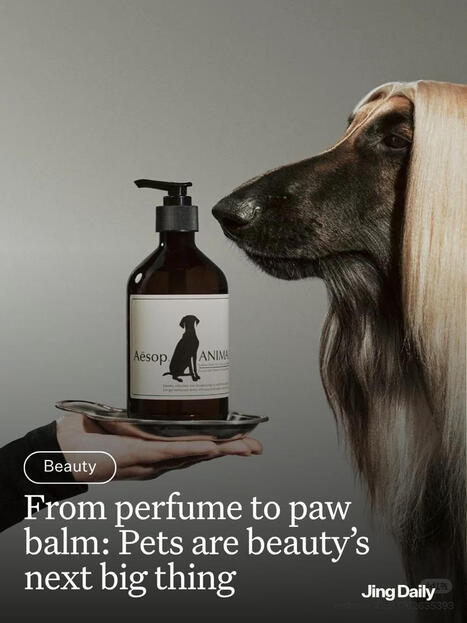
Consumer trends in China have been shifting beyond the human - TONG Global's Commercial Director, Jack Porteous, was asked by Jing Daily for insight into how luxury brands in China are embracing pet parents' increased spending, with global pet-care sales projected to reach $224.5 billion in 2026.
"The prime consumer group is known by marketers as ‘DINKWADs’ – double income, no kids, with a dog,” says Jack. “They are buying for their own lifestyle, as much as for the pet." A scented dog shampoo is no longer only about the animal’s coat; it sits inside the owner’s bathroom, home and ideas about cleanliness, comfort and taste.
Read the full article here: https://lnkd.in/e-wSUFmD
#ChineseConsumerTrends #PetCare #ConsumerSpending #ChinaMarket
|
|
Scooped by
Trevor Lee @ TravConsult
October 28, 9:50 PM
|
More Chinese flights from Budapest face cancellations. Could fuel costs, weak demand or financial pressures explain why?
|
|
Scooped by
Trevor Lee @ TravConsult
October 28, 8:13 PM
|
'Charm of Jiangsu' Global Communication CenterNANJING, China, Oct. 22, 2026 (GLOBE NEWSWIRE) -- The 'Charm of Jiangsu' Chinese Weaving an
|
|
Scooped by
Trevor Lee @ TravConsult
October 27, 10:33 PM
|
|
|
Scooped by
Trevor Lee @ TravConsult
October 27, 2:09 AM
|
Chinese beverage retailer Mixue has surpassed 500 million members in China, underscoring the scale of its consumer reach.
|
|
Scooped by
Trevor Lee @ TravConsult
October 1, 9:42 AM
|
Long-time Foreo Global Travel Retail Director Gary Leong is returning to TFWA World Exhibition in Cannes with his own company, Gulf Pacific, to meet existing and prospective brand partners. Here he shares his thoughts on the travel retail market.
|
|
|
Scooped by
Trevor Lee @ TravConsult
November 19, 7:26 PM
|
TenPayGo and McDonald’s China are working on a new way for visitors to China to explore the menu in their familiar languages and order for pickup with TenPayGo.
We’ve picked the fries. We’ll leave the rest to you, McDonald's China.🍟
|
|
Scooped by
Trevor Lee @ TravConsult
November 18, 12:31 AM
|
Miniso has reported a 19.3 per cent increase in revenue for the first nine months of FY26, supported by strong growth in mainland China.
|
|
Scooped by
Trevor Lee @ TravConsult
November 15, 6:04 AM
|
You've heard of Mandarin, Cantonese, Simplified Chinese, Traditional Chinese, and countless dialects.
But what do people actually speak in China?
The answer is more complex than you might think.
China has 7 to 10 major Chinese language groups, hundreds of local dialects, and around 300 living languages when ethnic minority languages are included.
And here's something surprising: two Chinese people from different regions might not understand each other when speaking their local dialects!
At HI-COM ASIA, we've put together a guide to help you understand China's fascinating linguistic diversity and what it means for communication and business.
Read our guide:
https://lnkd.in/eYDe4inJ| 12 commentaires sur LinkedIn
|
|
Scooped by
Trevor Lee @ TravConsult
November 12, 11:48 PM
|
A new survey by KPMG China and GS1 Hong Kong suggests that mainland Chinese brands are changing consumer perceptions through innovation and improving product quality. In GBA cities outside Hong Kong, 64% of consumers choose mainland brands for value for money, while 58% cite safety and reliability.
Hong Kong consumers, meanwhile, are still more likely to associate mainland brands with affordability. Only 39% consider them safe and reliable. By comparison, 74% of Hong Kong consumers and 61% of consumers in other GBA cities say safety and reliability are the main reasons they choose Hong Kong brands.
Anson Bailey, Head of Consumer & Retail, Asia Pacific at KPMG China, says mainland brands can no longer be seen simply as low-cost competitors. Their pace of innovation and improving product quality are helping them build stronger brand value.
The findings point to shifting consumer preferences across the GBA, putting pressure on Hong Kong retailers to rethink what sets their brands apart. How can Hong Kong brands stay competitive as mainland Chinese brands continue to move up the value chain?
KPMG China | GS1 Hong Kong | Anson Bailey (eMBA)
Link in the comments. 👇
#GreaterBayArea #HongKongRetail #ConsumerTrends #BrandInnovation #RetailIndustry
|
|
Scooped by
Trevor Lee @ TravConsult
November 6, 11:26 PM
|
𝐂𝐡𝐢𝐧𝐚’𝐬 𝐏𝐞𝐭 𝐌𝐚𝐫𝐤𝐞𝐭 𝐈𝐬 𝐌𝐨𝐯𝐢𝐧𝐠 𝐟𝐫𝐨𝐦 𝐎𝐰𝐧𝐞𝐫𝐬𝐡𝐢𝐩 𝐭𝐨 𝐂𝐚𝐫𝐞
As pets become family members, Chinese consumers are raising their expectations for what good pet care looks like.
Pet food retail sales reached USD 7.6 billion in 2025, with e-commerce contributing USD 5.1 billion, about 2/3 of the market. In 2025, JD found that 58% of pet owners see their pets as family, while sales of senior-specific dog food grew 87%.
The shift goes beyond premiumisation. Owners are paying closer attention to ingredients, safety, functional benefits and life-stage needs, driving demand for more specialised products across nutrition, grooming, dental care and beyond.
For international brands, being imported is only the starting point. Brands also need clear Chinese-language guidance, credible product claims, responsive customer service and content that demonstrates how a product fits into everyday pet care.
At RedFern, we approach the category with this in mind: building around ongoing care needs and repeat purchases, connecting consumer education with e-commerce, membership and replenishment.
#RedFernDigital #ChinaPetMarket #PetCare #ChinaEcommerce #PetFoodIndustry
|
|
Scooped by
Trevor Lee @ TravConsult
November 5, 8:00 PM
|
China’s retail sales grew an uninspiring 1.1% in the first nine months of 2026.
|
|
Scooped by
Trevor Lee @ TravConsult
November 2, 7:37 PM
|
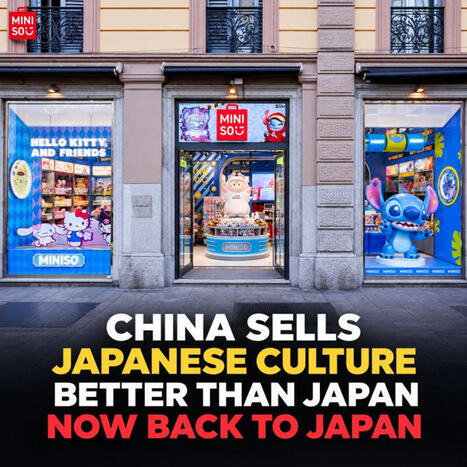
China is selling Japanese culture to the world. And now it is selling it back to Japan.
I find this almost surreal, and fascinating from a business perspective.
For decades, Japan has developed a visual language recognised everywhere: anime, manga, kawaii characters and collectibles. Today, several Chinese companies have become remarkably good at turning that language into products, experiences and global retail networks.
With Genshin Impact, miHoYo created an original universe that draws on anime aesthetics.
Miniso sells licensed Japanese characters such as Hello Kitty and Chiikawa. As of June 2026, it had more than 8,300 stores and a presence across 113 countries and regions.
Pop Mart has built a powerful engine of desire, surprise and repeat purchases around collectible characters and blind boxes, packages whose contents you discover only after buying them.
The cycle now reaches Japan itself, where both Pop Mart and Top Toy, the brand developed within the Miniso group, operate. This is what strikes me: a country can help create an entire cultural aesthetic, only for its businesses to face foreign competitors at home who have mastered its commercial potential. Competitive advantage also comes from securing licences, developing products, refreshing collections, building communities and reaching customers. Of course, when Japanese characters are licensed, their Japanese owners can benefit too. But the question remains: who builds the retail brand, controls distribution and maintains the customer relationship?
For those of us in Italy, this deserves attention. We have an extraordinary heritage of style, design and product culture. How good are we at turning it into businesses that grow internationally? How much value do you capture from creating an aesthetic if someone else builds the everyday relationship with the people buying it? #china #japan #popMart #businessAsia
|
|
Scooped by
Trevor Lee @ TravConsult
October 30, 5:47 AM
|
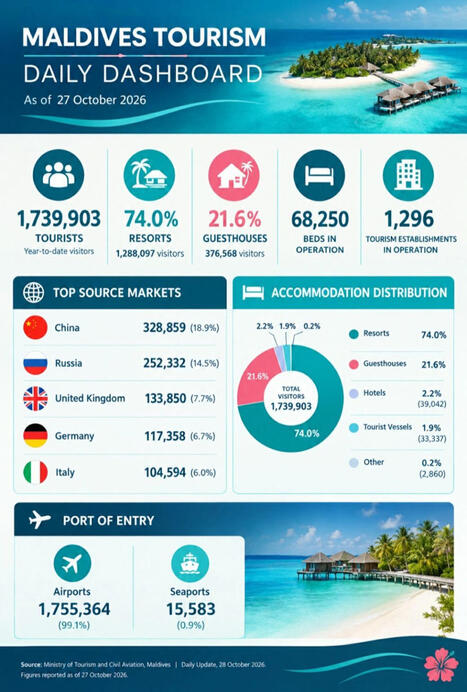
The latest Ministry of Tourism and Civil Aviation statistics, as of 27 October 2026, show that the Maldives has welcomed 1.74 million tourists this year, with resorts accommodating 74% of visitors and guesthouses welcoming a further 21.6%.
China leads our source markets with 328,859 visitors, followed by Russia (252,332) and the United Kingdom (133,850). With 1,296 tourism establishments in operation and 68,250 beds available, our focus remains on strengthening the Maldives’ global tourism leadership, diversifying experiences, empowering local communities and ensuring tourism creates opportunities across our inhabited islands.
Our success is not measured by arrivals alone, but by the quality of experiences we deliver and the benefits tourism brings to our people.
|
|
Scooped by
Trevor Lee @ TravConsult
October 28, 9:38 PM
|
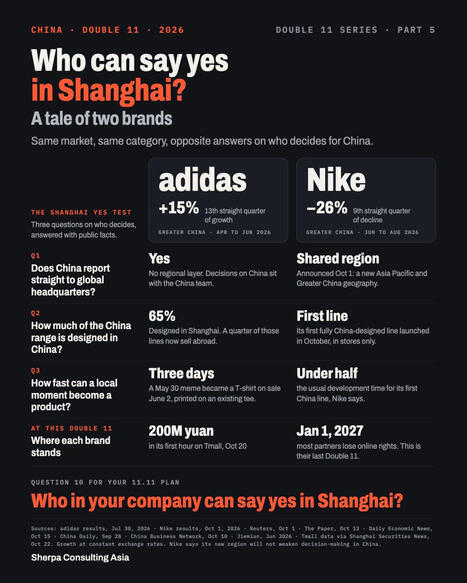
𝐀𝐝𝐢𝐝𝐚𝐬 𝐯𝐬 𝐍𝐢𝐤𝐞: 𝐖𝐡𝐨 𝐂𝐚𝐧 𝐒𝐚𝐲 𝐘𝐞𝐬 𝐈𝐧 𝐒𝐡𝐚𝐧𝐠𝐡𝐚𝐢?
In three days, adidas China turned a translation error into a T-shirt on sale.
Its product page had turned "errands around town" into a phrase that made shoppers picture a villager going to town to get things done, and they made it an online meme that became viral. The brand joined the joke, then printed the phrase on an existing basic tee, making it available on its site just three days after the meme had appeared.
Behind that speed sits a reporting line.
In October, adidas CEO, Bjørn Gulden, told the press in Shanghai that decisions on China rest with the China team, with no extra management layer to sign them off. "I have never stopped Adrian from doing anything he wanted to do," he said of his China head, Adrian Siu.
The Shanghai team now designs 65% of the China range, and a quarter of those lines sell in other markets. One of them, a track top with a high collar and knotted buttons, debuted at Shanghai Fashion Week 2025, went viral on TikTok and Instagram, and reached Europe in February 2026.
The numbers line up: adidas's Greater China sales rose 15% at constant exchange rates in the second quarter, a 13th straight quarter of growth, after a 36% fall in 2022 on the same basis. On the first night of this Double 11, the brand passed 200 million yuan on Tmall within an hour.
Nike is now taking up half of that model: it doubled its China design team and says its first China-designed line took under half the normal development time. But on October 1, it merged Greater China into a new Asia Pacific and Greater China region, while saying the change will not weaken decision-making in China. Its China sales fell 26% at constant exchange rates from June to August, a ninth straight quarterly decline.
China works here as a fast-forward lab, and what travels is a test that any brand can run:
1. Does China report straight to global headquarters?
2. What share of your China range is designed in China?
3. How many days does a local moment take to become a product on sale?
Part 1 of this series ended by asking which question you would add, and this is mine.
Who in your company can say yes in Shanghai and to what?
#ChinaRetail #adidas #Nike #ChinaSpeed #Localization
|
|
Scooped by
Trevor Lee @ TravConsult
October 27, 10:56 PM
|
Anta’s namesake line is lagging and China’s yoga labels have stalled, while homegrown outdoor brands such as Kailas and Pelliot are growing fast.
|
|
Scooped by
Trevor Lee @ TravConsult
October 27, 10:28 PM
|
Interviews with importers, distributors and wine bar operators suggest the shift is being driven by more casual drinking occasions: seafood dinners, late-night meals and gatherings among friends. Fresh, approachable wines are finding an audience beyond the formal banquets and business entertaining that have traditionally supported Chinese wine sales.
|
|
Scooped by
Trevor Lee @ TravConsult
October 1, 5:00 PM
|
I am not sure how Chinese people would react to this 🤭
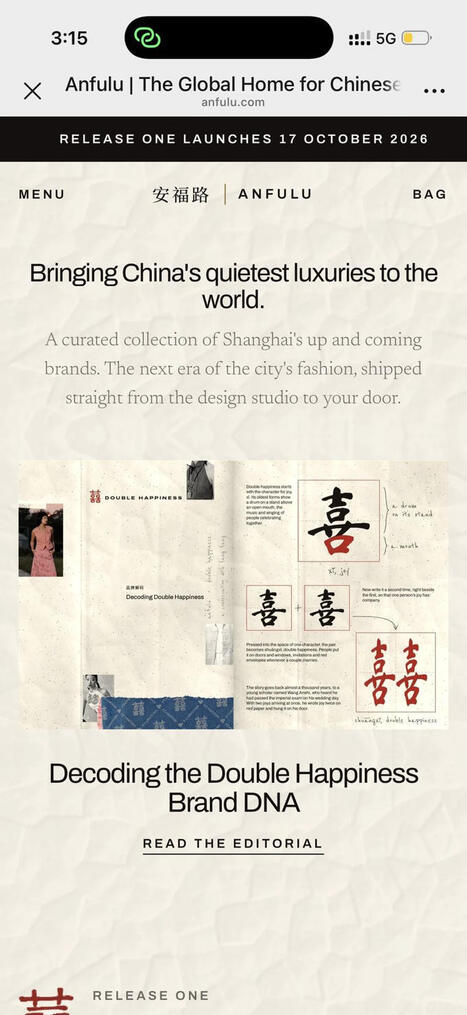
Brand is using 囍, the most auspicious Chinese character, as a fashion pattern.
Brand’s name is Anfu Lu (安福路)
My perspective is that the brand is walking on thin ice.
The target is obviously Shanghai expats.
After all, we all like Anfu Lu.
By the way, I like the designs a lot (says me sitting in a Qipao on October 1). But I would be careful buying it.
But Chinese people..will they like this..
Just some weeks after LV story
What do you think?
Tribute or appropriation
Olivier Verot
Coco L.
Ke Shi
Arnold Ma
Sean Upton-McLaughlinSean Upton-McLaughlin 马培善马培善
Yewen Zhang
Juju Meng (Global Headhunter)
Beifang Zhu
Iris Lau
Jon Wang
Jun Jiang
#xiaohongshu #rednote #wechat #douyin #tmall #taobao
|