

From
suu
Via Jonathan Acuña


 Your new post is loading...
 Scoop.it! 
No comment yet.
Sign up to comment
Scoop.it!
Click the link below to discover more information! http://go.sdsu.edu/education/dle/files/03459-2015_DLE_CORE_flyer_Final.pdf Earn a Professional ...
Scoop.it!
In this video we learn some things about consonants and vowels. What in the world is a long vowel? And, why do need short ones too?
Scoop.it!

Do you know many English proverbs? Here are 50 useful English proverbs that you should know!
Scoop.it!

From
www
"The way we mix languages and speech patterns is an apt metaphor for the way race, ethnicity and culture intersect in our lives."
Scoop.it!
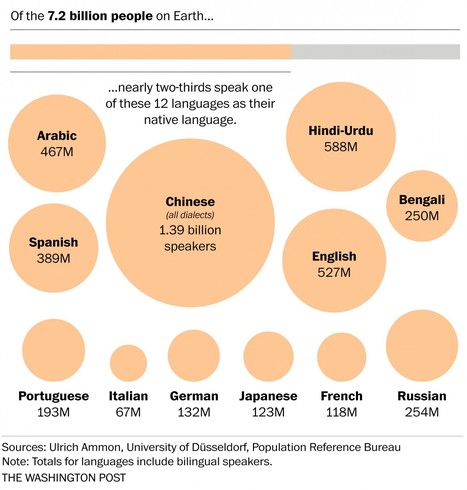
"These seven maps and charts, visualized by The Washington Post, will help you understand how diverse other parts of the world are in terms of languages."
Tags: language, culture, infographic.

Caitlyn Christiansen's curator insight,
May 26, 2015 10:35 AM
The world is extremely diverse in its spread of native languages. Yet only a handful are commonly spoken by the majority of the world, about 2/3. Over half of the world's languages are expected to go extinct because of the extreme diversity and the minimal distribution which means that in some places almost every person speaks a completely different language and many are dying as their last speakers do not pass it on to their children.
This article is relates to cultural patterns and processes through the geographic spread of languages around the globe and the increasing acculturation that causes the loss of many of these languages in our increasingly globalized world. 
Michael Amberg's curator insight,
May 26, 2015 10:35 PM
Its interesting to see just how many people speak the languages we speak everyday, and to see just how many people DONT speak it. 
Shane C Cook's curator insight,
May 27, 2015 5:34 AM
It is amazing to see all main languages in perspective to the world. Mandarine holding the top spot with 1.39 Billion surprises me but at the same time doesn't. There are 1.3 billion people living there in the first place.
Scoop.it!
From
issuu
British Council's magazine for English language teachers working in lusophone countries, May 2015 Via Nik Peachey

Nik Peachey's curator insight,
April 29, 2015 4:55 AM
Really useful free magazine published by the British Council in Portugal.
Scoop.it!

Greg Downey's curator insight,
February 27, 2013 3:23 PM
"Although backers of this supposed universal alphabet claim that "it will make pronunciation easy and foster international understanding", I have doubts that SaypU (Spell As You Pronounce Universal project) constitutes a viable route to world peace." But Douglas Adams has alread warned us about the potential in The Hitchhiker's Guide: "The Babel fish, by effectively removing all barriers to communication between different cultures and races, has caused more and bloodier wars than anything else in the history of creation."
Scoop.it!

Find and meet native speakers from all around the world. Browse our community to find your ideal language partner and enjoy improving your language skills. Via Nik Peachey
Nik Peachey's curator insight,
January 14, 2015 4:36 AM
Could be interesting for learners of all languages.
Scoop.it!

From
wyso
About a quarter of the students who attend Ruskin Elementary School on the east side of Dayton’s don’t speak English as their first language. Of the 11
Scoop.it!

I am writing for you a list of the Present Progressive which uses a form of the “be” verb + the “ing” form of the main verb. But we'll get to that more up ahead. Understanding and Teaching the Present Progressive A wonderful tool for getting a...
Scoop.it!

Student blogging provides opportunities for sharing, reflection, and ownership. With ELLs, blogs can provide deeper engagement and a public forum to demonstrate their developing skills.
|
Scoop.it!

English vocabulary quizzes. Test and evaluate yourself. Self evaluation. Self study. Via Jonathan Acuña
Scoop.it!

Grand View Boulevard Elementary in Los Angeles is an unconventional school. Subjects are taught in both English and Spanish. That ultimately puts these students ahead of their peers i...
Scoop.it!

From
paper
adaptivelearnin- ESL and #edtech, by Beth Crumpler: updated automatically with a curated selection of articles, blog posts, videos and photos.
Scoop.it!

Vivek Prakash / Reuters Educators from across the country gathered in Washington, D.C., this past Thursday to lobby in the interest of world languages.
Scoop.it!
"How well do you know your Saskatchewan slang? At Insightrix in Saskatoon, Saskatchewan, we've got the prairies down flat!"
Scoop.it!

"The state transportation authority relies on federal guidelines that outline what it can put on signs, and these rules say signs must use only 'standard English characters, so when we replaced the sign, we didn’t put the umlaut in.' On Wednesday, the state’s governor put his foot down: The dots were coming back."
Scoop.it!
"These seven maps and charts, visualized by The Washington Post, will help you understand how diverse other parts of the world are in terms of languages."
Tags: language, culture, infographic.
Caitlyn Christiansen's curator insight,
May 26, 2015 10:35 AM
The world is extremely diverse in its spread of native languages. Yet only a handful are commonly spoken by the majority of the world, about 2/3. Over half of the world's languages are expected to go extinct because of the extreme diversity and the minimal distribution which means that in some places almost every person speaks a completely different language and many are dying as their last speakers do not pass it on to their children.
This article is relates to cultural patterns and processes through the geographic spread of languages around the globe and the increasing acculturation that causes the loss of many of these languages in our increasingly globalized world.
Michael Amberg's curator insight,
May 26, 2015 10:35 PM
Its interesting to see just how many people speak the languages we speak everyday, and to see just how many people DONT speak it.
Shane C Cook's curator insight,
May 27, 2015 5:34 AM
It is amazing to see all main languages in perspective to the world. Mandarine holding the top spot with 1.39 Billion surprises me but at the same time doesn't. There are 1.3 billion people living there in the first place.
Scoop.it!
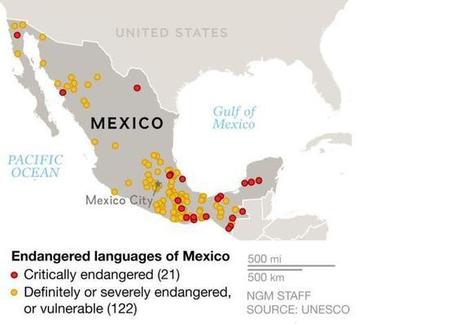
Sixty of Mexico's native languages are at risk of being silenced forever—but many people are working to keep them alive, experts say.

Mark Hathaway's curator insight,
September 22, 2015 8:29 AM
The demise of a language is a truly tragic event. I am heartened to see that there are efforts being undertaken to preserve these historic languages. New technologies will hopefully aid us in this effort. I imagine that the United States probably faces similar issues when it comes to language loss. We should coordinate some sort of national policy in how to deal with the issue. The current state of political affairs will probably hamper the cause, but it is still worth a shot. I am in full support of all efforts that might preserve these classic languages. 
Gene Gagne's curator insight,
December 2, 2015 9:29 AM
This is one of the reasons that when immigrants come into this country its important they keep their native language going as well as learning to speak English. The sharing of culture, and language is indeed very important. Lots of people come to America and are told to speak English and eventually they lose their native language as well as culture. The English speaking only citizens of this country lose out on a good education about someone's native country. Its too bad. Just think music, language, food, values etc...there is a lot to learn. 
Genesis Orellana Cabrera's curator insight,
January 24, 2018 10:45 PM
Languages are greatly important which is why I see the urgency in wanting to keep those endangered languages alive. Globalization through this article shows to be affecting cultural geography as Mexicans no longer see the need to know any other language but Spanish since it domains. This is causing the culture of Mexico to be forgotten. Just like Harrison said, "Each of the Mexican indigenous languages contains millennia of human experience, wisdom, and practical knowledge about the natural environment." The many languages are one of the things that shape Mexico and its people.
Scoop.it!

BEhereBEthere offers fun and free courses which improve your business english. Select your study level Watch videos, take tests and complete activities. Via Nik Peachey
Nik Peachey's curator insight,
October 25, 2014 7:14 AM
This site has some great interactive materials for teachers and students of Business English.
Scoop.it!

Welcome to our ESL lesson plan library designed for teachers running private lessons. We cover grammar, vocabulary and phonics, get in touch for access.

Andrew Sparks's curator insight,
April 24, 2015 12:04 AM
Good for reducing classroom sizes. As we know education is taking hold of technology. Even if english is your first language I know I personally still need education in grammar from time to time
Scoop.it!
To learn English, Spanish-speaking students need to master Spanish first, educators say. At Bowie Elementary in the Grand Prairie school district, many ...
Scoop.it!

Microsoft My dad has a story he likes to tell about one of his friends, a scientist. The scientist was giving a lecture in Japan, and opened with a joke that lasted a couple minutes.
|






