Your new post is loading...

|
Scooped by
Gilbert C FAURE
May 31, 2023 2:53 AM
|
Autoantibodies (AABs) neutralizing type I interferons (IFN) underlie about 15% of cases of critical coronavirus disease 2019 (COVID-19) pneumonia. The impact of autoimmunity toward type III IFNs remains unexplored. We included samples from 1,002 patients with COVID-19 (50% with severe disease) and 1 …
|
|
Scooped by
Gilbert C FAURE
May 23, 2023 8:31 AM
|
The field of medical research has been always full of innovation and huge leaps revolutionizing the scientific world. In the recent years, we have witnessed this firsthand by the evolution of Artificial Intelligence (AI), with ChatGPT being the most recent example.
|
|
Scooped by
Gilbert C FAURE
May 14, 2023 4:06 AM
|
A UK population-based study suggests that autoimmune diseases affect approximately one in ten individuals. In appears that the risk of autoimmune disease may be increasing as autoimmune frequency was 1/31 in 1997 and in 2005 the risk was 1/12 in women and 1/20 in men (total: 23.5 million) in the USA.
|
|
Scooped by
Gilbert C FAURE
May 5, 2023 2:28 AM
|
|
|
Scooped by
Gilbert C FAURE
April 13, 2023 1:47 PM
|
The full picture of post-COVID-19 autoimmune diseases and their prevalence is lacking despite numerous case reports and small series. Two studies that use large cohorts now highlight that SARS-CoV-2 infection is linked to a substantially increased risk of developing a diverse spectrum of new-onset autoimmune diseases.
|
|
Scooped by
Gilbert C FAURE
April 1, 2023 9:47 AM
|
|
|
Scooped by
Gilbert C FAURE
March 13, 2023 2:48 PM
|
Pemphigoid diseases are a group of autoimmune disorders characterized by subepidermal
blistering in the skin and mucosa. Among them, mucous membrane pemphigoid (MMP) autoantibodies are characterized by targeting multiple molecules in the hemidesmosomes, including collagen XVII (COL17/BP180),...
|
|
Scooped by
Gilbert C FAURE
March 1, 2023 6:26 AM
|
Autoreactive B cells and interferons are central players in systemic lupus erythematosus (SLE) pathogenesis. The partial success of drugs targeting these pathways, however, supports heterogeneity in upstream mechanisms contributing to disease pathogenesis.
|
|
Scooped by
Gilbert C FAURE
February 24, 2023 3:39 AM
|
WHAT IS ALREADY KNOWN ON THIS TOPICExcessive diagnosis delay and lack of coordinated care remain major challenges in SLE.WHAT THIS STUDY ADDSWe have identified significant disruption points in SLE patient pathways, including additional needs in the field of referral strategy, dedicated...
|
|
Scooped by
Gilbert C FAURE
February 17, 2023 3:46 AM
|
Article Text Article menu PDF Review Pathogenesis of systemic lupus erythematosus: risks, mechanisms and therapeutic targets http://orcid.org/0000-0002-7881-2020Mary K CrowMary Kirkland Center for Lupus Research, Hospital for Special Surgery, New York, New York, USACorrespondence to Professor Mary...
|
|
Scooped by
Gilbert C FAURE
February 11, 2023 4:04 AM
|
While rare, there is now a documented cohort of patients presenting with autoimmune hepatitis second...
|
|
Scooped by
Gilbert C FAURE
February 5, 2023 5:13 AM
|
The aim of this study was to evaluate the relationship between infection with SARS-CoV-2 and autoimmunity.Coronavirus disease 2019 (COVID-19) is an infectious disease caused by severe acute respiratory syndrome (SARS) associated coronavirus 2 (SARS-CoV-2).
|
|
Scooped by
Gilbert C FAURE
January 26, 2023 1:51 PM
|
Specific ACPAs and anti-native protein antibodies improve prediction of rheumatoid
arthritis-associated ILD. These findings implicate synovial protein antibodies in the pathogenesis of rheumatoid arthritis-associated ILD and, once validated in external studies, suggest that these antibodies might...
|
|
|
Scooped by
Gilbert C FAURE
May 25, 2023 3:48 AM
|
Autoimmune diseases are heterogeneous pathologies characterized by a breakdown of immunological tolerance to self, resulting in a chronic and aberrant immune response to self-antigens.The scope and extent of affected tissues can vary greatly per autoimmune disease and can involve multiple organs ...
|
|
Scooped by
Gilbert C FAURE
May 16, 2023 6:41 AM
|
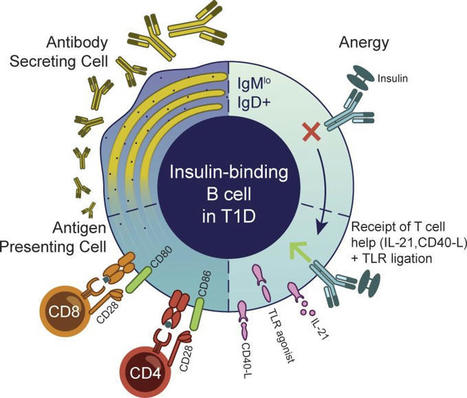
#Autoimmunity | Anergic #Bcells are Inappropriately Activated in Young-Onset #Type1Diabetes | Exciting New #Biomarker #Immunotherapy Opportunities for #T1D…
|
|
Scooped by
Gilbert C FAURE
May 6, 2023 11:25 AM
|
|
|
Scooped by
Gilbert C FAURE
April 24, 2023 5:17 AM
|
Antiphospholipid syndrome is an autoimmune disorder characterized by vascular thrombosis and/or pregnancy morbidity associated with persistent antiphospholipid antibody positivity. Cases fulfilling the Sydney criteria for obstetric morbidity with no previous thrombosis are known as obstetric antiphospholipid syndrome (OAPS). OAPS is the most identified cause of recurrent pregnancy loss and late-pregnancy morbidity related to placental injury. Cases with incomplete clinical or laboratory data are classified as obstetric morbidity APS (OMAPS) and non-criteria OAPS (NC-OAPS), respectively. Inflammatory and thrombotic mechanisms are involved in the pathophysiology of OAPS. Trophoblasts, endothelium, platelets and innate immune cells are key cellular players. Complement activation plays a crucial pathogenic role. Secondary placental thrombosis appears by clot formation in response to tissue factor activation. New risk assessment tools could improve the prediction of obstetric complication recurrences or thromboses. The standard-of-care treatment consists of low-dose aspirin and prophylactic low molecular weight heparin. In refractory cases, the addition of hydroxychloroquine, low-dose prednisone or IVIG improve pregnancy outcomes. Statins and eculizumab are currently being tested for treating selected OAPS women. Finally, we revisited recent insights and concerns about the pathophysiology, diagnosis and management of OAPS.
|
|
Scooped by
Gilbert C FAURE
April 12, 2023 2:30 AM
|
|
|
Scooped by
Gilbert C FAURE
March 17, 2023 3:09 AM
|
|
|
Scooped by
Gilbert C FAURE
March 7, 2023 4:04 AM
|
Infection with severe acute respiratory syndrome coronavirus 2 associates with diverse symptoms, which can persist for months. While antiviral antibodies are protective, those targeting interferons and other immune factors are associated with adverse coronavirus disease 2019 (COVID-19) outcomes. Here we discovered that antibodies against specific chemokines were omnipresent post-COVID-19, were associated with favorable disease outcome and negatively correlated with the development of long COVID at 1 yr post-infection. Chemokine antibodies were also present in HIV-1 infection and autoimmune disorders, but they targeted different chemokines compared with COVID-19. Monoclonal antibodies derived from COVID-19 convalescents that bound to the chemokine N-loop impaired cell migration. Given the role of chemokines in orchestrating immune cell trafficking, naturally arising chemokine antibodies may modulate the inflammatory response and thus bear therapeutic potential. Robbiani and colleagues show that antibodies against specific chemokines are detected in COVID-19 convalescents and may modulate the inflammatory response and disease outcome.
|
|
Scooped by
Gilbert C FAURE
February 27, 2023 9:05 AM
|
Skeletal muscle is one of the most abundant tissues of the human body and is responsible for the generation of movement. Muscle injuries can lead to severe disability. Skeletal muscle is characterized by an important regeneration capacity, which is possible due to the interaction between the myoblasts and immune cells. Neutrophils are fundamental as inducers of muscle damage and as promoters of the initial inflammatory response which eventually allows the muscle repair. The main functions of the neutrophils are phagocytosis, respiratory burst, degranulation, and the production of neutrophil extracellular traps (NETs). An overactivation of neutrophils after muscle injuries may lead to an expansion of the initial damage and can hamper the successful muscle repair. The importance of neutrophils as inducers of muscle damage extends beyond acute muscle injury and recently, neutrophils have become more relevant as part of the immunopathogenesis of chronic muscle diseases like idiopathic inflammatory myopathies (IIM). This heterogeneous group of systemic autoimmune diseases is characterized by the presence of muscle inflammation with a variable amount of extramuscular features. In IIM, neutrophils have been found to have a role as biomarkers of disease activity, and their expansion in peripheral blood is related to certain clinical features like interstitial lung disease (ILD) and cancer. On the other hand, low density granulocytes (LDG) are a distinctive subtype of neutrophil
|
|
Scooped by
Gilbert C FAURE
February 18, 2023 11:29 AM
|
A new study suggests that use of ELISA assays for CXCL-10 and IFN-α can predict which ANA+ individuals may progress to developing a systemic autoimmune rheumatic disease (SARD). Assays for cytokines (serum IFN-α or selected IFN-induced cytokines) were performed by nanoString, ELISA or Simoa.
|
|
Scooped by
Gilbert C FAURE
February 17, 2023 3:24 AM
|
Background: To assess the serum autoantibody profile in patients with dry and exudative age-related macular degeneration compared with healthy volunteers to detect potential biomarkers, e.g., markers for progression of the disease.
|
|
Scooped by
Gilbert C FAURE
February 9, 2023 12:58 PM
|
With the exception of an extremely small number of cases caused by single gene mutations, most autoimmune diseases result from the complex interplay between environmental and genetic factors. In a nutshell, etiology of the common autoimmune disorders is unknown in spite of progress elucidating certain effector cells and molecules responsible for pathologies associated with inflammatory and tissue damage. In recent years, population genetics approaches have greatly enriched our knowledge regarding genetic susceptibility of autoimmunity, providing us with a window of opportunities to comprehensively re-examine autoimmunity-associated genes and possible pathways. In this review, we aim to discuss etiology and pathogenesis of common autoimmune disorders from the perspective of human genetics. An overview of the genetic basis of autoimmunity is followed by 3 chapters detailing susceptibility genes involved in innate immunity, adaptive immunity and inflammatory cell death processes respectively. With such attempts, we hope to expand the scope of thinking and bring attention to lesser appreciated molecules and pathways as important contributors of autoimmunity beyond the ‘usual suspects’ of a limited subset of validated therapeutic targets.
|
|
Scooped by
Gilbert C FAURE
February 2, 2023 6:59 AM
|
|