Your new post is loading...

|
Rescooped by
Gilbert C FAURE
from Immunology and Biotherapies
January 30, 2020 1:15 PM
|
Point of view of an Immunologist/curator in 2020 Après Bobcatsss 2020, ECIL 2021, ICDF 2022, HESIVAXs with the motto UTA "Understand to Act" Notre proposition « Désinformation Vaccinale: Curation, Observatoire, Littératies » a été retenue pour le séminaire annuel de l’Académie des Controverses et de la Communication Sensible, intitulé « La désinformation : nouvelles formes, nouveaux défis », qui s'est tenu à Paris le mardi 26 novembre 2024. Voir ci-après posts du 27 novembre, avec lien vers la présentation sur Slideshare. Présentation le 20 mars 2025 à InfoxsurSeine deux jours pour décrypter la désinformation et échanger autour des solutions.
Quels outils concrets face aux manipulations de l’information et à l’essor de l’IA générative ? Avez vous acheté le numéro Juillet/septembre 2025 de la RECHERCHE sur LE FAUX? des sujets à approfondir - Vaccins et argent Making money with vaccines, against vaccines le sujet le plus chaud, de 3,36 euros par mois à 300 millions de dollars? - Publications vraies et fausses particulièrement difficile - Obligations, exemptions, incitations, peut-être plus simple?
|
|
Scooped by
Gilbert C FAURE
Today, 8:02 AM
|
Across Australia and Aotearoa New Zealand, a familiar but critical challenge persists: vaccination rates remain suboptimal and inequitable, particularly for underserved and medically high-risk populations.
A new rapid review published in Vaccine by our Deputy Director, Dr. Nadia A. Charania, and led by researchers at the Australian Institute of Health Innovation examines primary care-based interventions to improve vaccination coverage in underserved groups.
The review highlights barriers at every level:
• Consumer level: mistrust, hesitancy, competing priorities
• Practice level: time pressures, competing demands
• System level: lack of culturally informed services and fragmented systems
What’s striking is this: most interventions remain narrow in scope, often failing to address these interconnected barriers or leverage existing enablers.
Where we do see impact, it’s from practical, targeted strategies such as:
• Reminder and recall systems (e.g. SMS prompts)
• Personalised vaccination schedules
• Structured health assessments
👉 A key takeaway is if the barriers are complex and multi-level, the solutions must be too.
Improving vaccination rates in underserved communities requires coordinated, culturally grounded, system-wide approaches - designed with and for the populations most affected.
The opportunity is not just to implement more interventions, but to better align them with the real-world barriers people face.
📖 Read the full article here: https://lnkd.in/ere9R6BF
#Immunisation #HealthEquity #PrimaryCare #PublicHealth #Aotearoa #Australia #HealthSystems
Georgia Fisher Tina Vickery Dr. Bree Wright, PLY Samantha Spanos, PhD Lisa Pagano Kate Churruca Louise Ellis Bianca Forrester Jeffrey Braithwaite
|
|
Scooped by
Gilbert C FAURE
Today, 7:52 AM
|
IFPMA and the Global Coalition on Aging have collaborated on a new infographic, outlining the pathway from adult immunization to better health outcomes, higher productivity, and more future-proof economies.
💚 + 💼 Read the infographic below to see how health and employment are interconnected, and how adult vaccination programs can help sustain workforce participation, and ease pressure on public finances.
➡️ Adult immunization for healthy workforces and healthy economies in an aging world | IFPMA
|
|
Scooped by
Gilbert C FAURE
Today, 7:37 AM
|
Here's my first post on substack. George Washington mandated inoculations against smallpox in 1777, which would've devastated his army more than the British. These inoculations were done by making cuts in the skin and inserting pus from smallpox sores. I discuss how these must have worked immunologically and why this led to milder disease compared to natural infection
https://lnkd.in/g7ecvbj2
|
|
Scooped by
Gilbert C FAURE
Today, 7:34 AM
|
A new charter calls on the CDC's Advisory Committee on Immunization Practices (ACIP) to consider "non-vaccine interventions" and changes the focus, membership structure, and rules that govern the influential panel.
Societies led by the Infectious Diseases Society of America (IDSA) warned the updates could threaten access to immunizations and erode trust in U.S. vaccine policy.
Read more at: https://lnkd.in/djvievYV
|
|
Scooped by
Gilbert C FAURE
Today, 7:31 AM
|
Jeudi 18 juin, j'aurai le plaisir de participer à une table ronde sur les enjeux contemporains de la désinformation en santé, avec des regards nationaux et internationaux, à l'invitation de France Universités et du Portiqo think tank, aux côtés de Jean-François Delfraissy (Comité Consultatif National d'Éthique), Bana Jabri (Institut Imagine), Valentin Wyart (ENS-PSL) et Federica Granese (Inria).
Le sujet ne pourrait être plus actualité, comme nous le montrons dans notre rapport sur les DEFIS de l'information et de la lutte contre la désinformation en science et en santé avec Dominique Costagliola Herve Maisonneuve. https://lnkd.in/enr4_8yp
En 2021, dans un discours intitulé « The Universities are the Enemy » le futur vice-président des États-Unis, J.D. Vance, déclarait : « nous devons honnêtement et agressivement attaquer les universités de ce pays ». Quand le savoir est désigné comme un adversaire, c'est tout l'espace informationnel et démocratique qui vacille.
Ce n'est pas un hasard. Avec les juges et les journalistes, les enseignants et les chercheurs figurent parmi les premières cibles des régimes qui aspirent à devenir autoritaires : tous trois incarnent des contre-pouvoirs qui établissent les faits, disent le droit et garantissent un débat éclairé. Les affaiblir, c'est ouvrir la voie à la manipulation et à l'arbitraire.
Les universités sont en première ligne : elles forment les professionnels de santé, les scientifiques et les futurs cadres publics ; elles produisent la connaissance et garantissent sa fiabilité ; elles sont le lieu naturel de la recherche.
À ce titre, elles ont une responsabilité particulière : défendre les faits, lutter contre l'obscurantisme, intégrer la culture de l'esprit critique et de la communication scientifique dans tous les cursus, doter chaque établissement d'un plan public d'information et de lutte contre la désinformation, et protéger résolument les chercheurs qui s'engagent dans le débat public.
Restaurer un espace informationnel fiable n'est pas une option : c'est une condition essentielle de la santé publique et de la démocratie.
Stephanie RIST, Yannick NEUDER, PHILIPPE BAPTISTE, mylene bonnel, Lamri Adoui, Dean Lewis, Manuel Tunon de Lara, Clerici Christine, Yvon Berland, Odile Rauzy, Philippe Roingeard, Isabelle Laffont, vincent lisowski, Edouard Kaminski, Clémentine BODY, CHU de Bordeaux, Vincent-Nicolas DELPECH
|
|
Scooped by
Gilbert C FAURE
Today, 7:29 AM
|
𝗠𝘆 𝗺𝘂𝗺 𝗮𝗻𝗱 𝗜 𝘄𝗲𝗻𝘁 𝘁𝗼𝗴𝗲𝘁𝗵𝗲𝗿 𝘁𝗼 𝗴𝗲𝘁 𝘁𝗵𝗲 𝗖𝗢𝗩𝗜𝗗 𝘃𝗮𝗰𝗰𝗶𝗻𝗲 𝘁𝗵𝗲 𝘀𝗮𝗺𝗲 𝗱𝗮𝘆. 💉
𝗦𝗵𝗲 𝗴𝗼𝘁 𝗵𝗼𝗺𝗲 𝗳𝗶𝗻𝗲. 𝗜 𝗱𝗶𝗱 𝗻𝗼𝘁. 😭
On getting home she was feeling totally fine — no complaints, nothing. But me? I started having a fever, body pain and fatigue so bad it felt like I was having full blown malaria symptoms.
And my first thought was — ah ah, they don give me COVID? 😭😂
I did not know better then because I was not well versed on the topic of vaccines and vaccination.
But recently I was studying vaccines under my Public Health course and everything finally clicked into place, so let me break it down the way I wish someone had explained it to me back then.
💡 𝗗𝗶𝗱 𝗬𝗼𝘂 𝗞𝗻𝗼𝘄?
Vaccines have helped combat over 20 diseases globally — including smallpox which has been completely eradicated, and diseases like polio, measles and tetanus which have been dramatically reduced.That's one of the greatest achievements in the history of human medicine. 🔬
𝗦𝗼 𝘄𝗵𝗮𝘁 𝗶𝘀 𝗮 𝘃𝗮𝗰𝗰𝗶𝗻𝗲 𝗮𝗰𝘁𝘂𝗮𝗹𝗹𝘆?
A vaccine is not the disease itself — it contains either a weakened, killed or partial form of a germ (a pathogen), basically a version that cannot harm you but is enough to get your immune system's attention. Think of it like a "wanted poster".
Your immune system sees the vaccine and says — "noted, if this ever shows up for real, we'll be ready." It creates antibodies, builds memory, so when the actual pathogen comes your body already knows exactly how to fight it. 💪🏽
𝗦𝗼 𝘄𝗵𝘆 𝗱𝗶𝗱 𝗜 𝗵𝗮𝘃𝗲 𝘀𝗶𝗱𝗲 𝗲𝗳𝗳𝗲𝗰𝘁𝘀 𝗯𝘂𝘁 𝗺𝘆 𝗺𝘂𝗺 𝗱𝗶𝗱𝗻'𝘁?
Because immune responses are individual — your body is not your mother's body, and no two people will react exactly the same way.
Side effects like fever, fatigue and body pain are actually signs that your immune system is doing exactly what it's supposed to do, which is responding, learning and building protection.
A side effect is not a red flag, it's often your body saying "I received the message and I'm working on it."
Of course if symptoms are severe or prolonged please see a doctor, but mild reactions? That's just biology doing its job beautifully. 🔬
𝗕𝗲𝗳𝗼𝗿𝗲 𝗜 𝗴𝗼 —
To every scientist, researcher and healthcare professional who has ever worked on a vaccine — I celebrate you. 👏🥹
I now understand that behind every single vial of vaccine, there are years of clinical trials, failed attempts, long nights, ethical reviews and sacrifices made and that work is not taken for granted.
Don't let fear of side effects stop you from protecting yourself and your loved ones.
The science behind vaccines is one of the most remarkable things human beings have ever built together, and now that I actually understand it — I'm genuinely in awe. 🔬✨
Did you ever have a vaccine reaction that scared you? Drop it below 👇
#TeachItTuesday #HealthcareCommunication #PublicHealth #Vaccines#HealthLiteracy #TheChristianScholar
|
|
Scooped by
Gilbert C FAURE
Today, 7:25 AM
|
What is tetanus? Tetanus is a bacterial infection with symptoms that include muscle spasms and stiffness in the jaw (lockjaw), neck, and abdomen, making it difficult to swallow or breathe.
In the modern era, it is rare to contract a fatal case of tetanus in the United States. The annual risk of a child under 10 years of age contracting fatal tetanus is about 1 in 784,000 – or 0.0001%.
Want to learn more about the risks of tetanus vs. the risks of the tetanus vaccine? We've linked a resource in the first comment.
#vaccines #parenting
|
|
Scooped by
Gilbert C FAURE
Today, 7:19 AM
|
"I posted the stick figure comic on the right, lightly making fun of anti-vaccers and using analogies to demonstrate why they are wrong that 100% effectiveness is needed for vaccines to be useful. I love analogies. They are a great way to get people past their biases and show underlying flaws in their reasoning, but apparently many people don’t understand how analogies work, and the comments quickly filled with people saying that these were bad analogies/false equivalencies because (according to them) unlike seat belts, helmets, birth control, or air bags, vaccines cause serious injury, go inside you, and are protected from lawsuits (see examples below).
There is a lot wrong with these responses (e.g., serious side effects from vaccines are extremely rare, serious injuries can occur from the other things mentioned, etc.), but I want to focus on the big one. Namely, these responses totally misunderstand the nature of analogies and how to evaluate arguments.
This comic was about one specific argument: the argument that vaccines aren’t useful because they aren’t 100% effective. That’s it. Effectiveness is the only thing being discussed. As such, all other considerations are 100% irrelevant. Even if vaccines were horribly dangerous (they aren’t) that would not make this comic a bad analogy or a false equivalency because it is not about safety. It is about the effectiveness argument. The purpose of a good analogy is to get at the underlying logical structure of an argument, and nothing outside of that structure matters."
https://lnkd.in/gUKPvV-e
|
|
Scooped by
Gilbert C FAURE
Today, 7:16 AM
|
We're proud to share a new Comment piece in The Lancet Group, co-authored by VCP's Professor Heidi Larson, announcing the launch of a landmark new commission on Rethinking #Misinformation, #Health, and #HumanSecurity.
Misinformation and disinformation now rank among the top global risks identified by both the UN and the World Economic Forum, rated a higher short-term threat than extreme weather or armed conflict. Yet existing responses, from fact-checking to debunking, have not kept pace with the scale or complexity of the problem.
This Commission takes a different approach. Rather than treating misinformation as simply a matter of false information versus true information, it recognises something more difficult: that many of the narratives most damaging to health don't spread through outright lies, but through emotional manipulation, amplified fear, and the erosion of trust in science over time.
The Commission will bring together experts from risk science, security studies, the social and political sciences, mathematics, computer science, and health to develop a genuinely systemic response to one of the defining challenges of our era.
Health misinformation isn't a communications problem. It's a human security problem. And it demands thinking at that scale.
Read the full Comment piece here: https://lnkd.in/e8HUsRCm
|
|
Scooped by
Gilbert C FAURE
Today, 7:14 AM
|
One of the biggest challenges in health communication is that we don't control what happens to a message after it's published.
A recent study analyzed more than 11,000 YouTube videos and comments about avian influenza.
The videos themselves were largely factual and aligned with public health guidance.
The comments, however, often shifted toward speculation, distrust, misinformation, and debate about virus origins and treatments.
As a health communicator, I find this fascinating.
It suggests that misinformation can't just be solved with content. It needs to involve ongoing conversation.
Today, every health message is also the starting point for countless interpretations, discussions, and re-shares. Understanding those dynamics may be just as important as creating accurate content in the first place.
https://lnkd.in/e9rPEbhG
|
|
Scooped by
Gilbert C FAURE
Today, 7:11 AM
|
Australia's childhood vaccination rate has fallen for five years in a row.
In 2025, around 80,000 children weren't fully vaccinated by the recommended ages, and coverage for some adolescent vaccines has dropped below 80%.
This isn't happening by accident. Misinformation is better organised than it used to be, and we're now importing political doubt from overseas alongside the homegrown kind.
The science hasn't changed. The trust around it has.
I started the Immunisation Foundation of Australia after my son Riley died of whooping cough at 32 days old. I've since met so many other families whose lives have been changed by diseases we can prevent.
Our work is getting harder, not easier. We cover awareness, access and acceptance, without guaranteed government funding.
The financial year ends tomorrow. If you've been meaning to make a tax deductible donation before 30 June, I'd be so grateful if you considered IFA 🩵
Link in the comments (or welcome to message me if you would like to direct deposit instead). Thank you!
|
|
Scooped by
Gilbert C FAURE
Today, 7:05 AM
|
Publications "intégratives", vraiment?
FAFO
Il y a deux ans, paraissait un article de Fabrice Berna, Julien Nizard Professeur des Universités en Thérapeutique, Laurence Verneuil, en gros les plumes du Collège Universitaire de Médecines Intégrative et Complémentaires (CUMIC).
https://lnkd.in/eveRiitv
Cet article, publié dans Douleurs, se basait sur des échanges Twitter entre les auteurs et des membres de notre Collectif, et tordait nos propos et réponses pour soutenir le postulat du CUMIC, à savoir " les No Fakemed sont des vilains scientistes etc."
Ces méthodes inadaptées nous ont amenés à écrire à l'éditeur et aux universités des auteurs.
Juin 2026, la réponse.
L'article ne mérite que rétractation. 🙏
Merci Lonni Besançon Elisabeth Bik de nous montrer l'exemple.
Dommage de voir la réputation de Nantes Université et de l'université de Strasbourg entachée par ces méthodes détestables.
Mathieu Molimard Dominique Costagliola Herve Maisonneuve Stéphanie Marsan Victor Garcia
|
|
|
Scooped by
Gilbert C FAURE
Today, 8:08 AM
|
Social media has changed how people find, share, and discuss health information.
What do we still need to learn about social media's impact on health?
This year at PRISM, we'll be exploring three critical areas shaping the future of social media and health research:
Adolescent Health
Translating Research into Action
Methods in Social Media Research
Each raises important questions about how we study digital platforms and how we turn those insights into meaningful health outcomes.
Which of these topics do you think is most important for researchers to address right now?
PRISM Health Symposium
IgNITE Lab (UCSF)
Jon-Patrick Allem
Thomas (TJ) Bukowski, UXC, MA, MPA
Wen-Ying Sylvia Chou
Valentin Danchev
Michael Deiner
Scott Donaldson
César Escobar-Viera (he/him)
@Yulin Hswen
Pam Ling
@Sunny Xun Liu
Timothy Mackey, MAS, PhD
Philip Massey
Meredith Meacham
Ryan Moore
@Thu Nguyen
George Pearson, PhD
Alex Russell
Rahul Singh
Elyse Thulin, PhD
Molly E. Waring
Marco Zenone
Jason Nagata, Dimitri Christakis, Douglas Roehler, Tina D Purnat, Jingwen Zhang, Kirk Roberts, Dhiraj Murthy, Graciela Gonzalez Hernandez, MS PhD
#PRISM2026 #DigitalHealth #AdolescentHealth #MentalHealthResearch #SocialMediaResearch
|
|
Scooped by
Gilbert C FAURE
Today, 8:01 AM
|
💉 Are We Missing Opportunities to Vaccinate Children?
Every day, hundreds of mothers and children visit health facilities seeking healthcare services. Yet in many facilities, the number of children receiving routine immunization remains significantly lower than the number of children visiting the facility.
Consider this scenario:
📊 More than 1,000 under-five children visit a health facility every month.
👶 More than 60 babies are delivered monthly at the same facility.
💉 Yet fewer than 150 children receive routine immunization services.
The question is not whether children are available.
The question is:
Why are we missing so many opportunities to vaccinate?
One of the most effective ways to increase immunization coverage is to make vaccination everyone's responsibility within the health facility—not only the responsibility of vaccinators.
A child who comes for:
✅ Outpatient consultation
✅ Nutrition services
✅ Growth monitoring
✅ Treatment of illness
✅ Maternal and child health services
✅ Delivery services
should never leave the facility without their immunization status being checked.
To improve coverage, health facilities should focus on:
🔹 Screening every under-five child for vaccination status during every visit.
🔹 Establishing strong coordination between Maternity, OPD, Nutrition, MCH, and Immunization units.
🔹 Linking all newborns delivered at the facility directly to routine immunization services.
🔹 Maintaining a defaulter tracking system for children who miss scheduled doses.
🔹 Conducting regular data reviews to identify missed opportunities and service gaps.
🔹 Strengthening community awareness and caregiver education.
🔹 Using outreach activities to reach children who cannot access facility-based services.
🔹 Ensuring accurate documentation and timely reporting.
The reality is simple:
A facility that receives 1,000+ under-five visits every month already has access to its target population.
What is needed is stronger integration, better coordination, and a system that checks vaccination status at every point of contact.
When every healthcare worker becomes an advocate for immunization, coverage increases.
When every child encounter becomes a vaccination opportunity, dropout rates decrease.
When every newborn is linked to immunization services from birth, communities become stronger and healthier.
As Public Health Professionals, our goal should not only be to provide vaccines but to build systems that ensure no eligible child is missed.
🇸🇴 Somalia can achieve higher immunization coverage if we transform every health facility visit into an opportunity to protect a child.
💉 Every Contact Counts.
📈 Every Opportunity Matters.
👶 Every Child Deserves Protection.
👨⚕️ Omar Amed Adan
Public Health Professional
📧 cumardayax16@gmail.com
#ImmunizeWithOmar #EPI #Immunization #VaccinationCoverage #MissedOpportunities #PublicHealth #ChildHealth #VaccinesWork #HealthcareLeadership #CommunityHealth #HealthSystemsStrengthening
|
|
Scooped by
Gilbert C FAURE
Today, 7:38 AM
|
Anti-vaxxers… Still using 1700’s arguments to attack vaccines.
Doctors… Still relying on science to support the use of vaccines. But 21rst century science…
|
|
Scooped by
Gilbert C FAURE
Today, 7:36 AM
|
There Are No Ladders in Vaccination
Most of us have played Snakes and Ladders.
The ladders help us race ahead.
The snakes remind us that mistakes have consequences.
When I designed a version for vaccination, I removed every ladder.
Why?
Because there are no shortcuts to safe vaccination.
Every vaccine given represents a person's trust in healthcare. That trust deserves more than simply administering an injection. It deserves careful preparation, professional curiosity and attention to detail.
Before the needle is ever picked up, dozens of important checks have already taken place.
Is this the right patient?
Is this the right vaccine?
Is the vaccine within its expiry date?
Has it been stored correctly?
Has informed consent been established?
Are there any contraindications or precautions?
Is the equipment ready should an emergency arise?
None of these steps are optional. Each one protects the person sitting in front of us.
The snakes on the board represent the points where safety can fail: missed cold-chain checks, incorrect documentation, poor record keeping, failure to recognise an adverse reaction, or not reporting an incident so others can learn from it.
The purpose isn't to blame individuals.
It is to encourage conversations.
If you land on a snake, ask:
What happened?
Why did it happen?
Could our systems be improved?
What support or training would help prevent it happening again?
Those discussions strengthen teams far more than simply reaching the finish.
The final square doesn't say "You Win."
It says:
Protected Together.
Because successful vaccination isn't measured by the number of injections given.
It is measured by public confidence, safe practice, accurate records, compassionate communication and every opportunity taken to protect people from preventable disease.
There are no ladders in vaccination.
Only hundreds of small, careful decisions that, taken together, protect individuals, families and communities.
Tony Rogers
|
|
Scooped by
Gilbert C FAURE
Today, 7:33 AM
|
Today I published a personal reflection on something that has shaped my thinking for most of my life.
One of my earliest memories is being five years old in an oxygen tent because of a serious illness. That experience stayed with me and helped shape my respect for prevention, public health, and the role vaccines have played in protecting families around the world.
This isn't a political article.
It's not about telling people what to think.
It's about encouraging all of us to ask questions, seek evidence, and have conversations with our physicians—and, when it comes to our children, with their pediatricians.
Rumors are memorable.
Science saves lives.
#PublicHealth #Vaccines #Prevention #Science #EvidenceBased #Healthcare #CancerPrevention #HealthyCommunities
https://lnkd.in/etyRkCxC
|
|
Scooped by
Gilbert C FAURE
Today, 7:30 AM
|
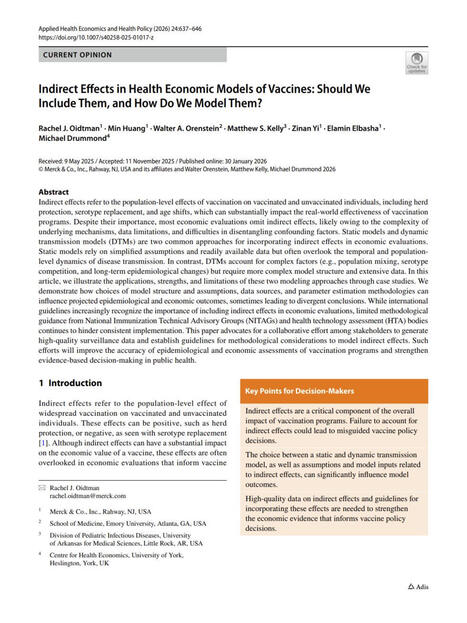
🧩Are vaccine economic models missing part of the picture when they omit indirect effects?
Indirect effects such as herd protection, serotype replacement, and age shifts can substantially change the estimated value of vaccination programs.
This opinion article examines when these effects should be included in vaccine economic models and how different modelling approaches can shape policy-relevant conclusions.
Key points:
💡 Indirect effects significantly influence impact & cost-effectiveness estimates
📊 Static models can include indirect effects, but are very sensitive to assumptions
🔁 Dynamic transmission models better capture indirect effects but need more data & expertise
⚖️ Model structure and assumptions can lead to different policy conclusions
📌 Stronger data and clearer guidance are needed to improve vaccine economic evaluations
🔗 Read more here: https://lnkd.in/eEAGkshk
Authors: Rachel Oidtman, PhD, Min Huang, Walter Orenstein, Matthew Kelly, Zinan Yi, Elamin Elbasha, Michael Drummond
|
|
Scooped by
Gilbert C FAURE
Today, 7:26 AM
|
I use AI-generated images on LinkedIn.
A lot.
So this is not an anti-AI post! It is just the opposite.
But we need to talk about the tiny-text problem. AI can help us create visuals, diagrams, frameworks, and graphics much faster than we could before. That is genuinely useful.
But if the image is going to appear in a LinkedIn feed, the question is not:
“Can I fit everything into the image?”
The question is:
“Can anyone actually read this without filing an insurance claim for eye strain?”
AI is very good at making something look impressive at first glance.
It is not always good at knowing what should be readable, what should be simplified, and what should move into the post text instead.
That is still our job.
Use AI.
Experiment.
Create.
Have fun.
But before posting, zoom out and ask:
What is the one thing this image needs to communicate? If the answer is “all 47 things,” maybe the image is not done yet.
The human in the loop is not just there to generate the prompt. The human is there to protect the reader.
|
|
Scooped by
Gilbert C FAURE
Today, 7:23 AM
|
"Vaccines divide everyone, even MAHA
Vaccine skepticism is the largest dividing force among the MAHA movement.
It’s widely considered a core principle of MAHA, and one Kennedy has pursued for decades. It’s true that about two-thirds of those who self-identify as part of the MAHA movement say they support reducing vaccinations among Americans — twice the share of non-MAHA Americans who say the same.
“I think the people who don’t support a reduction in vaccines aren’t really MAHA,” said Zen Honeycutt, founder and executive director of Moms Across America, a nonprofit and grassroots organization aligned with MAHA principles.
But 14 percent of MAHA adherents say they don’t support reducing vaccines, and another 20 percent remain neutral.
So while more and more Americans are expressing some doubt about vaccine safety in the wake of the Covid-19 pandemic, vaccine skepticism is still far from mainstream, and highly divisive.
About a third of Americans support all four major pillars of MAHA to some degree, including reducing vaccinations — while roughly the same share express a degree of support for those pillars except reducing vaccinations, the analysis found.
Regardless of the divisions, Kennedy has moved quickly to reduce the number of vaccines Americans receive, including by updating Covid-19 vaccine recommendations to exclude healthy children and pregnant women and overhauling the childhood vaccine schedule. A federal judge has halted the update to the childhood schedule, which would have reduced the number of diseases with universally recommended immunizations from 17 to 11, for now.
Vaccine skeptics tend to be Kennedy’s strongest allies: They are twice as likely as those who do not support reducing vaccines to say the secretary and the Trump administration have done enough to make the country healthy.
Overall though, they’re still dissatisfied with the administration’s progress, with about half of vaccine skeptics saying the administration has not done enough."
|
|
Scooped by
Gilbert C FAURE
Today, 7:17 AM
|
Did a new Florida Medicaid study just prove that childhood vaccines cause nearly 80% of all autism cases in the United States?
Anti-vaccine groups and prominent online influencers are sharing data from a paper published in Science, Public Health Policy, and the Law (SPHPL). They claim it provides definitive, peer-reviewed proof that the current CDC childhood immunization schedule is directly driving a massive surge in neurodevelopmental disorders.
However, an epidemiological look under the hood reveals a textbook example of "bad math" and basic diagnostic errors. Here is what the data actually reveals:
🔹 The Healthcare Utilization Trap: The study tracks Medicaid billing codes. It compares heavily monitored children who visit pediatricians multiple times for standard scheduled checkups (and vaccines) against completely unvaccinated children who rarely, if ever, see a doctor. It doesn't prove vaccines cause autism—it proves children who visit doctors more often are the ones actually getting diagnosed. Unvaccinated children are simply under-monitored.
🔹 The 80% Fake Math: The study itself never says vaccines cause 80% of autism. Influencers took a heavily compromised odds ratio (4.4x) and jammed it into a simplified Population Attributable Fraction (PAF) equation, rounding up the results to invent a terrifying—but completely manufactured—headline.
🔹 Fringe Publishing Standards: The paper was published on a non-indexed website owned by an anti-vaccine conspiracy group, completely bypassing mainstream, legitimate peer-review processes.
Tech ARP breaks down the exact epidemiological data, the math, and the structural funding biases behind this viral report.
👇 Read the full fact-check in the first comment below.
#PublicHealth #FactCheck #DataScience #Healthcare #SEO #TechARP
| 25 commentaires sur LinkedIn
|
|
Scooped by
Gilbert C FAURE
Today, 7:15 AM
|
More than half of internet users report encountering misleading health information online. The challenge isn't just correcting false claims its protecting patient trust, safety, and informed decision making.
|
|
Scooped by
Gilbert C FAURE
Today, 7:13 AM
|
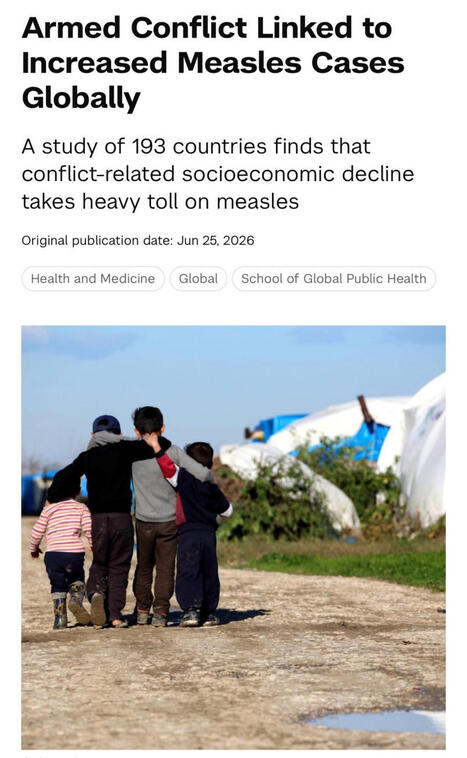
Armed conflict linked to increased measles cases globally
A study of 193 countries finds that conflict-related socioeconomic decline takes heavy toll on measles
Countries experiencing armed conflict tend to report more measles cases, and the elevated risk persists even a year after the fighting, according to new research published in PLOS Medicine.
The study links armed conflict to measles in two ways: directly through disrupting immunization programs, and—more powerfully—indirectly by eroding a country’s economic, educational, and health foundations that protect populations from preventable disease.
Source in comments.
|
|
Scooped by
Gilbert C FAURE
Today, 7:05 AM
|
Who do you trust when it comes to your health and why? Every day, millions of health decisions are shaped by information people find online. But how much of it is accurate, credible, and truly trustworthy? That is exactly what we are here to audit.
This 𝐉𝐮𝐥𝐲 𝟏, 𝐅𝐢𝐫𝐬𝐭 𝐂𝐡𝐞𝐜𝐤 𝐋𝐈𝐕𝐄 opens its inaugural curtain-raiser dialogue 𝗧𝗵𝗲 𝗧𝗿𝘂𝘀𝘁 𝗔𝘂𝗱𝗶𝘁: 𝗛𝗲𝗮𝗹𝘁𝗵 𝗜𝗻𝗳𝗼𝗿𝗺𝗮𝘁𝗶𝗼𝗻 𝗣𝗮𝘁𝗵𝘄𝗮𝘆𝘀 𝗮𝗻𝗱 𝘁𝗵𝗲 𝗙𝘂𝘁𝘂𝗿𝗲 𝗼𝗳 𝗣𝘂𝗯𝗹𝗶𝗰 𝗧𝗿𝘂𝘀𝘁, a conversation which is extremely urgent for anyone invested in their health, the information they consume, and the systems they trust.
Hear from an incredible lineup of speakers driving change across public health, research, technology, and communication.
This conversation is for researchers, healthcare professionals, policymakers, students, and anyone who has ever questioned the health information on their feed.
Join us from anywhere in the world this conversation belongs to everyone.
𝐑𝐞𝐠𝐢𝐬𝐭𝐞𝐫 𝐡𝐞𝐫𝐞 - https://lnkd.in/g-G6_Ben
🗓️ July 1, 2026
⏰ 3:00–4:30 PM IST
📍 Online
PATH Amitabh Nag Anjali Nayyar Tina D Purnat Siddharth Warrier Avijit Dutt Rajiv Sarkar Ankur Mutreja Rajiv Sarkar
Syed Nazakat Dr. Sabba Mehmood Surbhi Pandit Nangia Atul GuptaUrvashi K. Arushi Soni Anuraj Gupta
For More Information: https://lnkd.in/gP3t9KHd
Partnership Enquiries: arushi@dataleads.co.in
#FirstCheckLIVE #TheTrustAudit #GlobalHealth #PublicHealthIndia #DigitalHealth #HealthCommunication #InfodemicManagement #AIinHealth
|
|
Scooped by
Gilbert C FAURE
Today, 7:03 AM
|
The all-important starting point. Vaccine communication in high- and low-trust countries. Thanks to co-authors Anca Anton and Camelia Cmeciu!
Full text available:
https://lnkd.in/e93XMb7d
|




 Scoop.it!