


Te presentamos, y desmontamos, los cinco mitos más extendidos sobre los libros de texto digitales.


 Your new post is loading...
 Scoop.it! Te presentamos, y desmontamos, los cinco mitos más extendidos sobre los libros de texto digitales. 
No comment yet.
Sign up to comment
Scoop.it!
“List of 1700 videos in channel thang010146 (uploaded till 31 Dec. 2014) including pictures, brief descriptions and YouTube links can be downloaded at: http:/...” Via Gumersindo Fernández, Profa. Ann Rivera #Morreducation
Scoop.it!

La evaluación, como todo el mundo sabe, es un proceso crítico en el entramado del diseño de instrucción, pues afecta a todos los elementos del mismo, desde la organización del tiempo hasta los materiales empleados, pasando por los objetivos, los contenidos, las explicaciones del profesor, las preguntas de los alumnos. En fin, todo elemento que, dispuesto en el espacio (virtual también) y en el tiempo (sean procesos síncronos o asíncronos), se disponga de un determinado modo para promover un determinado aprendizaje que, a la postre, es lo que se trata de lograr.
Scoop.it!

This article provides two real-world examples of an onboarding program and a course that was gamified. Gamification Equals Engagement And Innovation!
Scoop.it!

For decades, schools have attempted to build and maintain this crucial bridge to lasting learning. Research shows that the stronger the connection between home and school, the greater the academic achievement can be for students. In socioeconomically challenged school districts, this correlation is magnified tenfold! Thankfully, there are new tools that all educators can leverage to easily maximize parent-teacher-student communication.
Scoop.it!

For students taking courses online, the endless distractions of the Internet can be a hindrance to success. But using software to limit those diversions can make a big difference. That’s the takeaway from a new study, which found that limiting distractions can help students perform better and also improve course completion. A paper describing the study, “Can Behavioral Tools Improve Online Student Outcomes? Experimental Evidence From a Massive Open Online Course,” was published by the Cornell Higher Education Research Institute this month. Richard W. Patterson, the author of the paper and a doctoral candidate in policy analysis and management at the university, says online courses and degree programs can provide opportunities for students who may not otherwise have access to higher education, but distraction and procrastination throw up barriers to their success.
Scoop.it!

Start off right with solid security tools, productivity software, and other programs that every PC needs.
Scoop.it!

The power of Mobile Learning exists in the ability to unhinge the learning environment from the traditional confines of an identifiable “study space.”
Scoop.it!

Gordon Rogers says that MOOCs and other alternative forms of credentialing are causing colleges to rethink their approaches. Via LGA
Scoop.it!

The online training and tutorial platform that helps people find & use sites, and helps sites reach & educate users.
Scoop.it!

Apple Watch began shipping Friday. What you need to know about the gadget.
|
Scoop.it!
Scoop.it!

Looking for a vibrant group of teachers, faculty and students using Flipboard? The FlipEDU account is the hub for our education community. At FlipEDU, you’ll find over 400 magazines made by educators and students, with more being added all the time. These magazines are organized into “metazines” (a magazine of magazines) devoted to common educational themes. For example, you can dive into the Teacher’s Lounge and find more than 40 magazines made by teachers sharing news and articles about the profession.
Scoop.it!

The Games for Learning Summit drew some big names from across industries.
Scoop.it!

One study revealed that repeated retrieval of learned information (100 Swahili–English word pairs) with long intervals produced a 200% improvement in long-term retention relative to repeated retrieval with no spacing between tests. Investigators compared different-length intervals of 15, 30, or 90 minute spacing that expanded (for example, 15-30-45 min), stayed the same (30-30-30 min) or contracted (45-30-15 min) revealed that no one relative spacing interval pattern was superior to any other. Another study has revealed that the optimally efficient gap between study sessions depends on when the information will be tested in the future. A very comprehensive study of this matter in 1,350 individuals involved teaching them a set of facts and then testing them for long-term retention after 3.5 months. A final test was given at a further delay of up to one year. At any test delay, increasing the inter-study gap between the first learning and a study of that material at first increased and then gradually reduced final test performance. Expressed as a ratio, the optimal gap equaled 10-20% of the test delay. That is, for example, a one-day gap was best for a test to be given seven days later, while a 21-day gap was best for a test 70 days later. Few of any teachers or students know this, and their study times are rarely scheduled in any systematic way, typically being driven by test schedules for other subjects, convenience, or even the teacher's whim.
Scoop.it!

Turning Minecraft to Mathcraft! This post teaches a lesson about Perimeter and Area using Minecraft.
Scoop.it!

This article highlights three key phases needed to turn your learning strategy into learning success.
Scoop.it!

Like a lot of kids, when I was a middle school and high school student the vocabulary of math often tripped me up. Once I wrapped my head around the meaning of terms I had an easier time understanding and solving the problems. Via Yashy Tohsaku
Scoop.it!

Sometimes the seemingly obvious can be overlooked when it comes to distance ed implementation.
Scoop.it!

You've heard that sitting is bad for you. But did you know it can actually kill you?
Scoop.it!
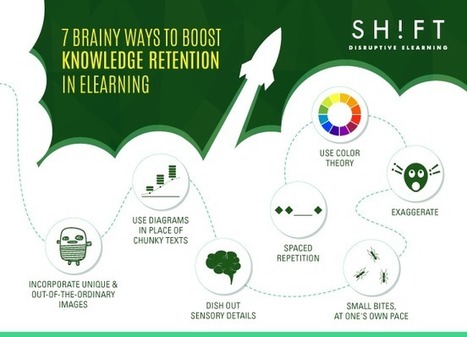
As instructional designers, you have to create courses that are easy to remember and difficult to forget. Here's how:
|






