Your new post is loading...

|
Scooped by
Dr. Stefan Gruenwald
August 15, 2016 12:52 PM
|
With Zika sparking anxiety at the Summer Olympic Games in Brazil, and now being transmitted in Florida through contact with mosquitoes, accurately mapping the distribution of the virus is increasingly urgent.
Accounting for a host of often-overlooked drivers of transmission, a team of University of Kansas researchers has mapped Zika risk around the world with unprecedented resolution while considering more factors than previous models.
The mapping effort uses ecological niche modeling, a technique used to predict distributions of species, to show the virus’ powerful ability to spread in South and Central America.
This study is the first to evaluate the risk of Zika virus transmission in Europe, which appears relatively low. Research suggests parts of the southern U.S., including parts of Florida, Texas and Louisiana, are vulnerable to transmission of the virus. “It’s the first detailed map that weighs different drivers of transmission,” said Abdallah Samy, who headed the research at the KU Biodiversity Institute. “We assessed different combinations of variables to see what are the major drivers — such as climate, or socioeconomics or people’s ability to access certain areas — and in the final map we merge all the variables.”
The resulting map predicts the likelihood of Zika exposure in the coming years by segmenting Earth’s landmasses into squares of 5-by-5 kilometers each and crunching the numbers for each of them.
Multiple factors influence risk assessment because the virus can spread through contact with mosquitoes in the genus Aedes, person-to-person via sexual contact, through blood transfusions and mother-to-child during pregnancy. The study focused on mosquito-driven transmission.
“For each area, we asked, ‘Is it mosquito exposure, climate or socioeconomic variables like accessibility for people to travel from areas where Zika is endemic and spread the virus upon their return?’” said Samy, who earned a doctorate in ecology and evolutionary biology at KU in May.
The findings recently were posted to the Zika Fast Track site and published in Memórias do Instituto Oswaldo Cruz, an international journal of biological and biomedical research based in Brazil, where the current outbreak has been centered since 2015.
When placed in an acoustic field, small objects experience a net force that can be used to levitate the objects in air. In a new study, researchers have experimentally demonstrated the acoustic levitation of a 50-mm (2-inch) solid polystyrene sphere using ultrasound—acoustic waves that are above the frequency of human hearing.
The demonstration is one of the first times that an object larger than the wavelength of the acoustic wave has been acoustically levitated. Previously, this has been achieved only for a few specific cases, such as wire-like and planar objects. In the new study, the levitated sphere is 3.6 times larger than the 14-mm acoustic wavelength used here. The researchers, Marco Andrade and Julio Adamowski at the University of São Paulo in Brazil, along with Anne Bernassau at Heriot-Watt University in Edinburgh, UK, have published a paper on the acoustic levitation demonstration in a recent issue of Applied Physics Letters. "Acoustic levitation of small particles at the acoustic pressure nodes of a standing wave is well-known, but the maximum particle size that can be levitated at the pressure nodes is around one quarter of the acoustic wavelength," Andrade explained. "This means that, for a transducer operating at the ultrasonic range (frequency above 20 kHz), the maximum particle size that can be levitated is around 4 mm. In our paper, we demonstrate that we can combine multiple ultrasonic transducers to levitate an object significantly larger than the acoustic wavelength. In our experiment, we could increase the maximum object size from one quarter of the wavelength to 50 mm, which is approximately 3.6 times the acoustic wavelength." Although there are several different ways to acoustically levitate an object, most methods use an ultrasonic transducer, which converts electrical signals into ultrasonic waves. The current setup uses three ultrasonic transducers arranged in a tripod fashion around the sphere. As the researchers explain, the angle and number of transducers can be changed, and this does not interfere with the setup's ability to levitate a large object. The ability to levitate the large sphere occurs because the three transducers produce a standing wave in the space between the transducers and the sphere. In previous methods, small objects are levitated by being trapped at the pressure nodes of the standing wave, but this is not the case here.
Via Mariaschnee
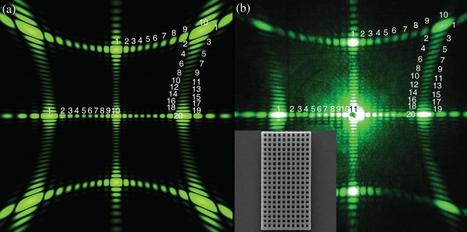
Scientists from Russia and Australia have put forward a simple new way of counting microscopic particles in optical materials by means of a laser. A light beam passing through such a material splits and forms a characteristic pattern consisting of numerous bright spots on a projection screen. The researchers found that the number of these spots corresponds exactly to the number of scattering microscopic particles in the optical material. Therefore, the structure and shape of any optical material can be determined without resorting to the use of expensive electron or atomic-force microscopy. According to the researchers, the new method will help design optical devices much faster. The work was published in Scientific Reports. The production of optical circuits requires devices that can amplify optical signals, bring them into focus, rotate and change their type of motion. Ordinary lenses cannot cope with these tasks at nanoscale, so scientists are working with artificial optical materials - photonic crystals and metamaterials, which can control the propagation of light in most extraordinary ways. However, fabricating optical materials with desired properties is a laborious process that needs constant improvement. The scientists from ITMO University, Ioffe Institute, and Australian National University for the first time suggested analyzing the structure of photonic crystals using optical diffraction method, that is, by looking at the light pattern generated while the sample is exposed to a laser beam. The study has shown that the number of these spots is equal to the number of scattering microscopic particles in the sample structure. Previously, such small particles could only be seen and counted with powerful and expensive electron or atomic-force microscopes. "The light senses heterogeneity," says Mikhail Rybin, first author of the paper, senior researcher at the Department of Nanophotonics and Metamaterials at ITMO University.
Via Mariaschnee
|
|
Rescooped by
Dr. Stefan Gruenwald
from Future Technology
August 12, 2016 8:14 PM
|
Technology can be awkward. Our pockets are weighed down with ever-larger smartphones that are a pain to pull out when we’re in a rush. And attempts to make our devices more easily accessible with smartwatches have so far fallen flat. But what if a part of your body could become your computer, with a screen on your arm and maybe even a direct link to your brain? Artificial electronic skin (e-skin) could one day make this a possibility. Researchers are developing flexible, bendable and even stretchable electronic circuits that can be applied directly to the skin. As well as turning your skin into a touchscreen, this could also help replace feeling if you’ve suffered burns or problems with your nervous system. The simplest version of this technology is essentially an electronic tattoo. In 2004, researchers in the US and Japan unveiled a pressure sensor circuit made from pre-stretched thinned silicon strips that could be applied to the forearm. But inorganic materials such as silicon are rigid and the skin is flexible and stretchy. So researchers are now looking to electronic circuits made from organic materials (usually special plastics or forms of carbon such as graphene that conduct electricity) as the basis of e-skin. Typical e-skin consists of a matrix of different electronic components — flexible transistors, organic LEDs, sensors and organic photovoltaic (solar) cells — connected to each other by stretchable or flexible conductive wires. These devices are often built up from very thin layers of material that are sprayed or evaporated onto a flexible base, producing a large (up to tens of cm2) electronic circuit in a skin-like form.
Via Anna Hu , TechinBiz
|
|
Scooped by
Dr. Stefan Gruenwald
August 12, 2016 8:07 PM
|
A metallic state of hydrogen is a holy grail for materials science because it could be used for superconductors, materials that have no resistance to the flow of electrons, which increases electricity transfer efficiency many times over. Scientists have looked for different ways to force hydrogen into a metallic state for decades. A metallic state of hydrogen is a holy grail for materials science because it could be used for superconductors, materials that have no resistance to the flow of electrons, which increases electricity transfer efficiency many times over. For the first time researchers, led by Carnegie’s Viktor Struzhkin, have experimentally produced a new class of materials blending hydrogen with sodium that could alter the superconductivity landscape and could be used for hydrogen fuel cell storage. The research is published in Nature. It had been predicted that certain hydrogen-rich compounds consisting of multiple atoms of hydrogen with so-called alkali metals like lithium, potassium or sodium, could provide a new chemical means to alter the compound’s electronic structure. This, in turn, may lead the way to metallic high-temperature superconductors. “The challenge is temperature,” explained Struzhkin. “The only superconductors that have been produced can only exist at impractically cold temperatures. In recent years, there have been predictions of compounds with several atoms of hydrogen coupled with alkali metals that could exist at more practical temperatures. They are theorized to have unique properties useful to superconductivity.” Now, the predictions have been confirmed. The Struzhkin team included Carnegie researchers Duck Young Kim, Elissaios Stavrou, Takaki Muramatsu, Ho-Kwang Mao, and Alexander Goncharov, with researchers from other institutions.* The team used theory to guide their experiments and measured the samples using both a method that reveals the atomic structure (X-ray diffraction) and a method that identifies molecules by characteristics such as their minute vibrations and rotations (Raman spectroscopy). Theoretically, the sodium/hydrogen material would be stable under pressure, have metallic characteristics and unique structures, and show superconducting properties. The team conducted high-pressure/high-temperature experiments. Matter under these extreme conditions can morph into new structures with new properties. They squeezed lithium and sodium samples in a diamond anvil cell to enormous pressures while heating the samples using a laser. At pressures between 300,000 and 400,000 atmospheres (30-40 gigapascals, or GPa) and temperatures of about 3100°F (2000 kelvin), they observed, for the first time, structures of “polyhydrides,” sodium with 3 hydrogen atoms (NaH3) and NaH7–sodium with seven atoms of hydrogen–in very unusual configurations. Three negative charged hydrogen atoms in the NaH7 material lined up and looked like one-dimensional hydrogen chains, which is a new phase that is very different from pure hydrogen.
|
|
Scooped by
Dr. Stefan Gruenwald
August 12, 2016 7:54 PM
|
An exhaustive search for a ghostly subatomic particle called the sterile neutrino has come up empty, weakening the case for its existence. Scientists from MIT and the University of Wisconsin at Madison, along with 40 other institutions, report today in Physical Review Letters that after analyzing 20,000 neutrinos detected over the span of a year at the IceCube Neutrino Observatory at the South Pole, they were unable to observe any sign of sterile, or “hidden,” neutrinos. Sterile neutrinos are hypothetical particles that may behave in ways that cannot be explained by the standard rules of physics. They are thought to have no interactions and thus to be completely “sterile” to physical matter — a quality that allows these particles to stream uninhibited and undetected through the universe. If they exist, scientists believe sterile neutrinos may be at the root of a number of cosmological mysteries, including dark matter, which makes up roughly one-third of the matter in the universe but somehow does not emit or reflect light. While there have been hints of sterile neutrinos in recent years, scientists have yet to detect these particles directly, as they are incredibly elusive and are thought to interact only with gravity. Scientists hypothesize that sterile neutrinos should manifest themselves through the interactions of ordinary neutrinos — the second-most abundant particle in the universe, next to photons, that stream through every cell in our bodies, by the billions, without any effect. These ghostly particles come in three “flavors,” or types: electron, muon, and tau neutrinos. Each flavor can transform into the other, in a phenomenon scientists call neutrino oscillation. If these ordinary neutrinos can also transform into a fourth flavor — the sterile neutrino — the total number of detectable neutrinos should dip, as sterile neutrinos are virtually invisible. Scientists looked for such telltale dips using the IceCube Neutrino Observatory, a huge, cubic-kilometer particle detector buried deep under the ice at the South Pole. The detector consists of more than 5,000 light sensors, suspended from 86 strings that stretch down through the ice to the Antarctic floor, 2,450 meters deep — about the vertical distance of five Empire State Buildings.
|
|
Scooped by
Dr. Stefan Gruenwald
August 12, 2016 7:50 PM
|
HiRISE, the High Resolution Imaging Science Experiment, is the largest and most powerful camera ever flown on a planetary mission, sending back incredibly beautiful, high-resolution images of Mars. While previous cameras on other Mars orbiters can identify objects about the size of a school bus, HiRISE brings it to human scale, imaging objects as small as 3 feet (1 meter) across. The HiRISE team has just released more than 1,000 new observations of Mars for the Planetary Data System archive, showing a wide range of gullies, dunes, craters, geological layering and other features on the Red Planet.
|
|
Scooped by
Dr. Stefan Gruenwald
August 12, 2016 7:42 PM
|
Three Australian-built satellites weighing just 2 kilograms each will be launched from the International Space Station next year as part of global research into the Earth's mysterious thermosphere. The Qb-50 project will launch 50 mini-satellites, or CubeSats, from the International Space Station into the little-understood thermosphere. The project involves 28 different countries and has been four years in the making. The CubeSats are expected to be launched from the ISS sometime in January next year after being sent into space from Houston, Texas, in December. In all, three Australian CubeSat satellites weighing just 2 kilograms each will be involved. Found between 200 and 380 kilometers above the Earth, the thermopshere is the section of atmosphere in which satellites circle the earth. It is the planet's last layer of atmospheric defense before space. The Thermosphere is also where weather patterns are measured, where the aurora borealis is created, and where the Earth's atmosphere is most impacted by solar activity. Researchers say it is the least understood layer of the atmosphere, and the research will have major implications. "The thermosphere affects us in many ways," said Dr Elias Aboutanios from the University of New South Wales (UNSW).
|
|
Scooped by
Dr. Stefan Gruenwald
August 12, 2016 7:39 PM
|
Crater size–frequency analyses have shown that the largest volcanic plains deposits on Mercury were emplaced around 3.7 Billion years ago, as determined with recent model production function chronologies for impact crater formation on that planet. To test the hypothesis that all major smooth plains on Mercury were emplaced by about that time, scientists determined crater size–frequency distributions for the nine next-largest deposits, which we interpret also as volcanic. Crater density measurements are consistent with those of the largest areas of smooth plains on the planet. Model ages based on recent crater production rate estimates for Mercury imply that the main phase of plains volcanism on Mercury had ended by ~3.5 Ga, with only small-scale volcanism enduring beyond that time. Cessation of widespread effusive volcanism is attributable to interior cooling and contraction of the innermost planet.
|
|
Scooped by
Dr. Stefan Gruenwald
August 12, 2016 7:30 PM
|
The new MeerKAT telescope in South Africa identified nearly 1300 previously unknown galaxies in a small portion of the distant universe. Astronomers say the MeerKAT First Light image shows more than 1300 galaxies in the distant Universe, compared to just 70 known in this location. The white dots. Professor Justin Jonas, SKA South Africa Chief Technologist, says in a statement, "Based on the results being shown today, we are confident that after all 64 dishes are in place, MeerKAT will be the world's leading telescope of its kind until the advent of SKA."
MeerKAT is a precursor to the Square Kilometre Array (SKA). It is being used today with 16 dishes. It will consist of of 64 dishes when it is completed at the end of 2017. MeerKAT is part of the sensitive SKA Phase 1 array. SKA1 MID will include an additional 133 dishes. The SKA is an international effort to build the world's largest radio telescope. It will be one hundred times more sensitive than any current radio telescope.
Dr Fernando Camilo, SKA South Africa Chief Scientist, says, "The scientists gathered at the May meeting were impressed to see what 4 MeerKAT dishes could do. They will be astonished at today's exceptionally beautiful images, which demonstrate that MeerKAT has joined the big leagues of world radio astronomy."
|
|
Scooped by
Dr. Stefan Gruenwald
August 12, 2016 7:24 PM
|
Researchers are scrambling to repair and expand data pipes worldwide — and to keep the information revolution from grinding to a halt. The channel, HBO, apologized and promised to avoid a repeat. But the incident was just one particularly public example of an increasingly urgent problem: with global Internet traffic growing by an estimated 22% per year, the demand for bandwidth is fast outstripping providers' best efforts to supply it. Although huge progress has been made since the 1990s, when early web users had to use dial-up modems and endure 'the world wide wait', the Internet is still a global patchwork built on top of a century-old telephone system. The copper lines that originally formed the system's core have been replaced by fibre-optic cables carrying trillions of bits per second between massive data centers. But service levels are much lower on local links, and at the user end it can seem like the electronic equivalent of driving on dirt roads. The resulting digital traffic jams threaten to throttle the information-technology revolution. Consumers can already feel those constraints when mobile-phone calls become garbled at busy times, data connections slow to a crawl in crowded convention centers and video streams stall during peak viewing hours. Internet companies are painfully aware that today's network is far from ready for the much-promised future of mobile high-definition video, autonomous vehicles, remote surgery, telepresence and interactive 3D virtual-reality gaming. That is why they are spending billions of dollars to clear the traffic jams and rebuild the Internet on the fly—an effort that is widely considered to be as crucial for the digital revolution as the expansion of computer power. Google has partnered with 5 Asian telecommunication companies to lay an 11,600-kilometer, US$300-million fibre-optic cable between Oregon, Japan and Taiwan that started service in June. Microsoft and Facebook are laying another cable across the Atlantic, to start service next year. “Those companies are making that fundamental investment to support their businesses,” says Erik Kreifeldt, a submarine-cable expert at telecommunications market-research firm TeleGeography in Washington DC. These firms can't afford bottlenecks.
|
|
Scooped by
Dr. Stefan Gruenwald
August 12, 2016 7:18 PM
|
Greenland sharks (Somniosus microcephalus) live at least as long as 400 years, according to a team of marine biologists led by Dr. Julius Nielsen from the University of Copenhagen, Denmark. Traditional methods for determining the age of a species involve analyzing calcified tissue, a feature that’s sparse in Greenland sharks. Therefore, to determine the average age of this species, Dr. Nielsen and his colleagues from Denmark, Greenland, Norway, UK and the United States applied radiocarbon dating techniques to the eye lenses of 28 female Greenland sharks (2.7 to 16.5 feet, or 81 cm to 5.02 m, in total length) caught as by-catch. The team’s analysis suggests an average lifespan of at least 272 years. The two largest sharks in the study, at 16.2 and 16.5 feet (4.93 and 5.02 m) in length, were estimated to be roughly 335 and 392 years old, respectively. “Our results demonstrate that the Greenland shark is among the longest-lived vertebrate species surpassing even the bowhead whale (Balaena mysticetus, estimated longevity of 211 years),” Dr. Nielsen and co-authors said. “The life expectancy of the Greenland shark is exceeded only by that of theocean quahog (Arctica islandica, 507 years).” “What’s more, since previous reports suggest that females of this species reach sexual maturity at lengths greater than 4 m (13 feet), the corresponding age would be at least 156 years old,” the scientists added. Based on these results, published in Science, the Greenland shark is now the oldest-known vertebrate roaming our planet.
|
|
Scooped by
Dr. Stefan Gruenwald
August 11, 2016 7:23 PM
|
A lot of information contained in cosmic voids, a new study suggests. Researchers who are looking for new ways to probe the nature of gravity and dark energy in the universe have adopted a new strategy: looking at what’s not there. In a paper to appear in upcoming issue of Physical Review Letters, the international team of astronomers reports that they were able to achieve four times better precision in measurements of how the universe’s visible matter is clustered together by studying the empty spaces in between. “Voids are empty. They’re boring, right? Galaxies are like the cities of the universe, full of bright lights and activity, and voids are like the miles and miles of quiet farmland in between,” Sutter explained.Sutter likened the new technique to “learning more about Swiss cheese by studying the holes,” and offered another analogy to explain why astronomers would be interested in the voids of space. “But we’re looking for bits of evidence that general relativity might be wrong, and it turns out that all the activity in galaxies makes those tiny effects harder to see. It’s easier to pick up on effects in the voids, where there’s less distraction—like it’s easier to spot the glimmer of a firefly in a dark cornfield than in a lit-up city bustling with nightlife.” The voids, he pointed out, are only empty in the sense that they contain no normal matter. They are, in fact, full of invisible dark energy, which is causing the expansion of the universe to accelerate. While Einstein’s 1915 general theory of relativity goes a long way toward explaining gravity in the universe, Einstein couldn’t have known about dark energy. That’s why, today, astronomers are working to find out whether the rules of general relativity hold up in a universe dominated by it.
|
|
|
Scooped by
Dr. Stefan Gruenwald
August 15, 2016 12:49 PM
|
Upon hearing the word “venom,” most people probably think of a snake’s fang. But the ability to produce and inject toxins into another animal is so useful, it has evolved multiple times in creatures ranging from jellyfishes to spiders, shrews to the male platypus. Now, a paper appearing this week in the journal Integrative and Comparative Biology catalogs instances of venomous aquatic life, for the first time showing that venom has evolved 18 separate times in fresh and saltwater fishes. Among the paper’s other findings: - In contrast to squamates like lizards and snakes, very few fishes have evolved venomous fangs or teeth
- The predominant function for venom in fishes is defense rather than offense
- Venom in freshwater is dominated by catfishes, as opposed to marine environments where it is widespread across many groups
- It is surprising how comparatively common venom is in deep-sea sharks (30 percent of venomous sharks) compared to deep-sea bony fishes (5 percent of venomous bony fishes)
“For the first time ever, we looked at the evolution of venom across all fishes,” said lead author William Leo Smith, assistant curator at the University of Kansas Biodiversity Institute. “Nobody had attempted to look across all fishes. Nobody had done sharks or included eels. Nobody had looked at them all and included all fishes in an evolutionary tree at the same time.”
|
|
Rescooped by
Dr. Stefan Gruenwald
from Nostri Orbis
August 14, 2016 9:33 PM
|
Yoshua Bengio leads one of the world’s preëminent research groups developing a powerful AI technique known as deep learning. The startling capabilities that deep learning has given computers in recent years, from human-level voice recognition and image classification to basic conversational skills, have prompted warnings about the progress AI is making toward matching, or perhaps surpassing, human intelligence. Prominent figures such as Stephen Hawking and Elon Musk have even cautioned that artificial intelligence could pose an existential threat to humanity. Musk and others are investing millions of dollars in researching the potential dangers of AI, as well as possible solutions. But the direst statements sound overblown to many of the people who are actually developing the technology. Bengio, a professor of computer science at the University of Montreal, put things in perspective in an interview with MIT Technology Review’s senior editor for AI and robotics, Will Knight.
Via Fernando Gil
|
|
Rescooped by
Dr. Stefan Gruenwald
from Future Technology
August 12, 2016 8:16 PM
|
The physical limitations of existing materials are one of main problems when it comes to flexible electronics, be it wearables, medical or sports tech. If a flexible material breaks, it either stays broken, or if it has someself-healing properties it may continue to work, but not so well. However, a team from Penn State have creating a self-healing, flexible material that could be used inside electronics even after multiple breaks. The main challenge facing researchers led by Professor Qing Wang, was ensuring that self-healing electronics could restore "a suite of functions". The example used explains how a component may still retain electrical resistance, but lose the ability to conduct heat, risking overheating in a hypothetical wearable, which is never good. The nano-composite material they came up with was mechanically strong, resistant against electronic surges, thermal conductivity and whilst packing insulating properties. Despite being cut it in half, reconnecting the two parts together and healing at a higher temperature almost completely heals where the cut was made. The thin strip of material could also hold up to 200 grams of weight after recovering. Unlike other healable materials, the boron-nitrate nanosheets the Penn State team used are unaffected by moisture, meaning it could also be used in high humidity environments like the shower. "This is the first time that a self-healable material has been created that can restore multiple properties over multiple breaks, and we see this being useful across many applications," said Qing Wang. "We need conducting elements in circuits but we also need insulation and protection for microelectronics."
Via TechinBiz
|
|
Scooped by
Dr. Stefan Gruenwald
August 12, 2016 8:10 PM
|
Neuroscience News has recent neuroscience research articles, brain research news, neurology studies and neuroscience resources for neuroscientists, students, and science fans and is always free to join. Our neuroscience social network has science groups, discussion forums, free books, resources, science videos and more. Researchers have mapped 180 distinct areas in our brain’s outer mantle, or cortex — more than twice the number previously known. They have also developed software that automatically detects the “fingerprint” of each of these areas in an individual’s brain scans. Funded by the National Institutes of Health through its Human Connectome Project (HCP), this software correctly mapped the areas by incorporating data from multiple non-invasive brain imaging measures that corroborated each other. “These new insights and tools should help to explain how our cortex evolved and the roles of its specialized areas in health and disease, and could eventually hold promise for unprecedented precision in brain surgery and clinical work-ups,” said Bruce Cuthbert, Ph.D., acting director of NIH’s National Institute of Mental Health (NIMH), which co-funded the research as part of the HCP. The new study identified — with a nearly 97 percent detection rate — 97 new cortex areas per hemisphere, in addition to confirming 83 that were previously known. NIMH grantees David Van Essen, Ph.D., and Matthew Glasser, Ph.D., of Washington University in St. Louis, and colleagues at six other researcher centers, report on their discoveries July 20, 2016 in the journal Nature. Earlier studies of cortex organization often used just one measure, such as examining postmortem tissue with a microscope. Uncertain delineation of cortex areas has sometimes led to shaky comparability of brain imaging findings. “The situation is analogous to astronomy where ground-based telescopes produced relatively blurry images of the sky before the advent of adaptive optics and space telescopes,” noted Glasser, lead author of the study. The HCP team set out to banish this blurriness by using multiple, precisely aligned, magnetic resonance imaging (MRI) modalities to measure cortical architecture, activity, connectivity, and topography in a group of 210 healthy participants. These measures — including cortex thickness, cortex myelin content, task and resting-state functional MRI (fMRI) – cross-validated each other. The findings were, in turn, confirmed in an additional independent sample of 210 healthy participants.
|
|
Scooped by
Dr. Stefan Gruenwald
August 12, 2016 8:04 PM
|
A 30-year-old mystery about black holes has just been solved. The story starts in the 1980s, when astronomers found that small (stellar-mass) black holes emit X-ray light that flickers in a curious pattern. At first, this flickering occurs every few seconds; however, the time between each flicker shortens over the course of a few months, eventually stopping completely. This "quasi-periodic oscillation" (QPO) was thought to be a result of a phenomenon predicted by Albert Einstein's theory of general relativity — that any object with enough mass, like a black hole, will twist space-time as it spins. Later, scientists calculated that these gravitational vortices will cause the orbits of particles around the black hole to change orientation, leading to the QPO phenomenon. "It is a bit like twisting a spoon in honey: Imagine that the honey is space, and anything embedded in the honey will be 'dragged' around by the twisting spoon," Adam Ingram, lead author of a new study describing the findings, said in a statement. "In reality, this means that anything orbiting a spinning object will have its motion affected," added Ingram, of the University of Amsterdam in the Netherlands. Observations by the European Space Agency's XMM-Newton spacecraft and NASA's Nuclear Spectroscopic Telescope Array (NuSTAR) satellite show that matter orbiting close to a black hole moves in paths that wobble in a characteristic way — one that reveals the gravity-twisting behavior of black holes, the researchers said. The two satellites observed the X-ray light emitted by iron atoms in one black hole's accretion disk — the flat collection of dust and gas spiraling into the object. The accretion disk is receding on one side and approaching on the other, relative to the spacecraft; the light emitted is therefore shifted toward the blue end of the spectrum on the approaching side, and red-shifted on the other. This is similar to the way sound waves emitted by an ambulance's siren are shifted as the vehicle approaches and then passes an observer. These shifts revealed the twisting motion of the accretion disk, which was caused by the black hole's powerful gravity, the researchers said. "We have spent a lot of time trying to find smoking-gun evidence for this behavior," Ingram said.
|
|
Scooped by
Dr. Stefan Gruenwald
August 12, 2016 7:52 PM
|
NASA’s Dawn spacecraft does not have the necessary equipment capable of studying Ceres’ interior, but remote measurements of subtle changes in the impact of the dwarf planet’s gravity on the spacecraft have revealed its internal structure.
Mission scientists measure the effect of Ceres’ gravity on Dawn by sending radio signals to the spacecraft, which then returns those signals to Earth.
The signals are received via a global network of large antennas known as the Deep Space Network (DSN), used by NASA to communicate with spacecraft exploring the Solar System.
They allow scientists to obtain extremely precise measurements of Dawn‘s speed, up to a minute 0.004 inches (0.1 millimeters) per second.
With this gravity data, scientists have created a detailed map of Ceres’ gravity field that encompasses the smallest variations.
This map provides crucial information about the dwarf planet’s internal structure, data that scientists can use to begin putting together a geological and thermal history of the small world.
Dawn scientists learned that Ceres is less dense than other rocky worlds in the Solar System and that it is geologically differentiated into layers comprising a core, mantle, and crust.
They also confirmed Ceres is in hydrostatic equilibrium, meaning its gravity squeezes it into a round or nearly round shape. This was determined via comparisons between its form and its gravity field.
Less dense than the Earth, the Moon, or protoplanet Vesta, which Dawn initially orbited, Ceres has long been suspected of harboring water ice and other low-density materials.
|
|
Scooped by
Dr. Stefan Gruenwald
August 12, 2016 7:45 PM
|
Actually, all the planets in the Solar System have some level of axial tilt. The Earth is tilted 23.5 degrees away from the Sun’s equator. Mars is 25 degrees, and even Mercury is 2.1 degrees tilted. These tilts are everywhere. But Uranus is 97.8 degrees. That’s just 0.2 degrees shy of a 90s boy band. You might be wondering, why have it be more than 90 degrees. High school geometry tells me that 97.8 degrees is the same as 82.2 degrees. And that’s true. But astronomers define the angle as greater than 90 degrees when you take its direction of rotation into account. When you describe it as turning in the same direction as the rest of the planets in the Solar System, then you have to measure it this way. What could have done that to Uranus, how could it have happened? The fact that Uranus is flipped over on its side tells us that the calm clockwork motion of the Solar System hasn’t always been this way. Shortly after the formation of the Sun and planets, our neighborhood was a violent place. The early planets smashed into each other, pushed one another into new orbits. Some planets could have been spun out of the Solar System entirely, while others might have been driven into the Sun. Our own Moon was likely formed when a Mars-sized object crashed into the Earth. Other moons might have been captured from three body interactions between worlds. It was mayhem. The Solar System that you see today contains the survivors. Everything that wasn’t delivered a death blow. And something really tried to deliver a death blow to Uranus, very early after it formed. We know this because the moons of Uranus orbit at the same tilt as the planet’s axis. This means that something smashed into Uranus while it was still surrounded by the disk of gas and dust that its moons formed from. When the massive collision happened, the planet flipped over, wrenching this disk with it. The moons formed within this new configuration. Astronomers think it was more complicated than that, however. If it was a single, massive collision, models suggest the planet would just flip over entirely, and end up rotating backwards from the other planets in the Solar System.
|
|
Scooped by
Dr. Stefan Gruenwald
August 12, 2016 7:41 PM
|
A team of astronomers from the Harvard-Smithsonian Center for Astrophysics has detected chiral molecules in interstellar space. Life on Earth is based on chiral molecules. Chiral molecules are those that have a “handedness,” that is, they take one of two forms, identical in chemical composition but with mirror image shapes – like our right and left hands: no rotation can convert one into the other. For reasons that are not known, essentially all biologically molecules are homochiral (having only one shape). On Earth this shape is left-handed; our bodies cannot digest right-handed sugars. The origin of homochirality is a key mystery in the study of our cosmic origins. Although some scientists have argued it has some evolutionary advantages, the mechanisms for the selection of one shape over another are uncertain. Disentangling them requires that we understand the potential origins of the phenomenon. The oldest materials studied in the laboratory so far are meteoritic samples, but astronomers have been searching for even more ancient examples in the rich chemistry of the interstellar medium using techniques of radio astronomy to look for spectral signatures of gaseous chiral molecules. CfA astronomer Ryan Loomis was part of a team of scientists who have detected the first known chiral, interstellar molecule, propylene oxide (CH3CHCH2O). The scientists predicted the strength of its spectral features using their models, and identified three features that they suspected would be strong enough to detect. One feature lies in a part of the radio spectrum with high background noise, but the other two, with wavelengths of about two centimeters, are in the clear. They searched for these spectral signatures in the public archives of the Green Bank Telescope’s observations of the giant molecular cloud Sagittarius B2, which is famous for its wealth of complex molecules. They clearly detected each of them, and for good measure they sought and found the third line using the Australian Parkes Radio Telescope which operates in a much lower background noise environment. A careful study of other possible explanations for the absorption features found no other reasonable candidates.
|
|
Scooped by
Dr. Stefan Gruenwald
August 12, 2016 7:37 PM
|
Jupiter is often referred to as a “failed star”, leading some futurists to wonder if our descendants might set it ablaze in a process called planetary stellification. A new study suggests this is indeed theoretically possible — and that we should be on the hunt for galactic aliens who have already converted their gas giants into stellar objects. In a speculative paper soon to be published in the Journal of the British Interplanetary Society, physicist and astrobiologist Milan M. Ćirković from the Astronomical Observatory of Belgrade presents an entirely new way for SETI scientists to search for signs of advanced extraterrestrial civilisations. Inspired by the work of British physicist Martyn J. Fogg and his suggestion that we turn Jupiter into a kind of mini-star, Ćirković says we should start looking for “stellified” objects in other planetary systems as signs of alien astro-engineering. Those of you who have read Arthur C. Clarke’s sci-fi classic 2010: The Year We Make Contact (1982) should be familiar with the concept of planetary stellification. In this novel, the alien Monoliths turn Jupiter into a small star. This causes the Jovian moon, Europa, to transform from an icy wasteland into a verdant jungle. Seven years after this book was written, Martyn Fogg took this very science fiction-like concept and turned it actual science. In his 1989 paper, “Stellifying Jupiter: A first step to terraforming the Galilean satellites“, Fogg explained how this astounding feat of astro-engineering could actually be accomplished.
|
|
Scooped by
Dr. Stefan Gruenwald
August 12, 2016 7:27 PM
|
The CRISPR–Cas9 tool enables scientists to alter genomes practically at will. Hailed as dramatically easier, cheaper and more versatile than previous technologies, it has blazed through labs around the world, finding new applications in medicine and basic research. But for all the devotion, CRISPR–Cas9 has its limitations. It is excellent at going to a particular location on the genome and cutting there, says bioengineer Prashant Mali at the University of California, San Diego. “But sometimes your application of interest demands a bit more.” The zeal with which researchers jumped on a possible new gene-editing system called NgAgo earlier in 2016 reveals an undercurrent of frustration with CRISPR–Cas9 — and a drive to find alternatives. “It’s a reminder of how fragile every new technology is,” says George Church, a geneticist at Harvard Medical School in Boston, Massachusetts. NgAgo is just one of a growing library of gene-editing tools. Some are variations on the CRISPR theme; others offer new ways to edit genomes. CRISPR–Cas9 may one day be used to rewrite the genes responsible for genetic diseases. But the components of the system — an enzyme called Cas9 and a strand of RNA to direct the enzyme to the desired sequence — are too large to stuff into the genome of the virus most commonly used in gene therapy to shuttle foreign genetic material into human cells. A solution comes in the form of a mini-Cas9, which was plucked from the bacterium Staphylococcus aureus1. It’s small enough to squeeze into the virus used in one of the gene therapies currently on the market. Last December, two groups used the mini-me Cas9 in mice to correct the gene responsible for Duchenne muscular dystrophy. Cas9 will not cut everywhere it’s directed to — a certain DNA sequence must be nearby for that to happen. This demand is easily met in many genomes, but can be a painful limitation for some experiments. Researchers are looking to microbes to supply enzymes that have different sequence requirements so that they can expand the number of sequences they can modify. One such enzyme, called Cpf1, may become an attractive alternative. Smaller than Cas9, it has different sequence requirements and is highly specific4, 5. Another enzyme, called C2c2, targets RNA rather than DNA — a feature that holds potential for studying RNA and combating viruses with RNA genomes6.
|
|
Scooped by
Dr. Stefan Gruenwald
August 12, 2016 7:21 PM
|
Health officials launch emergency immunization campaign. In a major setback to the global campaign to eradicate polio, Nigeria has seen its first cases of wild poliovirus in more than two years, the World Health Organization (WHO) in Geneva, Switzerland, announced on 11 August. The country will now start emergency-vaccination campaigns to hold back the virus's spread. Nigeria was on the brink of wiping out polio; its last recorded case had been in July 2014. That was a remarkable achievement, given that in 2012, it recorded 122 cases — more than all other countries combined. Improvements to vaccination efforts had prompted the turnaround, and seemed to have set the stage for Africa to be declared polio free in 2017. The earliest that could now happen is 2019: a region must be free of polio for three years for the WHO to officially declare that it has eradicated the virus.
|
|
Rescooped by
Dr. Stefan Gruenwald
from Talks
August 12, 2016 2:53 PM
|
CRISPR gene drives allow scientists to change sequences of DNA and guarantee that the resulting edited genetic trait is inherited by future generations, opening up the possibility of altering entire species forever. More than anything, the technology has led to questions: How will this new power affect humanity? What are we going to use it to change? Are we gods now? Join journalist Jennifer Kahn as she ponders these questions and shares a potentially powerful application of gene drives: the development of disease-resistant mosquitoes that could knock out malaria and Zika.
Via Complexity Digest
|