Your new post is loading...

|
Scooped by
Dr. Stefan Gruenwald
January 6, 2017 3:46 PM
|
Toxic algae blooms in lakes and reservoirs are highly destructive, resulting in fish kills and toxicity risks to wildlife, livestock — and even humans. But their development is difficult to predict. Resource managers would like to stop such events in their tracks, before blooms cross a threshold and grow to the point of damaging a body of water. A new study, published December 26, 2016, in the journal Proceedings of the National Academy of Sciences, demonstrates that automated monitoring systems that identify "regime shifts" — such as rapid growth of algae and then depletion of oxygen in the water — can successfully predict full-scale algae blooms in advance, and help resource managers avert their development. Prior studies indicated that this might be possible, but the researchers have now proven this is so during experiments in an isolated lake in Michigan. The researchers caused an algae bloom in the experimental lake by gradually enriching it with nutrients, similar to the flow of nutrients that might occur in a lake downstream of an agricultural area or city. As they did this, they also closely monitored a nearby un-enriched lake, and a third continuously enriched "reference" lake. Once the gradually enriched experimental lake exceeded pre-set boundaries, the researchers halted the flow of nutrients. They found that algae growth quickly declined, resulting in conditions similar to those in the un-enriched lake. Meanwhile, a large algae bloom formed in the continuously enriched lake.
|
|
Scooped by
Dr. Stefan Gruenwald
January 6, 2017 3:07 PM
|
Dr David Armstrong in Warwick’s Astrophysics Group has discovered that the gas giant HAT-P-7b is affected by large scale changes in the strong winds moving across the planet, likely leading to catastrophic storms. It is the first weather pattern observed on any exoplanet. This discovery was made by monitoring the light being reflected from the atmosphere of HAT-P-7b, and identifying changes in this light, showing that the brightest point of the planet shifts its position This shift is caused by an equatorial jet with dramatically variable wind-speeds – at their fastest, pushing vast amounts of cloud across the planet. The clouds themselves would be visually stunning – likely made of up corundum, the mineral which forms rubies and sapphires. The planet could never be inhabitable, due to its likely violent weather systems, and unaccommodating temperatures. One side of the planet always faces the star, because it is tidally locked, and that side remains much hotter than the other – the day side average temperature on HAT-P-7 being 2860K. Thanks to this pioneering research, astrophysicists can now begin to explore how weather systems on other planets outside our solar system change over time. Dr Armstrong comments on the discovery: "Using the NASA Kepler satellite we were able to study light reflected from HAT-P-7b’s atmosphere, finding that the atmosphere was changing over time. HAT-P-7b is a tidally locked planet, with the same side always facing its star. We expect clouds to form on the cold night side of the planet, but they would evaporate quickly on the hot dayside. “These results show that strong winds circle the planet, transporting clouds from the night side to the dayside. The winds change speed dramatically, leading to huge cloud formations building up then dying away. This is the first detection of weather on a gas giant planet outside the solar system.” First discovered in 2008, HAT-P-7b is 320 parsecs (over 1040 light years) away from us. It is an exoplanet 40% larger than Jupiter and 500 times more massive than the Earth - and orbits a star 50% more massive, and twice as large, as the Sun.
|
|
Scooped by
Dr. Stefan Gruenwald
January 6, 2017 2:35 PM
|
The extraordinary raspberry-like eyes of a tiny parasitic insect have been described for the first time. When Xenos peckii twisted-wing parasite males emerge as adults from within the body of the hapless wasp that served as their incubator, the race is on. With an adult lifetime spanning just a few hours, the male insects have to locate a female and mate before their time is up. And the challenge of locating a female mate – which is barely more than a fleshy bag of eggs with no eyes or limbs – is particularly problematic. Concealed within the body of her own host, only the female’s head and mating channel protrude from the surface. Despite their short lives and singleminded mission, the males are equipped with extraordinarily sophisticated hybrid eyes – composed of up to 50 micro-eyes, each equipped with a lens that projects a minute image onto a mini-retina of ∼100 photoreceptors. However, it was unclear whether these extraordinary creatures have color vision. According to Elke Buschbeck, from the University of Cincinnati, USA, some evidence suggested that the nocturnal males may lack color vision, but with the jury still out, Buschbeck and her colleagues Marisano James, Sri Nandamuri and Aaron Stahl embarked on a study to discover whether the insects’ extraordinary eyes include the basic equipment for color vision. Having stumbled across a fertilized X. peckii female during the summer and nurtured the offspring in northern paper wasps until the adult males emerged, Buschbeck and her team had only 3 h to investigate the males’ eyes before they perished. Cooling the insects to extend their life expectancy, Nandamuri and James then measured the electrical signals produced by the eyes in response to flashes of light ranging from ultraviolet to red wavelengths. nMeanwhile, Aaron Stahl analyzed the insect’s gene expression pattern to identify which light-sensitive opsin proteins, which are essential for color vision, are produced by the insects. Impressively, the males’ responses were strongest to green light (around 539 nm), while they responded more weakly to UV light (around 346 nm). And when the team analyzed the results of Stahl’s gene expression investigation, they identified one expressed gene that could produce a green-sensitive opsin, in addition to another that could produce a UV-sensitive opsin. Although the team emphasizes that these observations are not categorical proof that twisted-wing parasite (strepsipteran) males have color vision, they say, ‘the presence of distinct UV and green opsins presents the possibility that UV-green coloration could play a significant role in strepsipteran ecology, such as helping the male to find the female’. And they wonder whether our own limited color vision means that we are missing one of the parasite’s key tricks: could the females be advertising their presence in their cryptic hideaways by reflecting UV light – like bright homing beacons – to attract the males during their final desperate search? ‘If so, this could help explain another aspect of the complex life cycle of these extraordinary insects’, says Buschbeck. James, M., Nandamuri, S. P., Stahl, A. and Buschbeck, E. K. The unusual eyes of Xenos peckii (Strepsiptera: Xenidae) have greenand UV-sensitive photoreceptors. J. Exp. Biol. 219: 3866-3874 (2016). 10.1242/jeb.153841
|
|
Scooped by
Dr. Stefan Gruenwald
January 6, 2017 12:05 PM
|
Reminding us of a bygone era of dueling and chivalry, swordfish are some of the most charismatic creatures in the open ocean. Embellished with a rapier-like bill — which has been known to impale boats — and alleged to reach speeds of 100 km/h-1, these animals have fascinated humans since the earliest civilizations. However, swordfish may be less fearsome than their anecdotal reputation would have us believe. ‘They have no teeth’, says John Videler from Groningen University, The Netherlands, who explains that they probably dine on squid. And their formidable proboscis may be less robust than you would first assume: ‘Last summer, an article by Maria Habegger and colleagues appeared in JEB [Journal of Experimental Biology]. They were surprised to find that there is a very weak spot just at the end of the sword where it enters the head’, says Videler. Intrigued by the fish’s apparent vulnerability, Videler decided to revisit some MRI scans that he had collected 20 years earlier to identify the source of the fish’s weakness. The team publishes their discovery that the weakness is caused by a large oil gland situated at the base of the bill that lubricates the fish’s head to reduce drag and make them super-fast in the Journal of Experimental Biology.
|
|
Scooped by
Dr. Stefan Gruenwald
January 6, 2017 12:01 PM
|
In addition to its 67 moons, Jupiter is accompanied by two giant clusters of asteroids that orbit the sun along the same path, and is packed with as many large objects as the Asteroid Belt. Yesterday, NASA announced a new mission to investigate these “trojan” asteroids. Here’s what you need to know about this exciting new project. NASA announced two new space missions yesterday as part of its Discovery Program. Named Psyche and Lucy, these projects will deploy spacecraft to investigate asteroids, but the missions themselves are quite distinct. The Psyche space probe will visit a giant metal asteroid in 2030, and Lucy will investigate a half-dozen Trojan asteroids along Jupiter’s orbital plane from 2027 to 2033. By exploring the Jovian Trojans, scientists will gain a better understanding of these objects and how they got caught in Jupiter’s gravitational field, while also learning more about the chemical composition of the early solar system.
|
|
Scooped by
Dr. Stefan Gruenwald
January 5, 2017 1:26 PM
|
In 2016, liver-directed gene therapy delivered using adeno-associated viral (AAV) vectors to treat diseases such as hemophilia have advanced into human testing. The potential for continued technological improvements to expand the therapeutic applications of gene therapy to treat liver disorders and the remaining clinical challenges are examined in a comprehensive review article published in Human Gene Therapy, a peer-reviewed journal from Mary Ann Liebert, Inc., publishers. The article is available open access on the Human Gene Therapy website.
In a recent article named "Adeno-Associated Virus Gene Therapy for Liver Disease," Lisa Kattenhorn and coauthors from Dimension Therapeutics, Cambridge, MA, provide historical context for the remarkable progress achieved using this viral particular delivery vector to target therapeutic genes to the liver. The authors describe the preclinical and clinical studies that have led to a better understanding of immune responses to AAV gene therapy. In addition, they explore areas for future development and current challenges, including readministration of AAV gene therapy and minimizing the risk of hepatocellular carcinoma. Scientific paper is here
|
|
Scooped by
Dr. Stefan Gruenwald
January 5, 2017 1:12 PM
|
For the first time, scientists at the Cornell Lab of Ornithology have created an animated map showing the migrations of birds over the course of a year. Using millions of observations from the eBird citizen science database, the map's authors were able to document the migratory movements of 118 different species. Lead author Frank La Sorte said the data offered new insights into the birds' choice of routes. The study found that birds that head out over the Atlantic Ocean to spend the winter in the Caribbean and South America tend to follow a clockwise loop, tracing a path farther inland on their return. These circuitous routes seem to help the birds take advantage of weaker headwinds in fall and stronger tailwinds in spring. Species that don't fly over open water tend to hew to the same narrow routes in the spring and fall, following mountain chains or isthmuses. "After tracing the migration routes of all these species and comparing them, we concluded that a combination of geographic features and broad-scale atmospheric conditions influence the choice of routes used during spring and fall migration," La Sorte said.
|
|
Scooped by
Dr. Stefan Gruenwald
January 4, 2017 7:48 PM
|
Russian scientists have discovered that the proportion of unstable particles in the composition of dark matter in the days immediately following the Big Bang was no more than 2 percent to 5 percent. "The discrepancy between the cosmological parameters in the modern universe and the universe shortly after the Big Bang can be explained by the fact that the proportion of dark matter has decreased. We have now, for the first time, been able to calculate how much dark matter could have been lost, and what the corresponding size of the unstable component would be," says co-author Igor Tkachev of the Department of Experimental Physics at INR. Astronomers first suspected that there was a large proportion of hidden mass in the universe back in the 1930s, when Fritz Zwicky discovered "peculiarities" in a cluster of galaxies in the constellation Coma Berenices—the galaxies moved as if they were under the effect of gravity from an unseen source. This hidden mass, which is only deduced from its gravitational effect, was given the name dark matter. According to data from the Planck space telescope, the proportion of dark matter in the universe is 26.8 percent; the rest is "ordinary" matter (4.9 percent) and dark energy (68.3 percent). The nature of dark matter remains unknown. However, its properties could potentially help scientists to solve a problem that arose after studying observations from the Planck telescope. This device accurately measured the fluctuations in the temperature of the cosmic microwave background radiation—the "echo" of the Big Bang. By measuring these fluctuations, the researchers were able to calculate key cosmological parameters using observations of the universe in the recombination era—approximately 300,000 years after the Big Bang. However, when researchers directly measured the speed of the expansion of galaxies in the modern universe, it turned out that some of these parameters varied significantly—namely the Hubble parameter, which describes the rate of expansion of the universe, and also the parameter associated with the number of galaxies in clusters. "This variance was significantly more than margins of error and systematic errors known to us. Therefore, we are either dealing with some kind of unknown error, or the composition of the ancient universe is considerably different to the modern universe," says Tkachev.
|
|
Scooped by
Dr. Stefan Gruenwald
January 2, 2017 8:38 PM
|
An infamous disk-wiping malware called KillDisk is now functioning as ransomware. It will demand a surprisingly steep amount of 222 bitcoins, or equal to almost $215,000 to unlock infected files. A piece of malicious software called KillDisk, infamously known for wiping files on a hard drive and corrupting it afterwards, is now equipped with a ransomware component, giving it the ability to lock up a victim's computer and demand money. KillDisk was developed by a gang calling themselves 'TeleBots,' a group which is also behind a backdoor trojan of the same name, and responsible for a cyber-attack that sabotaged Ukrainian companies in 2016. Aside from this, Ukrainian banks have also been targeted, using malicious email attachments that contain the trojan. Once important data from infected systems have been collected, KillDisk will then be deployed, subsequently destroying and replacing system files, as well as modifying file extensions. At this point, with the damage being done, this will render the computer unbootable, as well as hide the identity of the attacker. And now, to make matters even worse, as KillDisk is mainly functioning as ransomware, and as Bleeping Computer puts it, it makes it much easier to cover the cybercriminals' tracks when they market themselves as ransomware, covering up the TeleBots backdoor trojan.
|
|
Scooped by
Dr. Stefan Gruenwald
January 2, 2017 8:24 PM
|
Natural gas is an increasingly important energy source, as vast reservoirs are being accessed through fracking, coal exploitation, and, in the not-too-distant future, subseafloor hydrate ice mining. But how exactly all of this fuel is being made deep underground is not very well known; figuring out will tell geologists how carbon moves through the planet and whether or not we should depend on natural gas reserves as a long term energy source. Methane is the dominant ingredient of natural gas, a result of complex, gooey organic molecules being chopped up into smaller pieces by industrious microbes or the pressure cooker burial of geological activity. The microbial instigators are members of the archaeal domain, producing methane from just a few precursors: carbon dioxide, methanol, methylamines, and dimethylsulfide. Now, a team of researchers from Japan’s Institute of Advanced Industrial Science and Technology led by Daisuke Mayumi reported a new addition to the list: methoxylated aromatic compounds (MACs). It doesn’t exactly roll off the tongue, but these molecules, which combine an aromatic ring with an oxygen-bound CH3 group, are common in coal beds. MACs are a lot bigger than most methanogenic precursors, and have typically been assumed to be relatively inert. They also have a distinct chemistry – tearing the CH3 from oxygen would presumably require a different biochemical process than those used for methanol or sulfur-bound CH3 groups. Mayumi tested ten types of previously isolated methanogens by feeding them several different flavors of MACs and looking for methane production. Only two of the microbial strains were up to the task, one of which had a home-field advantage: Methermicoccus shengliensis AmaM was isolated from a high-temperature oil reservoir deep underground, where it likely encounters MACs on a daily basis. To move up the ladder of complexity / realism, the team next fed the two winning strains coal with different MAC abundances. Again, the microbes made methane, but the activity rates seem to be pretty slow, so it’s unclear exactly how much this new metabolism contributes to natural gas production in coal beds. The team’s findings are a compelling indication of a previously unknown metabolism, a new way for microbes to make a living through biochemical innovation. And the subterranean reality is probably even more remarkable. For experimental ease, Mayumi only used known methanogens that can be grown on their own, in pure culture. But the vast majority of microbes have not been isolated, and the ability to produce methane seems to exist beyond canonical methanogens. These factors suggest that coal-based metabolism is an intricate process involving several members of a microbial community; making methane from MACs is likely just the tip of the iceberg.
|
|
Scooped by
Dr. Stefan Gruenwald
January 2, 2017 7:56 PM
|
In a clinical trial in Guinea of 5,837 people, none who were given the vaccine contracted the virus. Research, published in The Lancet, describes a vaccine that provides complete protection against the disease. The trial was led by the World Health Organisation (WHO). "Vaccine efficacy was 100 per cent," the scientists behind the rVSV-ZEBOV vaccine wrote in their paper. While not yet approved by any regulatory authority for widespread use, in the trial of the vaccine in Guinea, West Africa, none of the 5,837 residents who received it contracted Ebola 10 or more days later. People who fell ill within the first nine days were discounted as it was assumed – given the incubation period of the disease – they had been infected before the vaccination was given. Ebola is a devastating disease that during the 2013 to 2016 Ebola outbreaks in Africa took the lives of 11,300 people. "While these compelling results come too late for those who lost their lives during West Africa's Ebola epidemic, they show that when the next Ebola outbreak hits, we will not be defenceless," Dr Marie-Paule Kieny, WHO’s assistant director-general for Health Systems and Innovation, and the study’s lead author, said in a statement.
|
|
Scooped by
Dr. Stefan Gruenwald
January 2, 2017 7:50 PM
|
A new study led by Cedars-Sinai investigators dramatically illustrates the complexity of cancer by identifying more than 2,000 genetic mutations in tissue samples of esophageal tumors. The findings reveal that even different areas of individual tumors have various genetic patterns. The study results, published in the journal Nature Genetics, help explain why it is so difficult to battle cancer by targeting a specific genetic defect. A surgeon who performs a single biopsy on a patient’s tumor can decode only part of the tumor and its genetic variations. Additionally, cancer cells constantly change their makeup. “A tumor is not a single disease,” said Dechen Lin, PhD, assistant professor and research scientist in the Division of Hematology and Oncology in the Cedars-Sinai Department of Medicine. “It’s many diseases within the same person and over time. There are millions of cells in a tumor, and a significant proportion of them are different from each other.” Lin was the project coordinator for the multicenter study. The cancer that the team studied, esophageal squamous cell carcinoma, is especially difficult to treat. The disease attacks the esophagus, the hollow tube that connects the throat to the stomach. The five-year survival rate for patients with esophageal cancer is about 20 percent, according to the American Cancer Society. To create their catalog of mutations, the study’s investigators called on high-powered computers to compile genetic data on 51 tumor samples taken from 13 patients. Through complex algorithms, they analyzed both the genes and the processes, known as epigenetics, that turned the genes’ activities on and off within the cancer cells. Using these techniques, the investigators identified 2,178 genetic variations in the sampled tumors. Dozens of the variations involved genes known to be associated with enabling the development of cancer. The most striking finding was that many important mutations were detected only in some areas of a tumor, highlighting the complexity of the cancer cells. This finding also demonstrated the potential for inaccurate interpretation of a cancer’s genetic makeup using the single-biopsy method, which is the standard approach in the clinic. Using these techniques, the investigators identified 2,178 genetic variations in the sampled tumors. Dozens of the variations involved genes known to be associated with enabling the development of cancer. The most striking finding was that many important mutations were detected only in some areas of a tumor, highlighting the complexity of the cancer cells. This finding also demonstrated the potential for inaccurate interpretation of a cancer’s genetic makeup using the single-biopsy method, which is the standard approach in the clinic.
|
|
Scooped by
Dr. Stefan Gruenwald
January 2, 2017 7:43 PM
|
A human typically gives birth after nine months. An ostrich hatchling emerges from its egg after 42 days. But how long did it take for a baby dinosaur to incubate? Groundbreaking research led by a Florida State University professor establishes a timeline of anywhere from three to six months depending on the dinosaur. In an article in the Proceedings of the National Academy of Sciences, FSU Professor of Biological Science Gregory Erickson and a team of researchers break down the complicated biology of these prehistoric creatures and explain how embryonic dental records solved the mystery of how long dinosaurs incubated their eggs. "Some of the greatest riddles about dinosaurs pertain to their embryology—virtually nothing is known," Erickson said. "Did their eggs incubate slowly like their reptilian cousins—crocodilians and lizards? Or rapidly like living dinosaurs—the birds?" Scientists had long theorized that dinosaur incubation duration was similar to birds, whose eggs hatch in periods ranging from 11-85 days. Comparable-sized reptilian eggs typically take twice as long—weeks to many months. Because the eggs of dinosaurs were so large—some were about 4 kilograms or the size of a volleyball—scientists believed they must have experienced rapid incubation with birds inheriting that characteristic from their dinosaur ancestors. Erickson, FSU graduate student David Kay and colleagues from University of Calgary and the American Museum of Natural History decided to put these theories to the test. To do that, they accessed some rare fossils—those of dinosaur embryos. They found what they were looking for on those microscope slides. Growth lines on the teeth showed researchers precisely how long the dinosaurs had been growing in the eggs. "These are the lines that are laid down when any animal's teeth develops," Erickson said. "They're kind of like tree rings, but they're put down daily. We could literally count them to see how long each dinosaur had been developing." Their results showed nearly three months for the tiny Protoceratops embryos and six months for those from the giant Hypacrosaurus. "Dinosaur embryos are some of the best fossils in the world," said Mark Norell, Macaulay Curator for the American Museum of Natural History and a co-author on the study. "Here, we used spectacular fossils specimens collected by American Museum expeditions to the Gobi Desert, coupled them with new technology and new ideas, leading us to discover something truly novel about dinosaurs."
|
|
|
Scooped by
Dr. Stefan Gruenwald
January 6, 2017 3:10 PM
|
Fast radio bursts, powerful pulses of radio energy of unknown cosmic origin, are a source of endless fascination to astronomers and alien conspiracy theory fodder to everybody else. But while most FRBs discovered to date are one-off events—a single chirp in the interstellar void, if you will—these phenomena got more interesting last year when astronomers discovered the very first FRB signal that repeats. Now, they’ve pinpointed its location. FRB 121102, the only repeating fast radio burst know to science, is located over three billion light years away, in a dwarf galaxy a thousand times dimmer than the Milky Way, according to new research published today in Nature. Not only does the new analysis confirm that mysterious radio bursts emanate from a source far beyond our galaxy, zeroing in on their location means we can start unraveling what exactly that source is. All we know at this point is that FRBs are coming from something powerful. “These radio flashes must have enormous amounts of energy to be visible from over 3 billion light-years away,” Cornell astronomer and lead study author Shami Chatterjee said in a statement. “I think this is a really big deal, and I’m really excited about the result,” said Peter Williams, an astronomer at Harvard’s Center for Astrophysics who was not involved with the study. Over the past decade, astronomers have cataloged more than a dozen FRBs, seemingly random flashes of radio energy that appear in the sky at farflung locations and then disappear. FRB 121102 was first spotted in 2012 at the Arecibo Observatory in Puerto Rico, one of the world’s most powerful radio telescopes. But unlike earlier FRBs, 1211102 wasn’t just a flash in the pan: follow-up observations in 2015 revealed ten additional radio bursts emanating from the same region of space. “This unambiguously identifies FRB 121102 as repeating,” astronomers wrote of the discovery last year in Nature.
|
|
Scooped by
Dr. Stefan Gruenwald
January 6, 2017 2:58 PM
|
Srinivasa Ramanujan was born in Erode, Tamilnadu, India, on 22nd December, 1887. In his all too brief life of less than 32 years he made monumental contributions to Mathematics. While some of his contributions made into Journals - proverbial tip of the iceberg - much more remain as entries in several notebooks which he kept. The published papers were brought out in 2000, Ramanujan Papers, by Prism Publishers, Bangalore. The unpublished material in the notebooks are also of great interest to Mathematicians and they are available in book form, thanks to the efforts of the Tata Institute of Fundamental Research, Mumbai, and Narosa Publishers, Delhi. To commemorate his 126th birthday on 22nd December 2013, the published papers of Srinivasa Ramanujan as well as the unpublished manuscripts are made available to the world at large via the Internet. While the published papers are available in HTML, rendered using MathJax, and PDF, the manuscripts are available in DjVu format which can be easily seen on PCs via the DjVu plugin. History has seldom seen a person who was so passionate, unorthodox, as well as gifted in a field, as was Srinivasa Ramanujan, the self-taught Indian genius, who made several startling discoveries in the realm of Mathematics. Despite abject poverty and lack of formal training and encouragement, Ramanujan’s love for numbers never waned. And thanks to a chance encounter and ensuing collaboration with G.H.Hardy of Cambridge, one of the most eminent mathematicians of the world, his hidden genius came to light. Ramanujan went on to make thousands of discoveries with the apparent ease of experiencing and recording a series of religious epiphanies by amystic in a trance. The methods he followed are still shrouded in a veil of mystery, since he usually skipped the formal rigour (and hence made mistakes too sometimes) and relied more on leaps of intuition to arrive at sudden, surprising results. The several ‘Notebooks’ left behind by Ramanujan are strewn with cryptic formulae and equations, and are still being mined by mathematicians all over the world for beautiful gems and nuggets.
|
|
Scooped by
Dr. Stefan Gruenwald
January 6, 2017 12:15 PM
|
Thanks to a new development in nuclear physics theory, scientists exploring expanding fireballs that mimic the early universe have new signs to look for as they map out the transition from primordial plasma to matter as we know it. The theory work, described in a paper recently published as an Editor's Suggestion in Physical Review Letters (PRL), identifies key patterns that would be proof of the existence of a so-called "critical point" in the transition among different phases of nuclear matter. Like the freezing and boiling points that delineate various phases of water -- liquid, solid ice, and steam -- the points nuclear physicists seek to identify will help them understand fundamental properties of the fabric of our universe. Nuclear physicists create the fireballs by colliding ordinary nuclei -- made of protons and neutrons -- in an "atom smasher" called the Relativistic Heavy Ion Collider (RHIC), a U.S. Department of Energy Office of Science User Facility at Brookhaven National Laboratory. The subatomic smashups generate temperatures measuring trillions of degrees, hot enough to "melt" the protons and neutrons and release their inner building blocks -- quarks and gluons. The collider essentially turns back the clock to recreate the "quark-gluon plasma" (QGP) that existed just after the Big Bang. By tracking the particles that emerge from the fireballs, scientists can learn about nuclear phase transitions -- both the melting and how the quarks and gluons "freeze out" as they did at the dawn of time to form the visible matter of today's world. "We want to understand the properties of QGP," said nuclear theorist Raju Venugopalan, one of the authors on the new paper. "We don't know how those properties might be used, but 100 years ago, we didn't know how we'd use the collective properties of electrons, which now form the basis of almost all of our technologies. Back then, electrons were just as exotic as the quarks and gluons are now."
|
|
Scooped by
Dr. Stefan Gruenwald
January 6, 2017 12:03 PM
|
New climate model projections of the world's coral reefs reveal which reefs will be hit first by annual coral bleaching, an event that poses the gravest threat to one of the Earth's most important ecosystems. These high-resolution projections, based on global climate models, predict when and where annual coral bleaching will occur. The projections show that reefs in Taiwan and around the Turks and Caicos archipelago will be among the world's first to experience annual bleaching. Other reefs, like those off the coast of Bahrain, in Chile and in French Polynesia, will be hit decades later, according to research recently published in the journal Scientific Reports.
|
|
Scooped by
Dr. Stefan Gruenwald
January 6, 2017 12:00 PM
|
It is a record breaking image that gives an unparalleled view of the growth of black holes soon after the Big Bang.
The image from NASA's Chandra X-ray Observatory was collected with about 7 million seconds, or 11 and a half weeks, of Chandra observing time.
The central region of the image contains the highest concentration of supermassive black holes ever seen, equivalent to about 5,000 objects that would fit into the area of the full Moon and about a billion over the entire sky.
|
|
Scooped by
Dr. Stefan Gruenwald
January 5, 2017 1:24 PM
|
As the Cassini spacecraft executes its final daredevil maneuvers, scientists on both sides of the Atlantic are already thinking about the next mission to Saturn. But this time around, nobody’s talking about studying the gas giant itself. They’re talking about hunting for life in Saturn’s rings. Two Saturnian moons—Titan, a world of frigid methane seas, and Enceladus, a cratered ball of ice wrapped around a liquid water ocean—are on the shortlist of places in our solar system where alien life might exist. And scientists are determined to find out if it does. That much was clear at last week’s American Geophysical Union conference, where American and European researchers presented proposals for two future spacecraft that would determine if Saturn’s strangest moons are habitable. On the American side, there’s the Enceladus Life Finder (ELF), a proposed NASA New Frontiers-class spacecraft whose mission is in its name. ELF’s flight plan is simple: ten low-altitude (30 mile/50 km) passes over Enceladus’ south pole, where cracks in the moon’s icy crust spew frozen ocean water into space. Diving through Enceladus’ south polar geysers, ELF would sample the moon’s ocean water like Cassini has already done, but with fancier instruments. Two state-of-the-art mass spectrometers would search for key indicators of habitability, including hydrogen gas (an energy source). The spacecraft would also hunt for life directly by profiling amino acids and carbon isotopes, which occur in specific patterns when microorganisms are present. “The biggest hope for ELF is to fully characterize the habitability of Enceladus’ ocean,” Cassini project scientist and ELF co-proposer Linda Spilker said. “I would like to know if the Enceladus ocean can support life, and better yet, to find evidence for that life.” Enceladus’ subsurface ocean is one of the most Earth-like environments we know of out there. But it’s also possible that a different form of biology—a far stranger one—could have sprung up in Titan’s methane seas. A hypothetical model allows for methane-based cellular organism living in Titan’s oceans. So, why only search for life-as-we-know-it when we can visit both moons on the same trip?
|
|
Scooped by
Dr. Stefan Gruenwald
January 4, 2017 7:49 PM
|
Approximately 359 million light-years away from Earth, there is a galaxy with an innocuous name (PGC 1000714) that doesn't look quite like anything astronomers have observed before. New research provides a first description of a well-defined elliptical-like core surrounded by two circular rings—a galaxy that appears to belong to a class of rarely observed, Hoag-type galaxies. This work was done by scientists at the University of Minnesota Duluth and the North Carolina Museum of Natural Sciences. "Less than 0.1% of all observed galaxies are Hoag-type galaxies," says Burcin Mutlu-Pakdil, lead author of a paper on this work and a graduate student at the Minnesota Institute for Astrophysics, University of Minnesota Twin Cities and University of Minnesota Duluth. Hoag-type galaxies are round cores surrounded by a circular ring, with nothing visibly connecting them. The majority of observed galaxies are disc-shaped like our own Milky Way. Galaxies with unusual appearances give astronomers unique insights into how galaxies are formed and change. The researchers collected multi-waveband images of the galaxy, which is only easily observable in the Southern Hemisphere, using a large diameter telescope in the Chilean mountains. These images were used to determine the ages of the two main features of the galaxy, the outer ring and the central body. While the researchers found a blue and young (0.13 billion years) outer ring, surrounding a red and older (5.5 billion years) central core, they were surprised to uncover evidence for second inner ring around the central body. To document this second ring, researchers took their images and subtracted out a model of the core. This allowed them to observe and measure the obscured, second inner ring structure.
|
|
Scooped by
Dr. Stefan Gruenwald
January 4, 2017 12:57 PM
|
Geraint F. Lewis’ day job involves creating synthetic universes on supercomputers. They can be overwhelmingly bizarre, unstable places. The question that compels him is: how did our universe come to be so perfectly tuned for stability and life? For more than 400 years, physicists treated the universe like a machine, taking it apart to see how it ticks. The surprise is it turns out to have remarkably few parts: just leptons and quarks and four fundamental forces to glue them together. But those few parts are exquisitely machined. If we tinker with their settings, even slightly, the universe as we know it would cease to exist. Science now faces the question of why the universe appears to have been “fine-tuned” to allow the appearance of complex life, a question that has some potentially uncomfortable answers.
|
|
Scooped by
Dr. Stefan Gruenwald
January 2, 2017 8:27 PM
|
Ramanujan was very passionate about pi. Many of his results involve this favorite mathematical constant.
|
|
Scooped by
Dr. Stefan Gruenwald
January 2, 2017 8:02 PM
|
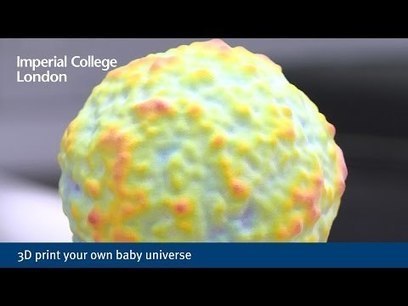
Physicists have created a 3D printed cosmic microwave background - a map of the oldest light in the universe - and provided the files for download. The cosmic microwave background (CMB) is a glow that the universe has in the microwave range that maps the oldest light in the universe. It was imprinted when the universe first became transparent, instead of an opaque fog of plasma and radiation. The CMB formed when the universe was only 380,000 years old – very early on in its now 13.8 billion-year history. The Planck satellite is making ever-more detailed maps of the CMB, which tells astronomers more about the early universe and the formation of structures within it, such as galaxies. However, more detailed maps are increasingly difficult to view and explore. To address this issue, Dr Dave Clements from the Department of Physics at Imperial, and two final-year undergraduate students in Physics, have created the plans for 3D printing the CMB. A paper describing the process is published today in the European Journal of Physics. Dr Clements said: “Presenting the CMB in a truly 3D form, that can be held in the hand and felt rather than viewed, has many potential benefits for teaching and outreach work, and is especially relevant for those with a visual disability.
|
|
Scooped by
Dr. Stefan Gruenwald
January 2, 2017 7:52 PM
|
Berkeley Lab scientists are developing new ways to see the unseen. Here are seven imaging advances that are helping to push science forward.
|
|
Scooped by
Dr. Stefan Gruenwald
January 2, 2017 7:48 PM
|
Sony’s new patent for a “smart” contact lens includes some pretty cool tech—such as the ability to record and playback images, store them internally, and even autofocus. Our memories are fallible things. We remember something one way; but the reality can be quite different. But imagine contact lenses that are also tiny cameras, recording and storing whatever you see, and even playing it back before your very eyes. What was really said at last week’s meeting? Play it back and see. Want to cherish forever some treasured moment—when you first saw your future spouse, or the birth of a child, or some other formative event? You may be able to soon. And it gets better. Imagine how it might change the criminal justice system, with such infallible eyewitnesses. Grandpa has an incredible Bigfoot, ghost, or UFO story? Maybe all three? Let’s see the playback, Gramps; let’s see the proof. It’s an intriguing concept, and a little frightening. And now, Sony is muscling its way into a game that already boasts such heavyweight players as Google and Samsung. The company has filed a patent for a “smart” contact lens. A key component of the new contact lens technology is that the camera recorders “know” when you’re deliberately blinking, as opposed to the natural, involuntary blinks; these deliberate motions activate the mechanisms of the camera. The patent claims: “It is known that a time period of usual blinking is usually 0.2 seconds to 0.4 seconds, and therefore it can be said that, in the case where the time period of blinking exceeds 0.5 seconds, the blinking is conscious blinking that is different from usual blinking (unconscious blinking).” What happens when you fall asleep? Rest your eyes for a few seconds? There are issues to be worked out, certainly, but it’s still a fascinating concept. Another exciting development is that the lenses record images to an internal storage device—a big improvement over other designs, such as Samsung’s, which would transmit images to an external device. It means you can easily and quickly access your recordings.
|