Your new post is loading...

|
Scooped by
Dr. Stefan Gruenwald
March 7, 2017 7:27 PM
|
Researchers from the University of Bristol have found a way to mimic the way cells in living organisms 'talk' to the world around them by creating a world-first synthetic receptor which can respond to chemical signals just like its natural equivalent. The breakthrough research, published in the journal Nature Chemistry, paves the way for further advances in biotechnology and in the future could be used in the treatment of medical conditions caused by faulty cellular communication. The research was supported by the European Research Council and the Engineering and Physical Science Research Council (EPSRC). Professor Jonathan Clayden from the University of Bristol's School of Chemistry explains: "Cells in living organisms find out what is happening in the world around them by using receptor molecules embedded in their outer membranes. These respond to chemical messages, such as hormones, by changing shape, which sets off a cascade of chemical events inside the cell. "Working with collaborators in Manchester, we have now designed and synthesised the first artificial mimic of one of these receptors." The synthetic receptor embeds itself into the membrane of simple cellular structures known as vesicles, and just like its natural equivalent, changes its molecular shape in response to chemical signals. The researchers were able to get the receptor mimic to respond to the natural hormone Leu-enkephalin (an "agonist"), which in humans is involved in pain relief, and were able to use another chemical messenger (an "antagonist") to switch this response off again. "The discovery that artificial molecules can respond to chemical signals in this way raises the possibility that the natural communication pathways used by cells could be added to or bypassed," said Professor Clayden.
|
|
Scooped by
Dr. Stefan Gruenwald
March 7, 2017 7:20 PM
|
A research group at Tohoku University and Japan Advanced Institute of Science and Technology has developed a molecular robot consisting of biomolecules, such as DNA and protein. The molecular robot was developed by integrating molecular machines into an artificial cell membrane. It can start and stop its shape-changing function in response to a specific DNA signal. This is the first time that a molecular robotic system has been able to recognize signals and control its shape-changing function. What this means is that molecular robots could, in the near future, function in a way similar to living organisms. Using sophisticated biomolecules such as DNA and proteins, living organisms perform important functions. For example, white blood cells can chase bacteria by sensing chemical signals and migrating toward the target. In the field of chemistry and synthetic biology, elemental technologies for making various molecular machines, such as sensors, processors and actuators, are created using biomolecules. A molecular robot is an artificial molecular system that is built by integrating molecular machines. The researchers believe that realization of such a system could lead to a significant breakthrough -- a bio-inspired robot designed on a molecular basis. The molecular robot developed by the research group is extremely small -- about one millionth of a meter -- similar in size to human cells. It consists of a molecular actuator, composed of protein, and a molecular clutch, composed of DNA. The shape of the robot's body (artificial cell membrane) can be changed by the actuator, while the transmission of the force generated by the actuator can be controlled by the molecular clutch. The research group demonstrated through experiments that the molecular robot could start and stop the shape-changing behavior in response to a specific DNA signal. "With more than 20 chemicals at varying concentrations, it took us a year and a half to establish good conditions for working our molecular robots," says Associate Professor Shin-ichiro Nomura at Tohoku University's Graduate School of Engineering, who led the study. "It was exciting to see the robot shape-changing motion through the microscope. It meant our designed DNA clutch worked perfectly, despite the complex conditions inside the robot."
|
|
Scooped by
Dr. Stefan Gruenwald
March 7, 2017 4:43 PM
|
3-D picture-language has far-reaching potential, including in physics. A trio of Harvard researchers has developed a new 3-D pictorial language for mathematics with potential as a tool across a wide spectrum, from pure math to physics. The trio presented a 3D topological picture-language for quantum information, called quon. Their approach combines charged excitations carried by strings, with topological properties that arise from embedding the strings in the interior of a 3D manifold with boundary. A quon is a composite that acts as a particle. Specifically, a quon is a hemisphere containing a neutral pair of open strings with opposite charge. The mathematicians interpreted multiquons and their transformations in a natural way. They obtained a type of relation, a string–genus “joint relation,” involving both a string and the 3D manifold. They used the joint relation to obtain a topological interpretation of the C∗-Hopf algebra relations, which are currently widely used in tensor networks. The team obtained a 3D representation of the controlled NOT (CNOT) gate that is considerably simpler than earlier work, and a 3D topological protocol for teleportation. In the past, topological quantum information was formulated by Kitaev (1) and Freedman et al. (2).
|
|
Scooped by
Dr. Stefan Gruenwald
March 7, 2017 4:35 PM
|
Telescopes around the world (and orbiting it) have turned their gazes to the seven Earth-size planets of the TRAPPIST-1 star system — but it's an upcoming megatelescope that could reveal whether any of them have life-friendly atmospheres. The James Webb Space Telescope (JWST), set to launch in 2018, is sensitive enough to identify the chemical components of the planets' atmospheres as the worlds pass in front of their star, NASA officials said. "If these planets have atmospheres, the James Webb Space Telescope will be the key to unlocking their secrets," Doug Hudgins, exoplanet program scientist at NASA Headquarters in Washington, D.C., said in a statement. "In the meantime, NASA's missions like Spitzer, Hubble and Kepler telescopes are following up on these planets."
|
|
Scooped by
Dr. Stefan Gruenwald
March 7, 2017 4:32 PM
|
An international team of scientists has tailored special X-ray glasses to concentrate the beam of an X-ray laser stronger than ever before. The individually produced corrective lens eliminates the inevitable defects of an X-ray optics stack almost completely and concentrates three quarters of the X-ray beam to a spot with 250 nanometers diameter, closely approaching the theoretical limit. The concentrated X-ray beam can not only improve the quality of certain measurements, but also opens up entirely new research avenues, as the team surrounding DESY lead scientist Christian Schroer writes in the journal Nature Communications.
|
|
Scooped by
Dr. Stefan Gruenwald
March 7, 2017 4:24 PM
|
The last woolly mammoths to walk the Earth were so wracked with genetic disease that they lost their sense of smell, shunned company, and had a strange shiny coat. That's the verdict of scientists who have analyzed ancient DNA of the extinct animals for mutations. The studies suggest the last mammoths died out after their DNA became riddled with errors. The knowledge could inform conservation efforts for living animals. There are fewer than 100 Asiatic cheetahs left in the wild, while the remaining mountain gorilla population is estimated at about 300. The numbers are similar to those of the last woolly mammoths living on Wrangel Island in the Arctic Ocean around 4,000 years ago. Dr Rebekah Rogers of the University of California, Berkeley, who led the research, said the mammoths' genomes "were falling apart right before they went extinct". This, she said, was the first case of "genomic meltdown" we have seen in a single species. Woolly mammoths were once common in North America and Siberia. They were driven to extinction by environmental factors and possibly human hunting about 10,000 years ago. Small island populations clung on until about 4,000 years ago. "There was this huge excess of what looked like bad mutations in the genome of the mammoth from this island," said Dr Rogers. "We found these bad mutations were accumulating in the mammoth genome right before they went extinct." Knowledge of the last days of the mammoth could help modern species on the brink of extinction, such as the panda, mountain gorilla and Indian elephant. The lesson from the woolly mammoth is that once numbers drop below a certain level, the population's genetic health may be beyond saving. Genetic testing could be one way to assess whether levels of genetic diversity in a species are enough to give it a chance of survival. A better option is to stop numbers falling too low. "When you have these small populations for an extended period of time they can go into genomic meltdown, just like what we saw in the mammoth," said Dr Rogers. "So if you can prevent these organisms ever being threatened or endangered then that will do a lot more to help prevent this type of genomic meltdown compared to if you have a small population and then bring it back up to larger numbers because it will still bear those signatures of this genomic meltdown."
|
|
Scooped by
Dr. Stefan Gruenwald
March 4, 2017 7:09 PM
|
"There are far-reaching implications for this discovery," said Tiago Campante, from the University of Birmingham's School of Physics and Astronomy, who led the research. "We now know that Earth-sized planets have formed throughout most of the Universe's 13.8 billion year history, which could provide scope for the existence of ancient life in the Galaxy. By the time the Earth formed, the planets in this system were already older than our planet is today." Thanks to the NASA Kepler mission, the scientists announced today (Tuesday 27 January 2015) in The Astrophysical Journal the observation of a Sun-like star (Kepler-444) hosting 5 planets with sizes between Mercury and Venus, that was formed 11.2 billion years ago, when the Universe was less than 20% its current age. This is the oldest known system of terrestrial-sized planets in our Galaxy - 2 and a half times older than the Earth. The University of Birmingham team carried out the research using asteroseismology - listening to the natural resonances of the host star which are caused by sound trapped within it. These oscillations lead to miniscule changes or pulses in its brightness which allow the researchers to measure its diameter, mass and age. The planets were then detected from the dimming that occurs when the planets transited, or passed across, the stellar disc. This fractional fading in the intensity of the light received from the star enables scientists to accurately measure the size of the planets relative to the size of the star. "The first discoveries of exoplanets around other Sun-like stars in our Galaxy have fuelled efforts to find other worlds like Earth and other terrestrial planets outside our Solar System," said Bill Chaplin, also from the University of Birmingham who has been leading the team studying solar-type stars using asteroseismology for the Kepler Mission. " We are now getting first glimpses of the variety of Galactic environments conducive to the formation of these small worlds. As a result, the path towards a more complete understanding of early planet formation in the Galaxy is now unfolding before us.'
|
|
Scooped by
Dr. Stefan Gruenwald
March 2, 2017 10:45 PM
|
Birdsnap is a free electronic field guide covering 500 of the most common North American bird species, available as a web site or aniPhone app. Researchers from Columbia University and the University of Maryland developed Birdsnap using computer vision and machine learning to explore new ways of identifying bird species. Birdsnap automatically discovers visually similar species and makes visual suggestions for how they can be distinguished. In addition, Birdsnap uses visual recognition technology to allow users who upload bird images to search for visually similar species. Birdsnap estimates the likelihood of seeing each species at any location and time of year based on sightings records, and uses this likelihood both to produce a custom guide to local birds for each user and to improve the accuracy of visual recognition.
The genesis of Birdsnap (and its predecessors Leafnsap and Dogsnap) was the realization that many techniques used for face recognition developed by Peter Belhumeur (Columbia University) and David Jacobs(University of Maryland) could also be applied to automatic species identification. State-of-the-art face recognition algorithms rely on methods that find correspondences between comparable parts of different faces, so that, for example, a nose is compared to a nose, and an eye to an eye. In the same way, Birdsnap detects the parts of a bird, so that it can examine the visual similarity of comparable parts of the bird.Our first electronic field guide Leafsnap, produced in collaboration with the Smithsonian Institution, was launched in May 2011. This free iPhone app uses visual recognition software to help identify tree species from photographs of their leaves. Leafsnap currently includes the trees of the northeastern US and will soon grow to include the trees of the United Kingdom. Leafsnap has been downloaded by over a million users, and discussed extensively in the press (see Leafsnap.com, for more information). In 2012, we launched Dogsnap, an iPhone app that allows you to use visual recognition to help determine dog breeds. Dogsnap contains images and textual descriptions of over 150 breeds of dogs recognized by the American Kennel Club.
For their inspiration and advice on bird identification, we thank the UCSD Computer Vision group, especially Serge Belongie, Catherine Wah, and Grant Van Horn; the Caltech Computational Vision group, especially Pietro Perona, Peter Welinder, and Steve Branson; the alumni of these groups Ryan Farrell (now at BYU), Florian Schroff (at Google), and Takeshi Mita (at Toshiba); and the Visipedia effort.
|
|
Rescooped by
Dr. Stefan Gruenwald
from Amazing Science
March 13, 2017 3:42 PM
|
Astronomy is one of the oldest natural sciences and studies celestial objects (such as moons, planets, stars, nebulae, and galaxies), the physics, chemistry, mathematics, and evolution of such objects, and phenomena that originate outside the atmosphere of Earth, including supernovae explosions, gamma ray bursts, and cosmic background radiation. Theoretical astronomy is oriented towards the development of computer or analytical models to describe celestrial phenomena. A related but distinct subject, cosmology, is concerned with studying the universe as a whole.Shine on the web
|
|
Scooped by
Dr. Stefan Gruenwald
February 28, 2017 11:20 AM
|
Proposals for a large public–private initiative to synthesize an entire human genome from scratch — an effort that could take a decade and require billions of dollars in technological development — were formally unveiled on 2 June 2016, almost a month after they were first aired at a secretive meeting. Proponents of the effort, named ‘Human Genome Project—Write’ (HGP-write), write in Science that US$100 million from a range of funding sources would help to get their vision off the ground1. The team is led by synthetic biologist Jef Boeke at New York University; genome scientist George Church at Harvard Medical School in Boston, Massachusetts; and Andrew Hessel, a futurist at the commercial design studio Autodesk Research in San Rafael, California. But the idea — which essentially aims to develop technologies that reduce the cost of DNA synthesis — has not met with universal excitement among researchers. To some, the proposal to create a human genome is praiseworthy for its ambition and sheer chutzpah: at present, only tiny bacterial genomes and a portion of a yeast genome have been made from scratch. But other researchers feel that HGP-write represents a needless centralization of work that is already taking place in companies trying to lower the price of synthesizing strings of DNA. Some of HGP-write’s proponents have financial stakes in those firms, which include Gen9 in Cambridge, Massachusetts. “My first thought was ‘so what’,” says Martin Fussenegger, a synthetic biologist at the Swiss Federal Institute of Technology in Zurich. “I personally think this will happen naturally. It’s just a matter of price at the end.” Others think that the project should be delayed until its leaders can win broader support for the idea. In an e-mail sent to reporters, synthetic biologist Drew Endy, at Stanford University in California, and religion scholar Laurie Zoloth, at Northwestern University in Evanston, Illinois, say that the HGP-write team has not properly justified its aims, and that the project should be abandoned. “We are still waiting for a serious public debate with participation from a broad range of people,” they say. Endy and Zoloth had already questioned the scientific rationale for synthesizing a human genome in May, when HGP-write was first aired at an invitation-only meeting at Harvard University that was attended by more than 100 scientists, entrepreneurs, lawyers and ethicists. The closed nature of the meeting also attracted criticism: Church told the health and medicine news service Stat that this was because the paper describing the effort was under embargo. “There was a lot of confusion on the day about what was going on,” says Tom Ellis, a synthetic biologist at Imperial College London, who attended the meeting. “Some people were in the know on the [paper’s] review process and others were trying to find out.” The three-page announcement of HGP-write fills in some detail. It notes that current technologies are both too expensive and too primitive to synthesize the 3-billion-base-pair human genome. The team calls for a series of pilot projects, including synthesizing much shorter segments of the genome and making slimmed-down chromosomes to do specific tasks, to make its eventual goal doable. The whole project should require less than $3 billion (the price of the publicly funded Human Genome Project), the researchers say. “I think it’s a brilliant project,” says Paul Freemont, a structural biologist at Imperial College London, who attended the meeting. “If you want to do this, it’s going to be on the same scale as the Human Genome Project, it’s going to need some big funding agencies and hundreds and hundreds of researchers around the world.” Read more in Nature WHITEPAPER is here
|
|
Scooped by
Dr. Stefan Gruenwald
February 28, 2017 12:44 AM
|
A decades-old method called the “bootstrap” is enabling new discoveries about the geometry underlying all quantum theories. In the 1960s, the charismatic physicist Geoffrey Chew, Member (1956) in the School of Mathematics/Natural Sciences, espoused a radical vision of the universe, and with it, a new way of doing physics, arguing that "Nature is as it is because this is the only possible nature consistent with itself.” He believed he could deduce nature’s laws solely from the demand that they be self-consistent. Particles, Chew said, “pull themselves up by their own bootstraps.” Recently, the bootstrap method has been re-energized. As the new generation of bootstrappers, including Professor Nima Arkani-Hamed and Carl P. Feinberg Professor Juan Maldacena, current Member David Simmons-Duffin, Member (2010–13) Thomas Hartman, and Junior Visiting Professor (2015–16) and Member (2011–12) David Poland in the School of Natural Sciences, explore this abstract theory space, they seem to be verifying the vision that Chew, now 92 and long retired, laid out half a century ago—but they’re doing it in an unexpected way. As physicists use the bootstrap to explore the geometry of this theory space, they are pinpointing the roots of “universality,” a remarkable phenomenon in which identical behaviors emerge in materials as different as magnets and water. They are also discovering general features of quantum gravity theories, with apparent implications for the quantum origin of gravity in our own universe and the origin of space-time itself. The bootstrap is technically a method for computing “correlation functions” — formulas that encode the relationships between the particles described by a quantum field theory. Consider a chunk of iron. The correlation functions of this system express the likelihood that iron atoms will be magnetically oriented in the same direction, as a function of the distances between them. The two-point correlation function gives you the likelihood that any two atoms will be aligned, the three-point correlation function encodes correlations between any three atoms, and so on. These functions tell you essentially everything about the iron chunk. But they involve infinitely many terms riddled with unknown exponents and coefficients. They are, in general, onerous to compute. The bootstrap approach is to try to constrain what the terms of the functions can possibly be in hopes of solving for the unknown variables. Most of the time, this doesn’t get you far. But in special cases, as the theoretical physicist Alexander Polyakov began to figure out in 1970, the bootstrap takes you all the way.
|
|
Scooped by
Dr. Stefan Gruenwald
February 27, 2017 6:29 PM
|
Researchers say 'benevolent bots', otherwise known as software robots, that are designed to improve articles on Wikipedia sometimes have online 'fights' over content that can continue for years. Editing bots on Wikipedia undo vandalism, enforce bans, check spelling, create links and import content automatically, whereas other bots (which are non-editing) can mine data, identify data or identify copyright infringements. The team analyzed how much they disrupted Wikipedia, observing how they interacted on 13 different language editions over ten years (from 2001 to 2010). They found that bots interacted with one another, whether or not this was by design, and it led to unpredictable consequences. The research paper, published in PLOS ONE, concludes that bots are more like humans than you might expect. Bots appear to behave differently in culturally distinct online environments. The paper says the findings are a warning to those using artificial intelligence for building autonomous vehicles, cyber security systems or for managing social media. It suggests that scientists may have to devote more attention to bots' diverse social life and their different cultures.
|
|
Scooped by
Dr. Stefan Gruenwald
February 27, 2017 6:12 PM
|
The Washington Post's Heliograf software can autowrite tons of basic stories in no time, which could free up reporters to do more important work — or allow them to just retire. USA Today has used this AI-driven production software to create short videos. It can condense news articles into a script, string together a selection of images or video footage, and even add narration with a synthesized newscaster voice. Reuters’ algorithmic prediction tool helps journalists gauge the integrity of a tweet. The tech scores emerging stories on the basis of “credibility” and “newsworthiness” by evaluating who’s tweeting about it, how it’s spreading across the network, and if nearby users have taken to Twitter to confirm or deny breaking developments. Originally designed to crowdsource reporting from the Republican and Democratic National Conventions, BuzzFeed’s software collects information from on-the-ground sources at news events. BuzzBot has since been open-sourced, portending a wave of bot-aided reporting tools.
|
|
|
Scooped by
Dr. Stefan Gruenwald
March 7, 2017 7:24 PM
|
A Yale-led team has produced one of the highest-resolution maps of dark matter ever created, offering a detailed case for the existence of cold dark matter -- sluggish particles that comprise the bulk of matter in the universe. The dark matter map is derived from Hubble Space Telescope Frontier Fields data of a trio of galaxy clusters that act as cosmic magnifying glasses to peer into older, more distant parts of the universe, a phenomenon known as gravitational lensing. Yale astrophysicist Priyamvada Natarajan led an international team of researchers that analyzed the Hubble images. "With the data of these three lensing clusters we have successfully mapped the granularity of dark matter within the clusters in exquisite detail," Natarajan said. "We have mapped all of the clumps of dark matter that the data permit us to detect, and have produced the most detailed topological map of the dark matter landscape to date." Scientists believe dark matter -- theorized, unseen particles that neither reflect nor absorb light, but are able to exert gravity -- may comprise 80% of the matter in the universe. Dark matter may explain the very nature of how galaxies form and how the universe is structured. Experiments at Yale and elsewhere are attempting to identify the dark matter particle; the leading candidates include axions and neutralinos. "While we now have a precise cosmic inventory for the amount of dark matter and how it is distributed in the universe, the particle itself remains elusive," Natarajan said. Dark matter particles are thought to provide the unseen mass that is responsible for gravitational lensing, by bending light from distant galaxies. This light bending produces systematic distortions in the shapes of galaxies viewed through the lens. Natarajan's group decoded the distortions to create the new dark matter map.
|
|
Scooped by
Dr. Stefan Gruenwald
March 7, 2017 4:46 PM
|
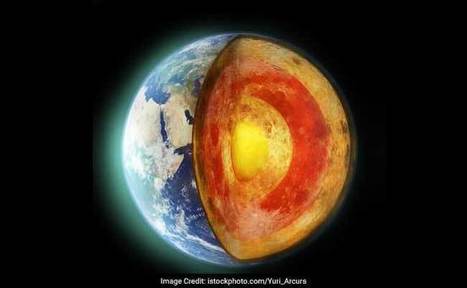
The mantle - the mostly solid, rocky part of Earth's interior - is about 60 degrees Celsius hotter than previously thought, a new study has found.
The findings led by Woods Hole Oceanographic Institution (WHOI) in the US could change how scientists think about many issues in Earth science including how ocean basins form.
A 60-degree increase may not sound like a lot compared to a molten mantle temperature of more than 1,400 degrees Celsius, researchers said. However, the result is significant as a hotter mantle would be more fluid, helping to explain the movement of rigid tectonic plates, they said.
Since it is not possible to measure the mantle's temperature directly, geologists have to estimate it through laboratory experiments that simulate the high pressures and temperatures inside the Earth.
Water is a critical component of the equation: the more water (or hydrogen) in rock, the lower the temperature at which it will melt. The peridotite rock that makes up the upper mantle is known to contain a small amount of water. To figure out how the water content of mantle rock affects its melting point, Emily Sarafian, a graduate student in the MIT-WHOI Joint Programme conducted a series of lab experiments.
She used a piston-cylinder apparatus, a machine that uses electrical current, heavy metal plates, and stacks of pistons in order to magnify force to recreate the high temperatures and pressures found deep inside the Earth. Following standard experimental methodology, Sarafian created a synthetic mantle sample. She used a known, standardised mineral composition and dried it out in an oven to remove as much water as possible.
Sarafian modified her starting sample by adding spheres of a mineral called olivine, which occurs naturally in the mantle. The spheres were large enough for Sarafian to analyse their water content using secondary ion mass spectrometry (SIMS). From there, she was able to calculate the water content of her entire starting sample. To her surprise, she found it contained approximately the same amount of water known to be in the mantle. Based on her results, Sarafian concluded that mantle melting had to be starting at a shallower depth under the seafloor than previously expected.
To verify her results, Sarafian turned magnetotellurics - a technique that analyses the electrical conductivity of the crust and mantle under the seafloor. Reconciling the temperatures and pressures Sarafian measured in her experiments with the melting depth from an earlier study led her to a startling conclusion: The oceanic upper mantle must be 60 degrees Celsius hotter than current estimates.
|
|
Scooped by
Dr. Stefan Gruenwald
March 7, 2017 4:37 PM
|
It took billions of years for most of the Earth's minerals to form, but scientists say hundreds more have been created in the years since the industrial revolution. Human-made minerals created in the years since the industrial revolution have been uncovered by scientists, who want them to be accepted as real minerals. Armed with the discovery, they are pushing to have the geological time scale recognise 'the Anthropocene' time period — or the epoch of human activity. "We define different periods of Earth history by the distinctive things we find in them," said Robert Hazen, a mineralogist at Washington's Carnegie Institution for Science. "They [the minerals] would tell future geologists that something was different about this layer — I think there is no question about it." The new minerals were created by chance, when substances that would otherwise have never encountered one another came into contact as a result of human activity.
|
|
Scooped by
Dr. Stefan Gruenwald
March 7, 2017 4:33 PM
|
Poker isn’t like other games artificial intelligence has mastered, like chess and go. In poker, each player has a different set of information than the others, and thus a different perspective on the game. This means poker more closely mirrors the kinds of decisions we make in real life, but also presents a huge challenge for AI. Now, an AI system called DeepStack has succeeded in untangling this imperfect information, refining its own strategy to win against professional players at a rate nearly 10 times that of a human poker pro.
|
|
Scooped by
Dr. Stefan Gruenwald
March 7, 2017 4:27 PM
|
Smelly footprints left by bumblebees can help them find good sources of food. The insects secrete invisible markers when they touch their feet on a surface, which can be detected by themselves and other bumblebees. Researchers from the University of Bristol, in the UK, found that bees can distinguish between their own scent, the scent of a relative and that of a stranger. This ability can be used to improve their success at finding good sources of food and avoiding flowers that have already been visited and mined of nutrients.
|
|
Scooped by
Dr. Stefan Gruenwald
March 7, 2017 4:20 PM
|
Nearly 200 million cases of polio, measles, mumps, rubella, varicella, adenovirus, rabies and hepatitis A — and approximately 450,000 deaths from these diseases — were prevented in the U.S. alone between 1963 and 2015 by vaccination, researchers estimate. The study is published in AIMS Public Health. In 1963, vaccination against these infections became widespread, thanks to the development of a human cell strain that allowed vaccines to be produced safely. Globally, the vaccines developed from this strain and its derivatives prevented an estimated 4.5 billion cases of disease and saved more than 10 million lives. Hayflick developed the normal WI-38 human cell strain in 1962, and it has been used ever since to safely grow the viruses needed to produce vaccines against more than 10 diseases. Before that, many viral vaccines had been grown in monkey cells, but contamination with potentially dangerous monkey viruses forced an end to production, leaving millions vulnerable to common diseases. “Given the acknowledged large, positive global health impact of vaccines in general, I was curious what contribution my discovery of WI-38 in 1962 had in saving lives and reducing morbidity, since a large number of viral vaccines in use today are made with my cell strain or its derivatives,” Hayflick said. To determine the number of cases of disease and deaths prevented by vaccines developed using WI-38, Olshansky used previously-published data on cases and deaths for each disease in the U.S. in 1960, before vaccines were available for these diseases. He assumed that these prevalence rates would have held constant through the years without vaccines. Because vaccines for individual disease were introduced over time, to determine how many cases were prevented and lives saved for each disease, Olshansky multiplied the number of years the vaccine has been out (from its debut through 2015) by the prevalence of cases and deaths caused by that disease in 1960. “Vaccination is a particularly important issue to think about now, given the rise of an anti-vaccine movement that has the potential to reverse the health gains achieved through one of the most powerful interventions in medical history,” Hayflick said. “The anti-vaccination movement endangers the health of an entire generation of children.”
|
|
Scooped by
Dr. Stefan Gruenwald
March 4, 2017 7:04 PM
|
Over the years, scientists have come up with a lot of ideas about why we sleep. Some have argued that it’s a way to save energy. Others have suggested that slumber provides an opportunity to clear away the brain’s cellular waste. Still others have proposed that sleep simply forces animals to lie still, letting them hide from predators. A pair of papers published on Thursday in the journal Science offer evidence for another notion: We sleep to forget some of the things we learn each day. In order to learn, we have to grow connections, or synapses, between the neurons in our brains. These connections enable neurons to send signals to one another quickly and efficiently. We store new memories in these networks. In 2003, Giulio Tononi and Chiara Cirelli, biologists at the University of Wisconsin-Madison, proposed that synapses grew so exuberantly during the day that our brain circuits got “noisy.” When we sleep, the scientists argued, our brains pare back the connections to lift the signal over the noise.
|
|
Scooped by
Dr. Stefan Gruenwald
March 2, 2017 10:43 PM
|
Your family tree might contain a few curious revelations. It might alert you to the existence of long-lost third cousins. It might tell you your 10-times-great-grandfather once bought a chunk of Brooklyn. It might reveal that you have royal blood. But when family trees includes millions of people—maybe even tens of millions of people—then we’re beyond the realm of individual stories. When genealogies get so big, they’re not just the story of a family anymore; they contain the stories of whole countries and, at the risk of sounding grandiose, even all of humanity. Last week, scientists using data from Ancestry.com and Geni.com each unveiled papers analyzing the genealogies for patterns like migrations, lifespan, and when people stopped marrying family members. Ancestry.com sells both subscriptions to its genealogy research site and a popular genetic test through its subsidiary AncestryDNA. Its geneticists— along with a historian—used the genetic data of 770,000 AncestryDNA customers along with the genealogy records of their ancestors to map migrations in North America. The team first analyzed the DNA tests to find clusters of closely related people in the present. Then, they matched up the people in those clusters with genealogy records containing 20 million people, which included the birthplaces of several generations of ancestors. With that, they could march backwards in time to see how those ancestors migrated across the U.S.
|
|
Scooped by
Dr. Stefan Gruenwald
March 2, 2017 8:58 PM
|
The world is churning out so much data that hard-drives may not be able to keep up, leading researchers to look at DNA as a possible storage medium. DNA is ultra compact, and doesn’t degrade over time like cassettes and CDs. In a new study, Yaniv Erlich and Dina Zielinski demonstrate DNA’s full potential and reliability for storing data. The researchers wrote six files—a full computer operating system, a 1895 French film, an Amazon gift card, a computer virus, a Pioneer plaque, and a study by information theorist Claude Shannon—into 72,000 DNA strands, each 200 bases long. They then used sequencing technology to retrieve the data, and software to translate the genetic code back into binary. The files were recovered with no errors. We spoke with Erlich about the results, and what they mean for the future of data storage.
|
|
Scooped by
Dr. Stefan Gruenwald
February 28, 2017 1:05 AM
|
The mathematician Simon Plouffe experiments with Maple (computer algebra system) and PSLQ (integer relations algorithm) and here are his findings and remarks.
|
|
Scooped by
Dr. Stefan Gruenwald
February 28, 2017 12:16 AM
|
Pluto could be set to regain its planetary status after 11 years in exile, if NASAscientists have their way. A new definition of planets would add over 100 to our solar system, with even Earth’s moon due a promotion. The International Astronomical Union (IAU) currently requires an object to be orbiting the Sun to be classified as a planet. But the NASA team wants the IAU to drop that requirement, insisting that a world’s physical properties are more important than their interactions with stars. “In keeping with both sound scientific classification and peoples’ intuition, we propose a geophysically-based definition of ‘planet’ that importantly emphasizes a body’s intrinsic physical properties over its extrinsic orbital properties,” the researchers explain. The proposal was made by a team of NASA scientists led by Alan Stern, principal investigator of the space agency’s New Horizons mission to Pluto.
|
|
Scooped by
Dr. Stefan Gruenwald
February 27, 2017 6:22 PM
|
An exotic binary star system 380 light-years away has been identified as an elusive white dwarf pulsar -- the first of its kind ever to be discovered in the universe -- thanks to research by the University of Warwick. Professors Tom Marsh and Boris Gänsicke of the University of Warwick's Astrophysics Group, with Dr David Buckley from the South African Astronomical Observatory, have identified the star AR Scorpii (AR Sco) as the first white dwarf version of a pulsar -- objects found in the 1960s and associated with very different objects called neutron stars. AR Sco contains a rapidly spinning, burnt-out stellar remnant called a white dwarf, which lashes its neighbor -- a red dwarf -- with powerful beams of electrical particles and radiation, causing the entire system to brighten and fade dramatically twice every two minutes. The latest research establishes that the lash of energy from AR Sco is a focused 'beam', emitting concentrated radiation in a single direction -- much like a particle accelerator -- something which is totally unique in the known universe. AR Sco lies in the constellation Scorpius, 380 light-years from Earth, a close neighbor in astronomical terms. The white dwarf in AR Sco is the size of Earth but 200,000 times more massive, and is in a 3.6 hour orbit with a cool star one third the mass of the Sun. With an electromagnetic field 100 million times more powerful than Earth, and spinning on a period just shy of two minutes, AR Sco produces lighthouse-like beams of radiation and particles, which lash across the face of the cool star, a red dwarf. As the researchers previously discovered, this powerful light house effect accelerates electrons in the atmosphere of the red dwarf to close to the speed of light, an effect never observed before in similar types of binary stars. The red dwarf is thus powered by the kinetic energy of its spinning neighbor. The distance between the two stars is around 1.4 million kilometers -- which is three times the distance between the Moon and the Earth.
|