"In 1926, thirteen years before James Webb Young’s Technique for Producing Ideas and more than three decades before Arthur Koestler’s seminal “bisociation” theory of how creativity works, English social psychologist and London School of Economics co-founder Graham Wallas, sixty-eight at the time, penned The Art of Thought— an insightful theory outlining the four stages of the creative process, based both on his own empirical observations and on the accounts of famous inventors and polymaths. Though, sadly, the book is long out of print, with surviving copiessold for a fortune and available in a few public libraries, the gist of Wallas’s model has been preserved in a chapter of the 1976 treasure The Creativity Question (public library) — an invaluable selection of meditations on and approaches to creativity by some of history’s greatest minds, compiled by psychiatrist Albert Rothenberg and philosopher Carl R. Hausman, reminiscent of the 1942 gem An Anatomy of Inspiration.
"Wallas outlines four stages of the creative process — preparation, incubation, illumination, and verification— dancing in a delicate osmosis of conscious and unconscious work. These phases, which literary legend Michael Cowley would come to parallel in his 1958 model of the four stages of writing, go as follows:"
Today's guest blog post by Cathy Mere will help you jump on the electronic record-keeping bandwagon. Learn how to use Evernote to keep conferring notes on all of your students.
"We learn so much sitting beside writers as they work in our workshops each day. Two years ago I gave up my spiral notebook I used to keep records of writing conference conversations for a digital system. Saying goodbye to my spiral notebook with tabbed sections for each student was easier than I anticipated. The time was right. More and more often I found myself wanting to do more than record handwritten snippets of evidence, thought, and conversation. More and more I found myself wanting to take pictures of student work or record student voices. More and more I found myself wanting to link to digital pieces students were creating. More and more I seemed to have a device in my hand instead of a pen. After learning about Evernote I decided to see if I could use it as a tool to record notes from across the day. I found myself enjoying the seamlessness of Evernote. It seemed Evernote was a tool to allow me to capture the learning journeys of the young writers in my classroom.
"To begin I created a notebook for each student and then placed them in a class stack. Each time I confer with a writer during writing workshop I use Evernote. Before I begin our conversation I glance through the last few notes, watch the work the writer is doing, and wait for an appropriate moment to chat. For me, it has worked to create a new note inside the student’s notebook each time I have a conference with a writer. My conferences are often structured like this:"
A well documented description of how one teacher has developed her own method to maintain digital notes for all her students in Writers' Workshop by using Evernote.
"Everyone has a Story to Tell Do you have a story you would like to share? Do you enjoy reading short stories?Narrativs believes that everyone has a story to tell and aims to connect people all over the world through storytelling. Narrativs has created a digital space where aspiring writers can gain support for their work and receive constructive criticism. On the Narrativs website everyone is invited to submit a poem or short story – fiction or non-fiction. The Narrativs editing team provides feedback on the submission and the author is encouraged to make the necessary changes. After the piece goes through the editing process the story is then published on the Narrativs site and readers can rate and write comments in reaction to the story. This new publishing format allows one to learn about the world from many different perspectives by reading this diverse collection of stories.
"Social Entrepreneurship Narrativs aims to give everyone a voice, not only by creating a platform for writers to share their work, but also by financially supporting non- profit projects that promote literacy. Founder, Rachel Ngoc Anh Bui was inspired to develop Narrativs after listening to a global responsibility-focused speech by the prince of Norway. Narrativs plans to gather the best stories from the site to publish in a book. The money that the book generates will be given to groups that aid education in developing countries. The Narrativs team hopes to inspire others to find ways to develop businesses that make the world a better place. The team has been visiting schools in the United States and motivating students to create businesses that are socially responsible. Narrativs is creating a valuable narrative around both digital authorship and global citizenship."
I love this idea because it is true. What I love even more is the idea of sharing narratives because that experience is what connects us to each other.
"The primary goal of the Educational Uses of Digital Storytelling website is to serve as a useful resource for educators and students who are interested in how digital storytelling can be integrated into a variety of educational activities. The site was originally created in 2004 and faculty members and graduate students in the Instructional Technology Program at the University of Houston College of Education continue to maintain the site and add new content. "
"Our long term goal is to make the Educational Uses of Digital Storytelling website a comprehensive clearinghouse of information for both those just starting to use digital storytelling as well as for educators, graduate students and researchers who want to deeply explore the many facets of this educational technology tool."
"Whether you're an individual making your own or a facilitator helping others to make theirs, here's a set of how-to guides that we hope you'll find useful. We cover the technical, the editorial, the storytelling, and more. We hope you find these guides useful. Happy storytelling!"
"Technology can be used to support any subject and technology to support creative writing is one such area. Here are some of my favourite but often overlooked sites and tools as well as some staples for inspiration, creation and publication and they work just as well in primary as they do secondary and in further education."
"For the most part, electronic books follow the printed book where stories are linear. It works and stories are written that way.
"Except for genre of interactive adventure writing. To do that, you need to investigateInklewriter. This application provides a wonderful environment for writing but, more importantly, it helps the author write the interactive, branching story. Just writing your story and when it comes time to branch, just add the options along with the paragraph that will be the destination! Inklewriter keeps track of everything so that you don’t have any points where your reader is left hanging!"
'Mr Majestyk', 'Stick', 'Cat Chaser', '52 Pick up' - just some of the colourful, clever and very exciting thrillers penned by Mr Elmore Leonard. Here he talks about his career to date, and gives us a lil insight into his writing methods.
"It is a myth that all it takes to write is to sit down in front of a blank page, to begin at the beginning and write through to the end, with no planning, break, editing, or changes in between. And yet, this is sometimes what we ask our students to do. Good writers plan and revise, rearrange and delete text, re-reading and producing multiple drafts before they produce their finished document. This is what a process writing approach is about."
"My personal favorite is using photos using the Picture Word Inductive Model. As I described briefly in my recent New York Times guest post, and in my book, it’s an “inductive learning process where students first brainstorm twenty words related to a picture, then put those words into categories and add new ones that fit those categories. Next they complete a “cloze” (or fill-in-the-blank) activity with sentences about the picture which are then put into categories of their own. They convert those sentence categories into paragraphs, and, finally, arrange the paragraphs into essays.” You can see sample pictures and read more about it here.
"A related lesson is using Picture Data Sets. For example, students can identifying images that fit a specific criteria (one week my ninth graders compiled images of Jamaican music, Jamaican history, and Jamaican nature attractions and then wrote about each one). These can also include students putting images into different categories and then having other students try to identify which ones they had in mind. Sites on The Best Online Virtual “Corkboards” (or “Bulletin Boards”) list work very well for these kinds of activities."
Ferlazzo is a great curator and this site shows him at his best. Photos are a terrific way to engage learners and this post is a treasure trove of ideas and resources. Don't miss it!
Why do we love our favorite stories? Do they need a beginning, middle and end, and a character who changes by the conclusion? Masters of storytelling explore new answers to age-old questions of the craft.
A mini workshop I did about interactive storytelling in september 2011 as part of the Photostories event at Noorderlicht photo festival in the Netherlands.
Handouts from 20 workshops conducted by Penny Kittle, a very accomplished speacialist in teaching reading and writing P-12. A great deal of wonderful material here; some of it is very clear without explanation, some of it makes you wish you understood the context -JL
"Twitter is one of a growing breed of part-technological, part-social communication media that require some skills to use productively. Sure, Twitter is banal and trivial, full of self-promotion and outright spam. So is the Internet. The difference between seeing Twitter as a waste of time or as a powerful new community amplifier depends entirely on how you look at it – on knowing how to look at it.
"When I started requiring digital journalism students to learn how to use Twitter, I didn’t have the list of journalistic uses for Twitter that I have compiled by now. So I logged onto the service and broadcast a request. “I have a classroom full of graduate students in journalism who don’t know who to follow. Does anybody have a suggestion?” Within ten minutes, we had a list of journalists to follow, including one who was boarding Air Force One at that moment, joining the White House press corps accompanying the President to Africa."
This site gives a brief and very helpful sequence of steps in planning and producing a digital story from the point of view of a non-profit organization. The list of the main varieties of stories, credited to the Center for Digital Storytelling is particularly helpful.
Announcing Flip Your Classroom Day: A Global Initiative
September 6, 2013, the Flipped Learning Network™ hosts Flip Your Classroom Day.
On 9-6-2013 educators across the globe will take a pledge to flip one lesson to experience Flipped Learning, with the expectation this leads to further flipped units or an entire course. Based on a survey conducted by the Speak Up National Research Project (Fall, 2012), we estimate that only 3% of teachers in the U.S. know about or "do" flipped learning. Yet 27% of principals indicated their teachers wanted to try it this year! So thank you for joining the growing ranks of educators who are moving from a teacher-centered classroom to a student-centered learning environment.
"To trace the development of double function terms in children, Asch and Nerlove presented groups of kids with a collection of different objects — ice water, sugar cubes, powder puffs — and asked them to identify the ones that were cold, sweet, or soft. This, of course, they were easily able to do.
"Asch and Nerlove then asked the children, Can a person be cold? Can a person be sweet? Can a person be soft? While preschoolers understood the literal physical references, they did not understand the metaphorical psychological references. They described cold people as those not dressed warmly; hard people were those with firm muscles. One preschooler described his mother as “sweet” but only because she cooked sweet things, not because she was nice.
"Asch and Nerlove observed that only between the ages of seven and ten did children begin to understand the psychological meanings of these descriptions. Some seven- and eight-year-olds said that hard people are tough, bright people are cheerful, and crooked people do bad things. But only some of the eleven- and twelve-year-olds were able to actually describe the metaphorical link between the physical condition and the psychological state. Some nine- and ten-year-olds, for instance, were able to explain that both the sun and bright people “beamed.” Children’s metaphorical competence, it seems, is limited to basic perceptual metaphors, at least until early adolescence."
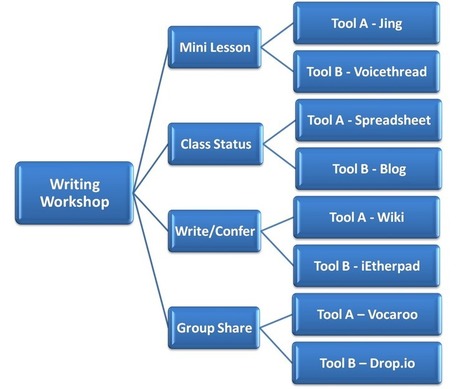
"While publishing student writing online fundamentally hooks students as writers, as teachers, we can take advantage of available tools to make our jobs easier. Just as our students have new digital tools, so do we as their teachers.
"This article is about 5 steps you can take, as a writing teacher, to digitize your writing workshop. There are many more, though, so "stay tuned" for future articles!
Embrace open web toolsFocus on the FacilitatorCreate an Online Writing SpaceFacilitate Online Conversations about Student WritingOffer feedback in audio or video, rather than written, format"
This aritlce leads you step-by-step through the process of digitizing your writing workshop approach and offers tons of practical tools and resources. Excellent teacher guide!
Graham Stanley gives a detailed account of a process writing presentation given by Alistair Grant at the 10th annual Anglo conference in Motvideo, Uruguay. Many great suggestions, links, and strategies here.
"Before I became a high school English as a second language teacher 9 years ago, I spent 19 years as a community organizer, primarily in immigrant neighborhoods and with institutions focused on immigrants. Organizing is a process of helping people—many of whom might be reluctant to change—learn new skills and engage in the world in a way that improves their situation. Organizing means helping people use their assets—their experiences, traditions, and stories—to reimagine themselves and their dreams. It's about helping them tap into their intrinsic motivation and embark on a journey of action, discovery, and learning. I call the process that successful organizers use the organizing cycle. As a teacher, I've adapted this cycle to help English language learners become accomplished readers and learners.
"The organizing cycle includes five actions: Build strong relationships with students; access prior knowledge through stories; help students learn by doing; identify and mentor students' leadership potential; and promote the habit of reflection."
Ferlazzo takes his background as a community organizer and applies it to teaching language skills. He focuses on ELLs, but the strategies are applicable in virtually any setting. This article synthesizes so much excellent pedagogy.
"Want to get students blogging and connecting to a global audience? Kidblog, developed by teachers for teachers (and of course their students) provides a free blogging platform where students can write and interact with readers in a moderated environment. Available on the web and as a free iOS app."
T.H.E. Journal asked educators for the most creative storytelling apps available, and we did a little digging on our own, too. The tools and apps we found turn students into novelists, artists, and moviemakers.
To get content containing either thought or leadership enter:
To get content containing both thought and leadership enter:
To get content containing the expression thought leadership enter:
You can enter several keywords and you can refine them whenever you want. Our suggestion engine uses more signals but entering a few keywords here will rapidly give you great content to curate.


 Your new post is loading...
















Another gem by Popova