"College completion is one of the primary measures schools use to assess the effectiveness of their institutions. According to the NCHEMS Information Center, in 2009 the average six-year graduation rate of bachelor’s degree students in the United States was 55.5%, so we definitely have room for improvement.
"There are a number of factors that can impact college success and completion, from social integration to getting hung up in developmental classes. Here we explore some of the programs that have been put in place to encourage students to succeed in school and achieve their degrees."
"To date, if you were not a programmer or sitting on a giant bucket of money, it was impossible to bring together media from across the web to create new experiences. The blog was your best option — a scrollable list — not at all immersive, and which separates different types of media. We believe now is the time we can truly invent a new medium native to the networked age. Video and photography were possible before the internet. Zeega is possible because of the internet. With Zeega anyone can easily create and share interactive, immersive, audiovisual experiences that combine personal media with media from the cloud."
"Cowbird is a simple tool for telling stories using images, text and audio. It was created by Jonathan Harris, an artist and computer scientist known for projects like We Feel Fine, I Want You To Want Me, and The Whale Hunt, which use vast amounts of data to create new forms of narrative. Cowbird, which may look simple, is made up of around a quarter million lines of code. We launched in December 2011 and as of now more than 50,000 stories have been told on Cowbird, by about 20,000 people from around the world. Our goal is to build a public library of human experience, so the knowledge and wisdom we accumulate as individuals may live on as part of the commons.
"If you’re an audio producer, Cowbird gives you a way to combine your tape with an image, and a beautiful way to share your audio pieces with the world. Here is our collection of audio stories, which should give you a sense of the range of voices on Cowbird and the narrative possibilities of playing with image and sound."
"Most of the following list of ideas for text exploitation was brainstormed in not much more than five minutes while we were planning sessions to form part of our Certificate in Teaching English for Business (CertTEB) course in Berlin. Seven of the ideas were contributed by CertTEB course participants and we would like to acknowledge and thank Louise Mc Cloy, Mark Giddings, Paul Milkaitis and Jessica Abraham for their ideas.
"The ideas are presented in the order they came to us, so there is a kind of logic to the list but it certainly isn’t in order of effectiveness. We would simply like to present them here with a little commentary on each.
"None of the ideas is anything new; the fun is in seeing them all together and realising how much more we can (and sometimes actually) do with texts in the classroom. Neither is the list exhaustive, we are sure that you will have come up with ideas that we do not mention here. If you do, we would love to hear about them so please drop us a line at the email address at the end of this article."
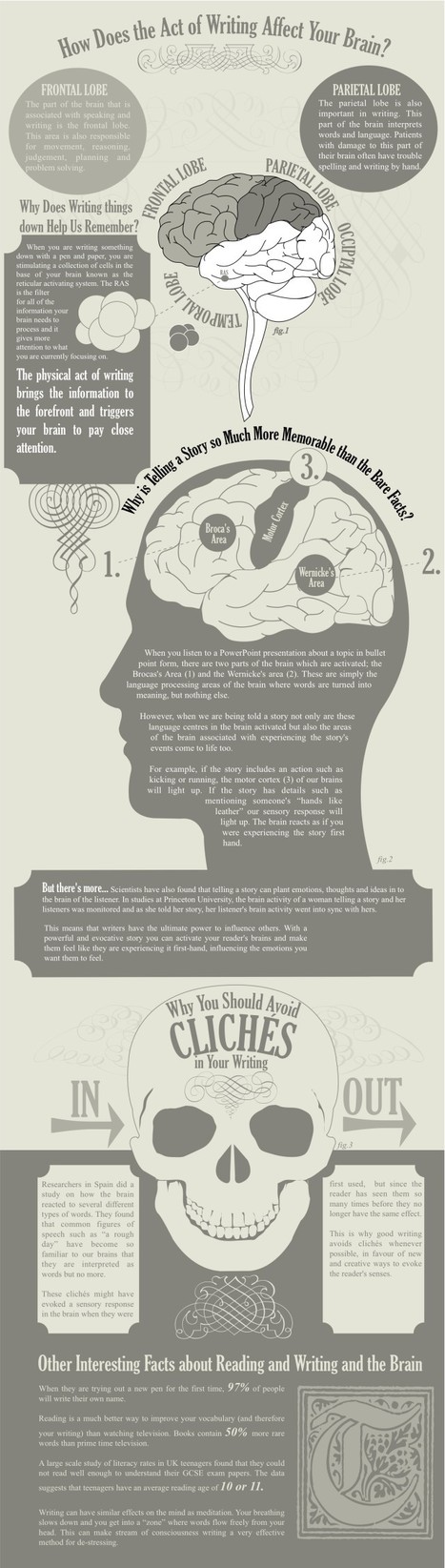
Here is an interesting infographic from the Daily Inforgraphic.This graphic features some scientific facts about the impact of the act of writing on our brain. These facts and stats very enlightening.
Emily Gera: "Video game narratives will continue to evolve based off of technology that mimics the style of film directors, according to Quantic Dream studio head David Cage during his BAFTA Games keynote in London."
"But there is still resistance from filmmakers. Cage cited directors Steven Spielberg and George Lucas who publicly stated it's impossible to tell a story that is controlled by a player. "It's interesting to see that maybe they're not fully aware of what this industry is really doing," he said. "Because actually we are making it, we are creating interactive storytelling."
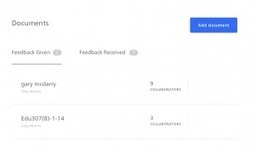
Use your voice to give students feedback about their papers in Google Docs. I've only played with this a little bit so far, but I'm really excited to be able to use Kaizena to give my students feedback this year. Being able to add links to resources and reuse those links for other students is so helpful. If you have questions I'm on twitter @JenRoberts1 and the guys who make kaizena are @kaizenaFB if you have feedback for them, or email founders@kaizena.com
I think this has the potential to be of great use with English Language Learners, especially since they tend to understand the spoken word better than the written.
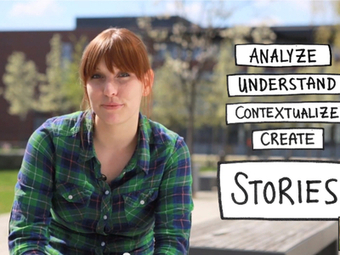
"Together with a whole network of media researchers, creators and students we will: - learn storytelling basics such as antagonist/protagonist relationships, narrative/narrated time, ... - have a look at exciting current media projects - analyze how they are designed and executed based on aforementioned basics - and discuss how (and if) new online tools and formats change the way stories are told and perceived.
The 8-chapter course starts on October 25th, 2013 and ends on December 20th, 2013.
It will offer weekly video material, lessons, interviews and tasks on the following topics (not necessarily in this order): - storytelling basics - serial formats (on the TV, web and beyond) - storytelling in role-playing games - interactive storytelling in video games - transmedia storytelling - alternate-reality gaming - augmented reality and location-based storytelling - the role of tools, interfaces and information architectures in current storytelling.
Our first Storytelling-MOOC will focus on fictional formats.
"Our goal is to inspire and help understand. To broaden our horizon of what is and might be possible and what has already been attempted, and what has succeeded or even failed - and why. In several little tasks you'll analyze and practice storytelling on your own and in teams."
Story Horizon: "For web series, we can often see the effect of the studio audience in the analytics/statistics on the video itself. Oftentimes, viewers will give a video more of a chance when seeing the high view count or thumbs up, modelling the behaviour of the audience that preceded them and not unlike responding to the canned laughter of the now dead “audience” as Orson so morbidly pointed out in the clip" ....
"Audioboo gives everyone the opportunity to be a digital broadcaster. Teachers, journalists, podcasters and professional broadcasters use our social-sharing and broadcast-platform audio tools to record, edit, publish and store exceptional stories.
"Educators employ Audioboo to strengthen writing, improve reading comprehension, teach languages and connect with other schools around the world via the Audioboo community. From the local college radio stations to the BBC, broadcasters create playlists of past shows, with Audioboo’s embeddable player, to provide listeners a way to “catch up” on missed programs."
“Meograph is the easiest way to create multimedia stories. With no training you can quickly create stories about the news, history, travels, life events, and more by combining video, audio, pictures, text, links, maps, and timelines. Then share by embedding anywhere on the web, or through your favorite social network.
"Meograph is being used by major media organizations, companies around the world, thousands of schools, and tens of thousands of storytellers. We are democratizing multimedia expression and are building an entire suite of easy-to-use creative tools.”
"Last year, I decided to experiment with Google’s 20% time during our literature circles unit. I love the idea of giving students time to pursue their passions and work on something that is meaningful to them. Some students chose to work on their own, while others banded together to focus on shared interests. It was fascinating to see the myriad projects that were born from this 20% time. Students composed and performed pieces of original music, they designed intricate board games, and others built worlds using Minecraft and used their virtual worlds as inspiration for creative writing.
"This year, I’m bringing that 20% philosophy to student blogging. I’ve always wanted students to blog, but organizing that many blogs felt overwhelming. I also worried about student buy in. What would get them excited to design and write a blog? This is where the 20% time philosophy comes into play."
Businesses are getting better at telling stories through content - either video or text -- and that helps with branding. View these examples to get started.
If you are trying to persuade your company to go with a story approach, it's always great to have some big guns to back you up. Save this for when you are doing your persuading to the unconverted. :-)
Cathy Davidson, Professor at Duke University, wrote this about this ebook in the NY Times on 9;17/13: "... last spring, in one of my graduate digital literacy classes (face-to-face with students from Duke, the University of North Carolina and North Carolina State University), my students proposed, in lieu of traditional term papers, to write a book together on open learning. They have published it online, and I recommend it to anyone interested in peer learning."
Cathy Davidson, Professor at Duke University, wrote this about this ebook in the NY Times on 9;17/13: "... last spring, in one of my graduate digital literacy classes (face-to-face with students from Duke, the University of North Carolina and North Carolina State University), my students proposed, in lieu of traditional term papers, to write a book together on open learning. They have published it online, and I recommend it to anyone interested in peer learning."
Cathy Davidson, Professor at Duke University, wrote this about this ebook in the NY Times on 9;17/13: "... last spring, in one of my graduate digital literacy classes (face-to-face with students from Duke, the University of North Carolina and North Carolina State University), my students proposed, in lieu of traditional term papers, to write a book together on open learning. They have published it online, and I recommend it to anyone interested in peer learning."
"Center for Digital Storytelling (StoryCenter) is sharing its expertise in powerful personal storytelling with video editors and content developers across the WeVideo user spectrum.
"The world is moving to the cloud, and so is Digital Storytelling with the enormously innovative online tool WeVideo," says Joe Lambert, Founder and Director of the Center for Digital Storytelling. "The cross platform, affordable, and easy-to-use editor has the potential to revolutionize the practices of Digital Storytelling in countless contexts. We can see teachers creating collaborative projects in international educational exchanges, small companies encouraging storytelling about their engagement with customers with the customers themselves, social service and human rights advocates working in new partnerships with local communities via the web, and many, many more uses. We are more than pleased to join forces with WeVideo."
"TED Talks are outstanding for the classroom and I'm always on the lookout for talks specifically applicable to writers, storytelling, research, and my writing classroom / workshops. Here is just a small collection to get you started."
"Includes strategies for topic selection, expository, persuasive, and narrative essays, effective beginnings and endings, adding descriptive detail, beating writer's block, and more. Easy-to-teach techniques for teachers up and down the grade levels and across the curriculum."
IntuiFace is the next generation of presentation programs. Build interactive experiences for multi-touch displays, remote gesture devices like Microsoft Kinect and Leap Motion,
IntuiFace is an amazing innovative platform with multi-touch, gesture recognition features for creating interactive presentations. There are examples and tutorials to help you get started.
Incredible but there is a free version which lets you explore the software and see if it is right for you.
Having read the dreaded “I am going to tell you about” 5-paragraph essay until my eyes glaze over and I fall into a comatose state, I have spent years scouring the earth for engaging approaches to ...
In a survey of Advanced Placement and National Writing Project teachers, a majority say digital tools encourage students to be more invested in their writing by encouraging personal expression and providing a wider audience for their work.
To get content containing either thought or leadership enter:
To get content containing both thought and leadership enter:
To get content containing the expression thought leadership enter:
You can enter several keywords and you can refine them whenever you want. Our suggestion engine uses more signals but entering a few keywords here will rapidly give you great content to curate.


 Your new post is loading...