


|
Rescooped by
Jim Lerman
from common core practitioner
September 25, 2013 11:49 PM
|


No comment yet.
Sign up to comment

 Your new post is loading...
 Scoop.it! No comment yet.
Sign up to comment
Scoop.it!

FREE E-BOOK Kristine E. Pytash, Richard E. Ferdig, Timothy V. Rasinski, et al. 2013 Preparing Teachers to Teach Writing Using Technology "Technology is changing not only how people write, but also how they learn to write. These profound changes require teachers to reconsider their pedagogical practices in the teaching of writing. This books shares instructional approaches from experienced teacher educators in the areas of writing, teacher education, and technology. Chapters explore teachers personal experiences with writing and writing instruction, effective pedagogical practices in methods writing courses, and professional development opportunities that effectively integrate technology into the writing classroom and contribute to students’ growth as writers and users of technology. While the chapters in this collection are written to inform practice, they are written from a theoretical and empirical base by research-oriented educators in our field. Each chapter provides a research base for a particular instructional approach, a description of their strategy, and examples from instructional settings that highlight how the pedagogical practice advanced the knowledge of the teachers in the areas of writing instruction and technology. This collected volume provides as up-to-date understanding of how teachers are prepared to teach writing using technology."
Scoop.it!

by Robinson Meyer "Editorially, a new piece of writing software which opened to the public last week, proposes its own set of answers to those questions. It was clearly built with a thesis: Designed by veterans of digital publishing, it aims to “make collaborative writing easy.” "To find out more, I interviewed Editorially’s CEO and co-founder, Mandy Brown. I interviewed her by writing in Editorially itself (meta!) and, during the course of our interview, she asked Editorially’s CTO, David Yee, and another editor who frequently uses the service, Nicole Fenton, to pitch in. All three of them, using Editorially, contributed paragraphs of their own and edited them together — a kind of further statement about how writing should work. The product of that process is below; the bolded words are mine."

Maryalice Leister's curator insight,
October 2, 2013 10:40 PM
New software to support writing - check it out and let me know! Share!
Scoop.it!

by Med Kharbach "I use Evernote for a wide variety of reasons most important of which is to organize my digital life and keep track of my projects. I also use it to jot down notes around web content I read, or to clip blog posts that interest me. There are also several third party tools I use with my Evernote and which enable me to get the maximum out of this application. Check them out HERE. Via Patty Ball
Scoop.it!

Because I am. Via mooderino
Scoop.it!

by Alex Quigley "This week I gave a seminar at TeachMeet Clevedon. I am going to post more fully on my topic of teachers getting better by undertaking ‘deliberate practice‘ sometime soon. One smaller aspect of my presentation was how teachers can improve written feedback, both to improve learning and to marginally reduce the time taken to give written feedback. With the gift of more time we can free ourselves to pursue becoming a better teacher more deliberately: with reflection, planning and deliberate practice. Of course, written feedback is so crucial that it can improve teaching and learning significantly, therefore it deserves our attention in its own right. "The following list of tips is a synthesis of my experience and that of my English department (see our policy for feedback here). It also draws upon many excellent teachers and their cumulative experience of effective written feedback." .
Scoop.it!

Another excellent source is Wonderopolis.
Via Dale Borgeson
Scoop.it!

"Whether you’re in a one-to-one iPad classroom or have access to a cart that you share with other teachers, it’s important to establish routines early in the school year to manage these devices in your classroom.`` Via John Evans
Scoop.it!
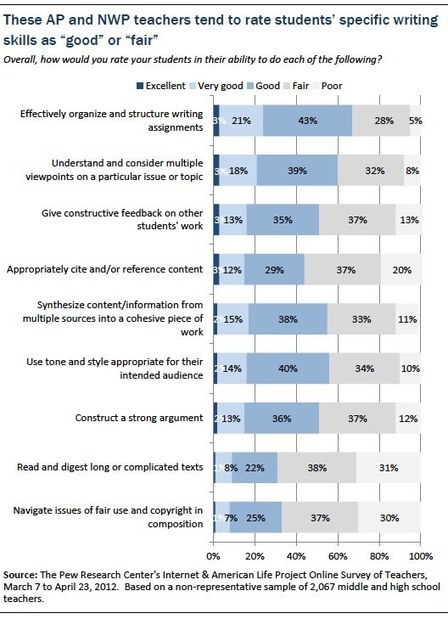
These teachers see the internet and digital technologies such as social networking sites, cell phones and texting, generally facilitating teens’ personal expression and creativity, broadening the audience for their written material, and encouraging teens to write more often in more formats than may have been the case in prior generations. At the same time, they describe the unique challenges of teaching writing in the digital age, including the “creep” of informal style into formal writing assignments and the need to better educate students about issues such as plagiarism and fair use. Via Nik Peachey

Tina Jameson's curator insight,
November 6, 2014 5:24 PM
Highly recommended reading - some stats and perceptions on the impact of digital tools on writing standards (some positive and some negative). 
CECI Jean-François's curator insight,
November 10, 2014 2:49 AM
Enquête sur la litteracie numerique, des chiffres intéressants... 
Pamela D Lloyd's curator insight,
January 12, 2015 9:46 PM
This study provides insight into the issues teachers see, positive and negative, regarding the ways in which digital tools impact student writing. Overall, they see many benefits, but there are specific areas of concern.
Scoop.it!

Here's a teaching strategy to use as a literary analysis tool. The Pattern Folder allows English teachers to help students gather textual evidence, draw conclusions and trace a pattern or theme. Via Stevi Quate, Lynnette Van Dyke

Stevi Quate's curator insight,
September 19, 2013 4:27 AM
Literary analysis can be quite tricky to teach. Sarah at the Teaching Channel has a great way to support kids.
Scoop.it!

“ By, Camille Gamboa, PR, SAGE US While it may have taken some time for many in academe to take seriously the informal, unpredictable, and undiscriminating world of social media, sites like Twitter, Facebook, WordPress, Tumblr, YouTube, Instagram, and...” Via Dr. Heidi Maston, Ivon Prefontaine, PhD

Pam Colburn Harland's curator insight,
September 28, 2013 8:45 AM
I love this! cite a tweet Accurately!
Scoop.it!

by Maria Popova (quoting Anais Nin) "You must not fear, hold back, count or be a miser with your thoughts and feelings. It is also true that creation comes from an overflow, so you have to learn to intake, to imbibe, to nourish yourself and not be afraid of fullness. The fullness is like a tidal wave which then carries you, sweeps you into experience and into writing. Permit yourself to flow and overflow, allow for the rise in temperature, all the expansions and intensifications. Something is always born of excess: great art was born of great terrors, great loneliness, great inhibitions, instabilities, and it always balances them. If it seems to you that I move in a world of certitudes, you, par contre, must benefit from the great privilege of youth, which is that you move in a world of mysteries. But both must be ruled by faith."
Scoop.it!

Storytelling today means crowding around someone's phone as they describe their photos. Shadow Puppet bring that show & tell experience online by letting you share a voice-over with an animated slideshow of your pics.
|
Scoop.it!

"Significant gains in writing productivity can be gained by a combination of the right kind of practice and the right kind of tools. I’ve written about many of these tools and techniques previously, but I’ve organised all the advice here into a three step program, with links to useful resources. Review your writing tools Often the ‘industry standard’ software is not the best tool for the job. Take Word processors as just one example. You must move back and forth over the text to achieve flow and make sure everything is in the right place. If you can move around your documents more easily your writing speed will increase. Unfortunately the industry default, MS Word, does not, out of the box, perform this task well. Anyone who has been reading this blog for a while will know this is the key reason I am a huge Scrivener fan. Scrivener is a different kind of word processor that enables you to write ‘chunks’ and move them around easily..." Via Howard Rheingold

Howard Rheingold's curator insight,
September 25, 2013 12:36 PM
This is about infotention -- "combination of the right kind of practice and the right kind of tools." I share thesis whisperer's enthusiasm for Scrivener for long projects or even short writing projects that have many moving parts. 
Ra-eesah Mohamed's curator insight,
October 2, 2013 9:38 AM
writing faster in class is a constant battle in lectures then learning how to write faster seems like a legit tool to use in everyday life.
Scoop.it!

"The latest installment of Edutopia’s Big Thinkers Series highlights the role of writing in the new Digital Age. There is a great short video that highlights the changing role of writing in the modern world: the writing/editing process, publication (including the rise of self-publication), and collaborative writing and analyses processes." 7 1/2 minute video features Elyse Eidman-Aadahk, Co-Director of the National Writing Project
Scoop.it!

by Med Kharbach "I use Evernote for a wide variety of reasons most important of which is to organize my digital life and keep track of my projects. I also use it to jot down notes around web content I read, or to clip blog posts that interest me. There are also several third party tools I use with my Evernote and which enable me to get the maximum out of this application. Check them out HERE. Via John Evans

Morgan Kroes's curator insight,
September 27, 2013 2:46 PM
I have an iPhone, so I upgraded to iOS 7. I personally like it, but for me it slows my phone down a lot. I tried a few of these, and the actually work. It also saves me battery. 
amber.hartgers's comment,
October 3, 2013 7:54 PM
I think this is something interesting. Its neat how people can give advise on making their phone faster. People don't to keep buying phones. So this help a Lot!!
Scoop.it!

We all want to write characters that have depth and complexity. We want them to feel like real people who struggle with decisions and choices, and we want the reader to be curious about what path they’ll take.
The problem is that if you give characters all the reactions and moods of a real person, they can turn into a confusing muddle of contradictions.
Conversely, if you try to streamline a character’s motivations and goals in an attempt to create a strong throughline which the reader can clearly identify and follow, that can make the character seem one-dimensional and robotic.
How, then, do you make a character feel fully formed and yet at the same time easy to engage with? Via mooderino
Scoop.it!

by Aaron Gilbreath "Writers can backtrack and pinpoint the origin of many essays, poems and stories, the moments where we recognized some shape in the ether as the start of something, a particle to split or terrain to explore. This is the proverbial “aha moment” when something clicks. Yet the whole process remains so mysterious that we often end up speaking in hazy clichés such as “something clicked” and “aha moment,” mapping a piece’s genesis on a vague psycho-geography composed of particles and ether, because the process of discovery is often as ambiguous as our understanding of it. "There is consolation, though. The more you write, the more you learn how to generate ideas. Even if you still depend on happenstance, you develop habits. Whether the places you search are on the streets or in books or the caverns of your mind, you learn to recognize the fertile locations where subjects turn up, in the same way an urban hawk learns where the pigeons roost, and you visit those locations frequently. The writer Barry Lopez summarized this tracking ability when he said something to the effect of (I’m paraphrasing from memory): once you train your eyes to see them, you realize that stories are everywhere. That’s true. But how do you learn to see?" Via Charles Fischer
Scoop.it!

by Alex Quigley "It is a helpful tool (in my view the most helpful ICT device by a mile), not a miracle cure – but any teacher who witnesses the motivation levels inspired by the iPad will experience how it can engage students in the challenging process of writing and much more. With its myriad of apps, the iPad can harness oral rehearsal like no other technology to aid the writing process. With its capacity to show students writing through the projector at any moment (Apple TV, Airplay or a variety of other apps), it becomes a powerful way to make formative assessment instantaneous for all; helping to make the craft of writing more easily visible, and with good teacher pedagogy, more understandable. With the capacity to make real ebooks the iPad can make the writing process feel more real and more valuable to our students – there is no better way to make students value the crucial skills of drafting and proof reading than to create the opportunity for a genuine audience and create products the look and feel professional."
Scoop.it!

“ Creating books has never been as easy as it is now with this set of interesting web tools. Web 2.0 technology has definitely played a decisive role in unleashing people's creativity and giving them...” Via Jon Samuelson, Dr. Joan McGettigan, Jenny Smith
Scoop.it!

via Pew Internet Overview A survey of teachers who instruct American middle and high school students finds that digital technologies are impacting student writing in myriad ways and there ar... Via Carlos Pinheiro, Luísa Lima
Scoop.it!

I've spent hundreds of hours over at tvtropes.org pouring over their character descriptions. The Barnum, for instance, is a kind of trickster character who lives by exploiting greed. Equally interesting--especially to those watching Under The Dome--is the Honest John's Dealership trope.
Via mooderino
Scoop.it!

by Tadhg Kelly "After 30 years of trying, with hundreds of books and white papers having been written on the subject, and the same marketing story saying the same thing about getting better at storytelling continuing to do the same rounds, I think it’s fair to say that games as a storytelling medium doesn’t really hang together. "Considered as a world in motion, like a painting with a sense of story but with a deliberately light touch, yields a better framework for understanding. It is not the case that writing has no place in games. Very far from it in fact, but its place is a portrait-filling rather than a storytelling one. "Videogames are not, in turns out, a storytelling art. They have tried very hard to be, and their reasons for trying are noble, but the results are always ham-fisted. There are no good game stories because game stories don’t really matter. What matters is the game world, in all of its glorious detail. "In writing my book, I mean to break you out of your old mode of thinking that games and stories must converge, because I think that’s a fight that you will always lose. When we learn to describe our own art in our own way and realise what actually does work, then we will finally move forward."
Jim Lerman's insight:
A deep and pensive meditation on the differences between narrtive writing (storytelling) and video game design (interactive story). Kelly makes some stark differentiations that should be helpful to writers in either realm.
Scoop.it!

FREE WEBINAR - THURSDAY, SEPT. 26, 2013 5-6 PM (EASTERN) Presented by Carolyn Skibba, Technology Coordinator and Apple Distinguished Educator "One of the most compelling benefits of classroom technology is that it enables students to share their ideas and knowledge in powerful new ways. Effective, thoughtful integration of mobile apps can empower students to create quality, meaningful work for a worldwide audience. Ultimately, this leads to true engagement that transforms how students see themselves and their learning. Through this webinar, you will learn how to integrate some of the best apps for student creativity and publishing. You will also gain practical tips that will support you and your students in creating authentic content and sharing it easily with others."
Scoop.it!

"iOS 7 represents the latest iteration of Apple's mobile device operating system and a sea change in the way that the company's customers interact with their smartphones and tablets. No more do skeuomorphic user interface elements clutter the screen; Apple designers know that after six years of iOS, customers have pretty much figured out how to use the devices." Via John Evans, Nikos Amanatidis
|






