"Publishing is an important step, but I urge educators to think of blogs as so much more than just a way to publicize student work. A blog empowers students to interact with a global audience. It helps students create their own online identity and authentically learn about the importance of a digital web presence. To help build connections, and become part of a global learning community, students must learn how to blog in a compelling way – a skill that requires more than just an understanding of good writing.
"Teaching blogging requires instructors to take a step back and really set up some of the initial ground work. Below are some practical strategies to make the blogging experience richer for students and to help them build new connections – to eventually become valued contributors of their learning community."
Infographics, when used correctly, appropriately, are powerful tools for conveying a lot of pertinent information plus they support visual learning and thinking. I curate a Scoopit on Infographics...
Beth Dichter's insight:
Jackie Gerstein shares her top picks for education infographics this year. Some of these have been shared in this Scoop.it but many are new. The list of infographics includes:
* The Internet Access Gap in Education
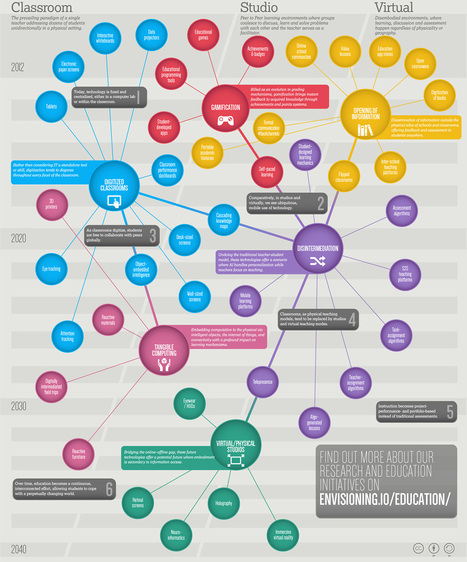
* The Past, Present and Future of Education
* State of Creativity in Education: An Adobe Survey
* The Gamification of Education
* Tapping into Mobile Learning
* Investing in Girls' Education Pays Off
Many of these would be useful as topics for discussion or to use to teach students why infographics are useful in displaying data.
From the advice you need (but rarely get) to pick the right PhD supervisor, to an extraordinary rant about the idiocy of the research excellence framework, we can now reveal our most-read stories of 2013...
Jim Lerman's insight:
Times Higher Education is the leading higher education news publication in the UK.
Every once in a while we come across a young person who sees with spectacular clarity and expresses with uncommon creativity and finesse that which many young people sense yet struggle to reveal. Suli Breaks falls into the former category and speaks for many in the latter one. Would that many more of our schools, their leaders, and policy makers come to the realization that, in today's world, successfully educating only a fraction of our young is not acceptable. What is required are new ways of conceptualizing what constitutes the ways of learning and the means of their delivery.
Yes, we were young a long time ago but not much has really changed. So we should be more experienced and share knowledge so you make more right moves, and quicker too.
"In part one, we looked at many of the ways blogging enables greater communication between classmates and educators. Beyond that, it also helps students develop crucial skills and share ideas and resources throughout the week.
"Here are a few other key benefits of student blogging as a tool for learning in higher ed."
"In 2012 John Tambunan became one of the youngest ever publishers on Apple’s iBookstore. His book ‘Little Fish’ has since been downloaded across the world over 7,800 times.
"It all began when John started telling his mum, Jane Ross, about the lake near their house where he loves to go and catch fish.
"Such was John’s enthusiasm, Jane decided to make a book about his experience. Taking John down to the lake, she took photos on her iPhone along the way and when they returned, they sat down together and made an ebook using Book Creator for iPad."
This chapter is from the book Media Literacy in the K-12 Classroom, published by ISTE. It is a good introduction to the field and contains numerous useful resources and examples.
We want you to succeed as an author, so here is a free copy of APE: Author, Publisher, Entrepreneur-How to Publish a Book by Guy Kawasaki and Shawn Welch.'
"Essential reading (and reference) for modern authors, regardless of experience." Kirkus Reviews
"It's a no-nonsense book that is filled with straightforward, actionable and most current information and advice available." Dr. Bojan Tunguz
"Authors will find APE an indispensable resource." Chanticleer Book Reviews
524 of 646 reviewers gave it a five-star rating! Don't delay because quantities are limited.
"A few months ago, shortly after the first EdTechTeacher iPad Summit, I spent the day with a college friend out on Cape Cod. In telling me about her daughter’s class iPad pilot, my friend seemed both excited and hesitant. At one point in the conversation, she turned to me and said, “The one thing I hate, though, is that writing just stinks on iPad.”
"Initially, I took a bit of a defensive position and prepared to launch into my iPad is NOT a computer schtick. However, the more I listened – and have since listened – to not only my friend but also educators in workshops, webinars, and conversations, the more I realize that parents, administrators, and even teachers fall victim to 5 Myths of Mobile Writing which lead them to believe that this critical facet of education cannot seemingly occur on a mobile device."
Great column about the power of technology as limited, or enhanced, by process. The success of this depends on adults/models/mentors who understand the tools, the process, and the students.
Why not keep paper and evolve screen-based reading into something else entirely? Screens obviously offer readers experiences that paper cannot. Scrolling may not be the ideal way to navigate a text as long and dense as Moby Dick, but the New York Times, Washington Post, ESPN and other media outlets have created beautiful, highly visual articles that depend entirely on scrolling and could not appear in print in the same way.
Surveys indicate that screens and e-readers interfere with two other important aspects of navigating texts: serendipity and a sense of control.
People report that they enjoy flipping to a previous section of a paper book when a sentence surfaces a memory of something they read earlier, for example, or quickly scanning ahead on a whim. People also like to have as much control over a text as possible - to highlight with chemical ink, easily write notes to themselves in the margins as well as deform the paper however they choose.
A detailed paper discussing screens vs paper. Lots of other links included. There is no research paper connected with article. I did a paper on practice modalites that involved print text vs media for learning and engagement. More papers are needed out there on such topics, as technology research studies can quickly become outdated.
“Allow yourself the uncomfortable luxury of changing your mind,” I offered in one of my 7 lessons from 7 years of Brain Pickings. Indeed, nothing stunts growth more powerfully than our attachment to the familiar, our blind adherence to predetermined plans, and our inability to, as Rilke famously put it, “live the questions.” Keats termed the willingness to embrace uncertainty, live with mystery, and make peace with ambiguity“negative capability” and argued that it’s essential to the creative process; Anaïs Nin believed thatinviting the unknown helps us live more richly, and even psychologists confirm that embracing uncertainty is essential to creativity. And yet we cling so vigorously to our comfort zones, our plans, our knowns — why?
Bronwyn Fryer interviews Screenwriting Coach Robert McKee
"Essentially, a story expresses how and why life changes. It begins with a situation in which life is relatively in balance: You come to work day after day, week after week, and everything’s fine. You expect it will go on that way. But then there’s an event—in screenwriting, we call it the “inciting incident”—that throws life out of balance. You get a new job, or the boss dies of a heart attack, or a big customer threatens to leave. The story goes on to describe how, in an effort to restore balance, the protagonist’s subjective expectations crash into an uncooperative objective reality. A good storyteller describes what it’s like to deal with these opposing forces, calling on the protagonist to dig deeper, work with scarce resources, make difficult decisions, take action despite risks, and ultimately discover the truth. All great storytellers since the dawn of time—from the ancient Greeks through Shakespeare and up to the present day—have dealt with this fundamental conflict between subjective expectation and cruel reality."
Jim Lerman's insight:
McKee is one of the best in the world at what he does; he travels world-wide giving workshops and seminars on storytelling and screenwriting. This article summarizes his ideas quite well, even though HBR doesn't give you the whole thing.
"Comics can be powerful learning tools. The mix of art, dialogue, character expressions, and frames engages learners and is brain-friendly. Moreover, comics break down a story’s plot and text into bite-sized chunks that are supported with visuals. This is much easier for our brain to process than reading a large amount of text on a page. Additionally, comics are an effective way to introduce your learners to digital storytelling. Many of the comic creation tools are easy to use allowing the learners to fill in their frames by clicking on a choice of characters, props, scenes, and more presented to them. Your learners will be able to quickly create a story, view it, and share it with their friends and family. Comics come in many formats and types to support and engage struggling readers as well as advanced readers. Creating comics engages students and encourages them to explore vocabulary, summarize information, and contextualize what they learn in a creative way. Creating comics is also being accepted as an effective way to teach complicated writing. Nick Sousanis, a doctoral candidate at Teachers College, Columbia University, wrote his PhD dissertation entirely in comic book form. View examples of his work on his blog, Spin, Weave and Cut. The following tips and free resources will help you engage learners with comics."
"As presenters we want people to pay attention, be engaged and remember the message. The key to doing that? Science now says it involves storytelling: Stories stimulate emotions, which may be the key to better learning, attention, memory and decision making.
"When we listen to stories, more of the brain lights up, according to Annie Murphy Paul, author of “Brilliant: The New Science of Smart.” Stories cause your neurons to fire the same way they would if you were doing the actual action talked about. For example, if you were listening to someone talk about kicking a ball, the motor part of the brain that would help you kick a ball in real life lights up."
"As technological tools like blogs and social media take on increasing importance in the business world, students have more reason than ever to learn some of the basics in using them before finishing college.
"Helping students with their future professional prospects should be a pretty strong argument in favor of bringing blogging into the classroom, but blogging offers a number of added benefits to the learning process."
"On Sunday I shared my ideas for using picture collages as writing prompts. I realize that creating a collage isn't always feasible or appropriate for every situation. Therefore, I went through my archives to create an updated list of sources of creative writing prompts."
Three great tips for creating engaging sessions in writing class, with an eye toward seamless integration of tech.
Jim Lerman's insight:
I so glad to see Guhlin turn his attention to writing. He is a true tech visionary, knows so much about it, and appears to be an excellent coach of writing teachers as well. A great person to follow.
"This past weekend, I spent half a day sharing a variety of content and ideas with English teachers, as well as encouraging them to create. Here are fun photo tools you can use to enhance teaching and learning:"
"The Journal of Digital Humanities is a comprehensive, peer-reviewed, open access journal that features "the best scholarship, tools, and conversations produced by the digital humanities community." This endeavor was started by the Press Forward Project and its rigorous evaluation process ensures that interested parties will be exposed to a wide range of talent and subject matter. Arranged by trimester, recent issues of the journal have focused in on the ways digital humanities projects can be used to teach undergraduates about the world around them, while also highlighting the pedagogy involved with such endeavors. Visitors can search through the entire collection of back issues or they may also look through the list of contributors to get a sense of those involved with the project."
"Launched last year by Twitter founders Biz Stone and Evan Williams, Medium has been making waves as a writing platform. Now, it has got its first major update, pushing it to version 1. “With 1.0, we’ve redesigned the reading and writing experience to make your stories look better and have more impact. We’ve also changed how collections work to enable curation and improve discoverability,” Williams says."
"How a serendipitous hand-lettered sign changed the history of photojournalism."
by Maria Popova
"At the same time that pioneering photographerBerenice Abbott was busy capturing the urban fabric and trailblazing anthropologist Margaret Mead was laying the groundwork for modern anthropology, Dorothea Lange mastered the intersection of the two in her influential Depression-era photojournalism and documentary photography. In Dorothea Lange: Grab a Hunk of Lightning (public library), Lange’s goddaughter Elizabeth Partridge, an accomplished and prolific author in her own right, presents a first-of-its-kind career-spanning monograph of the legendary photographer’s work, placing her most famous and enduring photographs in a biographical context that adds new dimension to these iconic images."
To get content containing either thought or leadership enter:
To get content containing both thought and leadership enter:
To get content containing the expression thought leadership enter:
You can enter several keywords and you can refine them whenever you want. Our suggestion engine uses more signals but entering a few keywords here will rapidly give you great content to curate.


 Your new post is loading...