“When people talk listen completely,” Hemingway counseled in his advice on how to be a writer. More than a century earlier, a little boy in Denmark, born into poverty to a shoemaker father and an illiterate washerwoman mother, was spending his days listening to the old women in the local insane asylum as they spun their yarn and spun their tales to pass the time. This unusual hub of peasant storytelling in the oral tradition of folklore became his laboratory for listening, out of which he would later concoct his own stories — stories beloved the world over, which have raised generations of children into a whimsical world of imaginative play. Hans Christian Andersen thus used that singular talent of listening to lift himself out of poverty and into international celebrity, becoming one of history’s greatest storytellers and the patron saint of the fairy tale genre."
INTEGRATIVE PORTFOLIOS FOR SOCIAL CHANGE: LESSONS LEARNED FROM THE COMMUNITY ACTION SOCIAL CHANGE MINOR AT THE UNIVERSITY OF MICHIGAN
"Key Webinar Take-Aways: In this webinar, we will discuss the CASC minor and detail its integrative learning capstone course and how it uses eportfolios to drive learning. We will also explore examples of eportfolios and some lessons learned from the process. We will address next steps for eportfolio use and research around portfolios in a social justice and social change context. This webinar will include some best practices for engaging students with eportfolios and how to leverage eportfolios to achieve learning outcomes."
"Today, I found a great short video on this topic by Nobel-Prize winner James Heckman, which is embedded below and which I’ll show my ninth-grade English classes.
"Since we’ve also been working a lot on writing — specifically on AWPE-style writing prompts (see Writing Prompts — Feel Free To Contribute Your Own!) — I’m going to have them write a short (not essay length) response to this prompt:
"In the video, how does Dr. John Heckman define “soft skills” and why does he say they are important? To what extent do you agree with him? To support your opinion, be sure to include specific examples drawn from your own experience, your observations of others, anything you have read, and information from the video.
"Bam! Two birds with one stone — a review of the importance on self-control and practice responding to an academic writing prompt. I’m figuring the whole thing will take up twenty minutes, including a quick sharing in partners."
Today, to build off of yesterday's paean to authorial fear, Andrea Phillips (author of the above pictured Creator's Guide to Transmedia Storytelling and also of the new serial pirate story, The Dar...
"Write About This is an engaging and creative writing application. It allows the user to use text and voice prompts, publish stories, create prompts, and much more. This app can create an exciting atmosphere during each writing lesson."
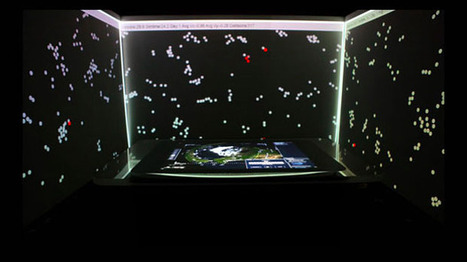
"While filming a documentary about divisive oil refinery ventures in the subzero cold of Fort McMurray, Alberta, the director David Dufresne said he wasn’t considering only pollution in that Canadian boomtown or the vast tar sands beneath its frozen ground. He was also thinking deeply about technology, about making a new kind of hybrid media, a docugame.
"Interactive documentaries have been widely available since the CD-ROM boom of the 1990s. Yet while they have become a genre unto themselves, few have included a game component. With “Fort McMoney,” a free program released online this week, Mr. Dufresne has tried to change that."
The Discipline of Organizing is a book, published by the MIT Press that offers a framework for the theory and practice of organizing anything.
A short, 7-page PDF synthesizing and introducing the book main ideas has just been published as part of the latest Bulletin of the Association for Information Science and Technology (Vol.40- N.1).
The PDF, as well as the book, have been authored by Robert G. Glushko (who teaches in the School of Information at the University of California, Berkeley) and, as I mentioned, are devoted to introduce the relevance of the TDO (The Discipline of Organizing) to anyone involved in organizing and maintaining content archives or in curating any type of digital content online.
From the PDF:
"A set of resources is transformed by an organizing system when the resources are described or arranged to enable interactions with them.
Explicitly or by default, this transformation requires many interdependent decisions about the identities of resources; their names, descriptions and other properties; the classes, relations, structures and collections in which they participate; and the people or technologies that interact with them.
These decisions and the analysis needed to make them have been systematized in The Discipline of Organizing, recently published by MIT Press in both print and eBook formats."
The PDF provides a good starting point to start asking the right questions needed to develop an organizing framework and to understand why they are so relevant.
"A very practical implication of teaching organizing using more generic concepts and vocabulary is that it enables students to obtain jobs with firms that might not otherwise hire them.
For example, a student who says she knows about curation can’t as easily sell her skillsto a business looking for someone to develop a business continuity plan as one who recognizes that “organizing resources and maintaining them overtime” is the skill the company wants and the one she has."
My comment: Useful for defining an organizing framework for anyone new to doing it. Could be more pragmatic and example-rich. 6/10
more than only rescooping, I would like to say that it is the challenge of every scientist, researcher, MD, and particularly university teacher who has to surf on waves of information. Curation, and especially scoop.it helps to keep abreast and more importantly to organize or at least to save and find again what has been collected in the cloud!
Daniel Burrus: "Augmented reality (AR) provides a live view of a physical, real-world environment whose are augmented by computer-generated input such as information, sound, video, graphics, or GPS data. AR has been in existence for quite a while"
Depending how much effort is involved, augmented reality (AR) could be used for training delivery. What are some examples where AR makes some kinds of learning possible that were not so straightforward before?
Kristi Mraz and Marjorie Martinelli are the talented authors of the popular book Smarter Charts: Optimizing an Instructional Staple to Create Independent Readers and Writers. If you haven’t seen it already, this book provides inspiration for using charts and other tools to help your students remember your teaching, and to create resources that kids can refer back to again and again across time, allowing them to work with a greater sense of independence. Instead of relying on a grown-up to tell them what to do, they can use the charts and resources in the room to work independently. When kids can look back at a chart to remember a strategy, or find a resource in the room to help them solve a problem, they develop a sense of agency and ownership over their own learning. Learning becomes less about teacher action, and more about student and teacher interaction.
The workshop will also give creators from any background: film, television, gaming, app development or consumer products the opportunity to learn transmedia storytelling techniques and to get individualized attention from a leading expert, Transmedia Producer Caitlin Burns.
You will learn how to take on the artistic and practical challenges of transmedia storytelling and project development. Each attendee will explore their personal goals and receive individualized attention helping put their skills to practice in group projects.
By the end of the course, attendees will have the experience of devising a multiplatform strategy and working with collaborators from different fields. Taking these skills and connections back to your own jobs and projects, you will make reasoned decisions about how to plan transmedia campaigns, and how to engage in their production."
Storyboarding is an essential part of the design process because it is at this initial stage when you can try your ideas more freely, encounter key questions about User Experience (UX) and User Interface (UI) and explore different alternatives until you find the best solution to present the content. If you miss this stage, you are jumping too prematurely to a final solution without exploring different possibilities that could work best at the end.
Jim Lerman's insight:
Everything said in this article about business applies just as readily to writing, composing, and course planning.
This graphic features some scientific facts about the impact of the act of writing on our brain. I find these facts and stats very enlightening and thought you might want to have a peek as well. Enjoy
"Younger kids typically love to draw and aren’t too worried about the outcomes of their artwork — until they get older. By the time they’ve learned to read and write, art takes a back burner to academics, primarily because of what most schools prioritize. Over time it becomes harder for kids to think in pictures the way they once did.
"But what if students were encouraged to think in pictures alongside words?
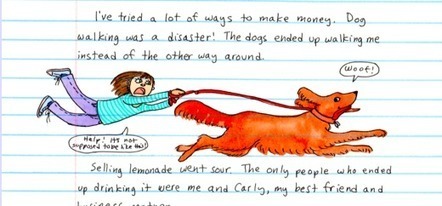
“There’s something about writing that is a link to your brain,” said Marissa Moss, author of the popular children’s book series Amelia’s Notebook. In the books, Moss takes on the persona of a little girl expressing her ideas about the world and people around her. The books are a combination of words and drawings and look free form – as though Amelia sketched them herself.
"Taking a cue from Moss, teachers from Oak Knoll Elementary School in Menlo Park, Calif., decided to have their students keep notebooks in a similar style. The notebooks aren’t graded; rather, they’re a place of private, free expression. Karen Clancy and Andrea Boatright presented the project at the Innovative Learning Conference hosted by the Nueva School recently."
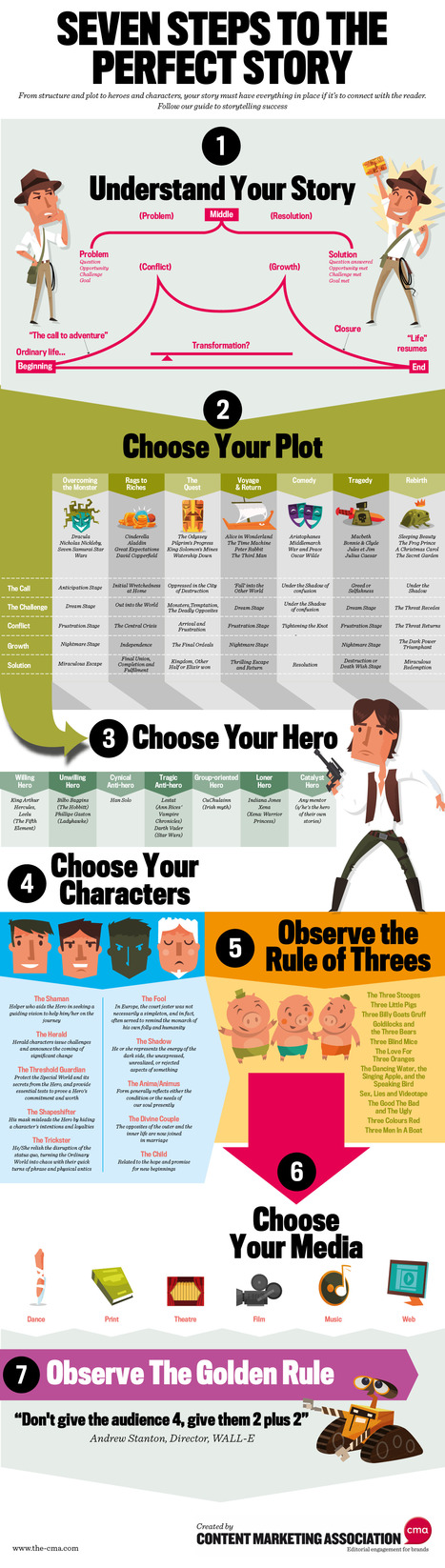
"Today's post is one example of this collaborative co-construction of the content of this blog. I was sent this wonderful graphic from one of my readers and I found it very relevant to what we have been talking about in the digital storytelling section here in Educational Technology and Mobile Learning. The infographic below has been designed by CMA and features the 7 steps to the perfect story. Check it out and share with us what you think of it. Enjoy"
"Explore the newest tools to implement best practices in a traditional writers workshop (draft, share, respond, revise, publish). The paperless classroom is within your reach!"
"Tour Builder is a cool web tool that allows users to create narrative stories using text, graphics, pictures, videos and Google Maps.Tour Builder lets you pick the locations right on the map, add in photos, text, and video, and then share your creation. Currently, Tour builder is still in beta version and it requires the Google Earth plugin which is only available for Windows and Mac OS X 10.6+"
MIT Open Documentary Lab: "[Lance] Weiler is a boundary-pushing transmedia storyteller who has, among many notable achievements, directed and self-distributed innovative movies (The Last Broadcast, Head Trauma), created an ARG for Head Trauma, made the immersive storytelling short Pandemic, and founded the regular creative conference diy days and the transmedia company Reboot Stories."
MIT Open Documentary Lab: "[Lance] Weiler is a boundary-pushing transmedia storyteller who has, among many notable achievements, directed and self-distributed innovative movies (The Last Broadcast, Head Trauma), created an ARG for Head Trauma, made the immersive storytelling short Pandemic, and founded the regular creative conference diy days and the transmedia company Reboot Stories."
Sara Wolozin, del laboratorio de documentales del MIT; conversa con Lance Weller. Se trata de un importante narrador transmedia que ha dirigido películas muy reconocidas entre los expertos del tema. Muy recomendable porque nos introduce en la trayectoria y experiencia de un realizador del tamaño de Weller.
"Why SHOULD kids WANT to write anymore? They text, tweet, Facebook, blog, etc. all day. Social media is the new chat rooms which were the new forums which were the new face-to-face social clubs. SO how are we supposed to convince our kids that they can and should write creatively...for school...for their teacher...without fear?
"I found an app that remarkably did exactly what I wanted it to do. (Yes, there is an app for that too!!) It is called ColAR Mix and it is FREE! (There is an in-app upgrade if you choose for $2.99). This app comes with coloring pages that can be turned into 3D Augmented Reality animated images!!!
"I did not tell the students about the app at first. I wanted to see what they would produce for me based on their pictures. I instructed them to write about what the think is happening in the picture. Who is it? What do they want? What's stopping them from getting what they want? Where are they? How do they change or do the circumstances change so that either they get what they want or stop wanting what they want?"
To get content containing either thought or leadership enter:
To get content containing both thought and leadership enter:
To get content containing the expression thought leadership enter:
You can enter several keywords and you can refine them whenever you want. Our suggestion engine uses more signals but entering a few keywords here will rapidly give you great content to curate.


 Your new post is loading...