Your new post is loading...

|
Scooped by
Jim Lerman
June 3, 2016 12:36 AM
|
An educator shares how our partner NaNoWriMo has affected the writing of youth in international schools. “My eyes were opened as I saw students who had previously struggled to write a paragraph effortlessly filling pages and pages of a first draft. It also unlocked writing in other classes across the curriculum, and writing was coming easier for these students in history, science, and literature classes.” By Nate Fleming
|
|
Rescooped by
Jim Lerman
from Cultivating Creativity
June 3, 2016 12:25 AM
|
As a media literacy educator, and someone who learned most of what I know from cinema, I love movies that pull back the curtain and show us the hidden side of media. Looking to movies to critique the media industry is a paradox, for sure, but it’s fun to revisit movies I love and examine just how much I learned about media from watching movies. The ten movies I selected challenge the way we see our news, television and advertising media, question the way men and women and race are represented, or underrepresented, in media, and the way we, the audience, are influenced and often exploited by media. The ten movies I selected are also entertaining. And I threw in a couple movies that critique the film industry, for good measure.
Via Jim Lerman
|
|
Rescooped by
Jim Lerman
from Cultivating Creativity
May 29, 2016 11:36 PM
|
|
|
Rescooped by
Jim Lerman
from Into the Driver's Seat
May 28, 2016 1:26 PM
|
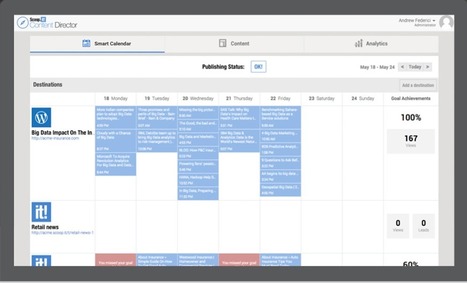
Content curation is an economical way to increase content production - & it's easy when you have an informative infographic to guide you.
Via Vladimir Kukharenko, Jim Lerman
|
|
Rescooped by
Jim Lerman
from Cultivating Creativity
May 28, 2016 12:36 PM
|
I can imagine no better guide through the history and variety of jazz than Langston Hughes, voice of the Harlem Renaissance and poetic interpreter of 20th century black American culture. Hughes’ 1955 First Book of Jazz is just that, a short primer with a surprisingly high degree of sophistication for a children’s book. I would, in fact, recommend it as an introduction to jazz for any reader. Hughes thoroughly covers the musical context of jazz in brief chapters like “African Drums,” “Old New Orleans,” “Work Songs,” “The Blues,” and “Ragtime.” He then “discusses the mechanics of jazz,” writes author and blogger Ariel S. Winter, including “improvisation, syncopation, percussion, rhythm, blue notes, tone color, harmony, break, riff….” Through it all runs the life and career of Louis Armstrong, whose story, Hughes states “is almost the whole story of orchestral jazz in America.”
|
|
Rescooped by
Jim Lerman
from Into the Driver's Seat
May 28, 2016 12:13 AM
|
From the Scout Report "When it comes to archival material, most people think of documents, photographs, or the occasional news clip. Rarely, however, do home videos come to mind. We love that the Home Movie Registry not only directs its attention toward the preservation and collection of amateur films, but that through the collaborative efforts of archives and museums across the country, material in the HMR may be easily accessed by anyone. We encourage readers to explore the intimate family moments captured here, and the many ways that home movies can be used to shed light on important components of American culture and history. "Since the 1920s, home movies have been produced by everyday people, documenting daily activities and offering a wealth of information about twentieth century American life. The Home Movie Registry, a curated search engine from the Center for Home Movies (CHM), is an innovative project designed to bring together the swarth of amateur films digitized and collected by participating archives. The About section of the site details the portal's extensive efforts and provides useful context. From there, readers may like to explore the two Exhibits currently featured on the site, one of which highlights Home Movies and the African American Community, while the other provides a look at Home Movies and Television. Readers may also simply scroll down the fascinating list of amateur-made films on the home page, which illuminate such ephemera as a 1950s Chicago picnic and a 1975 homemade travel documentary. For more targeted research, historians, artists, documentarians, students, and others will find an excellent search bar for easy filtering through the Registry's video troves."
|
|
Scooped by
Jim Lerman
May 25, 2016 2:17 PM
|
Dennis is the CEO and Founder of x.ai, whose artificial intelligence driven personal assistant lets people schedule meetings using plain English and nothing more than a CC to amy@x.ai. Founded in 2014, x.ai is backed by blue chip investors, including IA Ventures, Firstmark, and Two Sigma Ventures, and located in New York City.
Dennis is a pioneer and expert in the analytics, optimization and big data space and has been since its inception – he is also a fully-fledged entrepreneur and successfully delivered a number of company exits. He’s an accredited Associate Analytics Instructor at the University of British Columbia, the Author of Data Driven Insights from Wiley and a frequent speaker on the subject of Analytics and Data. A native of Denmark, Mortensen currently calls New York City his home.
|
|
Scooped by
Jim Lerman
May 25, 2016 2:12 PM
|
"The Story Collider was founded in 2010 by Ben Lillie and Brian Wecht, two physicists who met at a storytelling show in Queens and quickly realized that they could do that too. Since then, The Story Collider has been bringing true, personal stories about science to life both through our many live shows as well as our weekly podcast, and we've used what we've learned about science and stories to teach scientists to use narrative in our university and corporate workshop program. "We believe that, now, more than ever, science is a part of everyone's life. At The Story Collider, you'll hear from scientists about all the times things went wrong, and occasionally right, in their labs, but you'll also hear from people who haven't had a formal connection to science since high school. We have physicists, comedians, neuroscientists, writers, actors, doctors, and many, many more telling their story. Some are heartbreaking; some are hilarious. They're all true, and all, in one way or another, are about science."
|
|
Rescooped by
Jim Lerman
from AdLit
May 23, 2016 9:01 PM
|
Move beyond the five-paragraph essay. Bring school writing to life through freewriting, peer reviews, and allowing students to include relevant memories and vivid descriptions.
Via Nik Peachey, Lynnette Van Dyke
|
|
Scooped by
Jim Lerman
May 23, 2016 8:59 PM
|
I’ve published a number of posts on writing instruction, and thought I’d bring them all together into one “The Best” list. I’ve previously posted tons of lists sharing…
|
|
Rescooped by
Jim Lerman
from AdLit
May 23, 2016 8:54 PM
|
Use this five-step writing process to get started, cut the fluff, and finish writing a compelling piece of content that has a specific objective.
Via Lynnette Van Dyke
|
|
Rescooped by
Jim Lerman
from Technology
May 22, 2016 7:20 PM
|
Experiment with this list of creative digital tools that unite art and writing in amazing visual storytelling projects. Your students will love them!
Via Liz Bujaki
|
|
Rescooped by
Jim Lerman
from All digital
May 16, 2016 8:12 PM
|
"I brought a superhero into my classroom the other day. He wasn't wearing a cape. He didn't have an alias. But he had the greatest superpower of all: inspiration.
When you teach using project-based learning (PBL), one brings outside expertise into the classroom. My eighth graders begin the year creating science fiction based origin stories for original superhero characters as an introduction to a greater advocacy unit. Therefore, it seemed natural to bring in an actual scientist. Which brought me to CalTech and Dr. Spyridon Michalakis."
Via John Evans, Suvi Salo, Stephania Savva, Ph.D
|
|
|
Rescooped by
Jim Lerman
from :: The 4th Era ::
June 3, 2016 12:34 AM
|
"Four members on the spring Student Council for our partner The New York Times Learning Network curated a list of the best 18 articles on education, happiness, and social awareness that provide advice to youth entering adulthood. “We chose these 18 articles from The Times by first individually sifting through the paper and its archives and picking pieces that resonated. Then we shared our finds in a Google doc and noticed that we had all chosen things that could be categorized in one of three ways: Education, Happiness or Social Awareness.” By Jamie Gleklen, Jonathan Looi, Alex Schwartz, and Cooper Veit
|
|
Scooped by
Jim Lerman
May 29, 2016 11:37 PM
|
Attempting to control the uncontrollable is what frequently causes a good amount of our suffering. Yet that’s precisely what we do when we measure creative success solely by external measures. We restrict the flow of instinct, intuition and the desire to create what we want to see exist in the world.
It’s only when we’re able to let go of our attachment to outcomes and external measure that the best work we’re capable of producing starts to emerge. When you’re thinking too much about the outcome, you’re not focused on what actually matters, what you actually control, which is the energy you put into the actual work.
|
|
Rescooped by
Jim Lerman
from Ukr-Content-Curator
May 28, 2016 1:29 PM
|
Content curation plays a critical role in building your audience by adding value to other people's content. Here are 8 content curation best practices.
Via Vladimir Kukharenko
|
|
Scooped by
Jim Lerman
May 28, 2016 12:39 PM
|
Before he wrote cover stories for The Atlantic, before he won a National Magazine Award, before he taught at MIT, Ta-Nehisi Coates was laid off by Time magazine. “To put it bluntly,” he wrote last spring, “I was — like most freelancers — hurting. My wife had been unerringly supportive. My son was getting older. I was considering driving a cab.”
Of course, it’s now six years later, and Coates has had great success writing for The Atlantic, The New York Times, and other publications. But writing doesn’t get easier, he maintains — it’s always a process.
“It’s as though you have a certain music in your head, and trying to get that music out on the page is absolute hell,” he said in an interview for Atlantic Video’s Creative Breakthroughs series. “But what you have to do is give yourself a day, go back, revise, over and over and over again.”
|
|
Rescooped by
Jim Lerman
from Into the Driver's Seat
May 28, 2016 12:19 AM
|
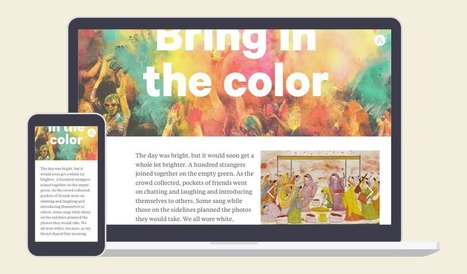
from the Scout Report "It's easy to see why readers were immediately drawn to Atavist with its sharp aesthetic appeal and integrative approach to graphic storytelling. Its user-friendly interface synthesizes narrative methods developed by predecessors such as Youtube, Instagram, and Wordpress, offering exciting new directions for creative projects like longform essay writing. We think Atavist just may become a staple for anyone looking to create visually appealing and impactful presentations or projects. "Atavist advertises itself as "a simple web tool for powerful storytelling." For those readers who love to write - and write online - it may be just the service they have been searching for, as it allows authors to upload photos, video, and audio to create an immersive experience. The best way to form a sense of what can be done with Atavist is to select the menu on the top right hand side of the screen and then go to Examples to peruse creative articles that integrate a variety of multimedia possibilities. Interested readers will then want to create an account using Facebook or their email address. From there, the instructions walk through the steps of creating a New Project, including writing text and using the convenient drag and drop functions for various media. Many readers will want to take the Tour, which can be located on the top of the screen after selecting New Project."
|
|
Scooped by
Jim Lerman
May 26, 2016 7:10 PM
|
I'm adding these three resources to So, You Want To Write A Book? Here's The Best Advice…: To self-publish or not to self-publish? That is the question is by Nik Peachey. A textbook problem: Seven suggestions to improve the quality of published resources is by Jose Picardo. This presentation is from the great Roxanna Elden:…
|
|
Scooped by
Jim Lerman
May 25, 2016 2:13 PM
|
Below are two good applications that provide short summaries to long chunks of text. The first one is called Smmry. This is a web based tool for summarizing text. Students can use it to help them with reading comprehension. The way it works is easy: you paste your text, customize some of the tool's settings and click on ’summarize’. Smmry does the rest and provides you with a synopsis of the text containing few topic-focused sentences. The second application is an iPad app called Clipped and is especially ideal for news readers. Clipped summarizes long news articles into bullet points extracting unnecessary information and data leaving you only the gist of the story.
|
|
Rescooped by
Jim Lerman
from :: The 4th Era ::
May 25, 2016 2:05 PM
|
A chance conversation gives Nneze Akwiwu a chance to study in the United States.
Nneze Akwiwu is currently a senior Biology major at Spelman College. She thinks of herself as a bubbly, outgoing and very family oriented individual. She has plans of becoming the first female president of Nigeria.
|
|
Rescooped by
Jim Lerman
from AdLit
May 23, 2016 9:01 PM
|
Love reading comics? You're not the only one. What about these stories about super-beings keep our eyes glued to the pages and our minds salivating for more? W…
Via Ariana Amorim, Lynnette Van Dyke
|
|
Rescooped by
Jim Lerman
from AdLit
May 23, 2016 8:55 PM
|
|
|
Rescooped by
Jim Lerman
from Into the Driver's Seat
May 22, 2016 7:21 PM
|
|
|
Scooped by
Jim Lerman
May 19, 2016 1:23 AM
|
Whether you’re writing a novel, maintaining a blog, or keeping a journal, the answers to these problems are mostly the same. Writing is like exercise: adopt a sensible training regimen, apply it consistently, and you’ll grow stronger. But it’s also like meditation: open your inner doors, let go of distractions, and you’ll become more centered. In both cases, the keys are discipline and focus.
With that in mind, here are ten simple techniques you can use to keep yourself in the writing zone.
|