Your new post is loading...

|
Rescooped by
Jim Lerman
from :: The 4th Era ::
July 30, 2021 10:12 AM
|
Writing a newsletter is an essential tool to growing your online audience. While it may sound like a fairly straightforward process, it can be difficult to make sure your newsletter reaches your readers.
Luckily, we have technology on our side to help us with this step. These email newsletter tools make it easy for writers to send newsletters to their audience.
Via Jim Lerman
|
|
Rescooped by
Jim Lerman
from Into the Driver's Seat
June 17, 2021 3:06 PM
|
"Next Thursday, June 24, from 7-8 p.m. ET, Chalkbeat will put student voices front and center with a virtual event titled In Their Voices: Students Speak with Secretary Cardona.
The first part of this event will feature student panelists from Michigan, New York, and Tennessee, who will talk candidly about how the pandemic changed their learning experiences over the last year. They will also have the opportunity to ask Secretary Miguel Cardona questions about the policy changes they would like to see happen within their communities.
Following the student panel, Sarah Darville, Chalkbeat’s national managing editor, will interview Secretary Cardona about the reopening of schools, as well as the upcoming school year. She will also hit on other big topics that have emerged this school year, such as racism and how history is taught.
Please RSVP to this free event, in partnership with EdTrust, so that you receive the streaming information ahead of time."
Via Jim Lerman
|
|
Rescooped by
Jim Lerman
from Into the Driver's Seat
June 5, 2021 7:48 PM
|
Here are all of our Student Opinion questions from the 2020-21 school year. Each question is based on a different New York Times article, interactive feature or video. "Each school day we publish a new Student Opinion question, and students use these writing prompts to reflect on their experiences and identities and respond to current events unfolding around them. To introduce each question, we provide an excerpt from a related New York Times article or Opinion piece, as well as a free link to the original article. "During the 2020-21 school year, we asked 177 questions, and you can find them all in this post. The questions are divided into two categories — those that provide opportunities for debate and persuasive writing, and those that lend themselves to creative, personal or reflective writing.
|
|
Rescooped by
Jim Lerman
from Into the Driver's Seat
May 5, 2021 9:41 AM
|
AA Google Docs add-on to create a fill-in-the-blanks worksheet or CLOZE exercise. Simply highlight or underline the words you'd like to be blank, click create - done!
Via Nik Peachey, Jim Lerman
|
|
Rescooped by
Jim Lerman
from Into the Driver's Seat
April 30, 2021 8:48 AM
|
In this lesson, students will learn about the wave of new Black superhero stories and how they are reimagining the genre. Then, students will create and pitch their own superhero reboot.
|
|
Rescooped by
Jim Lerman
from Into the Driver's Seat
April 2, 2021 1:32 PM
|
As more students return to in-person school in the near future, it seems wise to invest our time and energy on strategies to increase student engagement that work both virtually and in person. Like all of us, students are most engaged when their work honors their experiences, connects to their interests, and has the potential to lead them to improvement of themselves, their lives, and issues that matter to them. Teachers can increase student engagement by re-envisioning their curricula in the following ways.
Via Jim Lerman
|
|
Rescooped by
Jim Lerman
from Into the Driver's Seat
March 17, 2021 1:42 PM
|
Writing Assessment
When you want students to understand how writing is graded, turn to our vast selection of assessment examples. You'll find elementary and middle school models in all of the major modes of writing, along with rubrics that assess each example as "Strong," "Good," "Okay," or "Poor." You can also download blank rubrics to use with your own students.
Discover more writing assessment tools for Grade 2, Grade 3, Grades 4-5, Grades 6-8, Grades 9-10, and Grades 11-12—including writing on tests and responding to prompts.
|
|
Scooped by
Jim Lerman
March 8, 2021 1:35 PM
|
"Noting that art is deduced from this activity, Buck nonetheless cautions against preoccupation with forms and techniques at the expense of clarity of creative vision:
'The process which creates is not the process which deduces the shapes of art. The defining of art, therefore, is a secondary and not a primary process. And when one born for the primary process of creation, as the novelist is, concerns himself with the secondary process, his activity becomes meaningless. When he begins to make shapes and styles and techniques and new schools, then he is like a ship stranded upon a reef whose propeller, whirl wildly as it will, cannot drive the ship onward. Not until the ship is in its element again can it regain its course.'"
|
|
Scooped by
Jim Lerman
March 4, 2021 9:32 AM
|
'Writing, Rebranded': Kickstart Kit (Level I)
The 'Writing, Rebranded' Kickstart Kit is just what you need to return writing to the student-centered, self-directed process it was meant to be in your ELA classroom!
This resource includes:
180 days of authentic writing ideas
step-by-step strategies
video guidance to help you implement
mapping documents which help you tie writing to the standards
digital and hardcopy versions of the calendar
online tools that allow you to customize this activity
access to one, central location where all materials are housed
Get ready to unlock intrinsic motivation + unleash creativity as your learners build up their digital footprint while building out their foundation for writing!"
|
|
Rescooped by
Jim Lerman
from Into the Driver's Seat
March 2, 2021 11:17 PM
|
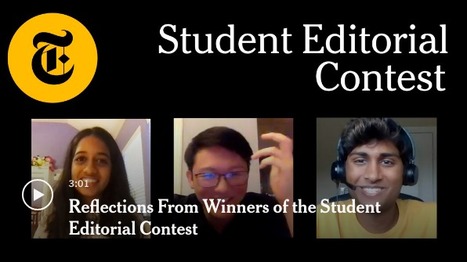
"Make an argument in 450 words or fewer about something that matters to you, and persuade us that we should care, too. "Take a look at the full guidelines and related resources below. And consider hanging this PDF one-page announcement on your class bulletin board. Please post any questions to the comments here, or write to us at LNFeedback@nytimes.com."
|
|
Scooped by
Jim Lerman
February 25, 2021 11:07 PM
|
Free access to all of the chosen stories. -JL "It can be a challenge to get middle schoolers interested in reading. The thought of tackling a thick novel can be overwhelming, especially during distance learning. Short stories are always a great choice.
"In addition to requiring less of a time commitment, they are an easy way to expose your students to new authors and genres. Also, the best short stories are every bit as engaging and meaningful as the best novels. We asked our audience on Facebook and Instagram to share some of their favorite short stories for middle schoolers. Here’s the big list!"
|
|
Rescooped by
Jim Lerman
from Into the Driver's Seat
February 23, 2021 7:58 PM
|
"YouTube video essays are long-form (relative to many other internet videos) critical videos that make arguments about media and culture. They're usually meticulously narrated and edited, juxtaposing video footage, images, audio, and text to make an argument much like a writer would do in a traditional essay. As former YouTube talent scout Jeremy Kaye puts it, video essays "take a structured, in-depth, analytical, and sometimes persuasive approach, as opposed to the quick 'explainer' video style."
Why Are They Great for Learning? "It's easy to dismiss a lot of what circulates on YouTube as frivolous, silly, or even obnoxious, but video essays are the opposite. They demand students' attention but not through cartoonish gesturing, ultra-fast editing, and shock value (which even some of the more popular educational YouTubers fall prey to) -- there's room to breathe in these essays. To capture attention, video essays use a time-tested trick: being flat-out interesting. They present compelling questions or topics and then dig into them using media as evidence and explication. This makes them a great match for lessons on persuasive and argumentative writing.
"Video essays model for students how YouTube can be a platform for critical communication.
"But what I really love most about video essays is that they have something at stake; they ground their arguments in important cultural or political topics, exposing the ways media represents gender or race, for instance, or how media evolves over time and interacts with the world at large. Most importantly, video essays model for students how YouTube can be a platform for critical communication."
|
|
Rescooped by
Jim Lerman
from Into the Driver's Seat
February 21, 2021 4:40 PM
|
Recommendation by Nik Peachey: "A while back I wrote a blog post about texting fiction and how popular it is with teens. At the time the choice of apps for creating these texting stories was quite limited if you wanted a free one. Now MessagInk seems to be changing that. It's a really nice free website that makes creating and reading texting fiction really easy. Great to use to get students writing."
|
|
|
Rescooped by
Jim Lerman
from Into the Driver's Seat
July 23, 2021 3:27 PM
|
Description by The Scout Report "TreeSheets calls itself a "free form hierarchical spreadsheet," that offers the intuitive usability of a spreadsheet or text editor combined with the organizational capabilities of an outline or mind map. From simple to-do lists and calendars to more complex data organization such as project management and requirements gathering, the hierarchical spreadsheet is astonishingly versatile. It is structured as a grid that will be familiar to spreadsheet users, but TreeSheets can also be easily divided into subgrids, allowing for nested organization and endless layout options. Users can change fonts or colors and insert images with a few clicks (also worth mentioning is the availability of unlimited "undo" functions). As evidenced by the simple website design, TreeSheets is compact and uses minimal memory (5MB for the equivalent of 100 pages of text on Windows 7, according to the developer). To see the tool in action and view a sampling of the style and layout options, readers can click the "Screenshots" link. Selecting the "Tutorials" link, readers will find how-tos for three types of learners: an in-app follow-along tutorial, a video, and a written tutorial. TreeSheets is free and open-source and is developed by Dutch programmer Wouter van Oortmerssen. " Jim Lerman's insight: This may not look like it at first glance, but Tree Sheets is an excellent mind map tool to use to teach writing. In my experience, there is no better tool to teach writing to secondary level (and above) students and adults, than mind-mapping. And Tree Sheets is the only FREE tool available that meets my standards for functionality. Having said that, it could be a bit more visually attractive - but hats off to the developer, Wouter van Oortmerssen, who, it seems, made it by himself. A great accomplishment and a wonderful contribution to us all.
|
|
Scooped by
Jim Lerman
June 5, 2021 7:58 PM
|
"For those of us on a budget, buying software can be expensive. With many companies switching to subscription models, the cost of paying for new versions of business essentials like Microsoft Office can ratchet up. "But, there is a method for saving money on software that not many people know about—renewed software. Buying renewed license keys can save you a mint as long as you buy from a reputable online reseller. Today, we’re going to show you the best way to get Microsoft Office for a deal. This process doesn't require a physical copy of the software, and getting set up is easy. Let’s get into it." Jim Lerman's insight: I "almost never" recommend anything here that isn't free. This time I'm making the rare exception. Here is a perfectly legal way to purchase a used license for a copy of Microsoft Office for quite a reasonable price. It's sort of like buying a used car...it will work perfectly fine but isn't brand, spanking new and so costs substantially less. I've found recommendations from Make Use Of to be consistently on point, so feel confident about passing this info along.
|
|
Scooped by
Jim Lerman
May 6, 2021 8:54 AM
|
Novels and short stories are filled with emotions. The characters in them experience the ups and downs of the human condition, often in dramatic fashion. And as we read along, we feel things, too—about the characters and ourselves. For these reasons, literature offers a gateway to social-emotional learning in your classroom.
When students analyze the emotions of the characters they are reading about, they gain not only a greater understanding of the text but also a greater understanding of their own emotions.
Use these activities from In Focus to have students identify, respond to, and learn from the emotions presented in the stories they read.
|
|
Rescooped by
Jim Lerman
from Cultivating Creativity
April 30, 2021 8:52 AM
|
Due in part to the coronavirus pandemic, Asian Americans have endured a challenging year of increased racism — from violent attacks and verbal harassment to civil rights violations and online bullying. Chalkbeat asked students of Asian descent, and allies, to share their thoughts about these trying times.
Here's what they had to say in six-word stories, artwork, poetry, and music.
|
|
Rescooped by
Jim Lerman
from Into the Driver's Seat
April 30, 2021 8:44 AM
|
Where do scientists — and science writers — get their ideas? They pay close attention to the world around them and ask questions, then look for answers to the ones that fascinate them most.
That, at least, is how many of the top 11 winners of our Second Annual STEM Writing Contest describe their process. Like last year, we and our partner, Science News, challenged teenagers around the world to choose any STEM-related question, concept or issue that interested them and, in 500 words or fewer, explain it to a general audience in a clear and engaging way. And, like last year, we added an optional field to our submission form that invited participants to also tell us how they chose that topic.
Here are a few excerpts. Read them, then scan the titles of the winning essays below and see if you can guess which might go with which. (Answers are at the bottom of the post.)
|
|
Rescooped by
Jim Lerman
from Cultivating Creativity
March 31, 2021 4:42 PM
|
Whether a part of online or in-person classes, videos are a teaching tool that can enable students to learn new concepts and skills and engage in practice activities, all at their own pace. What actually happens when students watch instructional videos in class, however, doesn’t always lead to the expected outcome. Before the pandemic, when I used videos in a classroom setting, students would hit play, sit back, and watch. When it came time to complete the subsequent activities, however, they immediately required assistance, despite my having explained and demonstrated what to do.
"Through my work as a facilitator of professional learning, I’ve encountered many frustrated teachers who’ve spent countless hours creating instructional videos as a way of providing instruction in an online setting, only to find that their students weren’t learning from them.
"From my own experience in a classroom and through my interactions with these teachers, I’ve discovered some strategies to help students learn from videos, regardless of the educational setting. It turns out that I had missed a huge step in the learning process. I had never taught my students how to learn from a video."
Via Jim Lerman
|
|
Rescooped by
Jim Lerman
from Into the Driver's Seat
March 17, 2021 1:41 PM
|
Each writing unit leads your students step by step through the process of creating a specific form, with models, examples, activities, assignments, audio, and much more! All units are optimized for viewing on any device, from smartphone to whiteboard.
Get units for free during this crisis:
These are strange times. In the 45 years that we’ve created writing instruction, we’ve never seen schools shut down nationwide, forced to teach online. That’s why we’re providing free access to all of our online writing units during this crisis. We want to help you teach from a distance.
At checkout, you don’t need to enter a credit card, and the cost of your purchase will be $0.
|
|
Rescooped by
Jim Lerman
from Into the Driver's Seat
March 7, 2021 2:11 AM
|
"This 1853 etiquette manual written by Eliza Leslie is not only funny, but there's even plenty of advice in there that still holds true today." Mentioned by MIT Technology Review newsletter. Full book available for download, free. Jim Lerman's insight: Great source for discussion and writing prompts.
Via Jim Lerman
|
|
Rescooped by
Jim Lerman
from Into the Driver's Seat
March 4, 2021 9:22 AM
|
More than ever, students need frequent chances to express and develop thoughts and feelings through the written word, to reflect and ask questions, to construct ideas about the world around them, to complain and argue in writing, to understand and name emotions, to wonder, to learn, to grow.
But how?
|
|
Scooped by
Jim Lerman
March 2, 2021 11:03 AM
|
In 1953, celebrated novelist Ralph Ellison (March 1, 1913–April 16, 1994) gave a remarkable National Book Award acceptance speech, arguing for fiction as a soapbox for injustice and a chariot of hope. Thirteen years later, in 1966, he gave a rare interview for the National Education Television, in which he discusses a number of timeless, timely topics — national identity, race, the purpose of literature — with extraordinary eloquence and grace, complementing E.B. White’s insights on the role and responsibility of the writer and George Orwell’s thoughts on the writer’s motives and political purpose.
|
|
Scooped by
Jim Lerman
February 23, 2021 7:59 PM
|
Student Portfolio Apps and Websites
Portfolios are a time-tested and teacher-trusted method for assessing student learning. But what happens when students ditch notebooks and folders for laptops and tablets? These tech tools are here to help, offering students virtual binders, folders, webpages, and galleries for collecting everything from text to video. They also give teachers the ability to easily browse through their students' work and assess remotely.
|
|
Rescooped by
Jim Lerman
from Into the Driver's Seat
February 22, 2021 11:42 AM
|
No matter the circumstances, the most powerful learning experiences for high school students often involve student-led discussions that foster connections with each other, as well as with critical texts and ideas. A highly structured, well-planned Socratic seminar can be an effective way to do both, whether your school is in person, virtual, or hybrid.
The Greek philosopher Socrates maintained that the surest way to attain reliable knowledge was through the practice of disciplined conversation. He called this method dialectic—the art or practice of examining opinions or ideas logically, often by the method of question and answer, so as to determine their validity.
Socratic questioning recognizes that questions, not answers, are the driving force in thinking. Done well, Socratic seminars explore ideas, values, and issues drawn from readings or artworks chosen for their richness, and when they are rooted in news articles or nonfiction texts, they can also help make sense of current issues. It’s all about strengthening learning by actively engaging students in rigorous critical thought and conversation.
|