


Here are 6 great reasons to begin exploring digital storytelling in your classroom along with some suggestions for tools to get you started.
Via Nik Peachey

 Your new post is loading...
 Scoop.it! Here are 6 great reasons to begin exploring digital storytelling in your classroom along with some suggestions for tools to get you started. Via Nik Peachey 

PIRatE Lab's curator insight,
December 4, 2016 12:59 PM
Some of these are a bit basic, but all can potentially be helpful to you guys in your courses.

Willem Kuypers's curator insight,
December 5, 2016 6:10 AM
De bonnes idées pour faire facilement des animations jolies au lieu des Powerpoint standards.
Sign up to comment
Scoop.it!
Here are 6 great reasons to begin exploring digital storytelling in your classroom along with some suggestions for tools to get you started. Via Nik Peachey
PIRatE Lab's curator insight,
December 4, 2016 12:59 PM
Some of these are a bit basic, but all can potentially be helpful to you guys in your courses.
Willem Kuypers's curator insight,
December 5, 2016 6:10 AM
De bonnes idées pour faire facilement des animations jolies au lieu des Powerpoint standards.
Scoop.it!

This is a brilliant, multi-sensory way to teach the construction of sentences. Click image or headline to go to Facebook video. -JL
Scoop.it!

When it comes to enhancing students writing skills, technology can play a decisive role. In his celebrated work “The Digital Writing Workshop’, author Troy Hicks explains in details how you can integrate technology in your writing instruction to help students become good writers. One key concept in this discussion is viewing writing as a process instead of an end product. Process here insinuates a state of unfinishedness because writing is always a task in the making. Students are continuously engaged in a never-ending process of discovery and sense making through the use of language. In this regard, the writing process is comprised of several phases or stages each of which has a specific role in creating and enhancing students writing skills. Going beyond the problematic of nomenclature, we will stick here with the conventional classification of the writing process as espoused by many scholars including Donal Murray, Donal Graves, Lucy Calkins and many more. This process is composed of four main stages: pre-writing, writing, revising, and publishing. The purpose of today’s post is to provide you with a number of tools and apps to help your students' writing needs in each of these stages.
Scoop.it!
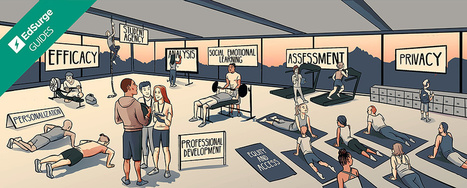
If you think data—in education, or any field—is cut and dry, think again. Working with data in the classroom, especially, can be either exhausting or exhilarating—depending on your fitness level. Data can be big, but also quite small. It’s often quantitative, but is increasingly qualitative. It’s predictive, but not always inclusive. It’s private, but not always protected. But one thing’s for certain: data has enormous power to impact teaching and learning.
Scoop.it!

The Educating for Democracy in the Digital Age (EDDA) Initiative in Oakland, California includes more than 100 teachers who are grappling with how to productively engage their students in today’s civic and political world. EDDA is a partnership between Oakland Unified School District (OUSD), Mills College, and the National Writing Project (NWP). EDDA aims to expand the opportunity structure in OUSD high schools and to develop students’ commitments and capacities for meaningful civic action in the 21st century. Via Jim Lerman
Scoop.it!

Commendation by Larry Ferlazzo
"Write The World lets teachers set-up virtual classrooms for free where they can monitor student writing progress and, if they wish, let classmates use it for a peer review process. They can be private or public groups. In addition, the site has writing contests, provides prompts, and encourages students to view each other’s work from around the world."
Scoop.it!

Getting to the Core of Character Motivation is a guest post by Becca Puglisi detailing inner and outer motivation of characters in fiction Via Penelope

Penelope's curator insight,
June 7, 2016 9:46 PM
Developing characters in our stories is one of the hardest things to get right. This is an excellent post that explains the character arc, which consists of four pieces. Worthwhile read. Link to the original article: http://www.livewritethrive.com/2013/12/02/getting-to-the-core-of-character-motivation/#comment-82217
Scoop.it!

Penelope's curator insight,
August 29, 2016 9:38 PM
Blank mind? Blank page? Pull out one of these writing prompts. At least one should inspire flying fingers or jotting pens. Link to the original article: http://www.carrieelle.com/writing-prompts
Scoop.it!

Librarian Abbe Klebanoff shares tips and suggestions for organizing a teen poetry slam event during National Poetry Month and beyond. Via Sarah McElrath
Scoop.it!

A step by step tutorial on how to set up your own self-hosted WordPress author website in less than 30 minutes. Plus tips on professional themes and setting up
Scoop.it!

Alanna Shaw's curator insight,
October 3, 2016 10:45 AM
While this list of ideas might be geared more towards the author in training, it is also a great place to get ideas for teaching creative writing to students.
Scoop.it!

To WWF, what’s important is to get their message passed to the public, and to arise the public awareness of the importance of protecting the nature. That’s why they rely heavily on advertisement. What we have collected here are some of the most powerful and eye-catching ads of WWF. They are all creative and well executed, and the message is clear. What it takes a make a great ads? Maybe you can learn something from the ads below.
|
Scoop.it!

I used to assign a “Letter to the Teacher” at the beginning of every year to get a snapshot of how a student writes while simultaneously learning background information. Being completely honest, this assignment is also an easy way to get the first few back-to-school days started when a 90-minute class period feels like 900 minutes, because everyone is typically on their best behavior and not talking much. Although I enjoy reading the letters, the assignment doesn’t lend itself to revising and is written only for a specific, one-person audience.
Scoop.it!

Break that writer's block! Here are 7 great online creative writing apps to inspire creativity for writing and other creative projects for any student. Via Elizabeth E Charles
Scoop.it!

Happy to welcome high-performance coach and author Nina Amir to the blog today. She’s got some great techniques for you to try if you ever hit a brainstorming wall, so please read on! Plot. S…
Scoop.it!

To be a good writer one must constantly work on his skills. However, it is not bad news. Considering the abundance of technologies that can help you make it a fun and entertaining activity, you will have no problems advancing your skills as a writer.
Scoop.it!

“I never started from ideas but always from character.” – Ivan Turgenev “You take people, you put them on a journey, you give them peril, you find out who they really are.” – Joss Whedon “You don’t really understand an antagonist until you understand why he’s a protagonist i
Scoop.it!

In our interactive session for “Makerspace in the Library: What it means for your Classroom,” we really let our participants drive the learning.
Jim Lerman's Insight: Quite a substantial and informative recap of what must have been a lively discussion.

johanna krijnsen's curator insight,
November 24, 2016 9:10 PM
how the processes of making and writing mirror each other
Scoop.it!

Ever wonder why your writing lacks the impact of your writing heroes? Find out the simple secret they don't want you to know. Via Penelope
Penelope's curator insight,
June 15, 2016 9:40 PM
This is an amazing post. Yes, the writing is crisp and concise, but the editing visual at the beginning is a stand-alone lesson. Every writer needs to bookmark this one!
***This review was written by Penelope Silvers for her curated content on "Writing Rightly" *** 
'Timothy Leyfer's curator insight,
June 16, 2016 8:06 PM
Here are 7 Simple Tips To Increase The Power Of Your Writing
Scoop.it!

In 2011, then Pixar storyboard artist Emma Coats, tweeted 22 rules of storytelling. Artist Dino Ignacio then turned them into image macros. Via Lynnette Van Dyke, Penelope
Penelope's curator insight,
July 21, 2016 11:36 AM
You may have already seen these rules of storytelling, but they are worth a refresher. Plus, now they've been married to some beautiful images from beloved Pixar films. My brain loves these visuals. Enjoy! Link to the original article: http://twistedsifter.com/2013/09/pixars-22-rules-of-storytelling-as-image-macros/
Scoop.it!

Penelope's curator insight,
October 31, 2016 2:42 PM
I love these tips shared for writers (or anyone) using Microsoft Word. These are great timesavers! ***This review was written by Penelope Silvers for her curated content on "Writing Rightly"***
Scoop.it!

Publishing student writing does not mean posting their assignment on a blog. Learn how to publish student writing and showcase it to the world to read. Via Sarah McElrath
Scoop.it!

A selection of online journaling tools that you can use to take your journaling practice digital.
Penelope's curator insight,
November 14, 2016 10:02 PM
Journaling is a great way to sort out emotions and solve problems. Bonus? You're squeezing in writing at the same time. Five online tools can make the job so much easier. Evernote, one of my favorites, makes the list again! Link to the original article: http://www.lifehack.org/articles/technology/5-online-journaling-tools.html
Scoop.it!

The Common Core English Language Arts Standards for Writing focus on building college and career readiness by having students demonstrate the ability to write in a variety of formats. As educators, we need to facilitate authentic experiences for students to practice and take risks during the writing process.
|






