"There are many books on the subject and I’ve found flow to be highly beneficial. My process of flow looks like this:
1. Go to the gym and workout hard so endorphins are released and I’m relaxed 2. Do five minutes of meditation before I start 3. Drink a black tea or coffee before I start 4. Warm up on some inspiring videos on YouTube that give me goosebumps
"Once I have done these four things, I’m usually able to get into flow really quickly."
Jim Lerman's insight:
This article has additional practical suggestions and strategies. I see it as a useful resource. Nice graphic, above, too.
Meet the Little Prompter The Little Prompter is a compact, versatile, and easy to use tool that helps you quickly deliver a polished video to your students, to your employees, or to the public. Up until now, teleprompters have been clunky, expensive, and difficult to operate–and many required film studios or a production team. The Little Prompter changes all of that. It’s a simple tool that promises to help you nail a smooth delivery using just a smartphone and your desktop computer, DLSR, or webcam.
Teachers and parents, use these picture books to model the process of writing a story. Some of these books show how writers get ideas. Others show the challenges of plotting and drafting the words in a story. All are about a part of the process of storytelling. Kids need plenty of these examples to encourage them as they develop their own story telling abilities.
You’ll want to look for books that meet your children where they are. What are your children or students struggling with currently? Is it finding ideas? Start there. Maybe it’s facing the challenges that come with writing a draft. I’ve divided the list into three parts: Finding an Idea, Plotting and Drafting, and The Writer’s Life and Getting Published.
Who says children's books can't teach us the craft of writing? I had no idea of the number of creative and adorable books on the subject.. Wish I had some of these when I was in school. Better late than never.
***This review was written by Penelope Silvers for her curated content on "Writing Rightly"***
Select a character to represent you and speak for you as you talk about yourself, your life story and your interests. Introduce yourself, talk about who you are, what you do, what you're interested in, what you like or don't like.
As soon as kids start talking, it's great to get them to tell stories. For younger kids, encourage them to narrate their activities as they build, climb, and pretend by asking questions such as, "What are you building? Who will use it? Tell me about your adventure!" There are also apps that let kids record their stories as they play. With older kids, some will naturally put pencil to paper, but others take a bit more prodding. For those kids, digital book creation can make their writing process feel more grown-up and tangible. Having a real audience also shows kids that their writing can matter, so tweens and teens can use sites and apps where they can share creations, and they can even riff off their obsessions in the form of fan fiction. Finally, if your tween or teen has strong opinions about issues or interesting people in their lives, they can use tools to document and share those stories, too.
1. After looking closely at the image above (or at the full-size image), think about these three questions:
• What is going on in this picture?
• What do you see that makes you say that?
• What more can you find?
2. Next, join the conversation by clicking on the comment button and posting in the box that opens on the right. (Students 13 and older are invited to comment, although teachers of younger students are welcome to post what their students have to say.)
3. After you have posted, try reading back to see what others have said, then respond to someone else by posting another comment. Use the “Reply” button or the @ symbol to address that student directly.
To my mind, Robinson is one of the great educationists of our day. He speaks with brilliance, wit, and remarkable clarity regarding the most essential of topics related to education and schools. The evolution of his expressed thinking has been a wonderful gift to follow. This presentation at UCLA was made on January 28, 2018; I believe it is the most recent long form (about an hour) video of him currently available. He addresses what is required for us to create the schools we so urgently need to save the earth and humanity. -JL
In the second part of this blog on mentor texts for narrative writing, we’ll be focusing on picture books, short stories, and more. To see the original messages this list is based on, click here.
Mary Zdrojewski was in for a surprise. Not long ago, the librarian in the Scio (NY) Central School District had been assigned a class of teens at her K–12 school. Zdrojewski asked the students what they wanted from their library class, expecting to hear requests for coding, robotics, or hands-on projects. “They just wanted me to read aloud to them,” Zdrojewski recalls. “I tried short stories, including the ‘Guys Read’ series, because I thought they would be ‘cool.’” But she soon discovered that “the students really wanted pictures to look at.”
Picture books and older students: More educators are making this match in their teaching, with significant success. While graphic and illustrated novels gain traction among teen and tween readers, traditional picture books hold a place of their own and provide versatile, effective teaching tools for a range of students. The ubiquity of social media might explain why today’s youth are particularly visually oriented, but that’s only part of the picture, says Wendy Lukehart, youth collections coordinator at the District of Columbia Public Library’s Penn Center. “People of all ages have always responded well to pictures,” she says. For centuries, she notes, humans spent quite a bit of time gazing at art, and, in the 20th century, flipping through photography-centric magazines, such as Life, to engage with current events and culture.
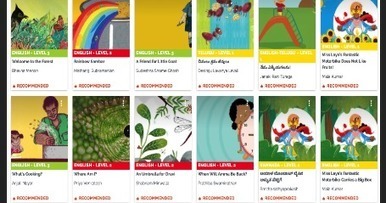
"StoryWeaver is an educational platform that draws on collaborative team work to develop ‘a rich digital repository of diverse children’s stories from Pratham Books.’ ..."
"BoomWriter Media, Inc. today announced its second annual Online Writing Camps, which offer five-day camp sessions where students can collaborate to write and publish a chapter book. Teachers promote and run their own camps, selecting camp dates and flexible daily schedules.
"BoomWriter will provide support for educators with web-based professional development will give teachers strategies and ongoing direction on how to provide their campers with effective feedback and how to manage students’ revision requests.
"The Online Writing Camps include writing instruction, personalized feedback, and collaborative peer review. To get their campers started each day, educators post a web-based writing lesson provided by BoomWriter.
"At the end of the camp, participants receive a published, paperback copy of the story sent directly to their home by BoomWriter. Teachers will be paid within two weeks of completing camp."
Your students can become moviemakers, too, thanks to some powerful apps for mobile devices. With these tools, your children can take videos and edit their work to make professional quality movies using iOS devices (iPads and iPhones) and Android tablets.
One good thing about this easy-to-use technology is that students can still use important English language arts skills like writing a narrative, planning a sequential story, and including key details when getting ready to make a movie. These apps can enhance the work that you are doing with children in the classroom and give them room to be creative storytellers.
A beautiful page where children from different countries are photographed from above with all the food they eat in a week. Nice source of speaking activities with young students and early teens!
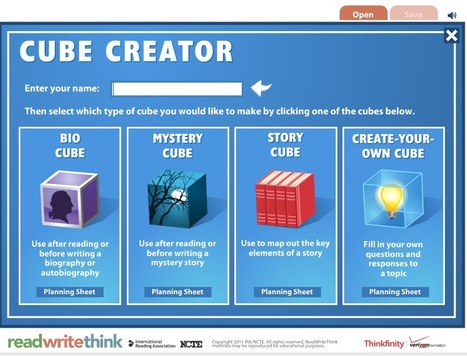
This interactive cube creator will help your students to start their own story writing. It breaks the writing process into six distinct parts which will guide students to write their own biographies, mystery stories, short stories, and free planning of story, a blank template that they can customize.
In our Text to Text lesson plans, we match an often-taught literary or historical work with a New York Times article that echoes, extends or challenges its themes or ideas.
In this edition, we pair a scene from John Green’s best-selling young-adult novel “The Fault in Our Stars” with Amy Krouse Rosenthal’s now-famous Modern Love essay, “You May Want to Marry My Husband,” published in 2017, just 10 days before she died of cancer. Together, the two examine relationships and mortality, and suggest ways to navigate life’s most profound challenges with grace and humor.
"-Write the World–Boundless site that helps young writers write, revise, think, and evolve.
-NaNoWriMo Young Writers Program- Wildly engaging contest turns students into novelists in 30 days,
-Penzu Classroom– This journaling platform motivates student writers, and also has strong teacher tools.
-Educreations– This neat app records student’s voice and writing.
-Writing Prompts– This app generates fiction, and nonfiction writing prompts, helping students master the skill of the short write.
-Flocabulary: Language Arts– Adds hip hop music to students’ language arts learning.
-com– Provides students with engaging parts-of-speech instruction and assessment.
-Youth Voices– Popular online community hosts authentic student writing.
-Storyrobe– Storyrobe allows writers to write, share their work, and receive feedback from
-Google Docs– Google Docs has all the traditional functionality of Microsoft Word but allows for collaboration between students and for easy-to-give and easy-to-receive feedback from teachers through the commenting and suggesting functions.
Hyperlinks to each of the apps are available by clicking the headline or image above. -JL
On this article you can find 10 different writing apps that provide a useful support to improve writing skills while practicing grammar. Those apps are very innovative and accurate for English language learners that want to make the learning process of a foreing language much more interesting and effective in this digital area. Besides, by using those apps we can foster different 21st century skills such as innovation and tecchnology literacy.
"...we’ve compiled educators’ favorite resources for teaching narrative writing. We received SO many fantastic suggestions, we had to break them into two posts! In this first post, we will be focusing on chapter books that were recommended to teach narrative writing."
To get content containing either thought or leadership enter:
To get content containing both thought and leadership enter:
To get content containing the expression thought leadership enter:
You can enter several keywords and you can refine them whenever you want. Our suggestion engine uses more signals but entering a few keywords here will rapidly give you great content to curate.


 Your new post is loading...