Your new post is loading...

|
Rescooped by
Jim Lerman
from Into the Driver's Seat
February 13, 2018 9:36 AM
|
"Now in 2018, NWP is getting ready to launch a new youth publishing opportunity connected to the PBS documentary American Creed (broadcast nationally February 27 and streaming free of charge starting February 28 at www.pbs.org/americancreed). Through stories set in big cities, small towns, and rural areas around the country, American Creed wrestles with key challenges facing American youth today, including creating economic opportunity and finding ways to meaningfully participate in civic life. The film encourages youth to explore questions like “What should America’s national ideals be?” and “How do we close the gap between ideals and reality?” American Creed is co-produced by Citizen Film and WTTW.
"You and the youth you work with are invited to add your voice to the conversation about American Creed. Bring the film to your classroom or learning center, and support young people in responding through writing, art, and media. Teens (13+) and young adults are invited to share their responses on the National Writing Project’s American Creed youth publishing site (also coming February 27).
"How to Get Involved:" ...go to website
|
|
Rescooped by
Jim Lerman
from Into the Driver's Seat
February 12, 2018 7:49 PM
|
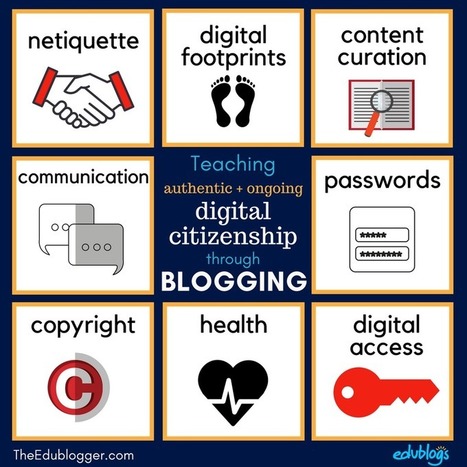
"There are many benefits to having a blogging program in your classroom. One advantage is that blogging can be the perfect avenue to teach digital citizenship.
"What is digital citizenship?
"Digital citizenship is used as more of an umbrella term for our goals to help our students to be safe, happy, productive, and ethical online. These same goals that we have for our students’ online experiences also apply to their offline world.
"Common Sense Media’s curriculum identifies eight topics under the umbrella of digital citizenship including: internet safety, cyberbullying, copyright and more. They describe digital citizenship as, empowering your students with skills to think critically, behave safely, and participate responsibly online, allowing them to connect and collaborate in meaningful ways.
"But how do we teach digital citizenship?
"Let’s look at eight ways blogging can be used to teach digital citizenship."
|
|
Rescooped by
Jim Lerman
from Cultivating Creativity
February 10, 2018 4:16 PM
|
THIS MULTIMEDIA INTERNET has been gaining on the text-based internet for years. But last year, the story accelerated sharply, and now audio and video are unstoppable. The most influential communicators online once worked on web pages and blogs. They’re now making podcasts, Netflix shows, propaganda memes, Instagram and YouTube channels, and apps like HQ Trivia.
"Consider the most compelling digital innovations now emerging: the talking assistants that were the hit of the holidays, Apple’s face-reading phone, artificial intelligence to search photos or translate spoken language, and augmented reality — which inserts any digital image into a live view of your surroundings.
"These advances are all about cameras, microphones, your voice, your ears and your eyes.
"Together, they’re all sending us the same message: Welcome to the post-text future.
"It’s not that text is going away altogether. Nothing online ever really dies, and text still has its hits — from Susan Fowler’s whistle-blowing blog post last year about harassment at Uber to #MeToo, text was at the center of the most significant recent American social movement.
"Still, we have only just begun to glimpse the deeper, more kinetic possibilities of an online culture in which text recedes to the background, and sounds and images become the universal language.
"The internet was born in text because text was once the only format computers understood. Then we started giving machines eyes and ears — that is, smartphones were invented — and now we’ve provided them brains to decipher and manipulate multimedia."
Via Jim Lerman
|
|
Rescooped by
Jim Lerman
from Cultivating Creativity
February 9, 2018 9:33 AM
|
“You start when you’re young and you copy. You straight up copy.”
—Shel Silverstein
"All artists begin by copying. (I wrote a book about it.) But what’s instructive about hanging out with kids all day is understanding on a day-to-day kid’s eye level just how natural copying comes to us.
"My kids (5 & 2) are gleeful, natural born copycats. Copying is how they wrap their hands and hearts and heads around the world. They not only copy drawings and music and recreate the world with blocks and play, they mimic their parents, they mimic each other, they mimic kids on the playground, etc. Copying and mimicry is as natural to them as breathing. There’s nobody around telling them they should do any differently, nobody saying something dumb like, “Don’t you want to do something original?” So they go about their mimicry, unfettered by any adult notions about originality." Jim Lerman's insight: A rich, enjoyable rumination on some of the benefits of copying. For sensitive people, please beware of the "f" word at the end.
|
|
Rescooped by
Jim Lerman
from Into the Driver's Seat
February 7, 2018 8:48 PM
|
Students love creating short films where they create the dialogue and animate the characters. Not only do students learn how to write a script, but they also have to think about the props, music, background, and other elements. Creating scenes helps learners develop a critical eye when it comes to supporting writing and plot with visual and multimedia content. This is an important skill needed for our digital producers. Below are free web tools and apps students can use to create short animated films.
|
|
Scooped by
Jim Lerman
February 7, 2018 2:48 PM
|
Via The Scout Report "The Purdue OWL (Online Writing Lab) offers this helpful collection of resources designed to help individuals understand the writing conventions and best practices of different professional and academic fields. These resources may be especially helpful for students as well as professionals who find themselves writing for new or specific audiences. This collection contains nine different guides - some of which include Professional, Technical Writing, Writing in the Social Sciences, Creative Writing, Writing in Engineering, and Journalism and Journalistic Writing. Many of these guides contain a number of more specific instructions for particular writing tasks. For example, the guide entitled "Healthcare Writing" contains instructions for medical journalism, SOAP notes (a kind of clinical documentation), and for writing patient education materials"
|
|
Scooped by
Jim Lerman
February 7, 2018 10:03 AM
|
Growing up, I always loved running to our mailbox to see if I had received a letter. Whenever I was disappointed, my mom would say, "If you want to get mail, you need to write letters." I still love to receive "real mail" and cards!
When I was in elementary school, I was very excited to sign up for an international pen pal program (this was back in the '70's). I had several pen pals, but one in particular, Stephanie (from England) & I wrote to each other regularly for several years. We loved learning about each other's country and traditions. We would even send each other little gifts in the mail. (I loved seeing the different spelling of certain words or learning the British words for everyday objects!) I've talked so often about having a pen pal, that my 11-year old has been begging for me to find her one. Luckily, through all the wonderful teachers across the country (& world!) I've met through TpT and blogging, she now has 3 pen pals in different states!
So when my friend, Monica at Fourth Grade Frenzy, suggested we have our classes be pen pals, I jumped at the opportunity! We are in California and she is in New Jersey, so our classes love that we can learn about fourth graders in another state! Monica has a terrific friendly letter writing product that makes teaching the format simple. You can check it out here.
Besides the excitement of receiving real mail, there are at least 5 other benefits to letter writing:
|
|
Scooped by
Jim Lerman
February 6, 2018 8:43 PM
|
“Should” is a word from which I’ve always reflexively shrunk; I’ve never much liked being told to do anything. It’s the surest way to get me—and so many others, I know—running in the other direction.
So what, you may wonder, am I doing promoting this list of books women “should” read before turning 30? Well, first, this list is hardly prescriptive; there’s no mandate to dive between the covers of even one of these books, let alone all 31. (Although, if it were mandatory for us all to read The Lover, I think we’d all be better for it.) And then also, this isn’t simply a list curated to include all the same books we’re always told we should be reading. Rather, the following 31 recommendations are an impressively varied lot, thanks to the fact that they come not from one person or a small editorial team, but rather from 30 of the best women writers working today, all of whom chose a book that meant something to them in their 20s.
And so while the list below contains few of the usual suspects you usually find on a lineup like this, when one of those titles does pop up, the personal reasons for valuing the book in question will make you see it in a whole new way (see: Jennifer Wright on The Great Gatsby). And nothing on here is a recommendation, exactly. Rather, each book carries with it a personal resonance with the writer who chose it; perhaps some or all of these books will mean something to you, too, and affect your life in a similarly profound way. There’s only one way to find out.
|
|
Rescooped by
Jim Lerman
from Into the Driver's Seat
February 4, 2018 5:57 PM
|
Are you looking for the 12 best Free Online Bibliography And Citation Tools? Check the 12 best Free Online Bibliography And Citation Tools! 2017 Update!
Via Ana Cristina Pratas, Jim Lerman
|
|
Rescooped by
Jim Lerman
from Cultivating Creativity
February 4, 2018 5:42 PM
|
A Tennessee high school student’s anti-bullying video has resulted in nearly 600,000 views on YouTube and a suspension for its creator.
"Lebanon High School student Emily Gipson said school administrators accused her of “trying to incite violence” and gave her a two-day in-school suspension for the video entitled “Welcome to Lebanon High School,” posted Jan. 22.
"In the video, prompted by a classmate’s October suicide, she asks students to treat each other better. It’s a broad indictment of campus culture, but contains neither profanity nor calls for direct action.
“Welcome to Lebanon High School, where smiles are fake and suicide prevention is something to laugh at,” she said in the video, criticizing her peers’ reaction to the Stop It app the Wilson County school had put out in response to the death."
Via Jim Lerman
|
|
Rescooped by
Jim Lerman
from Cultivating Creativity
February 1, 2018 1:49 PM
|
It seems that we never have enough of it and the result is a feeling of constant pressure to do things quickly. As a result, we fall into a pattern of making quick decisions, with incomplete information and then proceed to take hasty action and seek short cuts. Our busy lives, the business of those around us, the schedules we set ourselves and the constant stream of distractions and interruptions ensure we have very little time to do things well and we never seem to get things done.
"Could it be though that the disruptive, 24/ 7, multi-channel communications we value so much are actually eroding our ability to think clearly, creatively and expansively?” (Lewis, 2016 p1)
Against this trend towards doing more, in less time and at a faster pace is a trend towards slowing down, taking time and giving our minds time to catch up.
Once we realise that as described by Chris Lewis we are moving too fast to think, we can start looking for an alternate course of action. The obvious answer is to slow down, to pause, switch off and take the time we need to reset but doing this requires deliberate action. We begin the process by recognising that taking our time, slowing down and being deliberate in the processes of thinking is a pathway towards becoming more productive, more creative and more attuned to the world around us. In what seems like a contradiction in terms, the best strategy for coping with the rapid pace of our lives is not to speed up but to slow down. Jim Lerman's insight: Excellent, meaningful ideas; well presented.
|
|
Scooped by
Jim Lerman
January 30, 2018 9:09 PM
|
As a follow-up to our November 2017 #NCTEchat, Using Mentor Texts, we asked our social media community to share some of their favorite mentor texts with us. In the first part of this series, we’ve compiled educators’ favorite mentor texts for teaching argument writing. To see the original messages this list is based on, click here.
|
|
Rescooped by
Jim Lerman
from Digital Delights for Learners
January 25, 2018 9:00 AM
|
Join our creative writing community for kids. Imagine Forest has a fun collection of writing prompts, story crafts and reading lists for kids.
Via Ana Cristina Pratas
|
|
|
Rescooped by
Jim Lerman
from Tools for Teachers & Learners
February 13, 2018 9:24 AM
|
Imagine Forest makes writing stories easy and fun. Never again will you be lost for inspiration or story ideas. Improve your creative writing skills and imagination through completing quick and fun activities.
Via Nik Peachey
|
|
Rescooped by
Jim Lerman
from Best Voices & Perspectives
February 11, 2018 1:49 PM
|
|
|
Scooped by
Jim Lerman
February 9, 2018 9:37 AM
|
"Do not miss this deal: cartoonist Tom Hart, author of the incredible and heartbreaking Rosalie Lightning, is offering a free download of his guide to creativity and visual storytelling, How To Say Everything."
|
|
Rescooped by
Jim Lerman
from Cultivating Creativity
February 8, 2018 10:38 AM
|
"Do you know a budding young builder, maker or scientist? Encourage them to submit their best and brightest ideas for this year’s Inventor’s Challenge. The month-long challenge is underway and closes February 28.
The Inventor’s Challenge is designed to provide an opportunity for kids, both in and outside of school, to engage in a creative process that both fosters 21st century skills and is rewarding and fun.
Through the Inventor’s Challenge, we’ve watched children make their vision come to life and embrace their entrepreneurial side. Kids are challenged to find a problem they want to solve in their home, school, or community, invent something to solve it, and make a video sharing their invention with the world!
Students can submit videos demonstrating and explaining their invention for the contest portion of the Challenge, which will award prizes in four age categories to the inventions demonstrating the most originality, usefulness, and creativity of design and presentation."
Via Jim Lerman
|
|
Rescooped by
Jim Lerman
from Into the Driver's Seat
February 7, 2018 3:01 PM
|
Via The Scout Project "Hosted by Scholastic, this project is dedicated to the world of folklore and fairy tales and would be a valuable resource for teachers of creative writing or those who want to implement this genre into their lesson plans for grades K-12. Myths, Folktales & Fairy Tales contains sections dedicated to each of the three categories and provides advice by and online workshops with published writers. For example, the myth section offers "Myth writing with Jane Yolen," which explores the path of writing one's own myth story in addition to Yolen's biography. Users have the option to explore folklore from around the world and the site contains a wealth of material with a heavy emphasis on strategies for students who are writing their own stories. The homepage contains a link to a teacher's guide and a related booklist, which provides teachers with additional book titles to supplement subject-specific lessons."
|
|
Rescooped by
Jim Lerman
from Cultivating Creativity
February 7, 2018 12:47 PM
|
"It is not uncommon to see Middle Schoolers with earbuds in their ears, but how many of them have been encouraged to explore the podcasting genre?
"For the past few years, teachers Ceci Gomez-Galvez and Nathan Lill at Shekou International School in China, have implemented a podcast project with their Grade 8 students based on the popular NPR podcast series “This I Believe.”
"Students listen and respond to a range of “This I believe” examples – both from the original podcast and samples from previous students – and then undertake the process of creating their own.
"Attending a workshop with the pair last year, I couldn’t help but feed off their passion and excitement for the project. Listening to some of the finished student samples gave me chills. What phenomenal work students produce when given a platform to (literally!) share their own voice with the world.
"Ceci and Nathan have shared all of their resources (linked here with permission), so I encourage you to check out the vast array of material they have shared and get this project started in your school community.
"In addition, why not incorporate podcasts into your regular literacy programme? Below are a few of my favourites, which I hope you will explore with your Middle Schoolers."
Via Jim Lerman
|
|
Rescooped by
Jim Lerman
from Into the Driver's Seat
February 7, 2018 9:57 AM
|
I was very fortunate in that when I was about 11 years old a little girl from Japan started writing to me. Her English was amazing which astounded me as I could barely speak French. We wrote to each other for a couple of years before we decided to meet up. She was 2 years older than me and she asked if she could come and stay with my family. The parents discussed this and it was agreed she would fly over and stay with us. We had a wonderful time and did all the tourist stuff that you would expect.
The following year I went over to stay with her family in Japan, I flew alone for the first time at 15 and I loved every minute of it. It was one of the most amazing experiences of my life and encouraged me to travel (which I have done plenty of since) and also made me aware of different cultures.
|
|
Scooped by
Jim Lerman
February 4, 2018 11:23 PM
|
"We can’t restructure our society without restructuring the English language. One reflects the other. A lot of people are getting tired of the huge pool of metaphors that have to do with war and conflict [and] the proliferation of battle metaphors, such as being a warrior, righting, defeating, and so on. In response, I could say that once you become conscious of these battle metaphors, you can start “fighting” against them. That’s one option. Another is to realize that conflict is not the only human response to a situation and to begin to find other metaphors, such as resisting, outwitting, skipping, or subverting. This kind of consciousness can open the door to all sorts of new behavior.
"What literature does, Le Guin points out, is enlarge our understanding of our own experience by enriching its container in language:
"One of the functions of art is to give people the words to know their own experience. There are always areas of vast silence in any culture, and part of an artist’s job is to go into those areas and come back from the silence with something to say. It’s one reason why we read poetry, because poets can give us the words we need. When we read good poetry, we often say, ‘Yeah, that’s it. That’s how I feel.’
I"n a sentiment evocative of James Baldwin’s assertion that “an artist is a sort of emotional or spiritual historian [whose] role is to make you realize the doom and glory of knowing who you are and what you are,” she adds:
"Storytelling is a tool for knowing who we are and what we want, too. If we never find our experience described in poetry or stories, we assume that our experience is insignificant."
|
|
Scooped by
Jim Lerman
February 4, 2018 5:55 PM
|
Eddtor is one of my favourite writing tools right now. Free and easy to use, it counts words and and how long it takes to read a document.
It's writing space is clean and quiet, and yes, it does have a spell checker as well. It's fairly simpler than Word, but that is the beauty of Eddtor - a clean, quiet space with the basics so that the writer focuses on writing.
And with the advantage that you can log on from anywhere, at anytime.
|
|
Rescooped by
Jim Lerman
from Into the Driver's Seat
February 1, 2018 7:22 PM
|
Free webinar with Nicholas Kristof on Oct. 10. Will be archived after the live session. "How can writing change people’s understanding of the world? How can it influence public opinion? How can it lead to meaningful action?
In this post, which accompanies our Oct. 10 webinar, Write to Change the World: Crafting Persuasive Pieces With Help from Nicholas Kristof and the Times Op-Ed Page, we round up the best pieces we’ve published over the years about how to use the riches of The Times’s Opinion section to teach and learn.
We’ve sorted the ideas — many of them from teachers — into two sections. The first helps students do close-readings of editorials and Op-Eds, as well as Times Op-Docs, Op-Art and editorial cartoons. The second suggests ways for students to discover their own voices on the issues they care about. We believe they, too, can “write to change the world.”
Join our webinar (live on Oct. 10 or on-demand after) to learn more, and let us know in the comments how you teach these important skills."
Via Jim Lerman, Mary Reilley Clark
|
|
Scooped by
Jim Lerman
January 30, 2018 9:12 PM
|
"In February 2016, NCTE sunsetted the The Beliefs about the Teaching of Writing. These beliefs were revised and replaced by a new statement Professional Knowledge for the Teaching of Writing. These principles of writing include:
"Writing grows out of many purposes.
Writing is embedded in complex social relationships and their appropriate languages.
Composing occurs in different modalities and technologies.
Conventions of finished and edited texts are an important dimension of the relationship between writers and readers.
Everyone has the capacity to write; writing can be taught; and teachers can help students become better writers.
Writing is a process.
Writing is a tool for thinking.
Writing has a complex relationship to talk.
Writing and reading are related.
Assessment of writing involves complex, informed, human judgment." "Over the next few weeks, we will dig deeper to share concrete illustrations of effective classroom practices based on the professional principles that guide effective teaching." Go to the website to access links to each of the principles above.
|
|
Rescooped by
Jim Lerman
from Into the Driver's Seat
January 30, 2018 9:04 PM
|
"...it can be awkward for everyone if the teacher simply calls on a quiet student out of the blue, and the student either hasn’t done the reading or can’t answer the question. I dislike unpleasantness. Therefore, in recent years, in an effort to get everyone involved in a class discussion, I use “Heads-up Questions.” These are reading-related questions that I create—sometimes just a few, sometimes a dozen or so. I post them for students via Blackboard a couple of days before our class meeting.
"Here’s what makes the discussion of the “Heads-up Questions” different from other discussions and other questions. Everyone understands that in the next class I will directly call on students to respond to those questions. No volunteers or raising of hands. I call on students, but it’s not out of the blue because they have a chance to prepare a response, and they know there’s a pretty good chance they’ll get called on during that portion of class. (They also understand that I won’t call on them directly to answer questions I haven’t let them prepare for.)
"Here’s how I use Heads-up Questions in class:"
|