


|
Rescooped by
Jim Lerman
from Into the Driver's Seat
May 18, 2018 8:56 AM
|


No comment yet.
Sign up to comment

 Your new post is loading...
 Scoop.it! No comment yet.
Sign up to comment
Scoop.it!

On this site, we’re all about visual literacy, and some of our most popular features — from our Monday What’s Going On in This Picture? photojournalism exercise to our Friday Film Club to our daily Picture Prompts — were invented to use great New York Times multimedia storytelling to help students better understand the news, our culture and how current events can relate to their lives.

Jan MacWatters's curator insight,
May 12, 2019 9:27 AM
Visual literacy and media literacy. Using graphic novels in the classroom.
Scoop.it!

Scroll down on the page to locate this post. -JL
"Did you know that researchers have found that children's persuasive writing abilities develop more slowly than any other genre (Applebee, Langer, & Mullins, 1986)? That means that it is essential that we get students writing persuasively as often as possible. One of the best ways to motivate students to write persuasively is with really fun and engaging writing topics. In addition, when we give students different types of ways to write persuasively from speeches to critical reviews, we can really engage students.
via Elaine J. Roberts
Scoop.it!

In this teaching resource, we suggest nine exercises to use music to inspire student writing — from creating annotated playlists and critical reviews to music-inspired poetry and personal narratives. Each idea pulls from Times reporting, Opinion pieces and multimedia on music to give students a place to start. The activities are categorized according to three genres: creative and narrative writing; informative and explanatory writing; and persuasive and argumentative writing.
Scoop.it!

SOAPSTone is an analytical strategy that you can use when reading texts, writing about texts and planning original writing. There are 6 steps that make up the analytical process of the strategy (and the acronym).
Scoop.it!

DIDLS is a strategy for analyzing tone. It usually applies to a written or oral text. . It's an acronym that stands for diction, imagery, details, language and structure. To begin your analysis, it helps to have Via Sharrock, Jim Lerman
Scoop.it!

No matter what happens writing is a skill we will always need. It's one of the only skills that the need for it has gone unchanged in the age of technology. In fact, it's almost more needed because of online writing! Remember, when you post on social media you are writing!
Scoop.it!

Writing teachers know that students need to write a lot and get meaningful feedback in order to improve their writing. We also know what it feels like to be buried under a pile of student writing that needs to be read and commented on, and although there are many strategies that can help us deal with this paper load, it’s still a daunting part of our work with students. Via Mel Riddile, Dennis Swender
Scoop.it!

Via The Scout Report
"The Haiku Foundation (THF) is a non-profit organization that aims to "preserve and archive the accomplishments of our first century of haiku in English, and to provide resources for its expansion in our next." On the foundation's Educational Resources page, K-12 and college educators will find resources for integrating haiku into the classroom. These resources are organized by grade level and are designed to complement existing language arts curriculum. Resources include lesson plans, classroom handouts, and "teaching stories" (reflections from educators who incorporated haiku into their classrooms). Most lesson plans on this website were designed by THF president Jim Kacian and by poet Ellen Grace Olinger, Ed.D. Additional lesson plans were contributed by poets Brad Bennett and Tom Painting."
Scoop.it!

A guide to the 22 most common book marketing 'wrong turns', and how to avoid them - so you can start selling more books. Via Allen Tiffany

Allen Tiffany's curator insight,
December 28, 2015 6:05 PM
Though a couple years old, a good article on things new authors should avoid. As true now as it was when written.
Scoop.it!

Many celebrated writers have championed the creative benefits of keeping a diary, but no one has put the diary to more impressive practical use in the creative process than John Steinbeck (February 27, 1902–December 20, 1968). In the spring of 1938, shortly after performing one of the greatest acts of artistic courage — that of changing one’s mind when a creative project is well underway, as Steinbeck did when he abandoned a book he felt wasn’t living up to his humanistic duty — he embarked on the most intense writing experience of his life. The public fruit of this labor would become the 1939 masterwork The Grapes of Wrath — a title his politically radical wife, Carol Steinbeck, came up with after reading The Battle Hymn of the Republic by Julia Howe. The novel earned Steinbeck the Pulitzer Prize in 1940 and was a cornerstone for his Nobel Prize two decades later, but its private fruit is in many ways at least as important and morally instructive.
Scoop.it!

Over the last couple of months I've found and written about a number of really great tools and resources to help improve our students' writing skills. This is a collection of links to reviews of ten of the best. Via Nik Peachey
Scoop.it!

Video games are suspected of inciting violence in youth, but a subgenre of literature borrowing narrative structures from video games suggests that they can instead boost youth empowerment and activism. These ludic (game- or play-oriented) stories also suggest ways storytelling can evolve to engage youth in a world where technology is not an add-on, but an essential way of being. Through a close analysis of Salman Rushdie’s (2010) children’s novel Luka and the Fire of Life, this study demonstrates the potential of integrating technology and storytelling to develop young people’s problem solving skills and civic engagement.
|
Scoop.it!

There have been complaints leveraged against out of the box robots like Dash and Dot, Ozobot, Hummingbird, Sphero. The complaints usually revolve around the canned and prescriptive nature of their uses and programs, that they lack creative engagement by the younger users. I personally love the excitement my learners have using these robots. As with… Via juandoming, Jim Lerman
Scoop.it!

Does your child struggle with writing? From Journal Jars to scrapbooks, here are creative and fun ways to encourage her to write!
Scoop.it!

The main characters in a story drive plot, attract readers’ empathy (or loathing) and carry your story along. Understanding how to write a lovable, loathsome, or otherwise engaging main character is a vital skill to develop. Read on for definitions, examples and tips to make your primary characters memorable:
Scoop.it!

"When people talk about the future of learning, they often mention technology and engineering. Things like Sphero balls and Arduino sets and coding projects. While I love the emphasis on STEM and STEAM, I can’t help but wonder if maybe we miss out on the power of journalism because it isn’t shiny and new.
Scoop.it!
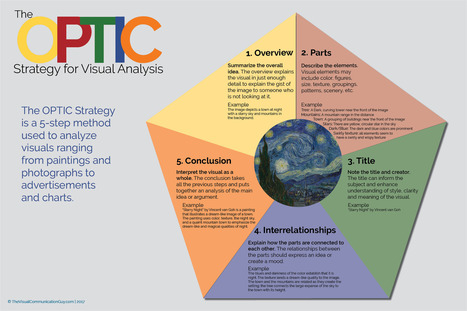
The OPTIC Strategy is a 5-step method used to analyze visuals. The strategy can be used to analyze any visual work.

Maddison Louise Pomeroy's comment,
May 31, 2018 12:38 AM
This is great, it's easy and I think the steps will make it easy for students to follow. It could also be used in other areas such as photography and design. Do you think there's anyways you could simplify this for a younger year group?
Scoop.it!
Writing can be an incredible tool for learning and understanding complex ideas. Writing can help you organize your thoughts, ascribe meaning to new concepts and see your own misconceptions about a topic. When you write, you connect ideas in ways you wouldn’t by just thinking about them.
Scoop.it!

21 Digital Tools To Build #Vocabulary @TeachThought https://t.co/plu5IMx1bC #edtech #teachers #literacy #K12 https://t.co/ZlmMnxotKG
Via Kirschty Birt, Terri Finn, Dennis Swender, Jim Lerman

Meg Wright's curator insight,
May 30, 2020 10:42 PM
This article highlights the importance of learners understanding vocabulary that is specific to each of their subjects given that this greatly impacts on their level of achievement. Regarding Mathematics, the Literacy General Capability requires learners to know mathematical vocabulary for the purpose of being able to interpret questions and being able to solve them.
Out of the range of tools on the website, my personal favourite is No. 9 (MathWords) as this online dictionary is easy to use and defines mathematical terms and formulas.
Scoop.it!

This set of OWL resources aims to help engineering instructors and TAs create and assess a variety of short, low-overhead writing exercises for use in engineering courses. The primary focus here is on “writing to learn” assignments, which leverage writing to improve students’ conceptual understanding of technical concepts.
From The Scout Report
"The Purdue OWL recently created this helpful resource for incorporating writing instruction into engineering classrooms, which may be useful for engineering instructors and teaching assistants. Created with support from the National Science Foundation's Research Initiation Grant in Engineering Education (RIGEE), these resources are designed with two purposes. The first is to support students in developing their writing skills; the second, to help students understand engineering concepts through writing exercises. With these dual aims in mind, this collection highlights six kinds of writing prompts that instructors might use with engineering students. These consist of conceptual writing prompts aimed at asking students to explain engineering concepts, such as fluid mechanics, in writing. Others include explain-a-problem writing prompts, which are designed to accompany engineering computational problems; how stuff works writing prompts (one example: "Explain how the gears of a bicycle work? What is changing when you change gears?"); real-world example writing prompts; design-a-problem writing prompts; and open-ended design writing prompts (one example: "Design a viewing platform that hangs over the Grand Canyon.")"
Scoop.it!
Over the last couple of months I've found and written about a number of really great tools and resources to help improve our students' writing skills. This is a collection of links to reviews of ten of the best.
Scoop.it!

Here are at least 14 trusty online tools of all kinds to give your students the edge as they work on improving writing skills. Via Allen Tiffany
Scoop.it!

[You owe it to yourself to read this. Despite what I thought I knew, I found it harrowing. -JL]
"When I downloaded a copy of my Facebook data last week, I didn’t expect to see much. My profile is sparse, I rarely post anything on the site, and I seldom click on ads. (I’m what some call a Facebook “lurker.”) Via Jim Lerman
Scoop.it!

Josh Allen began his career teaching kindergarten abroad in a completely analog classroom; flashcards, a laminator and a weekly visit to the local print shop were as high tech as it got. And while he felt students were making positive gains, they were lacking a real voice in the classroom and choice in their learning. Today, Josh is an Education Associate at Buncee ; the creation and presentation tool for K through 12 learners across the globe. Buncee turns students of all ages into digital storytellers able to engage with and visualize their learning in infinite ways. Josh Allen was joined by Eda Gimenez to discuss and demonstrate Buncee at the EdLab seminar in February of 2018.
|






