"The Good Person: Excerpts from the Yoruba is a compilation of hundreds of Yoruba proverbs. This resource was created by the late Oyekan Owomoyela, who taught African Literature at the University of Nebraska-Lincoln and was a leading scholar on Yoruba literary forms. Owomoyela writes in his introduction to this project, "[b]elieving that it carries great psychic properties, the Yoruba approach speech with deliberate care, taking great pains to avoid careless, casual, or thoughtless statements whose damage might outlast lifetimes." Proverbs, Owomoyela goes on to note, play a central role in Yoruba speech. In this collection, proverbs are organized into six thematic categories. These categories include: "On humility, self-control, self-knowledge, self-respect, and self-restraint;" "On perspicaciousness (good judgment, perceptiveness), reasonableness, sagacity, savoir-faire, wisdom, and worldly wisdom;" and "On consideration, kindness, and thoughtfulness." Within each of these six categories, proverbs are organized alphabetically. Each Yoruba proverb is accompanied by both an English translation and a note about the proverb's meaning."
Jim Lerman's insight:
Good source for writing/discussion prompts and to develop skills of comparison and analysis.
Reluctant readers and writers often have a difficult time with literacy. They may not like to read, or they find the process arduous because of poor reading skills or attention deficits.
Traditional literacy is about reading and writing, but digital technology has encouraged more broad definitions of literacy that include visual, media, and information literacy. Multiliteracy has reignited learners’ interest in literacy through digital storytelling, and teachers have discovered that they can capture the hearts of struggling learners with digital storytelling.
Digital storytelling lets struggling students bring their ideas to life in creative ways.
On Friday, July 6, 2018 as the Trinidad family were returning back to New Jersey, five members of their family (father and four daughters) were killed in a tragic car accident in Townsend, Delaware. The mother (Mary Rose) was the only survivor in their vehicle and currently hospitalized with serious injuries.
The father (Audie) was 61 years old, and his children include (Kaitlyn) a 20-year-old, (Danna) a 17-year-old and (Allison & Melissa) two 13-year-old twins.
It is unknown at this time the amount of support this mother will need and we did not intend to set a limited goal. However, any assistance of any kind is greatly appreciated at this difficult time.
"Can you improvise a coherent presentation from images you have never seen?
Enter a tag, press play, and see how well you can communicate a coherent message illustrated by 20 random photos, each one on screen for 20 seconds. Advanced options let you change the number of images and/or the timing."
Jim Lerman's insight:
A creative takeoff on the pecha kucha concept. Quite clever. Useful in a wide variety of settings.
"The kids in your classroom may not have been around when the choose-your-own-adventure books were popular in the ‘80’s and 90’s, but the concept of an interactive story will still engage them. There’s something about taking charge of a story’s direction that has broad appeal, and your students will want to see if they can find their way to a happy ending or will end up with some less-than-desirable outcome.
Making your own choose-your-own-adventure story is not difficult with the use of Google Forms. You can create a story yourself to get younger students reading. Or you can challenge older students to create stories, prompting them using their imagination as well as their writing skills. Here’s how you do it."
If you have a Google Home device in your classroom, your students can write and then hear amazing, interactive tales with the Story Speaker add-on.
Coding is an incredibly important skill in today’s world and all students should have some practice with it. But sometimes, you want to create something amazing without having to spend time on writing code. A new Google Docs add-on can help with that. Story Speaker allows students to easily create interactive “choose your own adventure”-type stories that are then read by any Google Home device.
Dr. Oakley is not the only person teaching students how to use tools drawn from neuroscience to enhance learning. But her popularity is a testament to her skill at presenting the material, and also to the course’s message of hope. Many of her online students are 25 to 44 years old, likely to be facing career changes in an unforgiving economy and seeking better ways to climb new learning curves.
Dr. Oakley’s lessons are rich in metaphor, which she knows helps get complex ideas across. The practice is rooted in the theory of neural reuse, which states that metaphors use the same neural circuits in the brain as the underlying concept does, so the metaphor brings difficult concepts “more rapidly on board,” as she puts it.
She illustrates her concepts with goofy animations: There are surfing zombies, metabolic vampires and an “octopus of attention.” Hammy editing tricks may have Dr. Oakley moving out of the frame to the right and popping up on the left, or cringing away from an animated, disembodied head that she has put on the screen to discuss a property of the brain.
Jim Lerman's insight:
Outstanding article with several links to valuable resources. Don't pass this by...it's worth your time.
"Given the opportunity to take notes by hand or on the computer, most students choose the latter. After all, modern technology offers plenty of benefits for writers.... Convenience, however, doesn’t trump old-fashioned writing by hand when it comes to learning. Writing by hand has benefits that technology has not been able to reproduce – yet."
Over 700 original science news videos. Featuring series on scientists in the field, behind-the-scenes tours, new research, and more!
Via The Scout Project
"Why did astronomers decide to designate Pluto as a dwarf planet in 2006? What did dinosaurs really look like? What can we learn from Vladimir Nabokov's extensive collection of butterflies? If these questions pique your interest, check out AMNH.tv: a collection of videos created by experts at the American Museum of Natural History that address a wide range of scientific questions. These videos are arranged into browsable sections on the left-hand side of the homepage. Shelf life, hosted by AMNH curators, highlights a variety of interesting collections in the museum (including the aforementioned Nabokov butterfly collection), allowing scientifically-minded individuals around the globe to learn more about the museum's offerings. Dinosaurs and fossils, which features a number of AMNH paleontologists, illuminates how some dinosaurs evolved into modern-day birds. Other collections in ANHM.tv include space, science bulletins, and kid science. "
"From the Schomburg Center for Research in Black Culture at The New York Public Library comes Black New Yorkers - an interactive timeline that traces the history of black individuals in New York City from 1613 through 2000. Black New Yorkers incorporates a number of thoughtful essays and primary source documents that illuminate this history. The timeline consists of five essays, each of which addresses a specific historical era. In the first essay, "Slavery and Freedom: 1613- 1865," readers can learn about the lives of free and enslaved black individuals during this period and view legal papers, illustrated portraits, and an 1841 issue of African Methodist Episcopal Church Magazine. This essay also highlights the stories of a number of important black New Yorkers from this period. The other four essays address the experiences of black New Yorkers during the Reconstruction, the first World War, the Great Depression, World War II and the 1950s, and between 1960-2000, respectively. Another highlight of this project is the resources page, which features two digitized NYPL collections. The first is "Negroes of New York," a Works Project Administration survey that documented the lives of black New Yorkers throughout history. Project writers included Ralph Ellison and Claude McKay. The second is a collection of issues of The Negro World, the newspaper of Marcus Garvey's Universal Negro Improvement Association. [MMB]"
"Last January, 1,200 undergraduate students at Yale University signed up for Professor Laurie Santos's seminar about positive psychology entitled "Psychology and the Good Life," making the seminar the most popular class in the history of the university. For those interested in learning more about positive psychology, Santos is teaching a course on Coursera called "The Science of Well-Being." This ten-week course, which begins on June 11th, is based on a spring 2018 semester Yale seminar and addresses topics such as meditation, growth mindset, and gratitude. As noted in the introduction to this course, "[t]he purpose of the course is to not only learn what psychological research says about what makes us happy but also to put those strategies into practice." In keeping with this goal, the course incorporates a number of weekly "rewirement" activities designed to help participants practice different positive psychology techniques. To take this course, visitors will have to create a free Coursera account. Interested individuals can audit this course for free."
"Of all the network tools we featured in the past year, Library Extension stood out as the clear reader favorite. We're also fans of this simple chrome extension that makes it easy to find and request books at your local public library. Best of all, Library Extension is continuing to grow, allowing readers to find books at libraries across the United States, Canada, and Australia. Library Extension also makes it easy for users to request new or additional libraries.
"Library Extension detects when you're viewing a book or ebook on a site like Amazon or Goodreads and adds a box showing the availability of that item in your local library. If you have access to more than one local library, it is able to check all of them. When an item is available from your library, Library Extension will also include a link allowing you to reserve it. Library Extension currently integrates with over 4,000 local libraries. Users can request support for additional libraries with a simple contact form. Users do not need to register for any additional accounts to use Library Extension. Currently, Library Extension is available for Google Chrome. A version for Mozilla Firefox is under development."
Now, creating a digital magazine is much easier. With web tools, students can layout their writings, pick from hundreds of cool fonts, and add their own images or choose from a library of stock images. Some web tools allow students to embed video and audio. Below I’ve listed some free educational web tools for creating a class ezine.
One of the most powerful techniques I used as a writing teacher was to do my students’ writing assignments with them. I would start my own draft at the same time as they did, composing “live” on the classroom projector, and doing a lot of thinking out loud so they could see all the decisions a writer has to make.
The most helpful parts for them to observe were the early drafting stage, where I just scratched out whatever came to me in messy, run-on sentences, and the revision stage, where I crossed things out, rearranged, and made tons of notes on my writing. I have seen over and over again how witnessing that process can really help to unlock a student’s understanding of how writing actually gets made.
Welcome to GoComics.com, the world's largest comic strip site for online classic strips like Calvin and Hobbes, Dilbert, Non Sequitur, Get Fuzzy, Luann, Pearl Before Swine, 9 Chickweed Lane and more!
Much of the current rhetoric about technology and education relates to devices and software programs—what types schools should purchase, how much money districts should spend on them, how they should be integrated into classroom learning, and what return on investment they should produce. The implicit message communicated by this rhetoric is that technology transforms education through the medium of specific tools—that these tools are what structure and produce powerful teaching and learning. Give teachers and students laptops and Google Classroom accounts and magic will ensue.
Over the past several years, a group of learning scientists—led by Mimi Ito at the University of California, Irvine—has pushed back against this perspective, arguing that technology has the potential to transform education not because of the affordances of any particular tool but because it creates a new ecology of learning that fosters collaboration, communication, and creativity. In a landmark 2013 report, this group detailed an educational approach, called connected learning, that aims to leverage this ecology to advance academic achievement, equity, and civic engagement.
Connected learning encourages us to consider how technological advancements allow us to interact in new ways and then develop learning opportunities that take advantage of these new forms of interaction. In this model, learning is of primary importance—not the tools. According to the connected learning framework, technology supports the development of open networks through which individuals who share interests can achieve a common purpose by creating together. As such, it suggests that teaching and learning should be designed to support these competencies. While this view of teaching and learning predates the digital revolution of the 21st century, connected learning offers a vocabulary and approach for harnessing technology in meaningful and relevant ways.
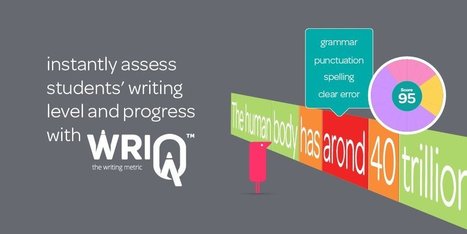
Discover WriQ, a Google Docs add-on that automatically marks the basics in student writing so that ELA teachers can concentrate on more difficult concepts.
Helping students improve their writing can be an extremely difficult and complex task. There are so many variables present in a piece of good writing that must all work together. Grammar, spelling, word choice, plot, sentence construction, voice — how can a teacher help students improve all of these and still have a life of her own that isn’t consumed by grading? Enter WriQ, a add-on for Google Docs.
Designed for the teacher and not the student, WriQ is a tremendous tool. The system scores and keeps track of students’ spelling, punctuation, and grammar errors so the teacher can focus on the things that computers can’t score as well. This will save the teacher time and frustration in marking those common errors. You can view a good introductory video on the power of WriQ here. The system auto-scores students’ docs and tracks the following measures over time:
"How can we rethink writing instruction to support students in writing authentic pieces about real-world issues that matter to them? How can we move beyond the "old school essay" and invite students to write compositions that reflect what we see in real world writing? These are the questions the authors address in the book Real Writing: Modernizing the Old School Essay. Check out our podcast, NWP Radio, to hear about this book and the practical strategies the coauthors have used to engage their students in civic writing."
Follow these steps to getting started with Book Creator on Chrome in their classroom. This post includes a webinar recording with strategies, lesson ideas, and answers to your frequently asked questions!
"This new online exhibit from the Harvard University Library Open Collections Program investigates "the intellectual, cultural, and political history of reading as reflected in the historical holdings of the Harvard Libraries." Curated by a team of librarians, archivists, and other Harvard University staff, this collection features a number of interesting items that illustrate the history of education and print culture, including early textbooks and books annotated by famous authors. Visitors may want to start by peaking at the collection highlights section. Highlighted works include a text from 1878 entitled A Fonetic Furst Reader by T.R. Vickroy; a copy of the The Life of Samuel Johnson, LLD., annotated by Hester Lynch Piozzi; and a 1697 "commonplace book" authored by John Hancock. Commonplace books were scrap-book type manuscripts that featured "short quotes, longer passages and transcriptions, letters, poems, tables of weights and measures, proverbs, prayers, and legal formulas." From here, visitors can explore additional items, which are arranged into three sections: Learning to read, featuring textbooks and books pertaining to the "science of reading"; Reading collectively, which includes items that illuminate the history of libraries and book clubs; and Reading on one's own, which contains several commonplace books as well as annotated texts."
"The National Film Board (NFB) of Canada recently released Indigenous Cinema, an online collection of films directed by indigenous Canadian filmmakers. Indigenous Cinema currently contains over 200 films, which visitors can browse by year (as of this write-up, the collection features films made between 1968 and 2017), director, nation, or by subject (including education, nature and ecological knowledge, and indigenous language). This collection includes animated shorts, feature-length documentaries, and a wide variety of short films. Some of these short films are part of Vistas, a 2009 series of 13 short films sponsored by NFB and the Aboriginal Peoples Television Network (APTN). Students and educators may want to navigate to the education tab, which highlights cinematic works by indigenous filmmakers and includes an array of educational materials. Visitors have the option to select highlighted works toward the top of the page, but scrolling down will uncover a large number of teacher resources. Available items include study guides, webinars, learning bundles, and interactive productions and apps. [MMB]"
This is that rarest of things—a high-quality, free, online resource made specifically for adult educators. Although the “Just Write!” Guide is mainly about writing instruction, there is a lot of material here regarding pedagogy in the adult ed classroom in general. What’s satisfying is that it is research-based (the fancy term is “meta-analysis) and that most of us who have worked in adult ed for any length of time will find our own understanding of how to teach adults validated in these pages.
"We dedicated our Fall 2017 special issue of The Scout Report to the topic of banned and challenged books, in honor of the American Library Association's 35th annual Banned Books Week. Our special issue was a reader favorite on social media and no website was more popular than the fabulous blog We Need Diverse Books. Why did we feature this resource in our Banned Books Week issue? As writer Malinda Lo noted in 2014, books that feature diverse characters and tackle issues such as disability, racism, and sexuality are more likely to be challenged than other fiction titles. We Need Diverse Books offers a wonderful way for readers to learn about new books for teen readers that address these issues.
"In 2014, young adult fiction writer Malinda Lo penned an essay called "Book Challenges Suppress Diversity." Drawing on the ALA's annual list of the most frequently challenged books, Lo demonstrated that "over half of the Top 100 Banned/Challenged Books from 2000-2009 addressed issues about race, sexuality and/or disability; or were about non-white, LGBTQ and/or disabled characters." We Need Diverse Books, part of the Banned Books Week Coalition, is a grassroots organization that aims to promote diversity and representation in young adult literature. The group defines diversity as "including (but not limited to) LGBTQIA, people of color, gender diversity, people with disabilities, and ethnic, cultural, and religious minorities." The organization's tumblr, which collects articles and reviews from around the web, provides an excellent way for readers, educators, librarians, youth workers, and caretakers to find books that are by diverse authors or feature diverse characters and topics. Recent posts include a profile of author Linda Sue Park for Kirkus Reviews; a story about the the first ever Well-Read Black Girl Festival that originally appeared in Electric Lit; and a story from Indian Country Today about Kinsale Hueston, a Navajo high school student who was recently named one of five National Student Poets."
This is a useful blog/tool that may be used to identify books of various diversities. The credibility of this blog may be in question; yet, it may offer ideas to librarians to further research in their quest for acquisitions.
To get content containing either thought or leadership enter:
To get content containing both thought and leadership enter:
To get content containing the expression thought leadership enter:
You can enter several keywords and you can refine them whenever you want. Our suggestion engine uses more signals but entering a few keywords here will rapidly give you great content to curate.


 Your new post is loading...