Making a newspaper is a great way to learn more about a time period or even a specific day of a famous event. During our homeschooling years, we put together several, including a Jamestown settlement newspaper and a Victorian era newspaper.
"This activity is perfect for an individual history project, but several students can also work together. Because there are so many different sections in a newspaper, there’s something for everyone, from the most advanced writer to the youngest child.
"TIP: If your children are not especially familiar with newspapers, pick one up at the grocery store. Have them do this free Newspaper Scavenger Hunt (courtesy of Moms and Munchkins) before launching into their project!
"Directions Consider the period you are currently (or soon to be) studying. Create a historical newspaper that centers on a specific year, decade, or era. Whether children are working alone or together, their newspaper should include 5-8 articles or sections:"
WriteBetter is a writing assistant available as a plug-in for Word 2013-2016, Chrome extension, and app for smartphone. This writing tool has three functions: contexts, dictionary, and translation. With contexts, learners can explore many sentences written by native speakers of English to discover how to use words in real contexts; with the dictionary, they can discover meanings, synonyms, antonyms, and expressions related to the word searched; with the translation function, they can explore human-made, contextualised translations in many languages, such as Spanish, Italian, French, among others.
The Most Dangerous Writing App is a free service that is designed to force you to write without stopping for a preset amount of time. You can set your writing timer for as few as three minutes or as many as many as sixty minutes. If you stop writing before the minimum time has been reached, all of your writing is deleted. Once you have reached the minimum time you can keep writing or you can download your writing as a plain text file.
The Most Dangerous Writing App can also be used with a minimum word count. The same concept as the timer mode applies to the word count mode. If you stop writing before your word count is reached, your work disappears.
Every once in a while an image appears that so viscerally frames the human story in a time of social or political paroxysm that it becomes a symbol. Such was the case this week with a smartphone photo taken during a demonstration in Sudan against the repressive regime of President Omar al-Bashir, as the protests that have been going on intermittently since December reached a new intensity.
In the picture, a woman in a white thoub and gold disc earrings stands on the roof of a car. She is caught in profile, mid-speech, one arm raised to the heavens, finger pointing upward, the other clutching her waist, amid a sea of heads and arms waving phones to record the moment. Posted on Twitter Tuesday by Lana H. Haroun, it had 50,000 likes by Wednesday morning and had taken on a life of its own.
Jim Lerman's insight:
A collection of several photos that dramatically communicate passionate and symbolic moments of recent history. Great works of art, they also provide excellent starting point for a wide variety of possible teachable moments in the arts, social studies, language arts, and more.
We all have our own unique ways of writing, so sometimes it’s helpful to learn from what others do. Here are some of the different strategies and techniques content writers use to enhance creativity on a day-to-day basis. Take a look:
Read Write Think Trading Cards is a free tool that students can use to create trading cards about people, places, and events both real and fictional. You can use it in your web browser, as an Android app, or as an iOS app. In this video I demonstrate how to use Read Write Think Trading Cards in your web browser.
In some ways, what you need to teach poetry well is a lot like what you need to write poetry well: You have to care a lot about your subject matter, and it’s important to foster conditions that inspire creativity. When these conditions are in place, teaching students to write poetry becomes much more fun, imaginative, and productive.
Maps can be great tools for supporting nonfiction and fiction stories. Being able to see the greater context of a location can go a long way toward helping students see the complete overview of a story. This can be helpful for learning about historical events, for supporting biographies, or for seeing the settings of fiction stories. Those are just a few of the types of stories that can be told with maps.
Yesterday, I featured a video about making map-based stories with StoryMap JS. That video is included at the end of this post. Here are four other ways that students can create map-based stories.
"MyStorybook is a nice online tool for creating short storybooks. MyStorybook provides blank pages on which you can type, draw, and place clipart. Your storybook pages can also include pictures that you upload. After signing into your MyStorybook account you can start creating your first book. Click on the text fields to edit any existing text in the title and author fields. You can add more text by clicking "text" in the editing menu. To add a picture of your own select "items" in the editing menu. At the bottom of the "items" menu you will find an option to upload your own images. MyStorybook provides lots of stock imagery that you can place on a page or use as the background to a page. If you want to branch-out beyond text and images, use the drawing tools on your pages."
Selection of site and description by Richard Byrne
"Book Creator is a popular tool for creating multimedia ebooks. It can be used in your web browser for free or you can purchase the iPad app to use it. Students can add pictures, drawings, and videos to their pages. Drawing tools are built into the service. Students can even add their voices to their ebooks. Watch my tutorial to see all of the ways that students can add content to their Book Creator ebooks.:
Writing is easily the one talent everyone needs, though not everyone has. It has the power to make us an *indispensable* resource for so many career paths out there…
So it's really important we *ease* our writers into the process!
The Photo Essay can be a great way to do this because this classroom activity focuses on the core foundations of writing (argument, specifically), but doing so in a way that appeals naturally to young adults (and doesn't feel as intimidating!)
What is a Photo Essay? Simply put, a Photo Essay is a collection of images that are intentionally ordered and arranged to convey a specific message or tell a particular story.
The hallmark of the Photo Essay is that it can convey this message clearly without the need of text to accompany. The goal, therefore, is to intentionally arrange photos in a logical sequence.
Depending on the basic purpose for writing (i.e. informational, argumentative, narrative), you can carry out the high aims of the Photo Essay in a number of ways, but for the purposes of this post, I'm going to zoom in on writing arguments, specifically.
So as a result of this lesson, students will be able to:
‘write' arguments to support claims, using valid reasoning and relevant + sufficient evidence. establish precise claims, and create an organization that establishes clear relationships among claims and evidence. But the reason I love Photo Essays the most is because students are ‘making‘, or creating their writing. It's a physical build-out of sorts that begs their creativity and critical thought.
"The first big technology platform was the web, which digitized information, subjecting knowledge to the power of algorithms; it came to be dominated by Google. The second great platform was social media, running primarily on mobile phones. It digitized people and subjected human behavior and relationships to the power of algorithms, and it is ruled by Facebook and WeChat.
We are now at the dawn of the third platform, which will digitize the rest of the world. On this platform, all things and places will be machine-readable, subject to the power of algorithms. Whoever dominates this grand third platform will become among the wealthiest and most powerful people and companies in history, just as those who now dominate the first two platforms have. Also, like its predecessors, this new platform will unleash the prosperity of thousands more companies in its ecosystem, and a million new ideas—and problems—that weren’t possible before machines could read the world."
Jim Lerman's insight:
This seems to me a very keen and well-informed look into the future of digital network technology. It's this month's lead article in Wired and it excited me so much I think everyone interested in the internet ought to read it. Author Kelly is well positioned to offer up his informed thoughts.
Below, we’ve chosen the best prompts — those that ask the most relevant questions and link to the richest Times materials — from our Student Opinion collection that address every stage of life, from coming-of-age and wrestling with one’s identity to understanding one’s role in a family; making friends; getting an education; falling in love; working; and experiencing old age. We hope they can provide jumping-off points for discussion and writing, and inspiration for further reading.
Most teachers know that our Student Opinion questions are free and outside The Times’s digital subscription service, but what you may not realize is that if you access the Times articles we link to from those questions via our site, the articles are also free. So in this list we hope we’re not just suggesting 100-plus interesting questions, we hope we’ve also helped you find 100-plus great works of nonfiction that can speak to the literature your students are reading.
So whether you’re taking on classic works like “The Catcher in the Rye,” “Romeo and Juliet” or “1984,” or whether you’re teaching more contemporary literature like “The Poet X,” “Speak,” “Refugee” or “There There,” we hope there are more than a few items on this list that will resonate.
"The Classtools SMS Generator is one of my favorite tools from the large catalog of free tools offered by Classtools. The SMS Generator is intended for creating fictional text message exchanges between fictional and or historical characters. It is free to use and does not require students to log-in. To use the SMS Generator just click the left speech bubble icon and enter a message. Then to create a reply just click the right speech bubble icon and enter a new message. You can make the exchange as long as you like. To share the conversation click the sprocket icon and grab the embed code, direct link, or QR code for the exchange."
Are you ready to dig into the instructional insights you need to help your students build their high school essays from the foundation up?
I thought so.
Click the button below to sign up!
Jim Lerman's insight:
Jill Pavitch runs a nifty website called edPioneer that focuses on teaching writing to secondary level students. She's offering this free masterclass; all that's required is free registration. She's playing it coy right now and not telling the date that it starts, but I imagine it will be in the next couple of weeks (today is April 15).
Reading comprehension is complicated. Teachers, though, can help students learn concrete skills to become better readers. One way is by teaching them how to think as they read.
Marianne Stewart teaches eighth grade English at Lexington Junior High near Anaheim, California. She recently asked her students to gather in groups to discuss books where characters face difficulties. Students could choose from 11 different books but in each group one student took on the role of “discussion director,” whose task was to create questions for the group to discuss together. Stewart created prompts to help them come up with questions that require deep reading.
This process of questioning while reading is one of a number of “cognitive strategies” Stewart teaches her students. The strategies focus on what research has shown to be the thought processes of good readers. Others include planning and goal-setting, tapping prior knowledge, making connections, visualizing and forming interpretations. By mastering these strategies explicitly, students learn that reading is an active process, not one in which they simply sound out words in their heads.
And it’s incredibly effective at improving their reading comprehension.
"...the Human Bar Graph (HBG) icebreaker isn't just a first-day-of-school type-of-gig. It can be used to ease into just about anything if angled right (and not overused).
"Trying to crack open a conversation, a novel, or a project with your students? This is a great way to get them on their feet while gathering valuable insights into their thoughts, beliefs, and/or attitudes as you launch into new learning territory.
Here's how it works…"
Jim Lerman's insight:
Excellent, detailed description of how to use this excellent technique. Definitely check this out.
"Editor's Note: In the next five years, most of America’s most experienced teachers will retire. The Baby Boomers are leaving behind a nation of novice educators. In 1988, a teacher most commonlyhad 15 years of experience. Less than three decades later, that number had fallen to just five years leading a classroom. The Atlantic’s “On Teaching” project is crisscrossing the country to talk to veteran educators. This story is the second in our series. Read the first one here.
“I want to say something important about writing,” Pirette McKamey told 25 seniors in her English class at San Francisco’s Mission High School one fall afternoon in 2012. It’s incredibly hard, and always incomplete, she explained. “I’ve reread some of my essays 20 times and I still go, ‘I can’t believe I made this mistake or that mistake.’”
“I’m going to read a powerful essay as a model today,” said McKamey, who frequently shares her students’ work at the beginning of class as a way to showcase examples of effective and creative approaches to writing. She appreciated the student’s paper for “the heft of its content,” she told the class. “It also feels real. It was written with real engagement and honesty.”
"Over 100 visual and video writing prompts for grades 6-8.
"One of the best aspects of being a teacher is watching students go from saying, “I hate writing,” to being so passionate about writing that they refuse to stop when the bell rings. In these moments, it can feel like magic. While there are many ways to spark the love of writing, one of my favorite strategies is a video or visual writing prompt. For over a decade, I have been creating authentic, teacher-tested writing prompts to spark the love of writing with even the most reluctant writer."
StoryMap JS is a free tool that comes from the same people that offer the popular multimedia timeline tool called Timeline JS. On StoryMap JS you can create map-based stories. You create the story by matching slides to locations on a map. In the following video I demonstrate how to use StoryMap JS.
"Alphabet Organizer is a great little tool from Read Write Think that students can use to create alphabet charts and books. The idea behind Alphabet Organizer is to help students make visual connections between letters of the alphabet and the first letter of common words. In this video I demonstrate how to use this tool."
"Picture Book Maker allows students to create six page stories by dragging background scenes into a page, dragging in animals and props, and typing text. All of the elements can be sized an positioned to fit the pages. Text is limited to roughly two lines per page. Completed stories are displayed with simple page turning effects. Stories created on Picture Book Maker can be printed and or saved as PDFs."
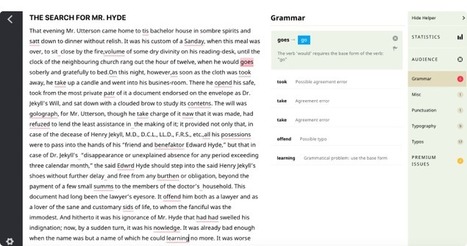
How To Add Feedback To Student Writing On Google Docs by TeachThought Staff Feedback is crucial for learning but there is an art and a science to its use. In 20 Ways To Provide Effective Feedback For Learning, we offered different strategies for learning feedback including the ideas of a ‘feedback sandwich.’ It can be …
Crucial para mi PFG, donde estamos utilizando Google Docs como herramienta para el seguimiento de avances e impulsamos su uso para la revisión de avances por parte de los docentes en el curso bimodal.
Over 2,000 students took us up on our second annual December challenge to “connect what you’re learning in school with the world today,” and, as you’ll see from the work of the winners, below, this year’s best were just as insightful and imaginative as last year’s.
Whether the connections these teenagers made were obvious, or whether they were so oblique it’s likely no one else has ever made them, what delighted us most was seeing the thinking in action. Many described aha moments, when a work of literature or an event in history was illuminated by something in The Times, whether a Letter to the Editor that helped make sense of “Death of a Salesman,” or a Smarter Living piece that, as one student wrote, would have greatly helped Hamlet “handle his anger responsibly.”
Our young citizens are leading through new thinking and ideas. We have a lot to look forward to from the teenagers of America as they step into their roles as everyday leaders!
To get content containing either thought or leadership enter:
To get content containing both thought and leadership enter:
To get content containing the expression thought leadership enter:
You can enter several keywords and you can refine them whenever you want. Our suggestion engine uses more signals but entering a few keywords here will rapidly give you great content to curate.


 Your new post is loading...