 Your new post is loading...

|
Rescooped by
Jim Lerman
from Tools for Teachers & Learners
June 22, 2019 1:15 PM
|
"WebSatchel allows you to save a replica of a web page. The page will be stored on cloud and can be opened later using any browser and any computer. For example you can save a page at home and access it from work. Saved pages are encrypted when stored and access to them is password protected. What is very important is that the page is not just saved but indexed as well. This will allow you to find this page even if you don't remember the exact details. "Essentially WebSatchel is your personal search engine which will only search the pages that you saved before. Thus you will get the best of both worlds. On one hand you will have the power of a search engine, on the other hand it will only search amongst pages that you value instead of returning you thousands of useless results. Another extremely useful feature is that you can mark or highlight some areas on the page before saving it. This mark-up will be saved along with the page and will allow you to immediately focus on the important information when you load the page in the future." Jim Lerman's insight: This is quite a useful research tool. Currently it says it's in beta, so improvements are likely to come fairly regularly for awhile. And right now (6/22/19), it's free. I personally subscribe ($) to Diigo for this purpose and shudder to think what my online life would be without it. I'm sure Websatchel users will find that service to be very useful as well. As Websatchel matures, I imagine it will evolve into an rich user-validated repository of excellent information resources. As they say, the more it's used, the smarter it gets.
Via Nik Peachey
|
|
Rescooped by
Jim Lerman
from Cultivating Creativity
June 21, 2019 9:51 AM
|
"The inner monologue of an anxious teenager. A fictional radio story about a robot takeover. An investigative report about teenage climate activists. A personal narrative about what it’s like to have a baby at 15." "These are just a few of the winning pieces from our Second Annual Student Podcast Contest, in which we invited teenagers to create an original audio program, five minutes or less, about anything they wanted." "We received nearly 900 submissions — including interviews, conversations, reviews, investigations, personal stories and fictional tales — from students all over the world." "But there were 39 entries — 12 winners, 15 runners-up and 12 honorable mentions — that stood above the rest. These podcasts pulled us in right from the start and kept our attention to the end. They brought their topics to life with music, environmental noise, media clips and the human voice. They were entertaining, informative and emotionally gripping" "But don’t take our word for it. You can listen to all the finalists for yourself, below."
|
|
Rescooped by
Jim Lerman
from Into the Driver's Seat
June 17, 2019 10:13 AM
|
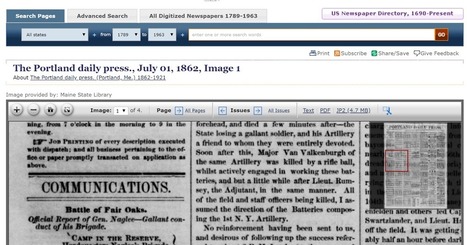
"There are two sites that often refer people to when I'm asked about locating copies of old newspapers. The first is the Google Newspaper Archive. The second is the Chronicling America collection from the Library of Congress. The Chronicling America collection contains more than 2,600 digitized copies of newspapers printed in the United States between 1789 and 1963. You can search through the collection according to date, state in which the newspaper was published, and keyword.
"The Library of Congress hosted an online conference for teachers in the fall of 2016. One of the featured presentations of that conference was Teaching With Historical Newspapers. Chronicling America was featured in the presentation. You can watch the recording embedded below to learn how to navigate the Chronicling America collection and pick up some tips for incorporating the newspapers into your practice."
|
|
Rescooped by
Jim Lerman
from Into the Driver's Seat
June 9, 2019 5:21 PM
|
You’ve wrapped your last major unit and final exams are still a week or so away. You could spend five days on Review Jeopardy (um…no, thanks) or you could grab some of these tried-and-true resources that’ll keep kids focused until finals. Click on the lesson title to learn more about each item. Some are free and some cost a few bucks.
|
|
Scooped by
Jim Lerman
May 24, 2019 11:24 AM
|
"Teachers tell us they use these prompts in all kinds of ways. Some use them to encourage students to develop a daily writing habit. Others as an exercise to practice inferences, spark discussion or support reading. This year, one elementary school music teacher told us how her class used the visuals as inspiration for writing short stories accompanied by music. "For more ideas, we have a lesson plan on how to teach with Picture Prompts and other Times images, as well as a free, on-demand webinar that explores how to use our thousands of writing prompts for everyday low-stakes writing practice across the curriculum. "Below, we’ve categorized the 140+ prompts we published during the 2018-19 school year based on the type of writing they primarily ask students to do — whether it’s penning short stories and poems, sharing experiences from their own lives, telling us their opinions, or interpreting an image’s message. All are still open for comment. "You can find even more images in our Picture Prompt roundups for the 2016-17 and 2017-18 school years."
|
|
Rescooped by
Jim Lerman
from Cultivating Creativity
May 24, 2019 11:08 AM
|
The idea behind Shlechty’s framework is, in short, to focus on the work that students do, and the systems that produce that work. While there are critics of how it works in practice, the ideas are sound. One of the stickier takeaways for me from the “WoW” resources was the idea of levels of student engagement. I had recognized every level in my classroom as a teacher (struggling students usually in the ‘Retreatism’ area, while even the ‘best’ students I had seemed to be around the ‘Ritual Compliance’ level. It was eye-opening for me.
For starters, the idea of ‘authentic engagement’ now had a new standard. No longer was ‘paying attention’ and eye contact and completing the assignments the standard. I started looking for sustained immersion.
I also began to itemize the kinds of things that motivated students. It was already clear to me that students want to ‘do well in school’ for different reasons, but now those ‘reasons’ had names and I could see a full continuum of student engagement in my mind. This helped me begin to plan (creating tiered learning targets, for example) not just for ‘mastery level’ but the engagement of minds that would then lead to that kind of mastery I’d been looking for.
Via Jim Lerman
|
|
Scooped by
Jim Lerman
May 21, 2019 11:59 PM
|
You do exceptional things in the classroom every single day. NCTE is here to recognize them. "NCTE and Penguin Random House Teacher Award for Lifelong Readers & Maya Angelou Teacher Award for Poetry Deadline: May 31 This newly created Penguin Random House partnership with the National Council of Teachers of English will recognize the nation’s most dynamic and resourceful teachers who use their creativity to inspire and successfully instill a lifelong love of reading and poetry in students. There are two separate and distinct $10,000 grants. Deadline: June 1 This new NCTE award recognizes a person with a disability who has made a significant contribution to the Council and to the development of our professional community. This award intends to include mental, physical, sensory, and other disabilities. Recipients of this award promote and support the advancement of people with disabilities in our profession through their service, writing, teaching, scholarship, and professional development. Deadline: June 1 Members of the LGBTQ+ community have always been active in literacy teaching and learning; they also have been active members of NCTE. This new NCTE award recognizes a member of the LGBTQ+ community who has made a significant contribution to the Council through their service, scholarship, and actions that promote and support the advancement of the LGBTQ+ community in the profession, in literacy-related activities, and in public engagement, creating a culture of change. Deadline: Extended to June 1 This award ($2,000 honorarium) recognizes teachers in grades K–6 who, through the teaching of writing, demonstrate an understanding of student improvement in writing." Jim Lerman's insight: NCTE offers quite a number of awards. Listed above are several with upcoming due dates for applications. Click on the image above or the headline to go to a listing of all of them throughout the year.
|
|
Scooped by
Jim Lerman
May 17, 2019 12:35 PM
|
What’s going on in this picture? Look closely at the image above or view it in a larger size, then tell us what you see by posting a comment. On Thursday afternoon, we will reveal more about the image and its origins at the bottom of this post
|
|
Rescooped by
Jim Lerman
from Cultivating Creativity
May 7, 2019 9:49 AM
|
As an educator, you may have several resources in your PLN (Professional or Personal Learning Network) where you collect tools for students. But where do you go for tools to use for your own reading and writing? Even if you have some more traditional tools you enjoy, consider some of these to help you, whether for fun or work. Jim Lerman's insight: Great tools for one's reading and writing.
|
|
Rescooped by
Jim Lerman
from Cultivating Creativity
May 1, 2019 12:40 PM
|
Facilitating inquiry does not have to be an obstacle to the successful implementation of PBL in your classroom. Following these three guidelines can help you organize, plan and facilitate flexibly- creating a great experience for both you and your students.
Via Jim Lerman
|
|
Rescooped by
Jim Lerman
from Into the Driver's Seat
April 30, 2019 9:47 AM
|
As an educator, you may have several resources in your PLN (Professional or Personal Learning Network) where you collect tools for students. But where do you go for tools to use for your own reading and writing? Even if you have some more traditional tools you enjoy, consider some of these to help you, whether for fun or work.
Editor's Note: In the next five years, most of America’s most experienced teachers will retire. The Baby Boomers are leaving behind a nation of novice educators. In 1988, a teacher most commonly had 15 years of experience. Less than three decades later, that number had fallen to just five years leading a classroom. The Atlantic’s “On Teaching” project is crisscrossing the country to talk to veteran educators. This story is the second in our series. Read the first one here.
“I want to say something important about writing,” Pirette McKamey told 25 seniors in her English class at San Francisco’s Mission High School one fall afternoon in 2012. It’s incredibly hard, and always incomplete, she explained. “I’ve reread some of my essays 20 times and I still go, ‘I can’t believe I made this mistake or that mistake.’”
Via John Evans
|
|
Rescooped by
Jim Lerman
from Cultivating Creativity
April 20, 2019 11:54 AM
|
Columbine High School teacher Kiki Leyba remembers April 20, 1999 as a day of two life-altering extremes. He was a first-year Columbine teacher meeting with then-Principal Frank DeAngelis, who had just offered him a contract to continue teaching at the school — his dream job — when gunshots rang out in another part of the building.
He quickly found himself guiding students outside and away from the building, attempting to call 911 on his cell phone but finding the line was busy, overloaded by calls from frantic people.
Via Jim Lerman
|
|
|
Rescooped by
Jim Lerman
from Cultivating Creativity
June 21, 2019 10:06 AM
|
"Every school day we choose an important or interesting news or feature story to become our Article of the Day, then write a quick series of questions and activities designed to help students both understand the piece and connect it to their own lives. "Each edition has suggestions for engaging students before they read, comprehension and critical thinking questions to support them as they go, and ideas for taking the topic further when they’re done. "As you might expect, many of our Articles of the Day respond to the big issues and news events of the day. This year, topics included the U.S. midterm elections, the synagogue shooting in Pittsburgh and the California wildfires, along with international events like protests and crises in France, Sudan and Venezuela. "But we also try hard to choose pieces as our Article of the Day that are “evergreen”: stories that are interesting in their own right, and that will be powerful, vivid and compelling in the future. From the 181 Articles of the Day we published during the 2018-19 school year, we selected 102 evergreen stories to include in the categorized list below, drawn from the Arts, Sports, U.S., World, Education, Science, Health and Technology sections. We hope some of these articles and their related learning activities can become part of your curriculum."
Via Jim Lerman
|
|
Rescooped by
Jim Lerman
from Into the Driver's Seat
June 17, 2019 11:35 AM
|
Fiction and Non-Fiction Writing Prompts - 5 Sources :: Richard Byrne
For many of our students the hardest part of any kind of writing assignment is just getting the first few sentences on paper. Over the years I've tried dozens of story-starter and writing prompt services. Here are the five that I recommend now. DIY Writing Prompt Generator in Google Sheets Flippity offers a Google Sheets template called the Mix & Match template. This is a template that you can use to create fiction and non-fiction writing prompts. In this video I demonstrate how to use Flippity's Mix & Match template. The great thing about this template is that you can use it in any subject area because you choose the words and phrases that appear in it. Comics as Writing Prompts Make Beliefs Comix offers more than 700 writing prompt pages. The printables section on Make Beliefs Comix is organized into dozens of categories. Some of those categories include A Book of Questions, Heroes, History, and Poetry. All the the printable writing prompt pages include artwork designed to spark a student's imagination. Some of the artwork is in color and some is in black and white. A perk of the black and white artwork is that you're essentially getting a coloring page and a writing prompt in one package. Pictures as Writing Prompts PicLits aims to provide inspiration for writing short stories through the use of pictures. PicLits tries to reach this goal by providing users with images upon which they can build their writing. To get writers started, PicLitsprovides a list of words which can be dragged and dropped into sentence form. If you don't want to use or don't need a word list, you can select the "freestyle" option to begin free-form writing. Shake Your iPad to Start a Story Story Dice for iOS is a free app that lets you select up to ten dice from four story categories. The dice feature pictures that are intended to prompt you to write about them or include them in a story. You can roll the dice by shaking your iPad or by just tapping the roll icon. Want to write your own Star Wars fan fiction? Story Dice has a Star Wars category. Keep Writing or All Progress is Lost! The Most Dangerous Writing Prompts forces you to write for a minimum amount of time or minimum words without stopping for more than a few seconds or all of your work is lost. If you do reach the minimum (you choose what the minimum is), you can download your writing as a Word doc to continue the writing and editing process. The Most Dangerous Writing Prompts contains 500 writing prompts. See the site in action in this video.
|
|
Rescooped by
Jim Lerman
from Into the Driver's Seat
June 17, 2019 10:03 AM
|
"Back in April I featured a neat creative writing tool called The Most Dangerous Writing App. Since then The Most Dangerous Writing App has changed to The Most Dangerous Writing Prompts. The service now includes 500 writing prompts to help you get started on your next great work of creative writing.
"The concept of The Most Dangerous Writing Prompts is the same as it was when it was called The Most Dangerous Writing App. You have to write for a minimum amount of time or minimum words without stopping for more than a few seconds or all of your work is lost. If you do reach the minimum (you choose what the minimum is), you can download your writing as a Word doc to continue the writing and editing process.
Watch my new video...to learn how to use The Most Dangerous Writing Prompts."
|
|
Rescooped by
Jim Lerman
from Cultivating Creativity
May 24, 2019 11:33 AM
|
Via The Scout Report "The Library of Congress is well known and loved for its vast online collections. Readers who find the library's digital enormity overwhelming, as well as those seeking royalty-free images, may appreciate these sets of copyright-free images and other content curated from the library's holdings. Here, visitors will find more than two dozen sets organized by theme, many of which are historical images and ephemera. The themes cover a diverse range of subjects, ranging from cats and dogs to Abraham Lincoln to roadside America, with several themes highlighting various types of historical posters. While most of the collections consist of photographs, documents, and other images, visitors will also find a collection of public domain films from the National Film Registry, as well as a vintage set of classic children's books that can be read online, including The Secret Garden and The Jungle Book. Because the "Library believes that this content is either in the public domain, has no known copyright, or has been cleared by the copyright owner for public use," the items featured in these sets have been deemed "free to use and reuse."
Via Jim Lerman
|
|
Scooped by
Jim Lerman
May 24, 2019 11:10 AM
|
Student engagement in learning is kind of important.
No matter the best practices of your curriculum mapping, instructional strategies, use of data for learning, formative assessment, or expert use of project-based learning, mobile learning, and a flipped classroom, if students aren’t engaged, most is for naught.
Historically, student engagement has been thought of in terms of students “paying attention”: raising hands, asking questions, and making eye contact. Of course, we know now that learning can benefit from learner self-direction and self-initiated transfer of thinking as much as it does simple “engagement” and participation.
That being said, increasing engagement and sheer participation is not a wrong-headed pursuit in and of itself, and in pursuit of that is the following infographic from Mia MacMeekin: 27 ways to increase student engagement.
|
|
Rescooped by
Jim Lerman
from Cultivating Creativity
May 24, 2019 10:41 AM
|
"Oxplore is an innovative digital outreach portal from the University of Oxford. As the ‘Home of Big Questions’ it aims to engage those from 11 to 18 years with debates and ideas that go beyond what is covered in the classroom. Big questions tackle complex ideas across a wide range of subjects and draw on the latest research undertaken at Oxford." Jim Lerman's insight: Great for project based learning or creative inspiration.
Via Nik Peachey, Jim Lerman
|
|
Rescooped by
Jim Lerman
from Into the Driver's Seat
May 18, 2019 4:20 PM
|
If you’ve ever taught writing to a group of struggling pupils, you can identify with the sense of helplessness you feel as a teacher who wants to catch them up on all they have missed, but they’re so far behind you have no idea where to start. For the last ten years, I’ve taught students who were years behind grade level — ninth graders who wrote like elementary students, who couldn’t hear the awkwardness of a poorly constructed sentence, who misspelled their, they’re, and there like it was their job.
Good teachers adapt to their students’ needs. Struggling writers are just as frustrated with the task of writing as we are with trying to assess their work. I’ve learned that students who have low self-confidence benefit from scaffolding and differentiation. Whether you teach students who fall into this category year round or just during summer school, these strategies might help you to adjust your instruction, thereby increasing their engagement and chances of success.
|
|
Rescooped by
Jim Lerman
from Into the Driver's Seat
May 17, 2019 12:34 PM
|
"A couple of weeks ago, we decided to flip the script of our usual Student Opinion questions. Instead of choosing an article and asking students to comment on it, as we’ve done daily all school year long, we asked you to tell us what you’re reading in The Times and why. "We heard from basketball fans in Philadelphia who read about 76ers star Joel Embiid as his team battled in the N.B.A. playoffs. We heard from teenagers concerned about climate change who chose pieces about a 16-year-old climate activist and a report on mass extinction. "We heard from overworked students who suggested articles on mental health, getting straight A’s, confidence and why giving up is sometimes the best way solve a problem. "And we heard from many young people who have been keeping up with front page news, from the college admissions scandal and election meddling to recent pieces on the Sandra Bland video and the abortion debate.
Below are 25 of the best responses we got. Not only do we think other teenagers might enjoy these articles, but we also want to show examples of the kinds of writing we’ll be looking for in June, July and August when we run our 10th Annual Summer Reading Contest. If you’re interested in participating, all the details are here, and all you have to do is what the students from Julia R. Masterman School, the Governor’s Academy, Hoggard High School and elsewhere did below: Just tell us what you’re reading, viewing or listening to in The Times and why."
.
|
|
Rescooped by
Jim Lerman
from :: The 4th Era ::
May 4, 2019 7:02 PM
|
"In spring 2018, Deep Center, thanks to an Educator Innovator mini-grant from the National Writing Project, piloted extended programming at one of Savannah’s most challenged public schools, Hubert Middle School.
"Deep Center’s mission is to empower Savannah’s young people to thrive as learners, community leaders, and agents of change. Through creative writing, cultural production, and art, Deep creates platforms for the city’s youth and the village of support around them, including their families and adult allies, to share stories, engage in debates, and make Savannah a more just and equitable place.
"In our workshop at Hubert, Deep Center used assets-based creative-writing, connected learning, multimodal exploration, and intergenerational community engagement to help young people connect their learning to their lives and their lives to their community.
"Deep and Hubert built from an existing partnership to expand and tailor programming to the school’s and neighborhood’s unique challenges and context. This expansion included a doubling of programming hours (meeting twice weekly for 11 weeks), replacing volunteer teaching artists with paid teaching artists, and more intentional engagement with the community around critical issues facing the surrounding neighborhoods that the youths called home. Final products were inclusion in a published book and a final performance.
"Immediately upon beginning the program, we realized our group of sixth graders needed a different program than the one we’d originally planned. Because of Deep’s grounding in a strong pedagogy and program plan, we were able to adapt our plan as our young people needed while remaining true to our pedagogical framework
Via Jim Lerman
|
|
Rescooped by
Jim Lerman
from :: The 4th Era ::
May 1, 2019 12:33 PM
|
"There are many reasons to be curious about the way people learn, and the past several decades have seen an explosion of research that has important implications for individual learning, schooling, workforce training, and policy. "In 2000, How People Learn: Brain, Mind, Experience, and School: Expanded Edition was published and its influence has been wide and deep. The report summarized insights on the nature of learning in school-aged children; described principles for the design of effective learning environments; and provided examples of how that could be implemented in the classroom. "Since then, researchers have continued to investigate the nature of learning and have generated new findings related to the neurological processes involved in learning, individual and cultural variability related to learning, and educational technologies. In addition to expanding scientific understanding of the mechanisms of learning and how the brain adapts throughout the lifespan, there have been important discoveries about influences on learning, particularly sociocultural factors and the structure of learning environments. "How People Learn II: Learners, Contexts, and Cultures provides a much-needed update incorporating insights gained from this research over the past decade. The book expands on the foundation laid out in the 2000 report and takes an in-depth look at the constellation of influences that affect individual learning. How People Learn II will become an indispensable resource to understand learning throughout the lifespan for educators of students and adults." Jim Lerman's insight: This is the most up-to-date, definitive, consensus, scholarly publication on how people learn in the US. Can be read online or downloaded, for free. This is an update of the 2000 edition.
Via Jim Lerman
|
|
Scooped by
Jim Lerman
April 28, 2019 9:04 PM
|
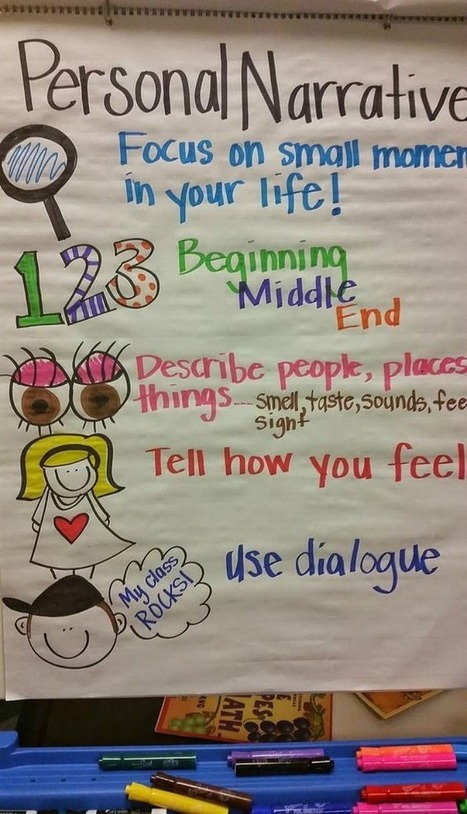
Anchor charts are a great way to make thinking visible as you record strategies, processes, cues, guidelines and other content during the learning process. Here are 25 of our favorite anchor charts for teaching writing.
|
|
Rescooped by
Jim Lerman
from Tools for Teachers & Learners
April 21, 2019 11:41 AM
|
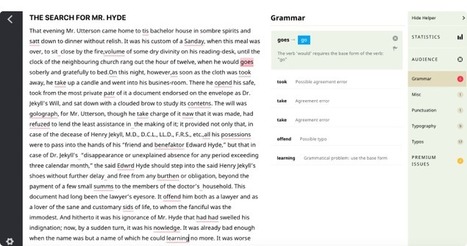
Millions trust Textly’s free writing app to make their messages, documents, and posts clear, mistake-free, and effective.
Via Nik Peachey
|













A useful research and study tool.