"What stereotypes about teenagers do the adults you know seem to hold? How does the media portray people your age — whether you’re called Gen Z, iGen or anything else?
"What can you show us from your own life, or the lives of those around you, that might help make that portrait more interesting, nuanced, complete or real?
"In this contest we invite young people to take photographs that depict some aspect of teenage life that you think may be misunderstood, ignored or largely unknown, and, in a short artist’s statement, tell us why.
"Below is the submission form, followed by the rules and guidelines, as well as a list of related resources, including a lesson plan and the work of last year’s winners.
"We can’t wait to see what you send us. Please let us know if you have any questions by posting a comment to this page, or by contacting us at LNFeedback@nytimes.com."
I’m going to share the tools and processes I use to produce this podcast, some do’s and don’ts I’ve picked up through trial and error, and just general advice for anyone who wants to start their own show. Because most of the people in my audience are teachers, I feel I should mention that this particular post is meant for anyone who is interested in podcasting, and that includes your students, their parents, other community members, and so on. So feel free to share this one widely.
This is not going to be a totally thorough, step-by-step tutorial, though. You can find some excellent ones online that will walk you through all the details from start to finish. The one I would recommend is from someone named Pat Flynn, and you can find it here. So rather than provide a full, step-by-step tutorial, what I’m going to do here is just share my own process and tips.
"Correct your English writing with virtualwritingtutor.com - the best grammar checker, essay checker, sentence checker, punctuation checker and spell checker for second language learners.
"This free online grammar check website or proofreader helps writers count words, check spelling, check grammar and punctuation, check paraphrasing, improve word choice, self-assess the use of target structures, and master English pronunciation. It also trains learners and novice teachers to become better proofreaders with an error correction game on the Error Correction Games page."
"Adjacent Possible. Have you heard of it? If you listen to the Educational Duct Tape Podcast, you probably have. It’s this theory that a new set of possibilities is enabled by taking one step beyond the current state of things. Every step opens up new possibilities, just like every conversation with a person can lead to new possibilities that you had not considered.
"Well, I had an Adjacent Possible experience a few days ago while interviewing Tony Vincent for Episode 26 of the Educational Duct Tape podcast. Tony was responding to a question about how to help students get to know each other. He shared with me about this activity that he had done where his students took side profile pictures of themselves and then turned them into silhouettes of in Google Slides. They then added in images and words that showed their interests. The students presented their slides to their classmates and, later, those same slides were played on a loop on a screen in the room. What I love about this activity is that, on the surface, it’s a great “getting to know each other” activity. But, underneath that, it’s also a fantastic way to teacher kids some new skills with a tool that the teacher planned on using in class."
Jim Lerman's insight:
This is a marvelous piece that discusses how a tool can be used to open up and leverage a single experience into something much deeper and broader. Well worth reading and trying with students!
Developing intercultural competence involves a transformation in thinking; it is an ongoing, highly rewarding process. Honest and open communication is key
As teachers, we usually go into the first weeks of school assuming full responsibility for building the learning space. But what happens if we put some of that responsibility in our students’ hands instead? Our new students come to us full of ideas, stories, expertise, and curiosity. These are the essential materials for a strong classroom community. Here are a few ideas for how to put those raw materials to use:
Most graduate writers who are struggling with their writing are actually struggling with their thinking. It isn’t a psychological block, but rather the intellectual confusions endemic to the process of communicating sophisticated research. To Rachael Cayley, these confusions are real and can have deleterious consequences for writing, but when we treat these problems as conceptual problems in our thinking we create the space to use writing as a strategy to solve them. The writer’s block label may just be further alienating us from our own writing; write your way out.
Words Without Borders Campus connects students and educators to eye-opening contemporary literature from around the globe.
Description by The Scout Report
"Language and literature educators interested in incorporating contemporary international writing into their curriculum may want to check out Words Without Borders Campus. This resource "connects students and educators to eye-opening contemporary literature from across the globe," and aims to "create a virtual learning space without borders, fostering meaningful cross-cultural understandings and inspiring a lifelong interest in international literature." Here, visitors will find stories, essays, and poems translated into English, originating from countries like Mexico, China, and Egypt. Most of the literature is drawn from the digital magazine Words Without Borders (last featured in the 7-12-2019 Scout Report). Under Find Literature, this project's resources are organized by country, genre, and theme, with Jump To buttons leading to an essay introducing and contextualizing each country's contemporary literature. In addition to an English translation, each piece of literature includes vocabulary definitions, an author's bio, contextual information such as recordings of pronunciations in its original language, and a "playlist" of related readings. Visitors who are logged in (after registering for a free account) can also access Teaching Ideas for each piece, which include suggestions for ways to foster students' engagement with the reading, potential assignments, and relevant educational standards. "
"Thanks to enthusiasm from schools about these opportunities to spotlight student voice, this year we’re offering more opportunities than ever before.
"For 2019-20, we’ll be running 10 contests, including two new additions to our usual lineup. In September, you’ll find our first-ever personal narrative essay contest, and in the spring we’ll be inviting students to write about STEM concepts.
"We are also excited to announce that our review contest, and possibly others, will now be open to middle schoolers. Please stay tuned for details.
"As each contest goes live, we will add a link here, on this page, but you can learn more now simply by clicking the “Rules and Guidelines” for each.
"To download a PDF version of this contest calendar, click here. To learn more about our contests in general, scroll to the bottom of this post. If you have any questions, please write to us at LNFeedback@nytimes.com or post a comment."
This teaching guide, the first installment in our seven-unit writing curriculum, includes daily writing prompts, lessons based on selected mentor texts, and the announcement of a new personal narrative essay contest.
Build skills and gain confidence in analyzing, making, and teaching with media-- across all subject areas and grade levels. Each course offers hands-on projects for you to learn how to make media and create instructional resources. Get ready to bring civic media literacy to your practice!
Jim Lerman's insight:
22 free courses for educators, laser-focused on key media skills. Some titles include: Communicating with Photography, Constructing Media Messages, Digital Portfolios, How to Manage and Assess Media Projects, Making Infographics, Podcasting, Understanding Copyright, Video Storytelling Essentials, and many more. Each course runs from 6 to 15 hours. Each online course is available any time.
"Civic IDEA is a media literacy intervention to help build the capacity of youth to be more engaged citizens through the creation and distribution of media. Civic IDEA incorporates accessible technologies and a focus on connecting critical inquiry with active engagement in daily life. Youth who engage with the IDEA framework will learn to identify and investigate issues, deliberate around their values, express alternative narratives to current messages, and advocate for communities and issues that matter.
Incorporating Dynamic Tools Into the Learning Process
"Each module in the IDEA framework-Investigate, Deliberate, Express, and Advocate-is anchored by an interactive digital learning tool and series of activity guides that facilitate fun and creative inquiries. Databasic is a simple online tool that allows users to quickly analyze data sets, look for correlations, and create visualizations and connections. @Stake is a mobile role playing game that enables small groups to deliberate about civic issues they define themselves. MediaBreaker allows youth to input and remix visual content to express themselves in relation to mainstream media narratives. Emerging Citizens encourages civic advocacy through popular social media modalities, such as Twitter, Wikipedia and memes.
"Collectively, the tools and guides move learners from critical inquiry to active engagement and participation in daily civic life."
Produced by The Engagement Lab at Emerson College with funding by the U.S. Agency for International Development. - JL
Register now to join our free live webinar on Sept. 25, 2019 at 4 p.m. E.T. — or to receive a link to stream the recorded webinar any time on-demand.
"Imagine a free teaching activity that:
Is fun for students of all ages and used by teachers across disciplines
Can serve as a bell-ringer, a homework assignment or the focus of a lesson plan
Helps students get better at observing closely, making arguments and using evidence to support their claims
"Welcome to “What’s Going On in This Picture?,” our popular weekly feature now in its eighth year.
"Here’s how it works: Each Monday we post an intriguing photograph that has been stripped of its caption and other identifying information. Then, students from around the world join a live-moderated discussion, telling us what they notice and what conclusions they can draw from those observations. The conversation continues all week, often attracting over a thousand comments, until we post a “reveal” on Thursday afternoons.
"In this free hourlong webinar, we’ll discuss a variety of ways to use “What’s Going On in This Picture?” in subjects from science to social studies, English to the arts, and we’ll participate together in our own live “WGOITP?” activity. We’ll be joined by teachers who use the feature, as well as moderators from our partner organization, Visual Thinking Strategies, who run the live-moderated Monday discussions.?"
"Create and view language learning content with interactive text reconstruction activities and quizzes based on short videos.
"Teachers can create classrooms and set assignments for their students. To see what a classroom looks like from a student's point of view, visit this example classroom, with assignments designed to demonstrate how assignment activities can be configured to provide varying levels of support."
"After the latest updates were announced during FlipgridLIVE at #ISTE19, we knew we could not do this alone anymore. Jen Saarinen, an original Flipgrid Hero and a dear friend of ours joined in the fun this time to help update and create a resource for the educators new to Flipgrid.
"Being the fourth iteration, this ebook guide has become a little bit of a passion project for Karly and Sean. We did not create this ebook for Flipgrid, we did it for you, our fellow educators! Teaching can be very difficult. So we hope this ebook will be a helpful guide to get you more comfortable using Flipgrid in your classroom and promote more student voice and choice in sharing their learning. Please reach out to us if you have any questions we can help you with."
Sean, Karly, and Jen
Jim Lerman's insight:
Flipgrid is a terrific app and this is a great beginner's guide to get all us educators up to speed..
Easy and free screen recorder for Mac, Windows, and Chromebooks. Record your camera and screen with audio directly from your Chrome browser and share the video with your team, friends, and family.
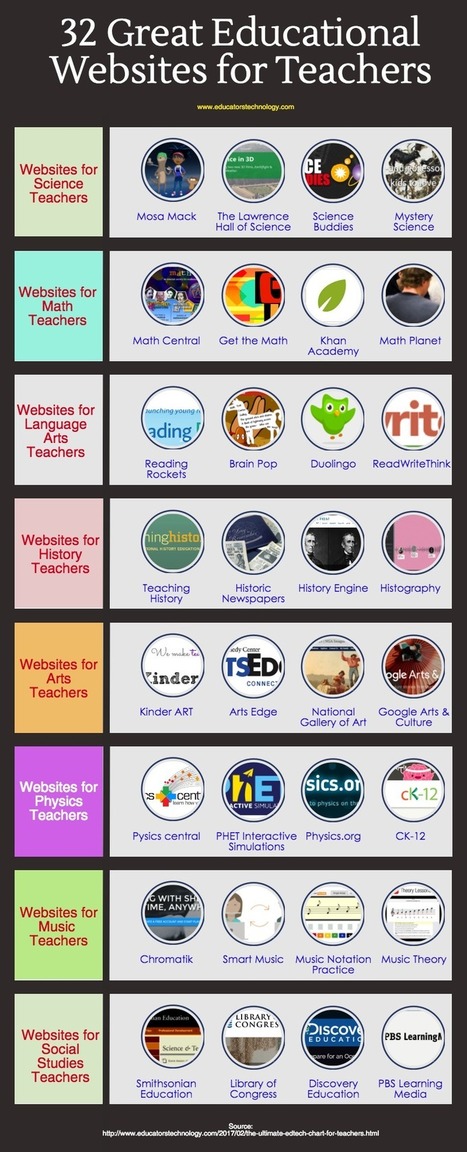
Here is a handy infographic we have been working on for the last couple of days. We compiled 32 educational websites based on the Ultimate EdTech Chart we published a few months ago. We arranged these websites into 8 different categories and for each of these categories we came up with four websites that best represent the selected content area. The categories we have included are : websites for language arts teachers, websites for math teachers, websites for science teachers, websites for physics teachers, websites for history teachers, websites for social studies teachers, websites for arts teachers, and websites for music teachers. You can find links to the websites in this chart.
I love teaching writing. Well, let me rephrase that, I love teaching writing, now… It wasn’t until I was in my graduate studies that I actually learned how to teach writing. Sure, I wrote in college, learned grammar and convention rules, explored genres, and had writing classes during my undergraduate work, but a class on how to actually teach writing… I don’t recall that being part of any course I took for my education degree.
Following my graduate studies my philosophy on the teaching of writing changed. I found my students more interested in writing and sharing their thoughts. I, too, began to write more and eventually started a blog to share with other educators. And along with an increase in enjoyment and confidence, the skills and craft of writing strengthened.
Now, I work with other educators on how they can best refine their instructional practices. And when I am lucky, I get to also share my best practices in the teaching of writing. One thing is certain when I share my love of writing with other educators; I have been influenced by many experts in the field of writing. The following is a small sampling of what I feel are important quotes, suggestions, and affirmations on the teaching of writing.
Crowdsourcing project By the People invites anyone to become a Library of Congress virtual volunteer. Explore, transcribe, review, and tag digital collections to improve search and readability and open new avenues of research.
Description by The Scout Report
"The Library of Congress (LOC) is home to a vast repository of documents, many of which have been digitized but need to be transcribed to become fully searchable. Launched by the LOC in November 2018, By the People is the web platform for the LOC's crowdsourced document transcription campaigns. Here, anyone interested in participating can "transcribe, review, and tag digitized images of manuscripts and typed materials from the Library's collections." In addition to making the documents searchable, these transcriptions also make them accessible to readers with vision challenges, or who are unable to decipher the handwriting from decades past. The materials available for transcription run the gamut of the LOC's diverse holdings. Current transcription campaigns include the papers of multiple leading suffragists like Mary Church Terrell, the manuscripts of poet Walt Whitman, and letters written to Abraham Lincoln. For educators interested in using By the People in their classrooms, the site provides a collection of teaching ideas and LOC lesson plans relevant to some of the campaigns. No account registration is required to participate in By the People, but those who choose to register can access additional features, such as reviewing other volunteers' transcriptions."
Jim Lerman's insight:
This would make a great student project for historical studies or for digital literacy -- or both.
"In Democratic Schools children can decide for themselves what to learn and how to learn it. There is no syllabus and no grading and exams are voluntary. Students and staff have the same rights and organise their schools cooperatively. When decisions have to be made, everyone has one vote.
"Can this really work?
'Democratic Schools. A film about the delight of learning."
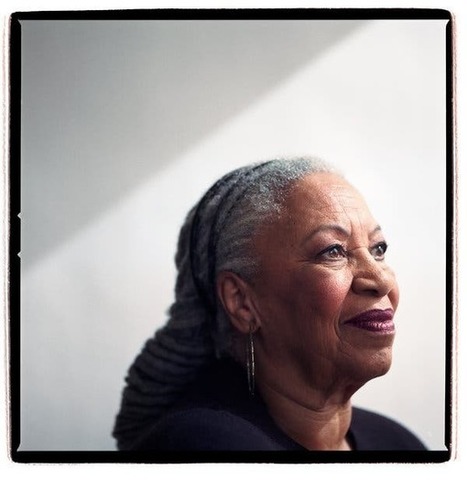
"As people around the world react to the death of Toni Morrison, we offer a few teaching ideas and resources from The New York Times and elsewhere for appreciating the work and the legacy of a writer who meant so much to so many."
The writing curriculum detailed below is both a road map for teachers and an invitation to students. For teachers, we’ve pulled together the many writing-related features we already offer, added new ones, and organized them all into seven distinct units. Each focuses on a different genre of writing that you can find not just in The Times but also in all kinds of real-world sources both in print and online.
But our main goal is to offer young people a global audience — to, in effect, invite them to add their voices to the larger conversation at The Times about issues facing our world today. Through the opportunities for publication woven throughout each unit, we hope to encourage students to go beyond simply being media consumers to become media creators themselves.
So have a look, and see if you can find a way to include any of these opportunities in your curriculum this year, whether to help students tell stories, express opinions, investigate ideas, analyze art or make connections. We can’t wait to hear what your students have to say!
"Welcome to the free media literacy teaching and learning hub for educators and students. You’ll find professional development courses, classroom resources and unique tools that allow students to practice critical thinking, media making and civil discourse.
"Provided by the nonprofit, public media station KQED."
To get content containing either thought or leadership enter:
To get content containing both thought and leadership enter:
To get content containing the expression thought leadership enter:
You can enter several keywords and you can refine them whenever you want. Our suggestion engine uses more signals but entering a few keywords here will rapidly give you great content to curate.


 Your new post is loading...