#eHealthPromotion, #SaluteSocial
119.8K views | +0 today
#eHealthPromotion, #SaluteSocial
E-Health promotion. #web2salute. Health 2.0
Your new post is loading...
Rescooped by Giuseppe Fattori from Pharma Hub
September 29, 2015 3:10 PM
Scoop.it!

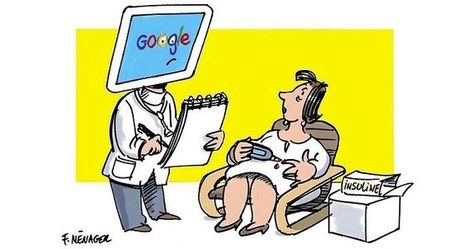
Quand la Big Pharma rencontre le Big Data

Quand la Big Pharma rencontre le Big Data | #eHealthPromotion, #SaluteSocial | Scoop.it
A l'instar du partenariat noué ce mois-ci entre Sanofi et Google, de plus en plus de passerelles existent entre les grands noms du Net et de la pharmacie. Ces derniers commencent seulement à percevoir le potentiel des données collectées auprès des patients.

Via Philippe Marchal
No comment yet.
Scooped by Giuseppe Fattori
September 29, 2015 9:02 AM
Scoop.it!

FDA Patient Engagement Committee Fosters mHealth Innovation - mHealthIntelligence

FDA Patient Engagement Committee Fosters mHealth Innovation - mHealthIntelligence | #eHealthPromotion, #SaluteSocial | Scoop.it
FDA has created a patient engagement advisory committee to oversee the development of mHealth devices and apps. This is intended to benefit mHealth consumers.
No comment yet.
Scooped by Giuseppe Fattori
September 29, 2015 12:56 AM
Scoop.it!

10 iPhone Healthcare, Fitness Apps That Actually Work - InformationWeek

10 iPhone Healthcare, Fitness Apps That Actually Work - InformationWeek | #eHealthPromotion, #SaluteSocial | Scoop.it
Some health apps for the iPhone are beneficial and others merely for fun. How to tell them apart and choose apps that will work for you.

It's time to reconsider our mobile health apps.

The Food and Drug Administration (FDA) defines mobile medical apps as "medical devices that are mobile apps, meet the definition of a medical device and are an accessory to a regulated medical device or transform a mobile platform into a regulated medical device."

Many of the health offerings in mobile app stores claim to monitor data like heart rate, blood pressure, quality of sleep, and cholesterol levels. They boast of capabilities to predict strokes and diagnose cancer. They tell us how long we exercise and the amount of calories burned.

Thousands of apps promise to transform your smartphone into a medical device. Many of them sound too good to be true -- because they are.

No comment yet.
Rescooped by Giuseppe Fattori from Salud Conectada
September 28, 2015 2:48 PM
Scoop.it!

Apps de salud, ¿cómo fiarse?

Apps de salud, ¿cómo fiarse? | #eHealthPromotion, #SaluteSocial | Scoop.it

El número de aplicaciones de salud disponible para los consumidores supera ya los 165.000, según un estudio publicado este mes por el IMS Institute for Healthcare Informatics. Tan sólo en el sistema operativo de Apple (iOS) la cifra se ha duplicado desde 2013. La funcionalidad de la mitad de ellas es limitada: apenas se limitan a facilitar información. Sólo un dos por ciento se conecta con el sistema encargado de proporcionar asistencia sanitaria. Esto repercute en las descargas: 36 apps acumulan casi la mitad de ellas, mientras que el 40 por ciento tienen menos de 5.000.


Leer en la razón

http://www.larazon.es/atusalud/ciencia/apps-de-salud-wcomo-fiarse-AL10824501#.Ttt115nsFEA04qF


Via Ignacio Fernández Alberti, ChemaCepeda
ChemaCepeda's curator insight, September 28, 2015 11:07 AM

¿Cómo garantizamos la fiabilidad de las apps de salud?

Scooped by Giuseppe Fattori
September 28, 2015 1:00 AM
Scoop.it!

mHealth Apps by Category 2015

No comment yet.
Rescooped by Giuseppe Fattori from Social Media and Healthcare
September 26, 2015 8:04 AM
Scoop.it!

25 Excellent Social Media Sites for Your Health

25 Excellent Social Media Sites for Your Health | #eHealthPromotion, #SaluteSocial | Scoop.it

Recently, Health 2.0 reported that 34 percent of Americans turn to social media for health research. Their information, based upon an iCrossing report, shows that consumers choose Wikipedia, online forums and message boards as their most favored resources for information. Additionally, while these users are looking for answers, they also seek support and interaction.

Interaction is what makes social media a bit different than Web 2.0. While Web 2.0 provides the tools for interaction between a user and a Web site, it may not provide the interaction required for a true “social” experience between the user and other users or site participants. For instance, teens and some adults who have disabilities and diseases such as cancer already use social-networking sites such as Facebook and MySpace.com to connect with peers.

Social media is not “top down” information with little to no interaction. While government groups struggle to impart information such as the latest news about tainted peanut butter products through blogs, Twitter and other Web 2.0 tools, others know that this isn’t enough. When you impart information, you also must respond. It is the era of the consumer, and the consumer is in control.

While some government groups still struggle with social interaction, many grassroots groups and visionaries ‘get it.’ The following 25 sites — among many dozens of other consumer-oriented social media sites — provide venues for patients, advocates, medical personnel, and others to interact on a level playing field. These tools allow news to flow freely, collaboration to become second-nature and support to become as pandemic as the diseases that threaten today’s populations.

The following sites are listed alphabetically under each category. This methodology shows that we do not favor one site over another.  Instead of top-down news and information, these sites provide information based upon user-generated input. You can read the latest news about any medical condition or offer and receive support and advice at these sites.

News and Information

Healthranker: Health Ranker was founded by Israel Lagares and the main contributor to this health news site is Dr. Kalvin Chinyere. Both men are dedicated to making Healthranker the number one social media health news site. Its success depends upon you, however, as users are encourages to submit health news and articles from medical information publishers to health care bloggers to main stream media news sites.

OrganizedWisdom: This site launched in 2006, and has become a keystone social media site for health information. Organized Wisdom provides hand-crafted search result pages called WisdomCards for the most popular health search terms and phrases. Users can become guides and make money while helping others find information on this site and to create WisdomCards. OrganizedWisdom was named to PC Magazines “Top Web sites of 2008″ for bringing innovation to online health care.

PeoplesMD: PeoplesMD is the first niche social bookmarking site exclusively for the health and wellness category. Share your online health research and help others when you bookmark your favorite articles, blogs and Web sites and store them here in “Stacks.” These bookmarks are turned into visual collections for your own use and to help others find information.

Trusera: Seattle startup Trusera built a strong community while in testing mode in 2008, and founder Keith Schorsch says his site is more focused on practical advice than the competition. Schorsch, a former Amazon executive, says he was spurred to start the company after his struggle with Lyme disease. At Trusera, you can pose questions to people who’ve been there and get practical answers and insights from others just like you.

Fitness Tools

Plenty of sites offer tools for fitness, but the true test of a social media fitness site is interaction among users and experts. The following sites can provide this support, along with the tools you need to meet your fitness goals.

FitLink: Keep a workout journal, map running or cycling routes, plan activities, research exercises, calculate your body mass index, and read fitness articles. But, you don’t need to do it alone. You also can find activity partners, training groups, personal trainers, health clubs, fitness centers and even local events based upon your goals and interests.

GIMME20: Gimme20.com is an online fitness tool that provides users with community, workout routines, and the ability to track workouts and share workout routines with others in the community. You can report fitness results from the gym with their mobile phones, too.

GymClik: This site is new, but looks promising. Join for free and get in on the ground floor to develop or join groups in tune with your goals. Additionally, you can add your favorite recipes, find a local trainer, share videos and images and more.

Gyminee: You’ll discover detailed workout tracking, a way to monitor your diet, the ability to meet others with similar goals, online accountability and motivation through friends, groups and communities at Gyminee. This interaction may be what you need to reach your goals.

introPLAY: Join as a player and find other athletes who train together as part of the introPLAY community. This site may seem intimidating, but it’s for both casual and committed athletes who want tools to track sports activities, health information and more from a truly interactive community.

iStats: After you complete a workout such as a run, gym, soccer game or training simply enter the details of the workout (reps, weight, time etc.). Select from Imperial or Metric. Create your own exercise if you can’t find it. Review your workouts and invite friends to create exercise teams so you can work out together, share tips and compare results.

Limeade: This tool allows you to assess 28 dimensions of your life scientifically correlated with well-being, recommends personalized goals, and helps you achieve those goals with step-by-step tracking, programs and support from experts and friends.

PeerTrainer: This site will help you become accountable for yourself, supported by others in small online groups and teams. Take advantage of their Calorie Wiki, health, fitness and diet content and more. Join supportive communities and groups and share your wisdom as well.

Traineo: Get in on the ground floor with a site that is geared to make fitness simple. Use their tools to log your activity and diet and take advantage of community-building to snag some support for your goals. Choose among groups that challenge obstacles such as diabetes or that are built upon family support. If nothing seems to fit you, you can create your own group.

Patient Activism, Peer Care

The following sites provide users with real-time social interaction. You can receive home care, find a peer group for support, become an activist in national health care reform and more. These sites truly are social, providing ‘meeting places’ for patients, medical professionals and visionaries.

American Well: This is the nation’s first online house call program. This site provides a truly interactive setting, where patients find doctors who will treat you from a distance. American Well is committed to supporting health plans in meeting consumer and employer demand for affordable, efficient, and immediate access to quality care.

Daily Strength: Patients and caregivers dealing with hundreds of issues, including asthma, celiac disease and depression, can join a support community, start a wellness journal, share advice and recommend doctors, link to news stories and Web sites with disease information. You can send other members a virtual hug while you’re there.

Group Loop: Group Loop bills itself as a safe place for teens with cancer and their parents to build online community for support, education and hope while dealing with a cancer diagnosis. Teens can talk with other teens, parents with parents so teens can learn how to cope with daily life and this disease.

Health 2.0: This wiki is set up to serve “the community of visionaries, entrepreneurs, intrapreneurs, policy makers, and professionals who are working on fundamentally redefining the healthcare industry along the lines of ‘Web 2.0.’” Don’t let the labels turn you off — this site is open for discussion. Take the challenge.

Mamaherb: At Mamaherb, people from all over the world can share their knowledge about herbs and other natural substances they’ve experienced as helpful, or even been tipped off about by their family members, friends, or even by their grandma. Join community to learn more about how you can use herbs safely.

MDJunction: This site supports an active center for online support groups, a place where patients meet every day to discuss feelings, ask questions and share hopes with others.

Patients Like Me: This site believes that when patients share real-world data, collaboration on a global scale becomes possible. New treatments become possible. Most importantly, change becomes possible. A truly interactive site, it appears that patients embrace the open sharing of personal health data because they believe that information can change the course of their diseases.

Real Mental Health: This was the first social networking site that focused on mental health treatment and wellness. Join online communities filled with individuals, families, loved ones and friends who want to interact and support each other through difficult and happy times. Obtain knowledge about symptoms and treatments, too, in topics such as addictions, ADHD, Alzheimer’s and more.

Real Self: Sometimes it takes a little nip and tuck to feel better. At Real Self, you will find comprehensive information about everything from Botox to Lasik to Zoom teeth whitening. Founded by Tom Seery in 2006, this site provides experts, many who are leading authorities in aesthetics, cosmetic surgery and dermatology, to participate on RealSelf.com without a commercial relationship or exchange of fees. Ask a question, get an answer. Easy.

RightHealth: Join active forums, get the latest mash-ups of medical news and watch the latest health videos. This site is fairly straightforward, easy to use and dedicated to giving every topic its own homepage.

Twit2Fit: If you want results and activism, choose Twitter to get going. Jason Falls experimented with Twitter to see how far he’d get in support for a fitness program, and his test blossomed into this Web site. “Twit2Fit members support and encourage those hoping to better themselves physically, mentally, emotionally and spiritually.”

Vitals: Vitals represents a place where doctors are examined. Unlike other listings for medical professionals, this one allows users to chime in. You can check up on your doctor, find a new doctor and rate doctors that you know and have visited in the past. Your opinions could, literally, save a life.


Via Plus91
WordHead's comment, September 20, 2015 3:27 PM
Before you scoop, this article was originally posted on November 29, 2010.
Scooped by Giuseppe Fattori
September 26, 2015 4:58 AM
Scoop.it!

Patient Voices on Social Media - When patients speak, some hear golden tones and others noise

Patient Voices on Social Media - When patients speak, some hear golden tones and others noise | #eHealthPromotion, #SaluteSocial | Scoop.it

A Brookings Institute economics expert and a patient advocate argued with each other last week during a live Google chat. They disagreed about the voices of patients, and how much these voices should count. Their debate is just one of hundreds going on as to how and where and when to register patient feedback in health care. The two of them had spent almost a week in barbed exchanges on Twitter, but were relatively kind to each other at the live chat.

Casey Quinlan is a prominent voice in social media who goes by the handle @MightyCasey on Twitter. She is a journalist, frequent testifier at conferences and hearings, and passionate advocate for open data that patients can access. She is also a survivor of breast cancer. Quinlan is a collaborator with researchers studying how to better incorporate patients into the design of health care systems.


No comment yet.
Scooped by Giuseppe Fattori
September 24, 2015 4:26 AM
Scoop.it!

Come calcolare il ROI su social media: uno «stetoscopio» per una vendita utile | Tech Economy

Come calcolare il ROI su social media: uno «stetoscopio» per una vendita utile | Tech Economy | #eHealthPromotion, #SaluteSocial | Scoop.it

In queste 5 parole sta il senso di ogni social media marketing maturo e consapevole, del digital marketing che intelligentemente scelga i social come piattaforma per la promozione del proprio business.
Queste almeno le conclusioni cui siamo giunti analizzando, la settimana scorsa, il senso del ROI su social media, spesso chiamato in causa senza averne chiara la natura. Ci siamo dunque chiesti «che cos’è», che si abbia per le mani quando ne parliamo, per capire poi «come ottenerlo» e, dunque, come misurarlo.

No comment yet.
Scooped by Giuseppe Fattori
September 24, 2015 1:00 AM
Scoop.it!

Gartner's 2015 Hype Cycle for Emerging Technologies Identifies the Computing Innovations That Organizations Should Monitor

Gartner's 2015 Hype Cycle for Emerging Technologies Identifies the Computing Innovations That Organizations Should Monitor | #eHealthPromotion, #SaluteSocial | Scoop.it

The journey to digital business continues as the key theme of Gartner, Inc.'s "Hype Cycle for Emerging Technologies, 2015." New to the Hype Cycle this year is the emergence of technologies that support what Gartner defines as digital humanism — the notion that people are the central focus in the manifestation ofdigital businesses and digital workplaces

The Hype Cycle for Emerging Technologies report is the longest-running annual Hype Cycle, providing a cross-industry perspective on the technologies and trends that business strategists, chief innovation officers, R&D leaders, entrepreneurs, global market developers and emerging-technology teams should consider in developing emerging-technology portfolios. 

"The Hype Cycle for Emerging Technologies is the broadest aggregate Gartner Hype Cycle, featuring technologies that are the focus of attention because of particularly high levels of interest, and those that Gartner believes have the potential for significant impact," said Betsy Burton, vice president and distinguished analyst at Gartner. "This year, we encourage CIOs and other IT leaders to dedicate time and energy focused on innovation, rather than just incremental business advancement, while also gaining inspiration by scanning beyond the bounds of their industry." 


No comment yet.
Scooped by Giuseppe Fattori
September 23, 2015 10:00 AM
Scoop.it!

Mobile Health and Technology Can Play a Significant Role in Realizing Efficiencies - YouTube

Over the past two years, there has been progress in understanding and addressing the barriers to more mainstream adoption of mHealth. However, for mHealth to...
No comment yet.
Scooped by Giuseppe Fattori
September 21, 2015 4:50 PM
Scoop.it!

Report: After two years, mHealth apps have evolved but majority are still lame

Report: After two years, mHealth apps have evolved but majority are still lame | #eHealthPromotion, #SaluteSocial | Scoop.it
Two years after the IMS Institute for Healthcare Informatics published a snapshot of the mHealth market, the ratio of useful apps to worthless ones is as large as it was before, if not larger. That’s just one of the takeaways for readers of IMS Institute’s mHealth app report, Patient Adoption of mHealth.

Just 36 apps account for nearly half of all downloads and 40 percent of apps have fewer than 5,000 downloads. But it also showed that apps have gotten increasingly sophisticated and can deepen the level of interaction with users.

Of the 165,000 apps from the iOS and Android app stores that claim a connection with healthcare, IMS Institute focused on the ones with more than 1,000 user ratings — 67, 424 and found only only 26,864 consumer oriented health apps were applicable. Non English apps and apps not available to the general public were kicked to the curb.

Illustrating the progress made in digital health, the report noted that 10 percent of apps can connect to a device or sensor. The majority are fitness apps. MapMyFitness developed a way to unpack data from fitness trackers and UnderArmour acquired the company in 2013. But what’s happening with disease management apps that can connect with blood pressure and blood glucose monitors show is more impressive. The best ones are using their connectivity to give users a better understanding of their health in connection with their exercise diet and mood and visualize that data so that it is easy to see the impact of when they successfully manage their health and what they can do to improve it.
No comment yet.
Rescooped by Giuseppe Fattori from Pharma Hub
September 21, 2015 3:07 AM
Scoop.it!

More on Twitter and Pharma | Eye on FDA

More on Twitter and Pharma | Eye on FDA | #eHealthPromotion, #SaluteSocial | Scoop.it
Before breaking for summer vacation, I had posted about the increase in Twitter followers among pharma companies this year over last and noted that the overall number of Twitter followers of pharma feeds had increase significantly. That was true despite the fact that we did not see a huge increase in the number of pharmas with Twitter feeds, meaning that the ranks of existing feeds grew considerably.

Via Philippe Marchal
No comment yet.
Scooped by Giuseppe Fattori
September 19, 2015 3:45 AM
Scoop.it!

Using Social Media: Communication tools to connect with peers, patients, employees and experts. - YouTube

Patient’s , Nurses and Hospitals use social media regularly, do you? ONL’s Nursing Informatics and Technology subcommittee offered this lecture to explore how social media is utilized and introduce some of the most popular social media applications - Facebook, LinkedIn, and Twitter. In addition to an overview of social media’s most popular app's, this lecture offers tips on "how to get started”, links to tutorials, examples of best practices and thoughts about using social media in a professional practice environment.
No comment yet.
Rescooped by Giuseppe Fattori from Social Media and Healthcare
September 29, 2015 2:41 PM
Scoop.it!

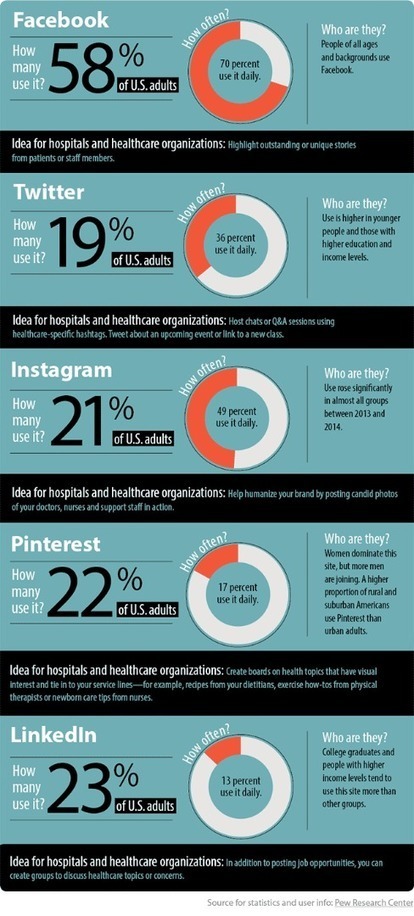
7 ways your healthcare organization can use social media

7 ways your healthcare organization can use social media | #eHealthPromotion, #SaluteSocial | Scoop.it

Here are just a few of the things you can use social to do:

1. Build your healthcare brand. Social media can help raise awareness of your brand in your community—whether that's local, regional or national.

2. Highlight your staff and services. Quality healthcare is more important than ever. And social media channels are a great place to highlight your expertise. For example, you might promote blog posts written by specialists, post videos about your service lines, or host Q&A sessions about important health topics.

3. Deepen connections. Social media gives you a chance to commune with healthcare consumers. You can hear—and share—personal and powerful stories and connect directly. And social can give people an everyday look at who you really are—highlighting your caring staff and culture.

4. Discover positives—and problems. People are probably talking about your hospital or health plan on social media already. Maybe they're raving about your classes or the healthcare their loved ones received. But they could be grumbling too. If you're not available on social, you won't know about these conversations. That means you'll miss the opportunity to see successes and show off your great customer service when someone has a complaint.

5. Share trustworthy and valuable health content. Let's face it: Social media can be a hotbed for bad health information that can spread and cause harm, from fad diets to false claims. You can help counter that. By sharing reliable, reader-friendly materials and tips, you can help serve and protect your community—and become a go-to source when people need answers or help.

6. Support your other marketing channels. Looking to bring more people to your website? Hoping to up your hospital or health plan's e-newsletter subscriptions? Social media can get the word out.

7. Communicate with your followers during a crisis. When a tragedy strikes, people often turn to social media to get news and connect with others who are affected. As a healthcare leader, your hospital or health plan can be a valuable voice in those discussions, providing up-to-date information and trustworthy advice.


Via Plus91
No comment yet.
Scooped by Giuseppe Fattori
September 29, 2015 5:48 AM
Scoop.it!

Why digital health goes beyond smartphone health apps and SMS text messaging

Why digital health goes beyond smartphone health apps and SMS text messaging | #eHealthPromotion, #SaluteSocial | Scoop.it

For digital health to have any impact, services must be inclusive for the population as a whole, and not just those with the latest smartphone, or super-fast broadband.

Providing patients with the choice around how they communicate with healthcare professionals enables digital health to be a realistic option for almost everyone, regardless of their internet accessibility, technical ability or smartphone availability.

Last night our development team released another update. The release included a range of new features, including enhancements to our SMS feature, which is just one of the ways in which we are able to remotely connect patients with their care teams.

Today people are more mobile than ever, juggling busy lifestyles, commuting and holidaying abroad. SMS appeals to many people because it is not only simple to use, but also easily available across the globe.  Alongside SMS we provide various methods for patients to communicate with their clinician and care teams.


No comment yet.
Scooped by Giuseppe Fattori
September 28, 2015 2:52 PM
Scoop.it!

How will the FDA regulate mobile medical apps?

The FDA will apply the same risk-based approach the agency uses to assure safety and effectiveness for other medical devices.  The guidance document (PDF - 269KB) provides examples of how the FDA might regulate certain moderate-risk (Class II) and high-risk (Class III) mobile medical apps. The guidance also provides examples of mobile apps that are not medical devices, mobile apps that the FDA intends to exercise enforcement discretion and mobile medical apps that the FDA will regulate in Appendix AAppendix B and Appendix C.

We encourage app developers to contact the FDA – as early as possible – if they have any questions about their mobile app, its level of risk, and whether a premarket application is required.


No comment yet.
Scooped by Giuseppe Fattori
September 28, 2015 12:57 PM
Scoop.it!

Integrating digital literacy into medical education

Integrating digital literacy into medical education | #eHealthPromotion, #SaluteSocial | Scoop.it

Bertalan Mesko, MD, PhD, has cracked the code on convincing medical students that digital literacy skills are equally as important as clinical knowledge. Seats in his Social MEDia course fill up within 45 seconds of registration opening. Former students report a 100 percent satisfaction rate with the class, and 80 percent of those enrolling in the course heard about it from a classmate. How does Mesko do it? As it turns out: daily educational challenges promoted on Facebook, an arsenal of high-tech gadgets and lots of chocolate.

On Thursday at Stanford Medicine X|ED, Mesko shared his secrets with medical educators on how to develop a digital literacy curriculum that will engage millennial learners and keep pace with the ever-changing landscape.

A self-describe medical futurist, Mesko launched his class on social media in medicine in 2008 when Facebook and Twitter were still in their infancy. “I wanted to design the curriculum for students to prepare them for the future that is coming toward us,” he said. “My goal was to help them understand how to use these tools to be more productive and stay up to-date.”

- See more at: http://scopeblog.stanford.edu/2015/09/25/integrating-digital-literacy-into-medical-education/#sthash.112ep3la.dpuf
No comment yet.
Scooped by Giuseppe Fattori
September 26, 2015 8:10 AM
Scoop.it!

Study: mHealth App Market Grows, Yet Barriers Remain

Study: mHealth App Market Grows, Yet Barriers Remain | #eHealthPromotion, #SaluteSocial | Scoop.it

There are now more than 165,000 mobile health apps available in the U.S., yet most continue to have limited functionality and barriers remain for connecting mHealth app data to providers’ clinical data, which hinders full adoption of mHealth into healthcare management, according to the findings of an IMS Institute for Healthcare Informatics study.

According to the IMS Institute’s recently released report about consumer-focused mHealth apps, the number of mHealth apps has nearly doubled in the past two years and almost a quarter of consumer apps are now focused on disease and treatment management, while two-thirds target fitness and wellness. Mental health apps led among disease specific apps, followed by diabetes.

For the study, researchers drew on IMS Health’s AppScript Score database and analysis of 26,864 apps available in the U.S. The study found that app connectivity has become a major focus for app developers, with one in ten apps now having some capability to connect to a device or sensor. This connectivity provides biofeedback and physiological function data from the patient and greatly extends the accuracy and convenience of data collection, according to the IMS Institute study.

As part of the study, the IMS Institute also interviewed healthcare provider executives on the role and status of healthcare apps.


No comment yet.
Scooped by Giuseppe Fattori
September 26, 2015 7:50 AM
Scoop.it!

Why #SocialMedia Needs Physician Voices

Why #SocialMedia Needs Physician Voices | #eHealthPromotion, #SaluteSocial | Scoop.it

For years, we have been talking about the power and potential of social media and how family physicians can use it to disseminate important health information to the public, correct misinformation in the media, raise the profile of family medicine, and advocate for our patients and practices.

Along the way, many of you have joined us in the Twitterverse, but there is so much more to be done. Although some still debate whether physicians should even be using social media, we would posit that it is an obligation.

Physicians know the science of medicine and the facts about our health care system. When we are not present in social media, other voices -- all too often uninformed voices -- can dominate important conversations.

Here's one example. In an attempt to manipulate and build public opinion against the use of vaccinations, from mid-August to Dec. 1, 2014, roughly250,000 tweets(www.wired.com) were sent using a popular anti-vaccine hashtag. One-fourth of those tweets originated from just 10 prominent anti-vax Twitter accounts, but to the casual observer, it looked as if the anti-vaccine movement was growing.

Scooped by Giuseppe Fattori
September 24, 2015 9:26 AM
Scoop.it!

Location of Wearable App Use

No comment yet.
Rescooped by Giuseppe Fattori from Doctors Hub
September 24, 2015 1:41 AM
Scoop.it!

Philips se lance dans la santé connectée !

Philips se lance dans la santé connectée ! | #eHealthPromotion, #SaluteSocial | Scoop.it
Philips sort une suite dans la santé connectée avec un bracelet connecté, deux capteurs de fréquence cardiaque, une balance connectée et un thermomètre.

Via Lionel Reichardt / le Pharmageek, Philippe Marchal
No comment yet.
Scooped by Giuseppe Fattori
September 23, 2015 11:00 AM
Scoop.it!

How Twitter users interact with brands and promoted tweets - American Press Institute

How Twitter users interact with brands and promoted tweets - American Press Institute | #eHealthPromotion, #SaluteSocial | Scoop.it

Most Twitter users (77%) have interacted with a promoted tweet in some way. The largest number, 56%, say they have noticed a promoted tweet, topic or account. Fifteen percent have clicked on a promoted tweet, 8% on a tweet under a promoted hashtag. Almost as many, 7%, have followed a promoted account and 6% have retweeted, replied or favorited a sponsored tweet. In addition, 4% have tweeted using a promoted hashtag.

No comment yet.
Scooped by Giuseppe Fattori
September 23, 2015 8:00 AM
Scoop.it!

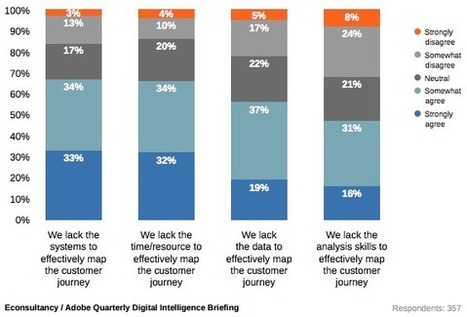
Only 17% of brands have the ability to fully analyse the customer journey | Econsultancy

Only 17% of brands have the ability to fully analyse the customer journey | Econsultancy | #eHealthPromotion, #SaluteSocial | Scoop.it

A new Econsultancy report in partnership with Adobe found that companies are still struggling to embrace multichannel marketing.  

We surveyed nearly 2,000 digital marketers and ecommerce professionals to find out the extent to which organisations are taking an integrated approach to marketing across different channels. 

Lack of capability an issue

Understanding the customer journey is becoming increasingly important as the number of both digital and offline touchpoints increases. 

But even in organisations that have been developing their digital competencies and tools, analytics and CRM have traditionally tended to be used in isolation, and the 17% figure quoted in the headline seems to confirm that. 

Consumers base their decisions on interactions across multiple media types, devices and locations. This creates a challenge for marketers to interact at important moments that might influence buying decisions.

No comment yet.
Rescooped by Giuseppe Fattori from Social Media and Healthcare
September 21, 2015 3:59 PM
Scoop.it!

Making social media and blogging work for occupational health scientists

Making social media and blogging work for occupational health scientists | #eHealthPromotion, #SaluteSocial | Scoop.it

Recent debate has emphasized scientists’ responsibility to communicate their results to the public. This is especially relevant in our field of occupational health and safety research, as these findings can be put into everyday use. But what can we scientists do to make this really happen? asks PhD Charlotte Wåhlin from Department of Occupational and Environmental medicine at University Hospital Linköping, Sweden.


Blogs – the way forward?

I belong to a team of researchers, ergonomists, occupational hygienists, psychologists and physicians from the Department of Occupational and Environmental Medicine in Östergötland, Sweden, that received funding to develop new strategies for science communication.

We took the opportunity to spark discussion on occupational and environmental health issues by writing a blog.

Since its launch this January, over 10 000 visitors have read one or more of our 44 posts. Politicians, labour unions, workers, and managers have commented on the blog or contacted us directly.

The blog has succeeded in engaging and spreading knowledge from many relevant stakeholders in Sweden, and its topics are inspired by our current research and everyday experiences at our unit that investigates and assesses risks to workers and environmental health at the workplace: issues such as future work environments, vibration damage, poor managers, back problems, and ergonomics.

To reach as many people as possible, we also use podcasts and social media.

Social media – a neglected tool

Via social media, Jani Ruotsalainen from the Finnish Institute of Occupational Health asked for my help in translating his Cochrane review ”Preventing occupational stress in healthcare workers” into Swedish, and record it as a podcast.

You can listen to Jani’s original podcast in English here: or my Swedish translation here.

This is living proof that it is possible to create fruitful contacts between researchers via Twitter even when you are given only 140 characters! Feel free to tweet us: @CSWahlin and@JHRuotsalainen using the hashtag #Talkevidence.

Social media is definitely an upcoming forum for the exchange of knowledge.

Future aims

We need to improve the way we communicate science by collaborating with journalists, science communicators, and web producers, both nationally and internationally.

If we want to live up to our mission of informing the public at large, we scientists need to revisit this mission and prioritize the need to communicate our findings amidst the haste and pressure of our everyday duties.

Leave your comfort zone!

No matter what support you have, where you work or how you contribute to the advancement of occupational health and safety, I dare you to step outside your comfort zone and dip your toes into this fantastic new world of communication and collaboration.

I promise you it will pay off!

I look forward to more innovative and flexible ways of disseminating research and knowledge that can improve workers’ health and their work environment.

Seven things that work when communicating science

1. Increasing your knowledge on how to write popular science

2. Getting support from your organization, involve your own workplace

3. Setting a goal if you want to blog; determine who you want to reach and why

4. Making facts and research readable, linking publications and websites

5. Leaving your comfort zone and looking for new collaboration  possibilities with journalists, science communicators, web producers and other researchers

6. Involving stakeholders such as labor unions and organizations, and creating a network

7. Evaluating what you do.


Via Plus91
No comment yet.
Scooped by Giuseppe Fattori
September 20, 2015 4:57 AM
Scoop.it!

Libri: funziona meglio il Reading dell’Adv! | Tech Economy

Libri: funziona meglio il Reading dell’Adv! | Tech Economy | #eHealthPromotion, #SaluteSocial | Scoop.it

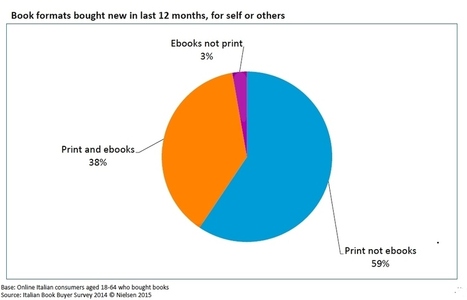
Lo sostengo da tempo che le tecniche “push”, quanto più è elevato il coefficiente culturale di un prodotto, tanto meno sono efficaci ai fini della vendita del prodotto stesso. Ora la recentissima ricerca della Nielsen lo prova con la forza dei dati, che mostrano anche come mutano i comportamenti degli italiani nel rapporto con i libri (scelta, acquisto e modalità di lettura). Della ricerca, ho visto finora “sventolare” dai media soprattutto un dato: il 97% degli italiani acquista on line libri di carta. Ma quel dato va disaggregato: per non indurre facili equivoci e capire più in profondità l’evoluzione dei comportamenti e del mercato.

Quella della Nielsen è un’indagine su come gli italiani scoprono e acquistano online libri ed e-book: lo studio ha coinvolto un campione di 2000 individui (18-64 anni), rappresentativo degli utenti digitali. Un’indagine con elementi di contestualizzazione rispetto alla realtà internazionale.

No comment yet.