Content curation trends
185.9K views | +0 today
Your new post is loading...
Scooped by Guillaume Decugis
October 10, 2012 12:52 PM
Scoop.it!

How much B2B traffic can Content Curation bring to a website? Study finds 464% growth in just 4 months.

How much B2B traffic can Content Curation bring to a website? Study finds 464% growth in just 4 months. | Content curation trends | Scoop.it

This is a very interesting case study by the team at B2B Content Engine on the impact Content Curation has on a B2B web site's traffic. B2B sites typically have niche audiences which are hard to find from untargetted methods and costly to generate with targeted advertising.


What this study shows is that consistent content curation provided not only impressive results on traffic growth but also lead generation conversion at a 12% rate. In addition to many other great benefits such as brand visibility, awareness, etc...


It also gives an idea of the volume of content that was required to achieve that, which - compared to what we see users typically achieve on Scoop.it - is very similar and reasonable. 


It also supports some other best practices we've mentioned already such as:


- being multi-channel: traffic doesn't come from one source but combining several channels (linkedin, twitter, ...) is key; it's what we call the hub model.


- frequent publishing: it's not about reaching our massive volumes so much than it is about publishing every week.


- use of topic site customization or web site integration to facilitate lead conversions (typically what Scoop.it Business allows to do very simply)


- giving context is important: for readers but also for SEO reasons.

ben bernard's comment, January 9, 2013 11:41 PM
thanks ! http://www.scoop.it/t/direct-marketing-services my newly made scoop.it :)
Scooped by Guillaume Decugis
October 3, 2012 3:36 PM
Scoop.it!

Who said Content Curation should replace Creation for Content Marketers?

Who said Content Curation should replace Creation for Content Marketers? | Content curation trends | Scoop.it

This is an interesting piece highlighting the dangers of relying solely on Content Curation and giving up Content Creation for Content Marketers.


As I told him in the comments, I disagree with Frank Dale's title though (which doesn't reflect his conclusion but I also like provocative headlines ;-) that content curation is usually bad. It is usually good but usually not enough. For the following reasons:


1. Curation is often a good starting point. Content Marketing takes time and the ROI is not instantaneous and can be slow to measure. Content Curation helps you get started more easily, particularly if you're a SMB.


2. Content Curation helps you identify where you should invest in Content Marketing creation: spotting these messages that will set you apart, these areas that not many people cover.


3. Content Curation is also an expression means: don't stop at sharing links on Twitter but use the full opportunities given by content curation platforms like Scoop.it (and others like Storify for instance) to add your point of view. That is a form of creation which, we've found, is much more accessible than full-blown content creation and that nicely completes it.


As a matter of fact, I will actually curate this great piece myself. Before I move on to uploading my latestcreated presentation on SlideShare...

No comment yet.
Scooped by Guillaume Decugis
October 1, 2012 7:56 PM
Scoop.it!

What Kind Of Curation Site Should You Use?

What Kind Of Curation Site Should You Use? | Content curation trends | Scoop.it

Deanna Dahlsad designed this simple decision-tree to help differentiate between different Content Curation platforms and which one you should use as a business user.


I found this interesting as it's one of the first ones I see that made this obvious and simple differentiation between the different platforms out there. I'm not sure I would describe Scoop.it as article-based (we obviously have large pictures, infographics, videos or SlideShare presentations that are not articles) but I can see where she's coming from and her intention: if the content you curate is not 100% image, "image-based eye-candy" is not enough.  

Deanna Dahlsad's comment, October 5, 2012 1:27 AM
Thank you for scooping my article and decision tree! Most content curation sites do offer images, as I noted; but there are distinct differences between image-based sites like Pinterest & sites like Scoop.It especially in terms of users.
Chris Lott UAF's comment, October 5, 2012 1:31 PM
The decision tree here represents our decisions on what curation technology to use as an educational organization. It's a great starting point for discussion.
Guillaume Decugis's comment, October 9, 2012 9:53 PM
Hi Deanna - Yes, I found it was a great one. By the way, I was thinking of using it in a future presentation. Would you be ok with that? I'd of course include the reference to your site that's on the original picture. Let me know. Thanks!
Scooped by Arabella DeLucco
September 27, 2012 3:10 PM
Scoop.it!

Social Curation Summit - December 2012

Social Curation Summit - December 2012 | Content curation trends | Scoop.it

Scoop.it's CEO Guillaume Decugis will be speaking at the Social Curation Conference in Los Angeles on Dec. 12, 2012. Check out his session: "Tastemaking through Curated Communities." Interested in attending? Use the Scoop.it fan discount code: SCOOPIT15. Hope to see you in sunny SoCal!


------


The Social Curation Summit is a full-day conference focused on the proliferation of visual social networks and the diverse array of content curation services that have drawn the attention of users, investors and brands alike.

No comment yet.
Scooped by Guillaume Decugis
September 24, 2012 9:30 PM
Scoop.it!

The New War Between People and Machines

The New War Between People and Machines | Content curation trends | Scoop.it

"So far in the evolution of the Web we've seen a tug of war between whether we need people to find and accomplish what we want online, or whether we only need machines" writes Sarah Lacy on Pandodaily.


It's a dialectic between algorithms and social curation that we've commented on before (recently here) and that I even wrote about. But as "nearly anything raising money in the Valley now is using big data as its opener" - she writes - the conflict takes new proportions.


Depending on their vision and culture, some startups are trying to solve problems with algorithms, some others with social or human curation. But the smart thing is not to choose, she believes, as "any modern Web company really needs both."


As a team of entrepreneurs, we've dealt with that at Scoop.it, starting with a first product that didn't satisfy us to finally pivot to the mix you're using now: topic-centric, likely-to-be-relevant algorithmic suggestions combined with streamlined publishing features make it easier to be a curator. But easy doesn't mean automated and we leave it to you to do the part that no robot can: express yourself through a conscious decision that also adds some context. Curation; not filtering.


Time for some Humanrithm then ?

No comment yet.
Scooped by Guillaume Decugis
September 13, 2012 11:18 AM
Scoop.it!

What are some real world best practices in terms of businesses using content curation?

What are some real world best practices in terms of businesses using content curation? | Content curation trends | Scoop.it

I've been asked to answer this question on Quora and so even though it's been already documented in a number of posts or SlideShare presentations (I mention a couple at the end of my answer by Corinne Weisgerber and Beth Kanter), I felt I should give the perspective we have from observing a number of practices on Scoop.it.


From the early days of the private beta, we've seen a lot of curation being made by our users for professional reasons. Some as independant pofessionals, a lot as businesses. This is what drove the development of Scoop.it Business and Scoop.it Pro, our two main premium plans which have known a great adoption and success since we launched them.


This might not be an exhaustive list and it is meant in a business context which is not what all curation activities are about. But let us know: do you see other best practices worht mentioning?

Gilbert C FAURE's comment, September 13, 2012 3:24 PM
Please discuss some day the Scoop it Education plan and the use of scoop it in following research developments! all the best
Guillaume Decugis's comment, September 13, 2012 4:17 PM
Hi Gilbert. Sure! Good suggestion. We'll cover that at some point. There are great examples there too. Feel free to share your own observations with us.
Guillaume Decugis's comment, September 13, 2012 6:35 PM
Thanks Deborah. We see a lot of non-profits indeed be successful on Scoop.it!
Suggested by Arabella DeLucco
September 11, 2012 2:32 PM
Scoop.it!

Why Brands are Becoming Publishers [video] - Brian Solis

Why Brands are Becoming Publishers [video] - Brian Solis | Content curation trends | Scoop.it

Insightful video interview by Brian Solis with Federated Media's CEO Deanna Brown on why "Context" could now be King. There's another element to content creation now...

No comment yet.
Suggested by Chuck Sherwood, Former Senior Associate, TeleDimensions, Inc
September 10, 2012 9:07 PM
Scoop.it!

French Publishers Want In On German Plan To Force Everyone To Pay To Link To News

French Publishers Want In On German Plan To Force Everyone To Pay To Link To News | Content curation trends | Scoop.it

This is an interesting though worrying follow-up to the German issue Chuck also kindly suggested to me. Luckily, when reading the original news, it seems this initiative doesn't have much substance. I'd be surprised to see that go through as the Right to Quote is an essential element of European copyright law and pretty much equivalent to Fair Use here in the US. 


Where the problem becomes more complex is that that none of the Internet Content giants - Google in the first place but also Amazon or Apple - end up paying any serious taxes in Europe which makes a lot of people angry. Advertising revenue on Google Search doesn't bring much to any European countries. Amazon Kindle eBook sales? Apple's iTunes songs? No VAT for France nor Germany. 


As US Internet giants use loopholes of the EU to avoid paying any significant taxes while they generate significant revenue from European consumers, some lawmakers could be tempted to consider these dangerous remedies that would hurt freedom of speech and the Internet model.

Guillaume Decugis's comment, September 11, 2012 12:42 PM
For those of you speaking French (or using Google Translate), here's an interesting article from LeFigaro.fr (*) that also ties this request with the tax loophole problem I mentioned: http://bit.ly/NkRIyt

¨by the way one of the supporters of that project...
Rescooped by Guillaume Decugis from Content Curation World
September 5, 2012 10:03 PM
Scoop.it!

Curation and reblogging

Curation and reblogging | Content curation trends | Scoop.it

"While both can lead consumers on a unexpected journey, chasing the white rabbit into previously unexplored corners of the web, [a Curator] actually helps sift through the media abyss, singling out worthwhile information, and often “adding value” by lending context through their own ideas and opinions. The former are rebloggers."


Great pick by Robin Good where writer Chris DeLine goes through the recent attacks on Tumblr to actually paint an interesting picture of Curation as something "not entirely different than Creation."


Reading this article took me back to when we started Scoop.it. Back then, we felt the need - in spite of Tumblr's already growing success back then - for a platform dedicated to Curation. While some questioned the opportunity, this post and the growing success not just of Scoop.it but other curation services are a great sign of the legitimacy of that need.


Interestingly as well, it's fascinating to me to see that post curated with one angle by Robin, with another angle by Jan and then by me with a different twist again. This is typical of this idea that Curation is some form of creation: by enabling expression. I would not have picked up Drake's opening comment nor would I have thought about writing about it but I can more easily express some thought on a piece of already-existing content. Hopefully adding context for a particular audience which - with great satisfaction - we see Scoop.it users develop a lot more (and in a better way) than - says DeLine - "rebloggers, basking in all the beautiful projections on their Tumblr sites and Pinterest pages, hoping that someone (anyone!) stumbles across them and sees the collection as a reflection of themselves."


(Image credit: Shutterstock)


Via Robin Good
Sinan Zirić's curator insight, January 19, 2013 11:50 AM

This is an excellent Curation review.

Scooped by Guillaume Decugis
August 28, 2012 10:02 PM
Scoop.it!

Knowledge curation: are there any services or resources online for personalized information curation?

Knowledge curation: are there any services or resources online for personalized information curation? | Content curation trends | Scoop.it

Apparently, the Quora user who asked this question was looking for a Web service where he could hire a personnal Web assistant - a human being, he wouldn't trus an algorithm - to be that person. 


"So why don't you try to be that person?" started my answer.

"Nobody knows your interests better than you do and no one can make a judgement on what is relevant to them better.

Lack of time, right?"


Rest is on Quora but the short story is that I felt the new topic-centric model of social media, combined with Curation (like we have on Scoop.it), is precisely serving that goal: highly personalized information, curated by informed, expert and relevant human beings on a given topic.

Guillaume Decugis's comment, August 29, 2012 11:38 AM
Love the analogy with personal computers and assistant, Marty: great one! I've actually never been good at having a PA myself (for the short time I had one in my pre-startup life...).

Invest in smarter and smarter tools: let the human brain take care of the rest :-)
Martin (Marty) Smith's comment, August 29, 2012 8:22 PM
Agree G
It is impossible to anticipate all the strange connections the right set of human brains will create, strange, wonderful and always where the money is :). Impossible to delegate that out to even the smartest tool or an army of assistants.

I did have an amazing "assistant" when I worked at NutraSweet. Michele knew how to clear away the BS so I could THINK - much needed in a Fortune 1,000 where there is BS to be cleared. Now, like you, I use tools to get close to what Michele did so magically back in the day.

One of my favorite Michele stories is I couldn't get a meeting with the President of H. J. Heinz to save my life. The "Top To Top" meeting was in my goals and so getting the meeting meant a bonus, something I didn't care about, and solving a perplexing puzzle, something I did care about.

Michele gets on the phone with her counterpart in David Scully's office (brother of John Scully of Apple fame) and I have the impossible to get meeting inside of 15 minutes. I doubt the "assistant" network that was so well intact then is as easy to tap into now, but it was amazing to see how easy something could be when the right person was on it (lol).
Marty
Guillaume Decugis's comment, August 30, 2012 4:47 PM
Nice story Marty. Thanks for sharing ;-)
Rescooped by Guillaume Decugis from Social Media Content Curation
August 16, 2012 11:25 AM
Scoop.it!

5 (or 6?) Reasons Why Web Publishing is Changing

5 (or 6?) Reasons Why Web Publishing is Changing | Content curation trends | Scoop.it

Excellent summary by Richard MacManus, the founder of ReadWriteWeb, on some of the recent shifts that affect Web Publishing. He lists 5 reasons but I would add a 6th (which actually reconciles his 1 and 4): the shift of value from Creation to Curation. 


As he points out, we're moving to more casual forms of publishing and at the same time are hungry for quality. As more and more people embrace curation as a form of expression, they're exactly doing that, using their own particular expertise to identify relevant quality content and publishing more easily than through writing a long blog post. 


Via Giuseppe Mauriello
Giuseppe Mauriello's comment, August 16, 2012 11:27 AM
Hi Guillaume,
thank you for rescoop and appreciation about my post!
Rachel Wild's comment, August 17, 2012 10:29 AM
Great. Thank you. Rescooped.
Scooped by Guillaume Decugis
August 14, 2012 7:11 PM
Scoop.it!

Stop Publishing Web Pages

Stop Publishing Web Pages | Content curation trends | Scoop.it

Not sure if I agree with everything but Anil makes an interesting case for streams vs pages. He also makes a point when he says that blog feeds are limited because "you can't choose to follow just the music-related posts on my blog, ignoring the ones about technology."


That's another reason why don't need just streams to go faster, we also need to have them personalized according to our interests in a topic-centric model.

lelapin's comment August 14, 2012 8:27 PM
Should pages be properly tagged (#music, #technology, ...) I don't see why it would be a problem following specific entries of any blog.
Guillaume Decugis's comment, August 15, 2012 9:35 AM
@lelapin I think the point was that readers have now switched to streams while media are still building pages. But like I said, I'm not sure I agree with the article: geeks and early-adopters like streams but how do you explain Flipboard's success then? Some people still love organized headlines and nicely written pages.
lelapin's comment August 15, 2012 9:47 AM
@gdecugis Thanks for staightening this out, wasn't sure whose point (yours or the author's) it was I didn't quite get along with. ^_^
Scooped by Guillaume Decugis
July 27, 2012 1:29 AM
Scoop.it!

Technology, curation, and why the era of big bookstores is coming to an end

Technology, curation, and why the era of big bookstores is coming to an end | Content curation trends | Scoop.it
This post by publishing industry expert Mike Shatzkin is worth reading beyond its direct implication for book publishers. First, he makes it a very interesting background story but also a lot can be generalized to other industries. And to all kinds of content.

Where Curation is needed (ie every time there's much more on the offer side than one can consume), the initial drive is to Create super stores. They became viable through technologies like the cash register and they provided massive wins for consumers. Not sure where to find a book? Best chance is the superstore. Same for news or records. Hence the success of Amazon, the online killer of books superstores.

But this makes me think the Social Web took things further and now that everyone can be a curator, we're seeing long-tail, niche curation become not only viable but much more valuable than the one-size-fits-all model.
No comment yet.
Scooped by Guillaume Decugis
October 4, 2012 12:21 PM
Scoop.it!

Humanrithm: why data without people is not enough - and how algorithms lost the Content Curation battle

These are the slides of my talk at DataWeek 2012.


This is what is it was about: "We engineers love data and algorithms. They help create amazing things. But if and when we forget that people create data and that data can be improved by people, we will miss the promise of Big Data. It's time we all thought of this not as social vs algorithm but as Humanrithm."


And I also took the example of Content Curation as a case study.

Beth Kanter's comment, October 7, 2012 12:25 PM
Were you in Boston this week? I was too!
Guillaume Decugis's comment, October 9, 2012 9:55 PM
Hi Beth! Me? No, this was for Dataweek here in San Francisco...
Michael Procopio's curator insight, January 27, 2013 12:48 PM

Love this quote "Content marketing and curation is like Star Trek chess. You are playing a game in many dimensions simultaneously."

Rescooped by Guillaume Decugis from A Marketing Mix
October 2, 2012 11:03 AM
Scoop.it!

Curation Is The New Black; But Will It Get In The Black?

Curation Is The New Black; But Will It Get In The Black? | Content curation trends | Scoop.it

"There’s a lot of talk about content curation; but is anyone making money?" asks Deanna Dahlsad on her blog. 


Though I can assure her we have plans to make some at Scoop.it (we've had premium offers from day 1 and they're ramping up very nicely), her focus is actually more on the curators themselves.


How can individual curators make money? She's not talking about brands or businesses who have an opportunity to get brand awareness or thought leadership out of this. She means the individuals who are willing to become professional curators and need to make some revenue  to justify it. Like some bloggers do. 


As I've outlined before, I think the answer will come from a mix of advertising (which can be promoted posts or sponsoring) and subscription revenue. This is not an original answer but we're starting to see some of our users do that:

- Check out http://hdslrnews.planet5d.com/ for an example of a sponsored topic;

- Some others want to be paid by their clients for their curation work and start to implement our privacy feature for that reason.


But maybe this picture needs to be looked at in a bigger way: in itself, blogging isn't either a massive revenue generation opportunity. There aren't that many blogging millionaires who make a fortune purely out of subscribing people to their blogs or selling ads on it. But most of the time, they're able to combine some direct revenue with offline or other services that their blogs help position and thus contribute to sell. 


Isn't combining that Content Marketing aspect of Curation with some direct revenue-generation the real winning bundle for Curators? What do you think?


Via Deanna Dahlsad
Brian Yanish - MarketingHits.com's comment, October 3, 2012 8:31 AM
Indirectly I've monetized my use of Scoop.it by driving traffic to my websites. I'm working on a whitepaper that will explain how. Right now I'm still gathering analyitic results for it.
Guillaume Decugis's comment, October 3, 2012 9:37 PM
Looking forward to read that Brian! I'm curious what you guys think of a solution like http://linqia.com - we've been exchanging with their founders on whether it could be a good solution for our users or not. Nothing decided yet but as we're discussing monetization, I'd love to have your thoughts (or anybody else's interested in that).
Brian Yanish - MarketingHits.com's comment, October 5, 2012 1:16 AM
I've always wondered about the legal part of putting ads with curated content. Say I scoop a New York Times article word for word and there is an ad displayed on Scoop.it with the copied article.
Scooped by Guillaume Decugis
September 28, 2012 3:22 PM
Scoop.it!

How is Content Curation helping Professionals? Where is it evolving to? The Friday Hangout

Guillaume, our CEO & Co-Founder, was invited to the Friday Hangout this morning with Social Media experts Janet Fouts and Steve Farnsworth. They talked about the role Content Curation has for Social Media Marketing and how it will help social media evolve from the social graph to the interest graph, something key for professionals who tend to have niche long-tail interests.

Sieg Holle's curator insight, December 31, 2012 11:53 AM

True. Take the time to talk to your customers least we forget marketing 101 and make it easy for them to do so. get and build traction 2013 

Scooped by Guillaume Decugis
September 27, 2012 2:45 PM
Scoop.it!

What curators can learn from journalists: the Social Media and Journalism Event Recap

What curators can learn from journalists: the Social Media and Journalism Event Recap | Content curation trends | Scoop.it

Lewis PR & SMCSFO hosted a panel on Social Media and Journalism last Tuesday which Arabella was a speaker of. This is the write-up they produced.


Extract: "With more and more people using sites like Twitter and Facebook as a primary “breaking news” source, we were curious to learn about social media’s impact on traditional approaches to journalism. How do journalists use social media as a tool? What are the biggest challenges and how have writers adapted to these changes?"


There were lots of interesting comments from all participants on news consumptions, journalism ethics, fact checking, influence and reputation that go beyond journalism but that can guide curators as well to become better media producers.

No comment yet.
Scooped by Guillaume Decugis
September 21, 2012 12:45 PM
Scoop.it!

Peretti: Human Curation Beats SEO in the Social Web

Peretti: Human Curation Beats SEO in the Social Web | Content curation trends | Scoop.it

"Jonah Peretti, a co-founder of Huffington Post and CEO of Buzzfeed, said at PandoMonthly tonight in New York that he doesn’t care about SEO anymore. He views it as a broken system that optimizes for robots, not humans." Erin Griffith reports on Pandodaily.


“Media and content are human businesses, and it’s a problem for humans to give so much power to Google, which is a robot” he said.


Without saying Google is Skynet and evil, more and more people now see the flaws compared to what information networks like Twitter can produce (not saying the latter is perfect either). His conclusion is that you shouldn't care about SEO anymore but I think there's an even more compelling reason to move to Curation. Google is increasingly taking social signals into account so that Social is becoming the new SEO no matter which angle you take it from:

- whether because your audience will find you first on social networks

- whether because your content will be well positioned in Search results because human curators will pick it up (and therefore Google too).


The debate whether SEO still matters or not is not important. What's relevant is that great content that please human genuine interests will surface more than it used to thanks to the work of human curators.

Jeff Domansky's curator insight, September 6, 2013 2:25 PM

Content producers take heart!

Aramis's curator insight, September 25, 2013 2:02 AM
nice
Scooped by Guillaume Decugis
September 12, 2012 11:19 AM
Scoop.it!

How Curation can scale

How Curation can scale | Content curation trends | Scoop.it

This is a very interesting piece by Erin Griffith (again!) on the potential scalability issues of content curation. You can pass quickly on her first part where she easily bashes the usual concerns about the curation word being overhyped and over used.


She makes a really good point on her second part, building on the experience of Behance, the platform to publish one's creative work: using a mix of algorithms and human curation is a part of the answer to this scale issue. 


But another way to scale curation is to add a topic-centric layer. In the problem she describes (which is typically Behance's problem), scaling up is tough because curation is being applied to sort out the best content on a unique dimension: a home page that's the same for everyone. "Behance’s front page could no longer display what algorithms determined was the most popular art within [the] site’s community. Because of boobs. They are universally the most popular thing on the Web, and not even a tasteful, creative site like Behance is safe when the “wisdom of the crowd” is involved. To be clear — boobs are welcome on Behance, but the site skews toward commercially viable work. A porn pit may entice creative directors but not in the way Behance wants to entice them." she funnily writes.


If you added topics to that, you can solve the problem by having people follow whichever topics they want. And I'm not talking about the usual 10-20 categories you find on any content sites. I'm talking about long-tail, user-created topics that any user can opt in to follow or unfollow. Boobs fans can then follow dozens of Boobs topics curated by other fellow users without having to pollute the experience for everyone else.


By mixing a topic-centric model with curation, you apply it to as many dimensions as your users will decide to curate. That's the model we've been using at Scoop.it and so far, it scales pretty well, doesn't it?

No comment yet.
Suggested by Scoop.it
September 11, 2012 12:18 PM
Scoop.it!

How to catch the curator's eye

Is great content enough? Here are 7 ways to help your work get noticed by the curators of the Web. Presented at WebVisions Portland, 2012.


Very interesting deck by the SlideShare team (who just got started on Scoop.it as we announced our new integration with them). 


Curators, the message we should see here is that we're being acknowledged as a driving force for content distribution by content creators and platforms designed to host and facilitate their distribution. SlideShare's presentation includes a great series of tips that show that the name of the game is not only SEO anymore but more and more to be discovered and curated by fellow humans.

No comment yet.
Scooped by Guillaume Decugis
September 10, 2012 8:33 PM
Scoop.it!

Curation is not just substance, format matters too - How Pinterest’s Design Legacy Might Trump the Company Itself

Curation is not just substance, format matters too - How Pinterest’s Design Legacy Might Trump the Company Itself | Content curation trends | Scoop.it

"If imitation is the sincerest form of flattery the founders of Pinterest must be blushing their asses off."

This is an interesting post by Erin Griffith on Pandodaily. Not just because she lists a number of interesting companies using a Pinterest-like design.


She makes a great point: just like Twitter and RSS (or is it email?) gave a stream-like design which spread to many apps, the column-based design (that Scoop.it also has - though in a larger format and actually before we had any idea of a site called Pinterest - there I said it!) is a great fit for content consumption.


This is something we've observed from our early days of developing content apps: Goojet - the previous mobile product that our team worked on before Scoop.it - had a stream-based design. We weren't happy with it and as we moved to the Web, we looked for a format that would help users quickly scan for the content they wanted on a curated page. The magazine format we came out with (kudos to our designer Thierry!) actually built on something very natural: what the human eye has been taught to read in decades of press magazine.


More fundamentally, it tells us Curation is not just a matter of substance: the format is important too. Museums show us that by the way they neatly layout paintings, highlight them beautifully and often are beautifully architectured themselves.


Image is a screenshot of http://pinteresti.st by http://www.roblord.org who had the idea of doing a Pinterest-like site of Pinterest-like sites ;-)

No comment yet.
Scooped by Guillaume Decugis
August 30, 2012 4:06 PM
Scoop.it!

Is Content Curation Just Organized Theft?

Is Content Curation Just Organized Theft? | Content curation trends | Scoop.it

Under that provocative title, Justin P Lambert actually does a great favor to Curators by outlining a key point between plagiarism, social sharing and curation.


While blog plagiarism has been as old as blog platforms - Justin shares his own story - he defines the clear line that exists between:

1. blog users who copy/paste entire articles 

2. social media users who share randomly without having their "audience’s needs or desires in mind"

3. curators who - he says - "put their audience first"


Curation done right "involves figuring out what your audience wants and needs to know about and then sifting through the overwhelming amount of information out there to hand-pick specific items that you know they will benefit from." This is a pretty good definition of Curation in my opinion and one of its direct consequences is that Curation works better in a topic-centric model.


Defining a topic and making your editorial line clear is a great first step to develop an audience with their interests in mind.

Guillaume Decugis's comment, August 31, 2012 2:54 PM
Thanks Gilbert for the comment. I of course agree (but I think Justin too: he actually defended the value curators bring and listed Scoop.it in the tools he loves :-). And you're right to point out Curation is an old habit which is just changing with technology and new platforms like ours. Thanks for the praise on Scoop.it!
Shaz J's comment, September 2, 2012 3:35 AM
I like the idea of the "set it and forget it" value of Scoop.it. But then that is definitely a dimension of the tool that one would have to consider - is that what you want from your curation? Does that match your audience?
I find this to be a very important point, especially for me personally. Thank you.
Perry the Pomskie's curator insight, April 28, 2015 10:43 AM

good definition of plagiarism.

Scooped by Guillaume Decugis
August 28, 2012 8:54 PM
Scoop.it!

Using Curation to Create the Perfect Content Marketing Mix

Using Curation to Create the Perfect Content Marketing Mix | Content curation trends | Scoop.it

Digital Publishing Software Uberflip released today an infographic on Curation and Content Marketing that has some interesting data on what Content Marketers see as their key challenges and what their main objectives are when considering Content Curation.


This data is supported by other similar observations that show Content Marketers are now clearly identifying Content Curation as a way to establish thought leadership and increase brand visiblity while saving time compared to a Content Marketing strategy that would solely rely on Content Creation.

No comment yet.
Scooped by Guillaume Decugis
August 15, 2012 9:41 AM
Scoop.it!

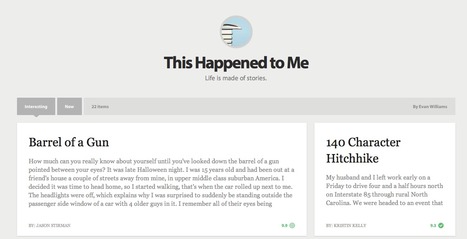
Is Medium a way for new bloggers/authors to find their voice by mixing it alongside famous ones?

Is Medium a way for new bloggers/authors to find their voice by mixing it alongside famous ones? | Content curation trends | Scoop.it

"We’re rethinking publishing and building a new platform from scratch. This is a preview." 


Interesting to see how Twitter co-founders' (Evan Williams & Biz Stone) new initiative - Medium - will develop into.


From what I could read - for instance on This Happened to Me - it seems to be a way to mix contributions from several authors on some editorialized collections. I set up a title, you can contribute.


A way for new bloggers/authors to find their voice by mixing it alongside famous ones?

No comment yet.
Scooped by Marc Rougier
August 13, 2012 11:15 AM
Scoop.it!

Curation, Creation | Enemies or Friends?

Curation, Creation | Enemies or Friends? | Content curation trends | Scoop.it

I had a very interesting discussion with Liam Boogar (author, entrepreneur and musician) about the synergies between Curation and Creation.


Authors bring fresh blood to the web. They are the sources from which we all drink - without them we die. We need to respect and nurture them.


There is however a legitimate - and far from trivial - question: where does "real creation" start? I recently discussed with a famous mathematician who told me that his discovery where not pure creation but just "smart re-use" of what other had done before him. Of course he was being modest but the point is: even if you write something with your own hand and add your own spark, there is a blurred line between what you truly create and what you merely aggregate, or "curate" - consciously or not. The effort of finding relevant pre-existing works, putting them together in a context-rich perspective and passing them to a new audience is both delicate and useful; and is certainly constitutive of the act of creation.


It was really excited to meet an author who shares this view: creation and curation not only go hand in hand, but it’s even sometime difficult to tell them apart. Glad to see that the debate is still dynamic!


No comment yet.
✖

Get a demo of Scoop.it Enterprise

Learn how content curation can help your company.
* Mandatory fields