Content curation trends
185.9K views | +0 today
Your new post is loading...
Suggested by Ileane Smith
July 19, 2012 12:29 PM
Scoop.it!

The Unanticipated Benefits of Content Curation

This is a slideshare presentation by Beth Kanter on Curation. If you've followed this topic for a while, you've seen other great posts by Beth on Curation such as this one for NTEN but this one is an up-to-date version which is worth looking at again. 


Curation is an idea that has been maturing fast recently. And it's great seeing Beth push the anlysis and highlights its specifities and best practices. She also commented this presentation and the corresponding webinar here on her blog.

No comment yet.
Scooped by Guillaume Decugis
July 12, 2012 8:50 AM
Scoop.it!

Are we stuck in filter bubbles? Here are five potential paths out

Are we stuck in filter bubbles? Here are five potential paths out | Content curation trends | Scoop.it

"Algorithms can help, but more fundamentally, we need to figure out what we want a diverse pool of information to look like."


Jonathan Stray gives interesting ideas on niemanlab.org on how to avoid the filter bubble, among which curation. "Editors still command attention" he reminds us. And he adds: "Editors could become curators, cultivating the best work from both inside and outside the newsroom."also pointing out that we prefer to rely on people instead of machines.


We agree!

No comment yet.
Scooped by Guillaume Decugis
July 9, 2012 7:48 PM
Scoop.it!

There’s nothing wrong with outsourcing the news

There’s nothing wrong with outsourcing the news | Content curation trends | Scoop.it

Sounds like a rewrite form Jeff Jarvis' quote "Cover what you do best and link to the rest". And it is.


William P. Davis suggests to replace it by "Do what’s hard and leave the easy stuff to the Filipinos" referring to the employees of Journatic, a company that newspapers have growingly used to outsource news.


While outsourcing news is growing and common, it has been at the heart of a controversy over fake bylines recently. But as this article points out, outsourcing news is not new.


To me, this whole debate is the one of Curation & Creation: what's true for news organizations is true for people and brands engaged in a Content Marketing Strategy. While essential for thought leadership, Content Creation will exhaust your resources and should be completed by Content Curation that points out related stories from 3rd-parties.

No comment yet.
Suggested by Therese Torris
July 6, 2012 7:16 PM
Scoop.it!

Content curation help brands increase their visibility and their customer engagment

Content curation help brands increase their visibility and their customer engagment | Content curation trends | Scoop.it

As Therese Torris explains on this blog post: "there is more smart content online than anybody could ever read". So that's why she decided to embrace curation rather than contributing to the "ongoing content inflation".


Her post is very complete and articulates very well how brands can leverage it to make it an efficient Content Marketing Strategy: "Content curation help brands increase their visibility and their customer engagment."


If you're trying to place Curation among your other Content Marketing efforts, this is an interesting read.

No comment yet.
Rescooped by Guillaume Decugis from SEO and Social Media Marketing
July 3, 2012 4:47 PM
Scoop.it!

Tweets do affect Rankings [Study]

Tweets do affect Rankings [Study] | Content curation trends | Scoop.it

From the original article: "In the biggest study of its kind, we have found that there is strong correlation between the amount of tweets about a URL, and its Google ranking.

 

Key Stats

1) Study shows that URLs receive a significant boost in Google rankings when they are shared on Twitter


2) The effects of this boost seem to level out at around 50 tweets, and the subsequent benefit of gaining additional tweets is minimal until around 5,000 tweets


3) After 5,000 tweets the average ranking of URLs improves considerably
URLs receiving over 7,500 tweets almost always rank inside the top 5 results


4) Average rankings are heavily correlated to the number of tweets about each URL".

 

Full Article Here: http://www.branded3.com/tweets-vs-rankings


Via Antonino Militello
No comment yet.
Scooped by Guillaume Decugis
June 26, 2012 12:47 PM
Scoop.it!

Thoughts on The New York Times / Flipboard paywall deal

Thoughts on The New York Times / Flipboard paywall deal | Content curation trends | Scoop.it

"The New York Times has just announced its unprecedented collaboration with Flipboard to deliver "full access to its content" for its digital subscribers" reports TC Sotteck on The Verge.


Read: including articles behind the paywall.


While some obviously didn't like it, I'm not sure news agregation should get in the way of the model publishers want to use. There is obviously technical and marketing complexity in creating a paywall, integrating it with other platforms and educating users to accept it. If the NY Times succeeds in establishing one, it's legitimate to me that they want it to survive other forms of distribution.


But beyond the theoritical legitimacy, I think the bigger problem resides in the complexity of making deals like this. Flipboard and the times must have been through a long negotiation process which meant lost distribution in the meantime.


By insisting on having the paywall integrated, the NY Times makes it harder for the many Flipboard competitors like Pulse, Zite, Feedly, etc... to distribute it. For one Flipboard that can and will do it, many will just pass. They might be smaller but together they might make significant distribution (remember that "Others" section in market studies that usually make the biggest chunk? That's them).


For Flipboard, this also signals to other media that they're ready to do so which will absorb some of their resources and slow them down. This reminds me of the model of the music industry which considerably slowed down adoption of legal music : every new startup in this business had to cut a deal with the music labels and wait patiently for them to have the resources to execute such a deal. 


Bottom line for the music industry 10 years later? Not much growth, I'm afraid.

No comment yet.
Scooped by Guillaume Decugis
June 25, 2012 10:53 AM
Scoop.it!

4 ways content curation could influence the Presidential election

4 ways content curation could influence the Presidential election | Content curation trends | Scoop.it
Newscred is writing on the future of news on their blog (and I invite you to check out their site) and they believe Curation will have an important role to play in this year's election.

Just like people or brands, candidates and parties have to raise awareness for their ideas but also show how they relate to the context voters are in.
No comment yet.
Suggested by Chuck Sherwood, Former Senior Associate, TeleDimensions, Inc
June 23, 2012 1:07 PM
Scoop.it!

In Germany, Proposed Licensing For Newspaper Snippets Could Threaten Users Of Blogs, Facebook And Twitter

In Germany, Proposed Licensing For Newspaper Snippets Could Threaten Users Of Blogs, Facebook And Twitter | Content curation trends | Scoop.it

This was suggested to me by Chuck Sherwood (thanks!) and reading it from Silicon Valley, it's both fascinating and somehow saddening:


"A few months ago we wrote about a really bad idea that was being floated in Germany: making companies like Google pay for the use of news snippets in services such as Google News. Unfortunately, that idea has now been turned into a concrete proposal for a new law; remarkably, it is even worse than the original plans."


It looks like after SOPA, the fight is not over between partisans of an open internet and declinging industries looking at tighter copyright enforcement as a solution to their lack of innocation.


My previous business was in the digital music industry and I understand the case against free copy of everything. I would argue that Spotify is a much better way to fight piracy than SOPA but I can understand why full length copying of copyrighted material is hard to accept for content creators.


This time however, the case of newspapers involved in that proposition seems tough to argue: Fair Use and the Right to Quote have long been copyright exceptions that existed long before the Internet. Both in the US and Europe. We need them simply because knowlegde works this way: you build on top of the existing by referring to it. 


What these (minority of?) newspapers fail to see is that if their news are only valuable from the snippets or their titles, they're pretty worthless. The Media & Publishing industry have to adapt and in particular emphasize the role of Curation by giving context, analysis and meaning. There's a winning model for Media in the future. But I'm certain it doesn't involve litigation and protective lawmaking.

No comment yet.
Suggested by Chuck Sherwood, Former Senior Associate, TeleDimensions, Inc
June 18, 2012 6:49 PM
Scoop.it!

Publishing is no longer a job or an industry -- it's a button

Publishing is no longer a job or an industry -- it's a button | Content curation trends | Scoop.it

"As author Clay Shirky points out, the simple act of publishing something -- whether it's a book or a news article -- doesn't require an industry any more, just a button." I missed this article by Mathew Ingram on GigaOm back in April but Chuck Sherwood brought it back to my attention and it's an interesting comment on Clay Shirky's "How we will read" series. 


Obviously, as we're building a platform that aims at making publishing as easy than clicking on a bookmarklet, we don't disagree. 


But what's left for publishers to differentiate upon then?


Well, plenty according to Shirky and Ingram. But provided they understand value-adding services and they're ready to give away distribution control. 


Interestingly, I believe these points are interesting not just for large or traditionnal publishers but also individual curators.

No comment yet.
Scooped by Guillaume Decugis
June 11, 2012 9:29 PM
Scoop.it!

The Unanticipated Benefits of Content Curation - NTEN:Change's Content Curation Issue

The Unanticipated Benefits of Content Curation - NTEN:Change's Content Curation Issue | Content curation trends | Scoop.it

Beth Kanter wrote a very complete and interesting piece in NTEN's latest edition of their quarterly journal for non-profit leaders. You have to download the journal but it's worth it and it's free (you just need to register). 


It's been fascinating for me to see how non-profits seem to embrace Social Media in general and Content Curation in particular - Beth of course being a key advocate in that move.


The broader take-away that I see for those of us in all sorts of organizations, as independant professionals or SMB-owners is the validation it brings to the model. When tightly-budgeted NPO's embrace a practice as a group, you can bet they're not wasting their scarce resources on a hype. They have to be efficient and as Beth puts it in the article: "Putting content curation into practice is part art form, part science, but mostly about daily practice. You don’t need to do it for hours, but 20 minutes every day will help you develop and hone the skills."


This is precisely where we see the opportunity with curation for professionals: building up a good practice that fits with one's daily routine and that -as Beth puts it - brings great "unexpected benefits".

Guillaume Decugis's comment, June 13, 2012 12:28 AM
You're welcome Beth. Thanks for the great piece!
Mshaber's comment, June 13, 2012 1:51 PM
Thanks...
janlgordon's comment, June 14, 2012 10:09 AM
Thank you Beth Kanter for the mention and for an amazing article, it's greatly appreciated!
Scooped by Guillaume Decugis
June 7, 2012 3:24 AM
Scoop.it!

Curation and the Questions No One Is Asking

Curation and the Questions No One Is Asking | Content curation trends | Scoop.it

Yes, curation wouldn't exist without creation, admits Mark Armstrong, the founder of Longreads and also a team member of Pocket.


But, he goes on, there are interesting questions - and perhaps more even more interesting answers - that highlights the value of Curation.


As he concludes, every one is a curator - a claim we won't disagree with at Scoop.it : "There is no “us vs. them.” There’s only “we.” So we should all start working harder to have some constructive conversations about how we improve the model."

No comment yet.
Rescooped by Guillaume Decugis from Content marketing for b2b
June 4, 2012 2:05 PM
Scoop.it!

Why Reporting Is Ripe For Innovation

Why Reporting Is Ripe For Innovation | Content curation trends | Scoop.it

This is an interesting post by Facebook's Journalist Program Manager, Vadim Lavruski, who's been writing on curation before and predicting it will have a growing impact on journalism in 2012. I rescooped it from Monique Watkins.


It reminds me of the idea of thinking newspapers as data platforms that you can look to integrate with other data inputs and platforms and that you can almost think of in terms of software stacks.


It seems to me as well that the challenge for newsrooms is no longer to be integrated in the classic sense (do everything in house) but to be open and distributed (leverage others' work, build on top of what already exists). Just like we build Web services on top of one another.


Via Monique Walhof
No comment yet.
Scooped by Guillaume Decugis
May 30, 2012 8:27 PM
Scoop.it!

Is Forbes the digital model for traditional media?

Is Forbes the digital model for traditional media? | Content curation trends | Scoop.it

"By now, we have some pretty good examples of what a digital-native media entity looks like: it looks a lot like The Huffington Post or BuzzFeed or Vox, with a relentless focus on the dynamics of the real-time web and the way that content lives online — and the power of the social web"


But how about traditional media asks Mathew Ingram?


Interesting analysis of what it took Forbes to change and adapt to digital. Expanding the contribution base while keeping some editorial control was key and is one of the things Ingram touches upon in that great article. Showing how a contribution-with-curation model becomes essential for media to become or stay relevant while avoiding the risks associated with opening the flood gates on contribution.


There are also other points such as feedback measurement tools and writer/reader connexions which are makes this a very interesting read.

No comment yet.
Scooped by Guillaume Decugis
July 18, 2012 2:30 AM
Scoop.it!

Twitter's Credibility Problem

"Where you read something may impact credibility as much as what you read - especially if where you read something is on Twitter, according to a new study."

This interesting study related by Read Write Web shows that people tended to be skeptical when discovering a study on Twitter which is dominated by news but where they are mixed with celebrities updates and other tweets. Apparently an adverse effect on Twitter's credibility.

The study didn't say whether dedicated social curation was a remedy but it's an interesting possibility judging from the facts outlined in the report.
No comment yet.
Rescooped by Guillaume Decugis from Neli Maria Mengalli's Scoop.it! Space
July 10, 2012 12:16 PM
Scoop.it!

Understanding Content Curation

Understanding Content Curation | Content curation trends | Scoop.it

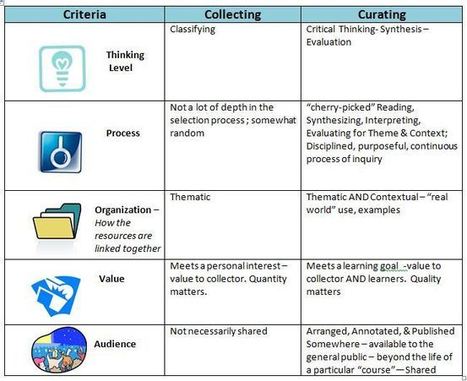
On her blog, Nancy White did a great job detailing the various levels at which Curation adds value. And how it differs from collecting.


A Learning & Innovation specialist, she also greatly outlines how curation and education are a great fit.


Via Neli Maria Mengalli
ProfessorBill Santiago's curator insight, October 21, 2014 12:08 PM


What do I need to know in order to give good safe care to those who are sick?

Rescooped by Guillaume Decugis from Curation, Social Business and Beyond
July 9, 2012 2:34 PM
Scoop.it!

Why Twitter Matters: Tomorrow’s Knowledge Network

Why Twitter Matters: Tomorrow’s Knowledge Network | Content curation trends | Scoop.it

Great pick by Jan Gordon and a vribrant defense of Twitter as way to do research, mutual curation and smart... cocktail parties! 


Nigel Cameron says in this post he doesn't like "the thought of “one great inter-connected world brain,” language proposed by the editors of a National Science Foundation volume a decade back." But reading him (and as he also admits), I couldn't help but think about this previous post on how curation might be shaping the global brain.


Thanks Jan!


Via janlgordon
Guillaume Decugis's comment, July 9, 2012 3:29 PM
I also love the smart Cocktail Parties. Reminds me of our chats in NYC at the #140 ;-)
janlgordon's comment, July 9, 2012 9:07 PM
gdecugis
Great minds think alike, I liked the 24/7 cocktail party too:) yes it was great chatting with you at the #140 last year, I missed you this year:)
Guillaume Decugis's comment, July 9, 2012 9:18 PM
This year was Chicago for me (TechWeek). But I love NYC so I'll be back!!!
Suggested by Scoop.it
July 5, 2012 10:02 PM
Scoop.it!

Curation: How the Global Brain Evolves

Curation: How the Global Brain Evolves | Content curation trends | Scoop.it

I just had an epiphany reading this article that explains how curation is the shaping out of a global brain for mankind. I've used this analogy in the past (such as recently in this TechCoktail interview) and I've always thought I was maybe sounding a bit crazy.


Well, good to see I'm not the only one. Thanks Eliot van Buskirk: you just made my day! 


And as I said in the comments on this post, the other important point that's happening is that human curators are not just passing the information: they enrich it. With context and meaning to a particular audience. So yes, this global brain we're building will be smart.


gdecugis

Scott D.Warner, PLS's comment, July 8, 2012 4:43 PM
Firstly, I must apologize for not reading the links in the post, however, I am not sure that I need to to understand the gravity of the epiphany. We are all curators of our own minds, and as an extension of our mind, we curate similarly online and in person. A properly cultivated idea can grow into a sort of "universal mind", or even a "universal mankind". These are not original ideas. I do not believe in original thought. What I do see is that social media has had the communicative effect on human beings that has been unrivaled since the development of the alphabet.
Guillaume Decugis's comment, July 9, 2012 2:19 PM
@Scott - The idea in the article is that curators pass ideas in a similar manner to neurons and synapses in the human brain, forming a global brain. An idea which isn't new but which could be taking shape with the Internet, social media and... curation.
Scooped by Ally Greer
June 29, 2012 9:06 PM
Scoop.it!

Content Curation Sneaks Up on Marketers

There are many varying opinions of curation, but what most people don't realize is that they curating information every day. 


Adding commentary to content, however, is what establishes the difference between curation and simply sharing. Scoop.it aims to create a place where you can share all of your content while adding your own commentary, and then push this content to all of your different social media presences. This is where the value of curation truly lies.


Thanks to Ardath Albee for this insightful post.

No comment yet.
Scooped by axelletess
June 25, 2012 1:07 PM
Scoop.it!

There’s no such thing as an objective filter: Why designing algorithms that tell us the news is hard

There’s no such thing as an objective filter: Why designing algorithms that tell us the news is hard | Content curation trends | Scoop.it

"filtering algorithm design is one of those wildly interdisciplinary problems. The challenge is to imagine systems that:
forward societal goals that we think are important, yet are precise enough to be phrased as performance yardsticks,
combine algorithms with humans in a productive way, and
can actually be built with available technology."

Great article explaining the different approaches that technologists and humanists take to deliver "relevant"news. The temptation of the "all technology" could be strong in a world where algorithms seem to solve many problems. But it's not only about "solving". Accessing news should be also about serendipity, exploration and "feeling" what people enjoy to discover. And human interactions stay key to be inspired. Curators of the digital age could be the link between these two different visions. Curation for Scoop.it is a celebration of the humanrithm, to build a deep culture of exploration. Accessing knowledge is not enough anymore. Exploring the opportunity of collective wisdom is an amazing challenge.

No comment yet.
Scooped by Guillaume Decugis
June 23, 2012 1:27 PM
Scoop.it!

How to create brand engagement with new audiences using content curation and the right editorial approach: the case of Intel IQ

How to create brand engagement with new audiences using content curation and the right editorial approach: the case of Intel IQ | Content curation trends | Scoop.it

Pretty interesting analysis of Intel IQ's initiative and how it can be generalized to other types of smaller busiensses.


Good summary of what Content Curation can bring to a Content Marketing Strategy.

No comment yet.
Scooped by Guillaume Decugis
June 21, 2012 11:39 AM
Scoop.it!

Remixing Digital Media, Curation & Content Marketing for all at the TechWeek Conference in ChicagoScoop.it

Remixing Digital Media, Curation & Content Marketing for all at the TechWeek Conference in ChicagoScoop.it | Content curation trends | Scoop.it

Curation is going to be a big topic at the TechWeek Conference starting this Friday 6/22 in Chicago. I’ll be speaking at two sessions related to it but there are several others worth looking at as they show how important Curation is becoming as a trend. Not just to the Social Media experts who predicted it, but now also to people and businesses everywhere.

No comment yet.
Scooped by Guillaume Decugis
June 15, 2012 1:12 PM
Scoop.it!

How Long Before You Will Scoop.it Instead of Google It?

How Long Before You Will Scoop.it Instead of Google It? | Content curation trends | Scoop.it

"Services like Scoop.it depend on a community of millions of hardworking experts who wonder what to do with the wealth of knowledge and wisdom they have accumulated in life and are happy to share it."


Written by blogger Shred Pillai on the Huffington Post, this vibrant praise of Social Curation in general and Scoop.it in particular, points out the changes we're seeing in the way we look for information. From basic search, we now look more and more for meaning and context from human experts.


Beyond information, we want knowledge.


And this is what Curation is all about.


As he concludes: "At the end of the day, Scoop.it, which is free, is the right answer for information seekers and providers as well as the experts who like to show off their expertise."

lelapin's comment June 17, 2012 3:46 AM
I may be wrong but I don't see this happening any time soon.
Rescooped by Guillaume Decugis from SEO and Social Media Marketing
June 7, 2012 12:51 PM
Scoop.it!

How Content Curation Can Improve Your Search Rankings

How Content Curation Can Improve Your Search Rankings | Content curation trends | Scoop.it

It's not the first article that points out how Curation and SEO are connected but it's an interesting recap.


To build up on that story and put things in perspective, you can filter that topic on the "SEO" keyword or click here.


Over the past 18 months, we've seen Google progressively change its algorithms through Panda and Penguin to augment the importance of the social signal. Curation also helps significantly in any Content Marketing strategy, which - as top blogger Neil Patel reminds us - is often the starting point to improve your Search Rankings.


A great read that I discovered through Antonino Militello on http://www.scoop.it/t/seo-and-social-media-marketing 


Via Antonino Militello
No comment yet.
Scooped by Guillaume Decugis
June 4, 2012 9:46 PM
Scoop.it!

Content Curation Can Inform, Engage Customers

Content Curation Can Inform, Engage Customers | Content curation trends | Scoop.it

Interesting data on how marketers see curation as a way to drive thought leadership, develop brand visibility and boost SEO.


The Study also touches upon what marketers see as challenges blocking them from doing more Content Marketing. Time is clearly an issue high on the list together with the ability to create original content.


Interesting results (also measuring progress between 2011 and 2012).

No comment yet.
Scooped by Guillaume Decugis
May 31, 2012 7:45 PM
Scoop.it!

Content Curation and Distribution is King

This is a podcast I recorded on Content Curation for Spark Tech Talk.


I had the privilege to be joined by Oliver Hsiang from StumbleUpon and Gary Griffiths from Trap.it.


It was great to have a dynamic conversation moderated by Agnes Cheek on the background and evolution of Curation as we all brought our different perspectives.


Part 2 of this podcast has now been published here.


Enjoy!

No comment yet.
✖

Get a demo of Scoop.it Enterprise

Learn how content curation can help your company.
* Mandatory fields