


The purpose of content used in business is to get the right content in front of the right people, at the right time.




 Your new post is loading...
 Scoop.it! The purpose of content used in business is to get the right content in front of the right people, at the right time.
Guillaume Decugis's insight:
I couldn't agree more with this post on Boston Content which outlines the different components which are essential in a Content strategy such as seeing your social channels as outposts that need to be fed from a Content Hub. As I commented on the blog, I'd add Search and email as two other key components to consider when making Content Distribution plans. 
Scoop.it!

Here’s a little piece of SEO nerdery that affects us all: Google is using Google+ to influence search results in a big way, and brands and media organizations alike have yet to wake up to the...
Guillaume Decugis's insight:
Erin Griffith analyzes how the use of authorships combined with Google+ is now impacting Google search results. This change is not new but, as she puts it, it is significant: "Google was always about the algorithm, not curation, certainly not curation through something as, well, human as a social network. The emphasis before was about what was on the page not who wrote it." While she focuses on the new importance of authorship given by Google, what's happening is actually a mix of a couple of things which are in my opinion equally good:
#1 means that an identified, reputable author will prevail; #2 is part of the social signal that Google uses more and more to rank results and that builds on curators' activity. Bottom line is that - as I predicted a while ago - the age of low-quality content cheaply produced by random anonymous writers in content farms for pure SEO purposes is over. By combining a measure of the author's influence as well as taking into account curators' appetite for a piece of content, Google is bringing quality back in the game. Which is good for authors, curators and... readers.

Laura Brown's comment,
January 28, 2013 1:49 AM
I fixed up the Author Rank last week on all my sites. I think it is far more reliable than the old Page Rank plan.
Laura Brown's comment,
January 28, 2013 1:49 AM
At least for another six months when some scammer will figoure out how to work around it.

Andre van Wyk's curator insight,
February 26, 2013 4:49 AM
I think people will now have to sit up and take notice, especially the naysayers ....
Scoop.it!

While there are a ton of essential skills that today's students need in order to succeed in tomorrow's world, learning to efficiently manage -- and to evaluate the reliability of -- the information that they stumble across online HAS to land somewhere near the top of the "Muy Importante" list.
Guillaume Decugis's insight:
Interesting example of using Content Curation to teach digital native students how to cope with the vast amount of information they get exposed to. Teacher Bill Ferriter had them go through a very concrete topic: the recent decision of New York City "to ban the sale of sugary drinks in containers larger than 16 ounces". Good decision? Bad decision? Biased information? I found this experiment really interesting and the result looks pretty impressive.

Tom Hood's curator insight,
January 28, 2013 7:39 PM
I see this helping to create a PLN Personal Learning Network 
bookwarrior's curator insight,
February 7, 2013 2:32 PM
This educator describes how Scoop.it can be the tool by which you teach students to gather, manage, and evaluate information. I 100% agree with his caveat at the bottom that Scoop.it doesn't do the teaching but because it is so simple and seamless and allows for so much interaction and feedback between student curator and instructor, it is the perfect medium for it. 
Pauline Farrell's curator insight,
March 6, 2013 7:18 AM
Need a new subjects or all higher education students - digital content curation - we provide less pre-preapred resources - students need to learn what is worth citing
Scoop.it!
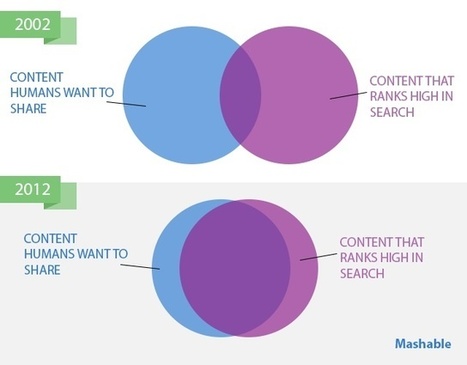
Five years ago, SEO was all the buzz. Today, it has shifted to "content marketing," which aims to create stories humans want to read and engage with. - The above chart is a good summary of this trend.
Guillaume Decugis's insight:
Shane Snow makes a good summary on Mashable of the trends impacting SEO these days. We moved from a machiavellian approach to game Google to influence-based content marketing because social media changed the game as others have observed before. The success of Social Content Curation is a good example of that trend: human sharing and curating content beat the system and become such an important trend that Google had not only to change their algorithms but also start a social network just because of that.

ben bernard's comment,
January 9, 2013 11:40 PM
thanks ! http://www.scoop.it/t/direct-marketing-services my newly made scoop.it :)

Guillaume Decugis's curator insight,
October 29, 2013 9:58 PM
This one slide alone summarizes the major trend of these past few years. In other words, Social Media is becoming the new SEO. This has at least 2 consequences for Content Marketers: 1. Content Marketing is becoming more and more important: companies can't use old fashion backlinking techniques anymore. 2. Content needs to be shareable and target humans - not robots. In particular content curators who will amplify their content impact by adding the right context to the right audience. 
Neil Ferree's comment,
October 31, 2013 11:19 AM
Social Shares is the New SEO. Sure, links let the bots know there are other sites (authors) who find your content useful but when someone publically "shares" your content with their social connections, this social signals evokes trust in the author's content and authority.
Scoop.it!

Not long ago, a few members of the Scoop.it team began discussing the answer to the all too popular question: how do I do content marketing if I’m a startup or professional without a big budget?
Ally Greer's insight:
This evening, we were happy to host the co-founder of the awesome social media tool BufferApp, Leo Widrich (@LeoWid), who shared five awesome lessons that he’s learned over the last two years of developing his very own content marketing strategy. At the time of its creation, Buffer App didn’t have any users and its two young founders tried relentlessly to get any tech blogs to cover them. When this didn’t work, the co-founders asked themselves, “if no one else will write about us, why can’t we just write about ourselves?” Since Leo was the “marketing guy,” he was charged with putting out as much content as he could to spread the word about Buffer App. Two years and a highly successful social media app later, Leo has learned some of the most important lessons in content marketing: 1. Pick Quantity over Quality 2. The Hidden Power of Images 3. Copy and Steal 4. Help 1 other person with each piece of content. 5. Show your passion and culture

Ally Greer's curator insight,
November 27, 2012 11:55 PM
This evening, we were happy to host the co-founder of the awesome social media tool BufferApp, Leo Widrich (@LeoWid), who shared five awesome lessons that he’s learned over the last two years of developing his very own content marketing strategy. At the time of its creation, Buffer App didn’t have any users and its two young founders tried relentlessly to get any tech blogs to cover them. When this didn’t work, the co-founders asked themselves, “if no one else will write about us, why can’t we just write about ourselves?” Since Leo was the “marketing guy,” he was charged with putting out as much content as he could to spread the word about Buffer App. Two years and a highly successful social media app later, Leo has learned some of the most important lessons in content marketing: 1. Pick Quantity over Quality 2. The Hidden Power of Images 3. Copy and Steal 4. Help 1 other person with each piece of content. 5. Show your passion and culture 
Barbara Kurts's comment,
January 9, 2013 9:08 PM
my topics here http://www.scoop.it/t/health-leads-plus
ben bernard's comment,
January 9, 2013 11:41 PM
thanks ! http://www.scoop.it/t/direct-marketing-services my newly made scoop.it :)
Scoop.it!

"In a room full of media heavyweights, CEOs, and high-tech entrepreneurs, the debate is hardly philosophical. "Will Robots overtake Humans?" and in some cases should they?
Via Giuseppe Mauriello
Guillaume Decugis's insight:
Interesting write-up by Steve Rosenbaum on how algorithms and humans compete to solve some of the biggest technological challenges today. Particularly in the content curation space, which reminds me of my own talk at Data Week earlier this year.
Scoop.it!
I gave this talk at TechWeek L.A. (where else on such a topic?) last week as I felt the new social media evolutions, particularly the rise of the interest graph, are making things move quickly on that subject. Why do we remember famous people in history? How? How about today's celebrities? And how are the Internet and the Social Web changing that now? A look at the fame creation process tells us it is indissociable from the media creation process, which has been deeply impacted by new information technology. The Andy Warhol prediction is probably no longer valid and we need to rethink fame in the context of a distributed Internet network which more and more becomes topic-centric and no longer people-centric.

Marco Fabiani's comment,
December 11, 2012 2:26 PM
I have to find out how to use the curation for myself
Scoop.it!

"Less is more" is a principle that made the success of some great products. Take the iPhone in its early days for instance: much less features than competing smartphones at that time but a beautiful interface that brought an ease-of-use never seen before.
Medium seems to be going down that path by focusing on delivering true wysiwyg editing on an online service while removing a lot of the bells and whistles that Wordpress and other platforms have. While this is certainly interesting and exciting, I wonder whether it won't make this too impressive for the casual blogger or writer. With Medium, it seems like you won't be able to rely on anything else than the simple power of words. But then again, it might be the intention: getting the best storytellers excited about the platform rather than an attempt to democratize publishing?
Scoop.it!

Interesting take by Hamish McKenzie on Pandodaily. In his opinion, the reason Media Publishers feel bold enough to attack Google and feel entitled to have a revenue share is that Google News is a declining service. He lists Mobile Agregation but also Human Curation as two trends that make its algorithmic filtering less relevant. So interestingly, while many have attributed to Google's own algorithm changes the demise of services like Wikio, it seems that now Google's own algorithmic approach is challenged by social curation. Via Giuseppe Mauriello
Scoop.it!

"In their fight against Google, traditional media firmly believe the search engine needs them to refine (and monetize) its algorithm. Let's explore the facts." Interesting demonstration by Frederic Filloux on Monday Note showing that the battle of the European press against Google might be based on collective myopia on their side. Though European media publishers might think different, facts show that "for Google, the most data-driven company in the world, having newspapers articles in its search system is no more than small cool stuff." So then why is Google fighting back? Even though the data Filloux presents show the monetization of news is very marginal for Google, there's another argument to that story: comprehensiveness. Yes, Google could easily shut down Google News and wouldn't feel worse financially for it. But indexing news content for its Search business is however critical, no matter how small a direct revenue stream it creates for them. As Google understood by constantly developping it, a good Search engine needs to index everything. Remove news from Search results, you end up with a broken tool. Where this gets even more interesting in my opinion is when you add Social to it. Google has been pushing Google+ content and social signals in search results and this is not just an algirithm this time: these are real people sharing and curating content, some of it form European media publishers. Facebook's Zuckerberg also said he was looking at Search as an opportunity. So while now, this seems to be abiout not letting an algorithm index media for free, how about tomororw? Will all European press titles remove the share buttons they have on their sites?
Scoop.it!

"Working so hard to make your blog great can be depressing without feedback. And that's difficult to come by!"
Mark Schaeffer touches a very interesting point of social media in general and blogging in particular. Why the heck am I doing that? This is the question you will sooner or later ask yourself if you started a blog or a social media publishing activity. If you've followed us for a while, you know this is one of the frustration we had that pushed us to create Scoop.it. And also the more important question of how do you make an impact? One of the answers we found is in developing the interest graph. Some people have the ability to impact many. That's rare. And most of us don't. But all of us have the ability to impact other people that share their interest. By looking at the complexity of the social web through the prism of interests, we come out with a totally different possible way to organize the web, define influence and being impactful. Think about it this way: in what you do everyday, is it more important to influence a million random strangers or the tens or hundreds of people who care deeply about the same topic that you do?
ben bernard's comment,
January 9, 2013 11:56 PM
thanks ! http://www.scoop.it/t/direct-marketing-services my newly made scoop.it :)
Scoop.it!
|

|
Scooped by
Guillaume Decugis
October 11, 2012 5:01 PM
|
Scoop.it!
Those are the slides of my talk at the Social Media for Non-Profits conference in San Francisco today.
1. Why does Content Curation matter for marketers?
2. 7 Best practices for Content Curation
3. And great examples of NPO's effectively using Content Curation.
Part #3 is specific to NPO's (but might be inspiring to any Content Curator) but #1 and #2 are generic for all Content Marketers.

|
|
Scooped by
Guillaume Decugis
January 15, 2013 2:35 PM
|
Scoop.it!

A Facebook page post gets half its reach within just 30 minutes of being published. Here's how you can make the most of this short window.
The tips listed here are interested but the fundamental message is the same as for Twitter (see a great bitl.ly analysis here): your social content won't live long. Unless you curate it somewhere resilient where it can be indexed for future consumption, it will melt like wet snow.

For more information on Online Solutions, please visit our website or contact us.
|
|
Rescooped by
Guillaume Decugis
from Lean content marketing
December 28, 2012 12:13 PM
|
Scoop.it!

My name is Ally Greer. I’m a marketer with expertise in content marketing and curation. You’ve probably never heard of me.
With over 500 million users on Twitter, 175 million on LinkedIn, and over a billion on Facebook, you probably haven’t heard of most people on the Internet. The bad news is that this also means most of those people probably haven’t heard of you either.
A great guest post by our own Ally Greer on why we we've never had better opportunities to be discovered online thanks to the rise of the interest graph - a major trend for social media 2013 - combined with content curation.

|
|
Rescooped by
Guillaume Decugis
from Content Curation World
December 8, 2012 12:55 PM
|
Scoop.it!

Robin Good: If you are looking for ways to expand your horizon of content sources that you can use to find valuable content for your curated news channel, Pawan Deshpande, founder and CEO of Curata, has done an excellent job of listing and describing the many alternatives available to you.
While many beginner curators rely on their set of RSS feeds and on simple web searches to find new and interesting stuff on their topic of interest, there are a dozen more content source types that can be tapped to find relevant stuff. This article helps you start learning where to look to find them.
Useful. Resourceful. 8/10
Full article: http://contentmarketinginstitute.com/2012/12/sources-content-curation-inspiration/
Interesting recap by Pawan Deshpande of the variety of sources you can use for curation. To complete the list or to make it easier for your workflow with all these sources, don't forget to check your advanced sources of your topic in Scoop.it.

If you are serious about your job search or developing your career, you cannot ignore content curation. Not only you need to read a lot of articles in your field to stay up to date but you also need to add some analysis and offer your opinion if you want to build and keep your reputation as an expert. 99% of recruiters are using internet to search for candidates.
|
|
Scooped by
Guillaume Decugis
December 3, 2012 9:18 PM
|
Scoop.it!

A new study finds that the use of computers and Facebook are more associated with information overload than the use of television and iPhones.
Interesting study that shows that the perception of having information overload might be impacted by what device you use to read content - the computer being very different than new mobile devices which by design offer more of a curated experience.

|
Scooped by
Marc Rougier
November 27, 2012 1:04 PM
|
Scoop.it!

There is a new profession of trail blazers, those who find delight in the task of establishing useful trails through the enormous mass of the common record.
Vannevar Bush brilliantly predicts, in his essay "As we may think", the crucial role of those who filter, organize and pass information. And this was back in 1945, when the "enormous mass of common record" was equivalent to what is created nowadays in... a day?
A very interesting post by Maria Popova.

Tu vivienda esta aquí (pisos, apartamentos, chalets, villas, casas, adosados, locales, estudios, etc .....o promoción de obra nueva) nunca fue tan fácil en comprar tu vivienda, nosotros les ofrecemos una gestión personalizada en compra de tu vivienda, pide mas información sin compromiso.

Mind boggling to think what that the overload of content he speaks of is now created in a single day, every day.

Applicare il metodo delle associazioni mentali all'archiviazione e alla ricerca delle informazioni. La visione profetica di Vannevar Bush.
|
|
Scooped by
Guillaume Decugis
November 26, 2012 8:09 PM
|
Scoop.it!
Interesting take on Medium by Dave Winer. Though I wouldn't agree with everything he says (he still finds blogging easy but hey, isn't he a natural-born blogger?).
|
|
Scooped by
Guillaume Decugis
November 19, 2012 5:40 PM
|
Scoop.it!

"If there's a universal truth in the digital age it's that there's too much content and not enough time to consume it. Naturally, a challenge this large and far reaching is creating opportunities for innovators." writes Steve Rubel of Edelman on the new LinkedIn Tought Leaders section.
He goes on to explain how Scott Beale of Laughing Squid is a great example of using curation to become a media that serves the purpose of developing a company's brand in the age of online media.
"The lesson here is that any company can potentially benefit by thinking and acting like a media company (...) However,you don't necessarily need to create original content."
Great case study.

|
|
Scooped by
Guillaume Decugis
November 15, 2012 6:28 PM
|
Scoop.it!


|
|
Scooped by
Guillaume Decugis
November 9, 2012 12:27 PM
|
Scoop.it!
How do you develop and display your talent efficiently and with impact? This is the SlideShare we've put together on why and how professionals embrace Content Curation to make their talents shine online.
|
|
Scooped by
Guillaume Decugis
November 7, 2012 6:31 PM
|
Scoop.it!

"Over half a century ago, management guru Peter Drucker presented the concept of the knowledge worker. Compared to the manual laborer, the knowledge worker focused on quality over quantity and worked more independently as problem solvers."
Over the many applications of Social Content Curation, Professional Development has been a strong trend. We keep observing it on Scoop.it but it's also been reported by Social Media influencers.
As more and more of us become Knowledge Worker, it should be no suprise that Content takes a growing importance on our Professional lives. So here's our take on it and why we announced this new integration with LinkedIn earlier today.
|
|
Scooped by
Guillaume Decugis
October 24, 2012 5:10 PM
|
Scoop.it!

Brian Yanish posted a great case study on his blog on how to use Content Curation as a secret weapon to market your business. As a consultant helping clients market themselves online, Brian has a lot of experience with various marketing strategies and it's great to see his angle on how content curation can help.
As he summarizes it after having been a Scoop.it user for quite some time (and testing lots of curation services), Content Curation "can drive traffic and help to show the world, yes the world that your business knows your market."
Must-read with very interesting data for business content curators.
(And by the way, if you're looking to hire Biran, he gave his contact details on the original post here: http://sco.lt/5BybWD)

|
Suggested by
Mick Farmer
October 19, 2012 2:02 PM
|
Scoop.it!

If you're not convinced yet, freelance Content Marketer and blogger Mike Farmer has some interesting points for you.
One thing I would add to his post is the importance of creating a Content Curation hub to really capture the benefits of your Content Curation efforts. Sharing links is just not going to be enough: in a world where tweets have a very short lifetime, you need to give your curated content a second chance by putting it on a curation layer where it can be discovered from search and from people with similar interests.
This can be a blog, a site or a Scoop.it page but if you're going to make content curation part of your content marketing strategy, you will need that long term repository that social networks don't bring.







Good distribution insight for content marketing and blogging. If your terrific content doesn't get shared or doesn't get results, your effort has been wasted.
For more information on Online Solutions, please visit our website or contact us.