
Many teacher do not adapt teaching to technology because they do not know how to. They do not use Web 2.0 for their own learning and so cannot conceive of how to use it to teach. Until the number of teachers familiar ...


|
Scooped by
Yashy Tohsaku
onto Education 2.0 & 3.0 July 22, 2012 11:00 AM
|
 Scoop.it!
Many teacher do not adapt teaching to technology because they do not know how to. They do not use Web 2.0 for their own learning and so cannot conceive of how to use it to teach. Until the number of teachers familiar ...
 Your new post is loading...
 Your new post is loading...
Your new post is loading...
Scoop.it!
From
www

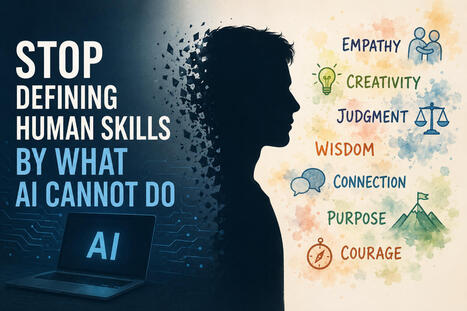
We now have AI agents that take multi-step actions without checking in. There are wearables that capture context all day. The soon-to-be-future of robotics is finally leaving the demo video. If your framework was already wobbling under a chatbot, it will not survive the next four things. So here
Scoop.it!

Glint uses AI to help teachers quickly create visual supports, communication boards and more.
Scoop.it!
What Adam Grant’s Think Again can teach trainers about turning participants into active learners
Scoop.it!

From
kid-voices-ai
Try KidVoice, an AI child voice generator with a free plan, 66 natural styles, multilingual previews, and permitted voice cloning. Via Nik Peachey 
Nik Peachey's curator insight,
Today, 5:37 AM
KidVoice enable you to create audio using AI generated children's voices. It can be really hard to get audio of young children's voices so this is a goo solution, though the range is very USA focused. https://kid-voices-ai.com/
Scoop.it!
AI Weekly Round-Up #44: Ambient voice mode for Codex and "ontologies" for agents
Scoop.it!
From
clalliance
Ask a teenager what they post online these days, and you may get a blank look in response. Posting has waned, scrolling has taken over, and what fills a feed now is more likely strategically produced content than friends’ photos. In a new essay, “Social Media Is Now Parasocial Media,” danah boyd argues the shift is significant enough to warrant a new name. danah is the Geri Gay Professor of Communication at Cornell University and founder of the Data & Society Research Institute. She helped coin the term “social network sites” in 2007, was a co-author of “Hanging Out, Messing Around, and Geeking Out” (2009), wrote “It’s Complicated: The Social Lives of Networked Teens” (2014), and has been a lasting influence in the connected learning community since its earliest days. In this conversation, danah discusses the transition from social media to parasocial media and unpacks the implications for young people. Question: What’s the critical issue? danah boyd: The essence of social media has changed: the practices that define social media in 2026 look extraordinarily different from what researchers like me were trying to document 20 years ago. I would argue — although many challenge me on this — that the “social” in “social media” has slowly become a misnomer. In 2006, most people who logged into MySpace and Facebook and Twitter regularly posted content because they were co-constructing sociable spaces to enjoy the companionship of others. In 2026, the content that is posted on the major social media sites is published by a very small subset of the platform’s users. Most social media users prioritize scrolling content published by people that they do not know rather than posting their own haphazard updates for friends. Even the vibes are different. The content published on social media is more strategically constructed, more intentionally curated, and more seemingly professional. Users are now lucky to see personal content that their friends are posting amid the slick content created by the advertisers, influencers, and other content creators who dominate most people’s feeds. What goes “viral” is now often manufactured in a lab, designed to appeal. In a world of algorithms and financialized platforms, this makes sense: highly polished content is rewarded. Welcome to the era of influencers. This is why I argue that “social media” is now better understood as “parasocial media.” Q: What is parasocial media? danah: Parasociality is the idea that you can be paying attention to someone who is typically a celebrity, someone who has built an audience and a following, but they don’t know that you exist. Parasociality has been around for as long as there have been celebrities. Take the Beatles, with some of the biggest fans ever: you could know every detail about John Lennon’s life, you could feel so close to him, but that was never a social, bi-directional relationship. Or think of Teen Magazine in the 1990s: you would read the magazine to obsessively learn the life details of the *NSYNC boys and tear out their pictures to post on your bedroom wall. For decades, broadcast TV made parasociality a common practice by minting pop culture celebrities that huge populations of fans would watch with every new episode. Influencers are today’s celebrities for young people. In my house, I hear: “Dude, did you see” that Minecraft influencer, whose name I can’t remember “go up against the Ender Dragon?” It’s the same kind of parasocial-celebrity-fandom at heart. My argument is that the platforms that we call “social media” aren’t focused on supporting sociality these days; they’re focused on encouraging parasociality. That’s why I call them parasocial media. Q: Why does this matter for young people right now? danah: Parasociality can be fun and fulfilling, but you don’t get one of the critical benefits of sociality: the building of a friendship that will actually support you when you’re in need. And while parasociality has been around for a long time, everything else about our social fabric has changed. When I think back to Beatlemania in the 1950s and 1960s, teens could work really hard to save up all their money to go to a show with their friends. Fandom played a crucial role in friendship. And even if you couldn’t make it to the show, there was something very social about being able to talk about your obsession with the Beatles. Now, young people have a fragmented media world with more atomized fan cultures, and the mega-celebrities, who have even broader appeal, are even further out of reach. Taylor Swift is just as intergenerationally appealing as The Beatles, but how many teens can afford tickets to see Taylor Swift with their friends? Accessibility to celebrity, while seemingly closer online, is also further away, and there’s less social connection around it. We have simultaneously erased the alternative role models and social fabric that used to surround young people. Consider, for example, how much intergenerational dynamics have changed. If you think back to the 50s and 60s, it wasn’t unusual for people to play sports or socialize across generations. In the United States today, that’s considered creepy. After decades of moral panics around stranger danger and fears that even friends’ parents might be potential abusers, young people have less access to non-custodial adults — like coaches, aunties, pastors, neighbors — than ever. Most parents don’t realize how important it is for their kids to have relationships with trusted adults other than them. Non-custodial adults model how to be an adult. But today, young people don’t typically witness adults building and maintaining friendships. Their primary role modeling of adult friendship is done by influencers on social media — but influencers get paid for drama, because that’s where there’s money to be made. More acutely, non-custodial adults are one of the critical lifesavers for young people in a mental health emergency. Q: What should those of us who care about connected learning be doing differently? danah: Conversations about connected learning often center tech. And tech is a notable part of kids’ lives. But we need... Read more » Via Vladimir Kukharenko
Scoop.it!

AI literacy in L2 writing (AILL2W) has the potential to maximize AI’s affordances and mitigate risks, but its factor structure remains contested, and the …
Scoop.it!
This study examined ChatGPT-4.0 as a feedback tool in Chinese as a Second Language writing instruction, focusing on writing performance and writing self-efficacy. An …
Scoop.it!
From
uxdesign
"Accessibility is one of those rare concepts that almost nobody argues against. Making websites easier to navigate for people with disabilities is a fairly uncontested virtue. Semantic HTML, descriptive links, meaningful image descriptions, and keyboard navigation all help create a web that is more inclusive and usable.
Yet the AI era has introduced an unexpected, deeply ironic wrinkle into this story. The websites doing the most to make information accessible to humans are often the same websites making it easiest for machines to harvest." Via EDTECH@UTRGV 
EDTECH@UTRGV's curator insight,
July 31, 12:06 PM
"[T]he web’s accessibility standards have undergone an unintended role reversal. They began as accommodations for people with disabilities. Today they also function as infrastructure for one of the largest technological industries in history."
Scoop.it!

Instead of attempting to predict the future, future-proofing online courses is about making them easier to update, more inclusive and more useful to students, even as context changes Via Vladimir Kukharenko
Scoop.it!

Innovative Leader Award - NASA Solar System Ambassador Tim Needles shares how exploring the world and space can provide learning experiences to infinity and beyond
Scoop.it!

From
caktus
Humanize AI-generated text with Caktus AI. Turn ChatGPT, Gemini, or any AI writing into natural, human-sounding prose. Choose your style, paste your text, and get results in seconds. Trusted by 3M+ students. |
Scoop.it!

From
www
Thank you for reading my latest article Is AI Making You Less Skilled? The Hidden Cost Of Letting Machines Think For You. Here at LinkedIn and at Forbes I regularly write about management and technology trends.
Scoop.it!

Discover what nobody tells you about teaching college for the first time, from emotional labor and student engagement to classroom management and faculty success.
Scoop.it!

From
blog
Back to school is the perfect time to dust off the robots, charge the batteries, and get students working together. But if you are starting the year with Explore this and more at TCEA TechNotes Blog, your go-to source for educational technology and teaching innovation.
Scoop.it!

From
lifehacker
If you wouldn't send a document or repeat information to someone you don't know, you shouldn't include it in a chatbot prompt either.
Scoop.it!
Standard generative AI interfaces allow L2 learners to bypass cognitively demanding writing processes by generating complete texts with minimal effort. This study examines whether …
Scoop.it!
From
uxdesign
"Rethinking friction in an AI world Why the best UX often disappears. And when it shouldn’t The paradox of “forgettable” design 'Make the experience forgettable'” Via EDTECH@UTRGV
EDTECH@UTRGV's curator insight,
July 31, 12:01 PM
"In UX design, friction is anything that slows a user down, prevents them from accomplishing their goal, or causes mental frustration."
Scoop.it!

From
go
In this engaging session hosted by Sarah Eiler, Matt Miller shares insights on effectively utilizing limited screen time in K-12 education. With a focus on harnessing AI tools and leveraging video content, the session addresses the ongoing screen time debate, promoting a balanced approach. Matt presents six strategies for using video to enhance learning experiences, fostering community, clarity, and creativity among students.
Scoop.it!

From
www
Coursera’s 2026 report shows micro‑credentials driving pay boosts, faster recruitment, and stronger employability in India’s AI‑driven economy. Via EDTECH@UTRGV
EDTECH@UTRGV's curator insight,
July 31, 12:08 PM
"In an AI-driven economy where technologies evolve rapidly, organisations appear to be rewarding candidates who can demonstrate practical expertise from day one."
Scoop.it!

Explore how AI can strengthen teaching by restoring creativity, supporting reflective practice, and helping faculty reconnect with their teaching identity. Via Vladimir Kukharenko
Scoop.it!

LIFT, or Literacy Intervention For Teens, is built to help older struggling readers succeed |






