The world is once again asking scientists and drugmakers to come up rapidly with a vaccine for a viral disease that, in the latest case, few people had heard of until a few weeks ago, and even fewer feared.

 Your new post is loading...
 Scoop.it! The world is once again asking scientists and drugmakers to come up rapidly with a vaccine for a viral disease that, in the latest case, few people had heard of until a few weeks ago, and even fewer feared. 
No comment yet.
Sign up to comment
Scoop.it!

From
qz

Krishna Ella never expected to be holding the key to fighting a new global health emergency. Yet, his Indian firm—Bharat Biotech—has become the first to ready two vaccine candidates against the rapidly spreading Zika virus, which has already infected millions of people in Latin America. Zika doesn't cause much harm to adults. Most of the infected individuals...
Scoop.it!

With birth defects blamed on the virus now deemed a matter of international concern, researchers must work fast to assess the extent of the threat.
Scoop.it!

Ugandan researchers say the mosquito-transmitted Zika virus is not considered a threat in the country where the virus was first discovered in a monkey in 1947.
Ed Rybicki's insight:
So much for it "spreading to Africa"?
Scoop.it!

Queensland researchers to investigate why the virus, which has long been present in Asia and the Pacific, has suddenly affected 1.5 million in Brazil
Scoop.it!
ABINGDON / UK — A British company Oxitec may have a way to fight Zika virus. They create genetically modified mosquitoes that produce offspring that will not...
Scoop.it!

Latin American countries are telling women to avoid pregnancy
Scoop.it!

As you’ve probably seen, unless you’ve been living in a cave, Zika virus is the infectious disease topic du jour. From an obscure virus to the newest scare, interest in the virus has skyrocketed just in the past few weeks: I have a few pieces already on Zika, so I won’t repeat myself here.…
Ed Rybicki's insight:
Nice, cautious piece by Tara Smith. I have been trying, via Twitter, to damp some of the hysteria and hype about Zika - but who cares about one cautious voice? So there should be MORE - and this is one such.
Zika virus is a flavirirus related to dengue and yellow fever and Japanese encephalitis virus, and like them, is mosquito-transmitted. In fact, it is transmitted by the same "Asian tiger mosquito" - Aedes aegyptii - as transmits YFV and dengue, and like them, has been spread around the tropics of the planet along with the mosquito vector.
The mosquito is an interesting beast, because it is hardy, can breed in very small deposits of water, likes preying on humans, and flies during the day - unlike most of its relatives. It also has a penchant for breeding in places like discarded car tyres, and it turns out that a LOT of these are literally shipped around the developing world from developed countries like Japan, which has resulted in the mosquito going worldwide. The virus is interesting too, because it is nothing like as nasty as dengue or YFV or JEV: there are apparently no deaths of children or adults that can be attributed to infection with it, unlike the case with its relatives. Where it is potentially dangerous is the linkage - in naive populations - with microcephaly, and also with the paralytic Guillain-Barre syndrome. I stress "in naive populations": the virus was discovered in Uganda's Zika Forest in 1947, and is endemic over large swathes of Africa, where it is not associated with anything other than mild and often inapparent infections, easily confused with influenza. Its endemicity also means that literally everyone that can be infected will have been AS A CHILD - and presuming that like YFV, exposure leads to lifelong immunity, adults will be immune to the virus AND the purported side effects. What will probably happen in Brazil and the South, Central and North American countries that it has spread to or is in the process of doing so, is that it will become endemic there - especially if it adapts to being spread by other mosquitoes such as the much more common Culex spp., which has apparently already happened. When that happens, the African experience will become the norm - and hopefully the hype and hysteria will die away. Until then - well, a vaccine would be nice!
Scoop.it!
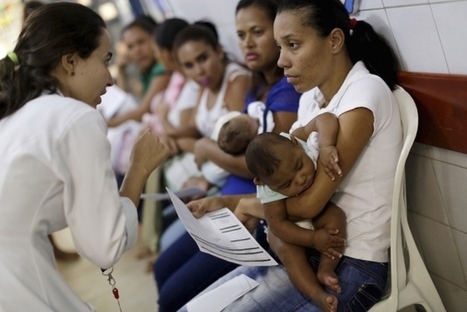
Organization says the spike might be largely the result of an increase in diagnoses of microcephaly — but not everyone agrees. Alarm is growing about a reported rise in suspected cases of the rare condition, which has been tentatively linked to the rapid spread of the Zika virus through the Americas. But Jorge Lopez-Camelo and Ieda Maria Orioli, from the Latin American Collaborative Study of Congenital Malformations (ECLAMC), say that the surge might largely be attributed to the intense search for cases of the birth defect, and misdiagnoses, because of heightened awareness in the wake of the possible link with Zika. This ‘awareness’ effect is well known and inevitable, they say, and must be revealing cases that would have gone unnoticed under normal circumstances. They also say that a high rate of misdiagnoses among reported cases is likely because the diagnostic criteria being used for microcephaly are broad.
Scoop.it!

Phage therapy to combat bacterial infections is garnering attention for the second time in 100 years, but solid clinical support for its widespread use is still lacking.
Ed Rybicki's insight:
REALLY nice brief history, and good review of current work.
Scoop.it!

The World Organization for Animal Health (OIE) has confirmed that five isolated outbreaks of bluetongue have been detected in Georgia.
Ed Rybicki's insight:
That would be the actual country, for all y'all...B-)
Scoop.it!
On 18 January 2016, the National Health and Family Planning Commission (NHFPC) of China notified WHO of 1 additional laboratory-confirmed case of human infection with avian influenza A(H5N6) virus.
|
Scoop.it!

Homeopathy is an alternative medicine, which means a few things. It means it’s not medicine, it’s an alternative; it means it’s seen by many as somehow better and healthier than modern medicines; and it means that people are incredibly emotional in their support for it. I’ve received death threats pretty much every time I’ve ever written …
Scoop.it!

British scientists are getting permission to alter embryos’ DNA. We have the chance to correct devastating diseases in the womb, so let’s get on with it
Ed Rybicki's insight:
Amen...B-)
Scoop.it!

(CNN) Vaccines and antibiotics have made many infectious diseases a thing of the past; we’ve come to expect that public health and modern science can conquer all microbes. But nature is a formidable adversary. And Zika is our newest threat, particularly to pregnant women. New, unfamiliar and mysterious threats to our health are scary. At the Centers for Disease Control and Prevention — where we identify, on average, one new health threat each year — we work around the clock with an approach that prioritizes finding out what we need to know as fast as we can to protect Americans. The CDC has some of the world’s leading experts both in diseases spread by mosquitoes and in fetal abnormalities. We get the facts, base actions on science, tell people what we know when we know it and what we are doing to add to our knowledge, and act to protect Americans today as effectively as possible.
Ed Rybicki's insight:
Be nice if it wasn't just Americans...?
Scoop.it!

In an important "Make in India" moment, scientists at a Hyderabad lab say they have developed the world's first vaccine against the Zika Virus. They say, in fact, that they have two.
Scoop.it!

WINNIPEG, Manitoba, Jan 28 (Reuters) - A vaccine for the Zika virus, which has been linked to severe birth defects in thousands of infants, could be ready for emergency use before year-end, one of its lead developers said on Thursday, a timetable...
Scoop.it!
Disease seems to be one of the biggest challenges in the world. The United States and Thailand have many kinds of cooperation in Health and Medicine and espe...
Scoop.it!

It is because his policies caused hundreds of thousands of avoidable deaths. By Nathan Geffen for GROUNDUP.
Ed Rybicki's insight:
Absolutely! I harbour a special animosity toward the Bearded Sage, largely because he was so wilfully misled during the HIV crisis years in South Africa. I sincerely hope he is brought to book for it one day - and not just IN a book, like the one by Nicoli Nattrass that so brillaintly exposes what the government did.
Scoop.it!

This week, Bill and Melinda Gates spoke to the Wall Street Journal at the World Economic Forum in Davos, Switzerland, about how food biotechnology can help those in Africa.
Scoop.it!

A new report revealed that the pre-historic human species Homo naledi may be about two million years old. Paleoanthropologist Francis Thackeray developed a mathematical method to obtain the age of the human species.
Ed Rybicki's insight:
Francis used to live on the same university residence corridor as me in 1974. He was serious even then...B-)
Scoop.it!

No sooner was the Ebola virus subdued in Africa than another virus, Zika, began sweeping through South and Central America. It has been linked to serious birth defects and is threatening to invade the United States. It is imperative that the World Health Organization not repeat its sluggish response to the Ebola crisis and act urgently this time to mobilize international action.
Scoop.it!

A public-health nonprofit and an international drugmaker team up to stockpile hundreds of thousands of doses of a promising vaccine and to speed along the approval process.
Scoop.it!

Despite the recent media frenzy concerning CRISPR and a much-vaunted genetics revolution, there have been few changes a lay person could use to show how our world has fundamentally changed thanks to genetic engineering. In fact, as technologypundit Peter Thiel put it, “Our world looks strangely old.” Save for cell phones and personal computers, much of our day-to-day existence is not that far removed from the state of things 20 or even 30 years ago. With the recent use of genetically engineered mosquitoes in Brazil to halt the spread of the Zika virus, we might be beginning to see some major health improvements as a consequence of the genetics revolution. A world in which mosquitoes were all but eliminated from the ecosystem would look quite different from the world of today, especially for people living in the tropics where the threat of mosquito transmitted infections does more than just mar an otherwise tranquil margarita sipped from the veranda of a beach resort. This is not to beggar the more mundane advantages of a mosquito-free habitat, but rather call attention to the fact that for large parts of the world, including Brazil, mosquitoes can be the difference between life and death.
Ed Rybicki's insight:
Bring 'em on, I say! Works in other insects, should work here too.
|