Your new post is loading...

|
Scooped by
Ed Rybicki
February 11, 2016 1:52 AM
|
Vaccinations, long recognized as an excellent investment that saves lives and prevents illness, could have significant economic value that far exceeds their original cost, a new study from researchers at the Johns Hopkins Bloomberg School of Public Health has found.
In what is believed to be among the first studies to examine the potential return on investment of vaccinations, the researchers assessed the economic benefits of vaccines in 94 low- and middle-income countries using projected vaccination rates from 2011 to 2020. When looking only at costs associated with illness, such as treatment costs and productivity losses, the return was $16 for every dollar spent on vaccines. In a separate analysis taking into account the broader economic impact of illness, vaccinations save $44 for every dollar spent.
|
|
Scooped by
Ed Rybicki
February 11, 2016 1:49 AM
|
In a follow-up story on the monkeypox outbreak in the Central African Republic (CAR), health officials say that no new monkeypox cases have been reported in Bangassou, according to a Journal De Bangui report (computer translated). “All the patients we have received and which were isolated at the hospital here, are healed and have already returned to their families. So I can confirm that at this time, no cases of ill monkeypox virus is reported in Bangassou “, noted John Paul Ogbia. The doctor spoke, however, a suspect case. John Paul Ogbia announced the arrival of a verification mission in Bakouma which is part of the disease , “the first two people who had presented this disease had come from Bakouma. We will organize a working mission in the coming days in this location to check the situation in the city “ he said.
|
|
Scooped by
Ed Rybicki
February 10, 2016 9:38 AM
|
Nigeria is facing a growing outbreak of a deadly virus similar to Ebola which has already killed 101 people since August.
|
|
Scooped by
Ed Rybicki
February 10, 2016 9:36 AM
|
On the 14th January 2016, the World Health Organisation declared an end of the Ebola outbreak in West Africa. Less than a day later, a new case in Sierra Leone was detected, indicating that the pat...
|
|
Scooped by
Ed Rybicki
February 10, 2016 5:03 AM
|
Gallery: ZIKA Virus on Russell Kightley Premium Scientific Pictures
|
|
Scooped by
Ed Rybicki
February 9, 2016 2:47 PM
|
Halite is one of the most extreme environments to support life. From the drought of the Atacama Desert to salt deposits up to Permian in age and 2000 meters in burial depth, live microbes have been found. Because halite is geologically stable and impermeable to ground water, the microbes allegedly have a syndepositional origin, making them the oldest organisms known to live on Earth. Recently, our understanding of the microbial diversity inside halite has broadened, and the first genome sequences of ancient halite-buried microbes are now available. The secrets behind prolonged survival in salt are also starting to be revealed.
|
|
Scooped by
Ed Rybicki
February 9, 2016 1:55 PM
|
|
|
Scooped by
Ed Rybicki
February 9, 2016 9:39 AM
|
Virology Journal is now inviting submissions for a new thematic series on “The interplay between the host and HSV-1 infection”. Edited by Chunfu Zheng (Soochow University, China), the collection welcomes research and review articles, and will also include specially commissioned topical reviews, written by leaders in the field. Herpes simplex virus type 1 (HSV-1) is a typical human-restricted pathogen, which is carried by 50-90% of the population worldwide, with higher frequencies in developing countries. HSV-1 is well known for its ability to establish a lifelong latent infection in neurons and trigger reactivation and lytic infection, mainly in epithelial or mucosal cells. Although HSV-1 was identified over 100 years ago, the battle between HSV-1 and the host continues, as there is no vaccine yet available, and HSV-1 is still one of the major infectious diseases worldwide. We will consider articles covering the interplay between the host and HSV-1 infection, including but not limited to: Virus-host interactionCellular responses to viral infectionPathogenesis and immunity The aim for this thematic series is to help us not only improve our knowledge of virus-host interactions but also develop novel antiviral approaches and vaccines against HSV-1 infection. The deadline for submissions is April 30th 2016. To submit your manuscript, please use our online submission system, and indicate in your cover letter that you would like the manuscript to be considered for this thematic series. If you would like to enquire about the suitability of a manuscript for consideration, please email a pre-submission enquiry tovirologyjournal@biomedcentral.com.
|
|
Scooped by
Ed Rybicki
February 9, 2016 8:44 AM
|
Watch the new Pandemic trailer. The zombie thriller stars Rachel Nichols, Mekhi Phifer, Pat Healy, Alfie Allen, and Missi Pyle.
|
|
Scooped by
Ed Rybicki
February 8, 2016 9:57 AM
|
Human papillomaviruses (HPV) cause cervical cancer and have recently also been implicated in mouth, laryngeal and anogenital cancers.
|
|
Scooped by
Ed Rybicki
February 5, 2016 9:32 AM
|
In the past week, the world has mobilised to tackle the latest threat to global health security—Zika virus, now spreading rapidly in the Americas. Udani Samarasekera and Marcia Triunfol report. Worldwide concern over Zika virus (panel) and its temporal and geographical association with clusters of birth and neurological conditions escalated this week, with WHO declaring a Public Health Emergency of International Concern.
|
|
Scooped by
Ed Rybicki
February 5, 2016 5:08 AM
|
A transmembrane protein receptor that is critical for adeno-associated virus infection has been identified through an unbiased, genome-wide screen. Its role in viral entry could potentially be harnessed to develop enhanced gene therapy vectors and better animal models of human disease.
|
|
Scooped by
Ed Rybicki
February 5, 2016 5:06 AM
|
|
|
|
Scooped by
Ed Rybicki
February 11, 2016 1:50 AM
|
The “preliminary” final numbers are finally out and the Philippines saw an increase in dengue fever of nearly 65 percent in 2015 compared to the prior year. Through Dec. 31, the archipelago reported 200,415 suspected cases of dengue, including 598 deaths.
|
|
Scooped by
Ed Rybicki
February 10, 2016 9:38 AM
|
At least 63 people reported dead out of 212 cases recorded since virus outbreak started in August 2015.
|
|
Scooped by
Ed Rybicki
February 10, 2016 9:37 AM
|
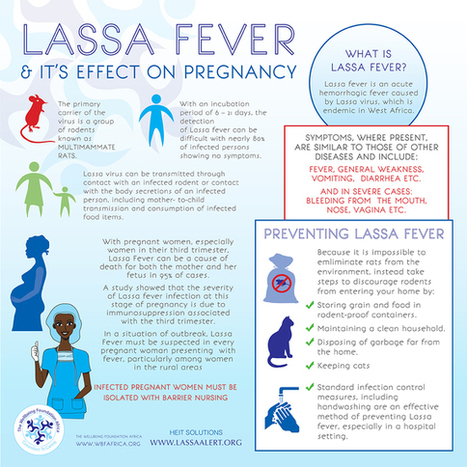
A university lecturer, Prof. Christian Happi, has claimed that Yoruba people, by the make-up of their genes, are immune to Lassa virus that causes Lassa fev
|
|
Scooped by
Ed Rybicki
February 10, 2016 9:35 AM
|
African leaders, including ministers of health, finance, and other line ministries from Nigeria and at least 50 other African countries are meeting in Addis Ababa, Ethiopia, to discuss the potential of developing, manufacturing and implementing effective Zika virus and Lassa virus vaccines on the continent.
|
|
Scooped by
Ed Rybicki
February 10, 2016 12:14 AM
|
With limited laboratory capacity and a lack of experts and funding, an outbreak of the Zika virus in Africa could be problematic.
|
|
Scooped by
Ed Rybicki
February 9, 2016 2:35 PM
|
Until recently, anthropologists drew the human family tree in the same way that my 10-year-old son solves a maze. He finds it much easier to work from the end to the beginning, because blind alleys lead with depressing sameness away from the start...
|
|
Scooped by
Ed Rybicki
February 9, 2016 1:53 PM
|
February 3, 2016 | Just over a year ago, Bio-IT World spoke to microbiologist Nick Loman about the recently released MinION DNA sequencer. The three-inch-long device, made by Oxford Nanopore Technologies of the UK, can read DNA in real time on a laptop, and Loman’s lab at the University of Birmingham was one of the first to receive one. Like many other early adopters we spoke to at the time, Loman was itching to try the MinION in real-world clinical contexts, following the genetic traces of an infection as it develops.
|
|
Scooped by
Ed Rybicki
February 9, 2016 9:07 AM
|
A small protein molecule, engineered through computer design, protects against diverse strains of influenza in mice. Its preventive and therapeutic power does not depend on the animals’ own immune response to viral infection.
These findings, from a multi-institutional study led by UW Medicine researchers in Seattle, are reported Feb. 4 in PLOS Pathogens.
The researchers are trying to address the public health need for better methods to keep flu at bay. Vaccinations can deter flu infections, but they are strain-specific. Flu viruses are notorious for forming new genetic subtypes that can evade vaccines and acquire resistance to antiviral medications.
|
|
Scooped by
Ed Rybicki
February 9, 2016 8:42 AM
|
Nicholas Jackson talks about Sanofi-Pasteur's efforts at developing a live vaccine against Zika virus.
|
|
Scooped by
Ed Rybicki
February 5, 2016 9:36 AM
|
The Lancet Zika virus resource centre brings together the best evidence from across The Lancet family of journals—offered with free access—to assist researchers, policy makers, and health workers, in understanding the effects of the outbreak and how best to respond. Find out more about Zika virus in thisSpecial Report.
|
|
Scooped by
Ed Rybicki
February 5, 2016 6:55 AM
|
Convoluted excuses and drunken declarations of love can be amusing, but I’m genuinely concerned about young people’s communication skills
|
|
Scooped by
Ed Rybicki
February 5, 2016 5:07 AM
|
Colossal microbes taking over the world sounds like a B-movie plot, rather than the business plan of a stuffed toy manufacturer. We asked Drew Oliver, the creator and CEO of Giant Microbes, about how the company came about, how their products have been received and his plans for the future.
|