


Epidermolysis bullosa (EB) is a clinically and genetically heterogeneous group of inherited blistering diseases that affects ∼ 500,000 people worldwide. Clinically, individuals with EB have fragile skin and are susceptible to blistering followin

 Your new post is loading...
 Scoop.it! Epidermolysis bullosa (EB) is a clinically and genetically heterogeneous group of inherited blistering diseases that affects ∼ 500,000 people worldwide. Clinically, individuals with EB have fragile skin and are susceptible to blistering followin 
No comment yet.
Sign up to comment
Scoop.it!
BigField GEG Tech's insight:
Adult-derived human liver stem/progenitor cells (ADHLSCs) have the potential to alleviate liver injury. However, the optimal delivery route and long-term biodistribution of ADHLSCs remains unclear. In this paper, the scientists used a triple fusion reporter system to determine the kinetic differences in the biodistribution of ADHLSCs following intrasplenic (IS) and intrahepatic (IH) administration in SCID-beige mice. They showed that ADHLSCs can be safely transduced with the triple fusion reporter. Radiolabeled ADHLSCs showed acute cell retention at the sites of injection. The IH group showed a confined BLI signal at the injection site, while the IS group displayed a dispersed distribution at the upper abdominal liver area, and a more intense signal. In conclusion, ADHLSCs could be monitored by BLI for up to 4 weeks with a spread out biodistribution following IS injection.
Scoop.it!
BigField GEG Tech's insight:
Lentiviral vectors (LVs) are a highly valuable tool for gene transfer currently exploited in basic, applied, and clinical studies. The authors of this study have previously reported successful, transient and stable production of LVs pseudotyped with RD114-TR for good transduction of T lymphocytes and CD34+ cells. In this work, to simplify the vector design, they decided to codon-optimize the entire RD114-TR ORF. In fact, the elimination of the interfering sequences would have avoided using the BGI, therefore reducing the size of the vector. Unexpectedly, they found that, despite the high level of transcription/translation and cytosol export, RD114-TRco is functionally dead. These data strengthen the conclusion, also supported by other studies, that codon optimization may not always lead to functional improvement of the gene of interest.
Scoop.it!

This protocol from Feng Zhang's lab enables genome-scale knockout and transcriptional activation screening using the CRISPR-Cas9 system, as sgRNA libraries are constructed and packaged into lentiviral vectors for delivery into cells for screening.
BigField GEG Tech's insight:
Here we describe a protocol for genome-scale knockout and transcriptional activation screening using the CRISPR-Cas9 system. Custom- or ready-made guide RNA libraries are constructed and packaged into lentiviral vectors for delivery into cells for screening. Beginning with library design, a genome-scale screen can be completed in 9–15 weeks, followed by 4–5 weeks of validation.
Scoop.it!

Duchenne Muscular Dystrophy (DMD) is caused by a lack of dystrophin expression in patient muscle fibres.
BigField GEG Tech's insight:
In this work, scientists have demonstrated that lentiviral vectors can package and deliver inserts of a similar size to dystrophin. They report a novel approach for delivering large transgenes in lentiviruses, in which they demonstrate proof-of-concept for a ‘template-switching’ lentiviral vector that harnesses recombination events during reverse-transcription.
Scoop.it!
BigField GEG Tech's insight:
Here, the scientists report the efficiency of retrograde gene transfer of a recently developed FuG-E pseudotyped lentiviral vector in the primate brain by comparing its transduction pattern with that of the parental FuG-C pseudotyped vector. After injection of the FuG-E vector encoding green fluorescent protein (GFP) into the striatum of macaque monkeys, many GFP-immunoreactive neurons were found in regions projecting to the striatum, such as the cerebral cortex, thalamus, and substantia nigra.
Scoop.it!

Multiplexing allows for analysis of multiple samples in parallel, but often permits
BigField GEG Tech's insight:
In this study, the scientists describe the development and initial validation of three generations of lentiviral fluorescent genetic barcoding (FGB) systems that allow the creation of 26, 14, or 6 unique labels. Color-coded populations could be tracked in multiplex in vitro assays for up to 28 days by flow cytometry using all three vector systems. This novel series of FGB vectors provides new tools for assessing comparative growth properties in in vitro and in vivo multiplexing experiments, while simultaneously allowing for a reduction in sample numbers by up to 26-fold.
Scoop.it!
BigField GEG Tech's insight:
This patient, who was 13 years old at the time of treatment, was treated with LentiGlobin drug product in the HGB-205 clinical study conducted in Necker Hospital, Assistance Publique-Hôpitaux de Paris, Paris, France. The data in the publication reflect 15 months of follow-up, and a brief summary of this patient’s outcomes with 21 months of follow-up was presented at the 58th American Society of Hematology Annual Meeting in December 2016.
Scoop.it!
BigField GEG Tech's insight:
Here the authors review the factors related to risk assessment regarding viral vector usage in animals and the relevant regulatory documents associated with this research, and they highlight the most commonly used viral vectors in research today. This review is particularly focused on the background, use in research and associated health and environmental risks related to adenoviral, adeno-associated viral, lentiviral, and herpesviral vectors.
Scoop.it!

Lentiviral vectors have evolved over the last decade as powerful and reliable gene transfer tools for dividing and non-dividing cells because they
BigField GEG Tech's insight:
Lentiviral vectors have evolved over the last decade as powerful and reliable gene transfer tools for dividing and non-dividing cells because they possess a large packaging capacity, weak immunogenesis, and a high flexible of design. However, in some cases, the integrating feature of lentiviral vectors may cause unbalanced gene expression, gene silencing and insertional mutagenesis. The sMARt design of non-integrating lentiviral vectors (NILV) can avoid these problems because they do not integrate into the cell genome. In the related study, the scientists incorporated a tetramer of a 155-bp module from human β-interferon S/MAR sequences into non-integrating lentiviral vectors. This tetramer sequence can function as an origin of replication and maintain the episomal replication of the NILV in dividing cells. They tested an S/MAR-based NILV to see whether it can maintain a therapeutic gene expression in dividing cells. They observed that S/MAR can retain episomal expression through successive rounds of cell division up to 74 days. GEG Tech offers a wide range of lentiviral vectors including Lenti-ONE EPI (ie NILV) which induce transient expression in dividing cells and stable expression in non-dividing cells. GEG Tech has observed more than one year of in vivo expression after injection in the retina of mice with Lenti-ONE EPI. Furthermore, GEG Tech provides several types of Lenti-ONE EPI which have different features of expression to adjusting your project.
To know more about the Article To know more about Lenti-ONE EPI To know more about GEG Tech
Scoop.it!

Despite lentiviral system’s predominance, its ultimate potential for gene therapy has not been fully exploited. Currently, most lentivirus vectors are non-inducible expression system or single-gene-in
BigField GEG Tech's insight:
In this study, the scientist designed a novel lentiviral vector containing HSP70 promoter and TRE promoter. Compared to traditional lentiviral vectors and inducible vectors, this controllable system has many advantages.
Scoop.it!
BigField GEG Tech's insight:
To understand how receptors are involved in neuronal trafficking and to be able to utilize them for specific targeting via the peripheral route would be of great benefit. Here, the scientists describe the generation of novel lentiviral vectors with tropism to motor neurons that were made by coexpressing onto the lentiviral surface a fusogenic glycoprotein (mutated sindbis G) and an antibody against a cell-surface receptor (Thy1.1, p75NTR, or coxsackievirus and adenovirus receptor) on the presynaptic terminal of the neuromuscular junction.
Scoop.it!
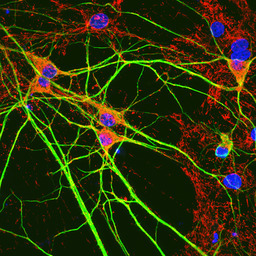
During development, dopaminergic neurons born in the substantia nigra extend their axons toward the striatum.
BigField GEG Tech's insight:
The present study shows that dopaminergic neurites extended along striatal neurons in the paired-cultures of mesencephalic cells with striatal cells. Using lentiviral vectors, short hairpin RNA (shRNA)-mediated knockdown of integrin α5 in dopaminergic neurons suppressed the neurite outgrowth to the striatal cell region. In contrast, the knockdown of integrin α5 in non-dopaminergic mesencephalic and striatal cells had no effect. Furthermore, overexpression of integrin α5 in dopaminergic neurons differentiated from embryonic stem cells enhanced their neurite outgrowth on striatal cells. These results indicate that integrin α5β1 expression on dopaminergic neurons plays an important role in the dopaminergic neurite outgrowth on striatal neurons.
|
Scoop.it!
BigField GEG Tech's insight:
The present study aimed to investigate the expression of cluster of differentiation 82 (KAI1), a gene involved in the suppression of tumor metastasis, in human retinoblastoma (RB) tissue and to study the effect of KAI1 expression on RB cell migration and invasion. A lentiviral vector containing KAI1 cDNA was used to transduce the two RB cell lines, HXO-Rb44-Gl and Y79. KAI1 expression was observed to be downregulated in invasive RB compared to non-invasive RB. The migratory and invasive capacities of KAI1 transfected cell lines were significantly decreased compared to those of the control cells. KAI1 may be involved in retinoblastoma metastasis, and increased expression of KAI1 significantly inhibits the metastatic ability of RB cells in vitro.
Scoop.it!
BigField GEG Tech's insight:
In this review, the authors discuss steps involved in the cell processing of the technology, including the use of an optimal vector for consistent cell processing, along with addressing the challenges of expanding chimeric antigen receptor T cell therapy to a global patient population.
Scoop.it!
BigField GEG Tech's insight:
In this article, Gentner and colleagues undertake a comprehensive strategy to advance ex vivo genetic engineering of HSCs for gene therapy. They experimentally define an optimal strategy to purify HSCs, which allows uncoupling long-term from short-term hematopoietic reconstitution, and implement ex vivo conditions that best preserve their biological properties applying novel transduction-enhancing compounds and pyrimidoindole derivatives to support HSC expansion.
Scoop.it!
BigField GEG Tech's insight:
In this study, the aim was therefore to understand the cellular and behavioural consequences of local overexpression of mutant huntingtin (mHTT) in the hippocampus of adult mice. The authors found that a targeted injection of a lentivirus, encoding an N-terminal of mHTT with 82 CAG repeats, into the murine hippocampus led to the focal formation of mHTT aggregates, long-term spatial memory impairments with decreased neurogenesis and expression of the immediate early gene c-fos. This study has therefore shown for the first time that local expression of mHTT in the dentate gyrus has deleterious effects, including its neurogenic capacity, with functional behavioural consequences, which fits well with recent data on hippocampal deficits seen in patients with Huntington's disease.
Scoop.it!

BACKGROUND:Lentiviral vectors have been successfully used for human skin cell gene transfer studies. Defining the selection of integration sites for retroviral vectors in the host genome is crucial in risk assessment analysis of gene therapy
BigField GEG Tech's insight:
In this study, 874 unique lentiviral vector integration sites in human HaCaT keratinocytes after long-term culture were identified and analyzed with the online tool GTSG-QuickMap and SPSS software.
Scoop.it!
BigField GEG Tech's insight:
In this article, Okano, Nakamura and colleagues report that the iCaspase9 system abolished
Scoop.it!

Sci Rep. 2017 Dec;7(1):79. doi: 10.1038/s41598-017-00152-5. Epub 2017 Mar 6.
BigField GEG Tech's insight:
In this work, the scientists have demonstrated that lentiviral vectors can package and deliver inserts of a similar size to dystrophin. They report a novel approach for delivering large transgenes in lentiviruses, in which they demonstrate proof-of-concept for a 'template-switching' lentiviral vector that harnesses recombination events during reverse-transcription. Their results shown gene therapy with this vector by restoring dystrophin expression in DMD myoblasts, where dystrophin was expressed at the sarcolemma of myotubes after myogenic differentiation.
Scoop.it!

The amount of genetic material that can be packaged in AAV vectors used for genome editing is limited.
BigField GEG Tech's insight:
Here, the scientsts present the smallest Cas9 orthologue characterized to date, derived from Campylobacter jejuni (CjCas9), for efficient genome editing in vivo. CjCas9, delivered via AAV, induces targeted mutations at high frequencies in mouse muscle cells or retinal pigment epithelium (RPE) cells. Furthermore, CjCas9 targeted to the Vegfa or Hif1a gene in RPE cells reduces the size of laser-induced choroidal neovascularization, suggesting that in vivo genome editing with CjCas9 is a new option for the treatment of age-related macular degeneration.
Scoop.it!
BigField GEG Tech's insight:
In this article, we describe how optogenetics works and the inputs of the lentiviral vector technology in this field.
Scoop.it!

A versatile system for rapid multiplex genome-edited CAR T cell generation
BigField GEG Tech's insight:
In this study, the scientists accomplished rapid and efficient multiplex genomic editing, and re-directing T cells with antigen specific CAR via a one-shot CRISPR protocol by incorporation of multiple gRNAs in a CAR lentiviral vector. High efficient double knockout of endogenous TCR and HLA class I could be easily achieved to generate allogeneic universal CAR T cells. Simultaneous gene editing of four gene loci using the one-shot CRISPR protocol to generate allogeneic universal T cells deficient of both PD1 and CTLA-4 was also attempted.
Scoop.it!
BigField GEG Tech's insight:
In this study, the scientists set out to explore the effect of promoter-enhancer selection on the efficacy and safety of human immunodeficiency virus-1-derived lentiviral vectors in γc-deficient mice. They observed incomplete or absent T- and B-cell development in mice transplanted with progenitors expressing γc from the phosphoglycerate kinase (PGK) and Wiscott–Aldrich syndrome (WAS) promoters, respectively. In contrast, functional T- and B-cell compartments were restored in mice receiving an equivalent vector containing the elongation factor-1-α (EF1α) promoter; however, 4 of 14 mice reconstituted with this vector subsequently developed lymphoma. Extensive analyses failed to implicate insertional mutagenesis or γc overexpression as the underlying mechanism. These findings highlight the need for detailed mechanistic analysis of tumor readouts in preclinical animal models assessing vector safety, and suggest the existence of other ill-defined risk factors for oncogenesis, including replicative stress, in gene therapy protocols targeting the hematopoietic compartment.
Scoop.it!
BigField GEG Tech's insight:
Huntington's disease (HD) is a devastating neurodegenerative disorder caused by abnormal polyglutamine expansion in the huntingtin protein (Exp-Htt). In this work, the authors used bidirectional lentiviral transfer vectors to generate in vitro and in vivo models of HD and to test the therapeutic potential of vascular endothelial growth factor 165 (VEGF165).
|



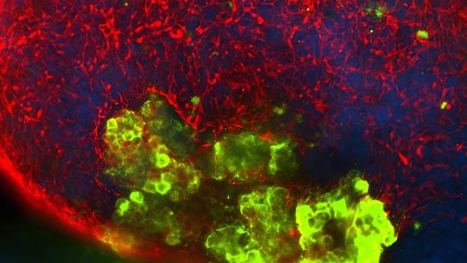











Here, the authors review current treatment modalities available as well as novel and emerging therapies in the treatment of recessive dystrophic epidermolysis bullosa (RDEB). Clinical trials of new translational therapies in RDEB offer hope for improved clinical management of patients as well as generating broader lessons for regenerative medicine that could be applicable to other inherited or acquired abnormalities of wound healing or scarring.