
Key selections from On Tyranny, for viewing and sharing
Get Started for FREE
Sign up with Facebook Sign up with X
I don't have a Facebook or a X account


|
Scooped by
Richard Platt
onto Low Power Heads Up Display April 1, 2025 3:26 AM
|
 Scoop.it!
Key selections from On Tyranny, for viewing and sharing

 Your new post is loading...
 Your new post is loading...
Your new post is loading...
Scoop.it!

It's the world's first big-screen TV that can be rolled up to hide away when not in use. Via Tiaan Jonker
Richard Platt's insight:
When you roll your future TV out of sight into a little box, thank LG Display. (Well they had the competitive help of Samsung also going after this, and both of these companies use TRIZ to come up with these systems - too bad other companies aren't savvy in this way as they too could bring awesome new designs to the world). The leader in big-screen OLED manufacturing, not satisfied to debut the first 88-inch 8K OLED TV, will show off another world's first at CES: a 65-inch 4K OLED display that's, get this, rollable. Although some concept big-screen TVs shown at past CES shows have been bendy, this is the first one that's flexible enough to spin up into tube form. LG's images depict it descending into a little box the size of a sound bar, but the company also talks about making the display portable. The secret, as usual, is its paper-thin organic light emitting diode display (OLED).
Scoop.it!
From
www

Research increasingly shows a variety of habits and hobbies offer a helpful cognitive workout. One recent study linked lifelong learning — things like reading, learning another language, playing chess — to slower cognitive decline, even postponing Alzheimer's for a few years.
Richard Platt's insight:
Research increasingly shows a variety of habits and hobbies offer a helpful cognitive workout. One recent study linked lifelong learning — things like reading, learning another language, playing chess — to slower cognitive decline, even postponing Alzheimer's for a few years. These activities act as a "cognitive workout" stretching the brain and forcing it to use different cognitive systems, helping to maintain brain health and postpone the onset of dementia. Key Takeaways are:
Scoop.it!

Invisible graveyard tools healthcare fail due to poor workflow integration, not algorithm flaws, says UCLA and Atlantic Health leaders. Via Lionel Reichardt / le Pharmageek
Richard Platt's insight:
Invisible graveyard tools healthcare fail due to poor workflow integration, not algorithm flaws, says UCLA and Atlantic Health leaders.
Scoop.it!

Anthropic CEO Dario Amodei gave his most honest interview yet. 10 lessons from 68 minutes on human-level AI, why he left OpenAI, what jobs survive, and where the next investment wave begins. Via Lionel Reichardt / le Pharmageek
Richard Platt's insight:
Anthropic CEO Dario Amodei gave his most honest interview yet. 10 lessons from 68 minutes on human-level AI, why he left OpenAI, what jobs survive, and where the next investment wave begin
Scoop.it!

Quest Diagnostics is launching a chatbot tailored for laboratory test results as it seeks to allow patients the ability to get a handle on their findings and perform deeper dives on their own healt | Quest Diagnostics is launching a chatbot tailored for laboratory test results as it seeks to give patients the ability to get a handle on their findings and perform deeper dives on their own health. Via Lionel Reichardt / le Pharmageek
Richard Platt's insight:
Quest Diagnostics is launching a chatbot tailored for laboratory test results as it seeks to allow patients the ability to get a handle on their findings and perform deeper dives on their own healt | Quest Diagnostics is launching a chatbot tailored for laboratory test results as it seeks to give patients the ability to get a handle on their findings and perform deeper dives on their own health.
Scoop.it!

Salesforce is building out its library of pre-wired artificial intelligence agents to take on manual, administrative work on behalf of payers, providers and public health organizations. | Salesforce is building out its library of pre-wired AI agents to take on manual, administrative work on behalf of payers, providers and public health organizations. Via Lionel Reichardt / le Pharmageek
Richard Platt's insight:
Salesforce is building out its library of pre-wired artificial intelligence agents to take on manual, administrative work on behalf of payers, providers and public health organizations. | Salesforce is building out its library of pre-wired AI agents to take on manual, administrative work on behalf of payers, providers and public health organizations.
Scoop.it!

The Portrait of a Teacher project aims to redefine the role of educators in response to the rapid technological and workforce changes shaping society. Via Nik Peachey
Richard Platt's insight:
Very useful PDF download - Includes research findings from 12 studies - The Portrait of a Teacher in the Age of AI - How will the role of a teacher evolve in a world transformed by AI?

Nik Peachey's curator insight,
February 26, 5:32 AM
Very useful PDF download - Includes research findings from 12 studies - The Portrait of a Teacher in the Age of AI - How will the role of a teacher evolve in a world transformed by AI?
Scoop.it!

The DfE published its updated Generative AI Product Safety Standards on 19 January 2026. They are, in principle, exactly what education needed. Guardrails for AI in schools. Protections for children. A clear statement that developers can't just ship consumer AI into classrooms and hope for the best. And overnight, they've made the AI tools most… Via Nik Peachey
Richard Platt's insight:
This is article is a good summary of attempts being made to add guardrails to AI in schools - and as usual it highlights how the people leading the charge don’t have the understanding and literacy levels they need to do the job in the first place: https://theaienglishteacher.wordpress.com/2026/02/23/safety-standards-slamming-brakes-and-the-no-mans-land-schools-are-stuck-in/
Nik Peachey's curator insight,
February 23, 1:39 AM
This is article is a good summary of attempts being made to add guardrails to AI in schools - and as usual it highlights how the people leading the charge don’t have the understanding and literacy levels they need to do the job in the first place: https://theaienglishteacher.wordpress.com/2026/02/23/safety-standards-slamming-brakes-and-the-no-mans-land-schools-are-stuck-in/
Scoop.it!

From
hbr
One of the promises of AI is that it can reduce workloads so employees can focus more on higher-value and more engaging tasks. But according to new research, AI tools don’t reduce work, they consistently intensify it: In the study, employees worked at a faster pace, took on a broader scope of tasks, and extended work into more hours of the day, often without being asked to do so. That may sound like a win, but it’s not quite so simple. These changes can be unsustainable, leading to workload creep, cognitive fatigue, burnout, and weakened decision-making. The productivity surge enjoyed at the beginning can give way to lower quality work, turnover, and other problems. To correct for this, companies need to adopt an “AI practice,” or a set of norms and standards around AI use that can include intentional pauses, sequencing work, and adding more human grounding.close Via Lionel Reichardt / le Pharmageek
Richard Platt's insight:
One of the promises of AI is that it can reduce workloads so employees can focus more on higher-value and more engaging tasks. But according to new research, AI tools don’t reduce work, they consistently intensify it: In the study, employees worked at a faster pace, took on a broader scope of tasks, and extended work into more hours of the day, often without being asked to do so. That may sound like a win, but it’s not quite so simple. These changes can be unsustainable, leading to workload creep, cognitive fatigue, burnout, and weakened decision-making. The productivity surge enjoyed at the beginning can give way to lower quality work, turnover, and other problems. To correct for this, companies need to adopt an “AI practice,” or a set of norms and standards around AI use that can include intentional pauses, sequencing work, and adding more human grounding.close
Scoop.it!

Quiet quit your TEFL job? Here's how to fall back in love with teaching using Action Research - turn your classroom into a laboratory and rediscover curiosity. Via Nik Peachey
Richard Platt's insight:
Here's how to fall back in love with teaching using Action Research - turn your classroom into a laboratory and rediscover curiosity.
Scoop.it!

Until a few months ago, for the vast majority of people, “using AI” meant talking to a chatbot in a back-and-forth conversation. But over the past few months, it has become practical to use AI as an agent: you can assign them to a task and they do them, using tools as appropriate. Because of this change, you have to consider three things when deciding what AI to use: Models, Apps, and Harnesses. Via Nik Peachey
Richard Platt's insight:
Until a few months ago, for the vast majority of people, “using AI” meant talking to a chatbot in a back-and-forth conversation. But over the past few months, it has become practical to use AI as an agent: you can assign them to a task and they do them, using tools as appropriate. Because of this change, you have to consider three things when deciding what AI to use: Models, Apps, and Harnesses. - Worth some of your time to get a better understanding of what you are using or should use.
Nik Peachey's curator insight,
February 18, 1:41 AM
Worth some of your time to get a better understanding of what you are using or should use.
Scoop.it!

Richard Platt's insight:
Interesting research and analysis on the pedagogical perils of "dehumanised" feedback from AI
Scoop.it!
Why you should not use VSMs (Value Stream Mapping) to try and find the bottleneck in your factory. VSM is a powerful and widely used tool. It can be used to improve the speed and efficiency of the production of one product. But is is not the right tool to identify the bottleneck or capacity constraint in a production system. This short video explains why. Via Philip Marris
|
Scoop.it!
Microsoft released a set of prompts to help create a personalized AI Blueprint for your organization
Richard Platt's insight:
Microsoft released a set of prompts to help create a personalized AI Blueprint for your organization
Scoop.it!
Richard Platt's insight:
New Report from Stanford - Evidence Base on AI in K-12: 2026

danna.salinas0720@gmail.com's curator insight,
March 16, 6:56 PM
las IA son muy buenas para los estudiantes y profesores, nos ayudan mucho
Scoop.it!
Richard Platt's insight:
Artifical Intelligence, cognitive offloading and implications for education
Scoop.it!

Learn why and how teachers can use generative AI to streamline lesson planning, personalize explanations, and automate retrieval practice—without losing instructional control. Via Ana Cristina Pratas, Nik Peachey
Richard Platt's insight:
Learn why and how teachers can use generative AI to streamline lesson planning, personalize explanations, and automate retrieval practice—without losing instructional control.
Scoop.it!

From
www
Following a privacy-preserving framework, an open-source platform allows for continuous monitoring of a wide range of smartphone-based signals, including moment-by-moment capture of screenshots, application usage logs, interaction histories and phone sensor readings. Via Emmanuel Capitaine , Lionel Reichardt / le Pharmageek
Richard Platt's insight:
Following a privacy-preserving framework, an open-source platform allows for continuous monitoring of a wide range of smartphone-based signals, including moment-by-moment capture of screenshots, application usage logs, interaction histories and phone sensor readings.
Scoop.it!
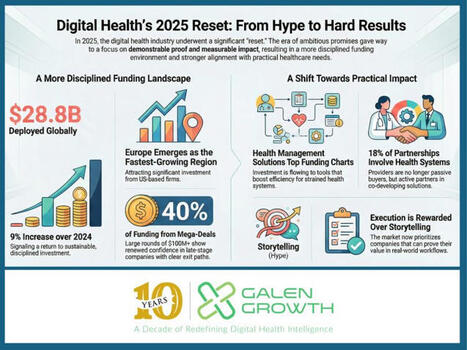
Digital health funding stabilized in 2025 as investors shifted from hype to measurable impact. Key trends across the US, Europe, and health systems. Via Lionel Reichardt / le Pharmageek
Richard Platt's insight:
Digital health funding stabilized in 2025 as investors shifted from hype to measurable impact. Key trends across the US, Europe, and health systems.
Scoop.it!

Anil Seth Why consciousness is more likely a property of life than of computation and why creating conscious, or even conscious-seeming AI, is a bad idea. Read the full article at: www.noemamag.com Via Complexity Digest, Nik Peachey
Richard Platt's insight:
Why consciousness is more likely a property of life than of computation and why creating conscious, or even conscious-seeming AI, is a bad idea. -- Read the full article at: www.noemamag.com (Via Complexity Digest)

Alessandro Cerboni's curator insight,
February 16, 3:10 AM
Perché la coscienza è più probabilmente una proprietà della vita che del calcolo e perché creare un'intelligenza artificiale cosciente, o anche solo apparentemente cosciente, è una cattiva idea.
Scoop.it!

Researchers tested whether generative AI could handle complex medical datasets as well as human experts. In some cases, the AI matched or outperformed teams that had spent months building prediction models. By generating usable analytical code from precise prompts, the systems dramatically reduced the time needed to process health data. The findings hint at a future where AI helps scientists move faster from data to discovery. Via Lionel Reichardt / le Pharmageek
Richard Platt's insight:
Researchers tested whether generative AI could handle complex medical datasets as well as human experts. In some cases, the AI matched or outperformed teams that had spent months building prediction models. By generating usable analytical code from precise prompts, the systems dramatically reduced the time needed to process health data. The findings hint at a future where AI helps scientists move faster from data to discovery.
Scoop.it!
Richard Platt's insight:
AI accelerates biopharma innovation and growth.
Scoop.it!

Long dismissed as a digital laggard behind on every major innovation wave, healthcare is now setting the pace for enterprise AI adoption. Via Lionel Reichardt / le Pharmageek
Richard Platt's insight:
Long dismissed as a digital laggard behind on every major innovation wave, healthcare is now setting the pace for enterprise AI adoption.
Scoop.it!

Richard Platt's insight:
Can you say "subverting the corporate overloards"
Scoop.it!

These AI guidelines for teachers, now with checklists, are part of a series of steps designed to address that gap. The British Council is committed to supporting teachers with the skills, tools and resources they need for managing their classrooms and keeping up to date with key developments. These AI guidelines offer principles to help teachers make responsible choices when using AI in teaching or for continuing professional development. While primarily designed for English language teachers, these guidelines may also be useful for other subject teachers in English-medium education. We hope the guidelines are a valuable resource for teachers, empowering them to take an informed, ethical and context-specific approach to integrating AI into their teaching. Via Nik Peachey
Richard Platt's insight:
These AI guidelines for teachers, now with checklists, are part of a series of steps designed to address that gap. The British Council is committed to supporting teachers with the skills, tools and resources they need for managing their classrooms and keeping up to date with key developments. These AI guidelines offer principles to help teachers make responsible choices when using AI in teaching or for continuing professional development. While primarily designed for English language teachers, these guidelines may also be useful for other subject teachers in English-medium education. We hope the guidelines are a valuable resource for teachers, empowering them to take an informed, ethical and context-specific approach to integrating AI into their teaching.
Nik Peachey's curator insight,
February 11, 5:45 AM
Great to see the guidelines I worked on are now available.
Scoop.it!
|








The best guidance for action, rendered beautifully by the great John Lithgow. First published these lessons + 8 years ago, in late 2016. They open the 20 Chapters On Tyranny: 20 Lessons from the Twentieth Century. Millions of you, around the world, have put these lessons to good use; it has been humbling to learn from courageous and creative dissenters, protestors, and oppositionists.