 Your new post is loading...

|
Scooped by
Charles Tiayon
June 7, 2:49 PM
|
"La traduction du Shahnameh en espagnol était une quête mystique June 07, 2025 IQNA-Pour la première fois en plus de mille ans, le chef-d’œuvre de Ferdowsi, le Shahnameh, a été intégralement traduit en espagnol. Cette prouesse est l’œuvre de Beatriz Salas, professeure de littérature espagnole, installée en Iran depuis près de trente ans. Pour elle, cette aventure a été bien plus qu’un simple travail académique : une véritable expérience mystique. Beatriz Salas, née d’un père vénézuélien et d’une mère espagnole, a suivi son époux originaire du Khorasan du Sud en Iran, où elle a enseigné pendant trois décennies à l’Université de Téhéran et à l’Université islamique Azad. C’est au détour d’un appel du ministère iranien des Affaires étrangères, relayé par l’UNESCO, que le projet a vu le jour. D’abord hésitante face à l’ampleur de la tâche, elle accepte de lire l’œuvre. Dès les premières lignes, elle est saisie : "Le Shahnameh est comme une forteresse que ni le soleil ni le vent ne peuvent ébranler." La traduction du Shahnameh, qui s'étend sur sept volumes, aura nécessité près de dix ans, entrecoupée par la pandémie. Salas l’a réalisée en prose, avec l’aide précieuse de son mari pour la prononciation, d’une ancienne étudiante pour la saisie de près de 4 000 pages, et du soutien logistique d’anciens diplomates et universitaires. Malgré des moyens limités, le premier volume a été publié en édition de luxe par l’ambassade du Venezuela, avant que Salas ne poursuive seule l’aventure, convaincue de la portée universelle de ce récit. Le Shahnameh, épopée monumentale de 50 000 distiques, traverse les siècles en abordant des thèmes intemporels : loyauté, honneur, quête de justice, respect familial. Pour Salas, cette œuvre est une leçon de vie : "Ferdowsi enseigne comment être un meilleur humain, père, fils, membre de la société." Elle raconte comment, dès son arrivée en Iran, elle découvre la force culturelle du Shahnameh à travers deux enfants jouant Rostam et Sohrab dans un village du Khorasan. "En Espagne, on ne voit pas deux enfants jouer Don Quichotte," dit-elle avec tendresse. Salas affirme avoir repéré de nombreuses influences du Shahnameh dans la littérature mondiale, de Cervantès à Shakespeare, et même dans des séries modernes comme Game of Thrones, dont certains éléments visuels et narratifs semblent directement inspirés de Ferdowsi. Aujourd’hui, elle sillonne le monde hispanophone pour faire connaître l’épopée perse, multipliant les conférences, notamment auprès des jeunes. Son objectif : rendre cette œuvre vivante et accessible. Dans un monde numérique, elle compare même le Jam-e Jam, la coupe mythique du Shahnameh, à nos téléphones portables : puissants mais nécessitant des cœurs purs pour ne pas en faire un mauvais usage. Pour Salas, "le Shahnameh est un cadeau de Dieu au peuple". Elle y voit un rempart contre l’oubli de la langue et de l’identité perse, et une source inépuisable de sagesse pour le monde entier. Une œuvre d’âme et de résistance, traduite avec foi, passion… et amour." IQNA June 07, 2025 https://iqna.ir/fr/news/3492454/la-traduction-du-shahnameh-en-espagnol-%C3%A9tait-une-qu%C3%AAte-mystique #metaglossia_mundus

Researchers across Africa, Asia and the Middle East are building their own language models designed for local tongues, cultural nuance and digital independence
"In a high-stakes artificial intelligence race between the United States and China, an equally transformative movement is taking shape elsewhere. From Cape Town to Bangalore, from Cairo to Riyadh, researchers, engineers and public institutions are building homegrown AI systems, models that speak not just in local languages, but with regional insight and cultural depth.
The dominant narrative in AI, particularly since the early 2020s, has focused on a handful of US-based companies like OpenAI with GPT, Google with Gemini, Meta’s LLaMa, Anthropic’s Claude. They vie to build ever larger and more capable models. Earlier in 2025, China’s DeepSeek, a Hangzhou-based startup, added a new twist by releasing large language models (LLMs) that rival their American counterparts, with a smaller computational demand. But increasingly, researchers across the Global South are challenging the notion that technological leadership in AI is the exclusive domain of these two superpowers.
Instead, scientists and institutions in countries like India, South Africa, Egypt and Saudi Arabia are rethinking the very premise of generative AI. Their focus is not on scaling up, but on scaling right, building models that work for local users, in their languages, and within their social and economic realities.
“How do we make sure that the entire planet benefits from AI?” asks Benjamin Rosman, a professor at the University of the Witwatersrand and a lead developer of InkubaLM, a generative model trained on five African languages. “I want more and more voices to be in the conversation”.
Beyond English, beyond Silicon Valley
Large language models work by training on massive troves of online text. While the latest versions of GPT, Gemini or LLaMa boast multilingual capabilities, the overwhelming presence of English-language material and Western cultural contexts in these datasets skews their outputs. For speakers of Hindi, Arabic, Swahili, Xhosa and countless other languages, that means AI systems may not only stumble over grammar and syntax, they can also miss the point entirely.
“In Indian languages, large models trained on English data just don’t perform well,” says Janki Nawale, a linguist at AI4Bharat, a lab at the Indian Institute of Technology Madras. “There are cultural nuances, dialectal variations, and even non-standard scripts that make translation and understanding difficult.” Nawale’s team builds supervised datasets and evaluation benchmarks for what specialists call “low resource” languages, those that lack robust digital corpora for machine learning.
It’s not just a question of grammar or vocabulary. “The meaning often lies in the implication,” says Vukosi Marivate, a professor of computer science at the University of Pretoria, in South Africa. “In isiXhosa, the words are one thing but what’s being implied is what really matters.” Marivate co-leads Masakhane NLP, a pan-African collective of AI researchers that recently developed AFROBENCH, a rigorous benchmark for evaluating how well large language models perform on 64 African languages across 15 tasks. The results, published in a preprint in March, revealed major gaps in performance between English and nearly all African languages, especially with open-source models.
Similar concerns arise in the Arabic-speaking world. “If English dominates the training process, the answers will be filtered through a Western lens rather than an Arab one,” says Mekki Habib, a robotics professor at the American University in Cairo. A 2024 preprint from the Tunisian AI firm Clusterlab finds that many multilingual models fail to capture Arabic’s syntactic complexity or cultural frames of reference, particularly in dialect-rich contexts.
Governments step in
For many countries in the Global South, the stakes are geopolitical as well as linguistic. Dependence on Western or Chinese AI infrastructure could mean diminished sovereignty over information, technology, and even national narratives. In response, governments are pouring resources into creating their own models.
Saudi Arabia’s national AI authority, SDAIA, has built ‘ALLaM,’ an Arabic-first model based on Meta’s LLaMa-2, enriched with more than 540 billion Arabic tokens. The United Arab Emirates has backed several initiatives, including ‘Jais,’ an open-source Arabic-English model built by MBZUAI in collaboration with US chipmaker Cerebras Systems and the Abu Dhabi firm Inception. Another UAE-backed project, Noor, focuses on educational and Islamic applications.
In Qatar, researchers at Hamad Bin Khalifa University, and the Qatar Computing Research Institute, have developed the Fanar platform and its LLMs Fanar Star and Fanar Prime. Trained on a trillion tokens of Arabic, English, and code, Fanar’s tokenization approach is specifically engineered to reflect Arabic’s rich morphology and syntax.
India has emerged as a major hub for AI localization. In 2024, the government launched BharatGen, a public-private initiative funded with 235 crore (€26 million) initiative aimed at building foundation models attuned to India’s vast linguistic and cultural diversity. The project is led by the Indian Institute of Technology in Bombay and also involves its sister organizations in Hyderabad, Mandi, Kanpur, Indore, and Madras. The programme’s first product, e-vikrAI, can generate product descriptions and pricing suggestions from images in various Indic languages. Startups like Ola-backed Krutrim and CoRover’s BharatGPT have jumped in, while Google’s Indian lab unveiled MuRIL, a language model trained exclusively on Indian languages. The Indian governments’ AI Mission has received more than180 proposals from local researchers and startups to build national-scale AI infrastructure and large language models, and the Bengaluru-based company, AI Sarvam, has been selected to build India’s first ‘sovereign’ LLM, expected to be fluent in various Indian languages.
In Africa, much of the energy comes from the ground up. Masakhane NLP and Deep Learning Indaba, a pan-African academic movement, have created a decentralized research culture across the continent. One notable offshoot, Johannesburg-based Lelapa AI, launched InkubaLM in September 2024. It’s a ‘small language model’ (SLM) focused on five African languages with broad reach: Swahili, Hausa, Yoruba, isiZulu and isiXhosa.
“With only 0.4 billion parameters, it performs comparably to much larger models,” says Rosman. The model’s compact size and efficiency are designed to meet Africa’s infrastructure constraints while serving real-world applications. Another African model is UlizaLlama, a 7-billion parameter model developed by the Kenyan foundation Jacaranda Health, to support new and expectant mothers with AI-driven support in Swahili, Hausa, Yoruba, Xhosa, and Zulu.
India’s research scene is similarly vibrant. The AI4Bharat laboratory at IIT Madras has just released IndicTrans2, that supports translation across all 22 scheduled Indian languages. Sarvam AI, another startup, released its first LLM last year to support 10 major Indian languages. And KissanAI, co-founded by Pratik Desai, develops generative AI tools to deliver agricultural advice to farmers in their native languages.
The data dilemma
Yet building LLMs for underrepresented languages poses enormous challenges. Chief among them is data scarcity. “Even Hindi datasets are tiny compared to English,” says Tapas Kumar Mishra, a professor at the National Institute of Technology, Rourkela in eastern India. “So, training models from scratch is unlikely to match English-based models in performance.”
Rosman agrees. “The big-data paradigm doesn’t work for African languages. We simply don’t have the volume.” His team is pioneering alternative approaches like the Esethu Framework, a protocol for ethically collecting speech datasets from native speakers and redistributing revenue back to further development of AI tools for under-resourced languages. The project’s pilot used read speech from isiXhosa speakers, complete with metadata, to build voice-based applications.
In Arab nations, similar work is underway. Clusterlab’s 101 Billion Arabic Words Dataset is the largest of its kind, meticulously extracted and cleaned from the web to support Arabic-first model training.
The cost of staying local
But for all the innovation, practical obstacles remain. “The return on investment is low,” says KissanAI’s Desai. “The market for regional language models is big, but those with purchasing power still work in English.” And while Western tech companies attract the best minds globally, including many Indian and African scientists, researchers at home often face limited funding, patchy computing infrastructure, and unclear legal frameworks around data and privacy.
“There’s still a lack of sustainable funding, a shortage of specialists, and insufficient integration with educational or public systems,” warns Habib, the Cairo-based professor. “All of this has to change.”
A different vision for AI
Despite the hurdles, what’s emerging is a distinct vision for AI in the Global South – one that favours practical impact over prestige, and community ownership over corporate secrecy.
“There’s more emphasis here on solving real problems for real people,” says Nawale of AI4Bharat. Rather than chasing benchmark scores, researchers are aiming for relevance: tools for farmers, students, and small business owners.
And openness matters. “Some companies claim to be open-source, but they only release the model weights, not the data,” Marivate says. “With InkubaLM, we release both. We want others to build on what we’ve done, to do it better.”
In a global contest often measured in teraflops and tokens, these efforts may seem modest. But for the billions who speak the world’s less-resourced languages, they represent a future in which AI doesn’t just speak to them, but with them."
Sibusiso Biyela, Amr Rageh and Shakoor Rather
20 May 2025
https://www.natureasia.com/en/nmiddleeast/article/10.1038/nmiddleeast.2025.65
#metaglossia_mundus

"The Judicial Council of California has approved recommendations from a study on how to expand access to the pool of court interpreters able to assist the state’s nearly 6.4 million limited-English-proficient (LEP) residents and potential court users.
Study considerations for the council include reviewing interpreter examination standards and content, adopting carryover scoring to aid candidates, and creating structured career pathways—including tiered systems and apprenticeship programs, particularly for Spanish interpreters. The study also advises the council to work with courts to develop a statewide directory for interpreters trained in video remote interpreting and to continue expanding access to American Sign Language and emerging languages.
The study also calls for action by the legislature, courts, and experienced court interpreters, which includes recommendations to continue adequately funding interpreter services, review and improve compensation packages, and develop mentorship programs.
“There was broad agreement among the stakeholders for the recommendations and considerations,” said Court Executive Officer Anabel Romero, vice-chair of the council’s Court Interpreters Advisory Panel. “The study offers a roadmap for the branch to improve interpreter services for the public and to ensure our goals of high-quality equitable access for all Californians, regardless of the language they speak.”
California Courts Newsroom (12/12/25) By Blaine Corren"
https://www.atanet.org/industry-news/judicial-council-to-continue-efforts-to-improve-the-availability-of-court-interpreters/
#Metaglossia
#metaglossia_mundus
"Why 2026 belongs to multimodal AI
The text-based era of interacting with AI is over.
For the past three years, AI’s breakout moment has happened almost entirely through text. We type a prompt, get a response, and move to the next task. While this intuitive interaction style turned chatbots into a household tool overnight, it barely scratches the surface of what the most advanced technology of our time can actually do.
This disconnect has created a significant gap in how consumers utilize AI. While the underlying models are rapidly becoming multimodal—capable of processing voice, visuals, and video in real time—most consumers are still using them as a search engine. Looking toward 2026, I believe the next wave of adoption won’t be about utility alone, but about evolving beyond static text into dynamic, immersive interactions. This is AI 2.0: not just retrieving information faster, but experiencing intelligence through sound, visuals, motion, and real-time context.
AI adoption has reached a tipping point. In 2025, ChatGPT’s weekly user base doubled from roughly 400 million in February to 800 million by year’s end. Competitors like Gemini and Anthropic saw similar growth, yet most users still engage with LLMs primarily via text chatbots. In fact, Deloitte’s Connected Consumer Survey shows that despite over half (53%) of consumers experimenting with generative AI, most people still relegate AI to administrative tasks like writing, summarizing, and researching.
Yet when you look at the digital behavior of consumers outside of AI, it’s clear consumers crave immersive experiences. According to Activate Consulting’s Tech & Media Outlook 2026, 43% of Gen Z prefer user-generated platforms like TikTok and YouTube over traditional TV or paid streaming, and they spend 54% more time on social video platforms than the average consumer, abandoning traditional media for interactive social platforms.
This creates a fundamental mismatch: Consumers live in a multi-sensory world, but their AI tools are stuck delivering plain text. While the industry recognizes this gap and is investing to close it, I predict we’ll see a fundamental shift in how people use and create with AI. In AI 2.0, users will no longer simply consume AI-generated content but will instead leverage multimodal AI to bring voice, visuals, and text together, allowing them to shape and direct their experiences in real time.
MULTIMODAL AI UNLOCKS IMMERSIVE STORYTELLING
If AI 1.0 was about efficiency, AI 2.0 is about engagement. While text-based AI is limited in how deeply it can engage audiences, multimodal AI allows the user to become an active participant. Instead of reading a story, you can interact with a main character and take the plot in a new direction or build your own world where narratives and characters evolve with you.
We can look to the $250 billion gaming industry as the blueprint for the potential that multimodal AI has. Video games combine visuals, audio, narrative, and real-time agency, creating an immersive experience that traditional entertainment can’t replicate. Platforms like Roblox and Minecraft let players inhabit content. Roblox alone reaches over 100 million daily users, who collectively spend tens of billions of hours a year immersed in these worlds; engagement that text alone could never generate.
Shaping the mine of the future: The engineering challenge of a lifetime
With the rise of multimodal AI, users everywhere will be able to create these types of experiences they’ve loved to participate in through gaming. By removing technical barriers, multimodal allows everyone to build experiences that not only feel authentic to the real world but also actively participate in them. Legacy media is also responding to this trend. Disney recently announced a $1 billion investment in OpenAI and a licensing deal that will let users create short clips with characters from Marvel, Pixar, and Star Wars through the Sora platform.
WHY MULTIMODAL AI CAN BE SAFER FOR YOUNGER USERS
As AI becomes part of everyday life, safety—particularly for younger users—has become one of the most critical issues facing the industry.
Moving from open-ended chat to structured, multimodal worlds allows us to design guardrails within the gameplay. Instead of relying on continuous unstructured prompts, these environments are built around characters, visuals, voices, and defined story worlds. Interaction is guided by the experience itself. That structure changes how and where safety is designed into the system.
Educational AI demonstrates this approach. Platforms like Khan Academy Kids and Duolingo combine visuals, audio, and structured prompts to guide learning. The AI isn’t trying to be everything; it focuses on one task well. As multimodal AI evolves, one of its most meaningful opportunities may be this ability to balance creative freedom with thoughtful constraint. AI 2.0 presents a design shift that could give builders, educators, and families new ways to shape safer, more intentional digital spaces for the next generation.
WHY MULTIMODAL AI IS THE NEXT FRONTIER
In 2026, I predict that consumers won’t be prompting AI; it will be a more immersive interactive experience. This excites me because users won’t just passively receive outputs; they’ll actively shape experiences and influence how AI evolves in real time. We could see users remixing the series finale of their favorite TV show, or students learning history not by reading a textbook, but by actively debating a historically accurate AI simulation.
For founders and creators, the next step is to stop building tools only for efficiency and start building environments for immersion and exploration. The winners of the next cycle won’t be the ones with the smartest models, but the ones who make AI feel less like a utility and more like a destination for rich, interactive experiences."
Why 2026 belongs to multimodal AI - Fast Company
BY Karandeep Anand, CEO of Character.AI
https://www.fastcompany.com/91466308/why-2026-belongs-to-multimodal-ai
#Metaglossia
#metaglossia_mundus

Mobvoi launches TicNote AI-powered voice recorder in the Philippines with Shadow AI for smarter transcription and insights.
Mobvoi has launched the TicNote AI-powered voice recorder in the Philippines. Apart from being just a recorder, the device also features Shadow, an AI agent that can transcribe, summarize, and even connect ideas across projects.
TicNote is built for everyday use. It has a slim, credit card-sized body with MagSafe support, making it easy to carry around. It features dual recording modes for meetings, notes, or calls, and advanced noise cancellation for clear audio.
The recorder can run up to 25 hours on a single charge, packs 64GB of storage, and offers unlimited cloud backup. Privacy is also baked in, with data protection enabled by default.
Shadow is where things get interesting. It can handle smart transcription in over 100 languages, provide quick answers through Flash Chat, and even surface “aha moments” by linking ideas across files.
You can also group recordings and documents into projects, giving Shadow more context to work with. The more you use it, the smarter it gets.
The TicNote AI-powered voice recorder is priced at ₱9,499. It’s available now at Aerophone stores nationwide and online, with Shopee and Lazada to follow. Buyers get a free three-month Pro Plan with 1,500 AI credits per month."
By Bryan Rilloraza
December 27, 2025
https://www.technobaboy.com/2025/12/27/ticnote-ai-powered-voice-recorder-launches-in-the-philippines/
#Metaglossia
#metaglossia_mundus
"« Tout traduire nous ralentit » : l'obligation d'utiliser le français pèse sur les entreprises au Québec
Face au recul du français, le Québec durcit le ton. La loi impose des règles strictes aux entreprises, avec des sanctions pouvant atteindre 30.000 dollars canadiens par jour.
La loi adoptée en 2022 impose le français comme langue de travail et de commerce au Québec, y compris pour les entreprises de taille moyenne.
Dans le centre-ville de Montréal, la langue anglaise semble avoir déserté les commerces. Les enseignes, les menus et même les messages d'accueil s'affichent désormais en français. Et pour cause : depuis l'entrée en vigueur de la loi sur la langue officielle et commune du Québec, communément appelée loi 96, la province a considérablement durci ses exigences linguistiques.
Le texte, adopté en 2022, impose le français comme langue de travail et de commerce, y compris pour les entreprises de taille moyenne. Depuis plusieurs mois, les contrôles se sont multipliés, les plaintes aussi, sous l'impulsion d'un gouvernement qui veut freiner le déclin du français.
10.000 contrôles en un an
En un an, l'Office québécois de la langue française (OQLF) a mené près de 10.000 inspections, soit un bond de 47 %. Les plaintes, elles, ont augmenté de 140 % en cinq ans, signe d'une vigilance accrue du public. « La langue de service reste le principal motif, devant la documentation commerciale et l'affichage », explique Nicolas Trudel, porte-parole de l'Office.
« Depuis la loi 96, nous recevons beaucoup de demandes d'entreprises qui cherchent à comprendre comment se conformer. Nous avons mis en place une équipe dédiée à la validation des maquettes d'affichage et des sites web », précise-t-il.
L'OQLF assure privilégier l'accompagnement avant la sanction. « Nous offrons un soutien personnalisé aux PME qui peinent à se mettre en règle. Si l'entreprise collabore, nous cherchons toujours une solution avant d'imposer une ordonnance », poursuit Nicolas Trudel.
Mais les pénalités peuvent vite grimper : jusqu'à 30.000 dollars canadiens par jour (18.000 euros environ) pour une première infraction, et trois fois plus en cas de récidive. « On comprend la logique de protection du français, admet Julie Lemieux, gérante d'un café dans le quartier du Plateau à Montréal, mais pour une petite structure, ces ajustements pèsent lourd sur les marges. »
Le français face à l'économie nord-américaine
Depuis juin, les entreprises de 25 employés et plus doivent adopter le français comme langue de travail principale. Plus de 14.000 sociétés se sont inscrites au processus de francisation, contre 11.500 un an plus tôt. Mais certaines peinent à suivre.
« Dans la finance, le numérique ou le jeu vidéo, l'anglais s'impose naturellement, même dans des filiales françaises », observe Benoît Dubreuil, commissaire à la langue française. L'intégration économique du Québec au marché nord-américain rend la contrainte linguistique plus complexe. « On reçoit des contrats et de la documentation en anglais. Traduire tout, ça ralentit nos opérations », reconnaît Martin Caron, salarié d'une société d'import-export à Brossard.
Pour l'Office, ces ajustements font partie du prix à payer pour préserver une langue minoritaire sur un continent anglophone. « Le but n'est pas de punir, mais de maintenir le français vivant dans les milieux de travail », insiste Nicolas Trudel.
Une langue devenue sujet de polarisation
Au-delà de la politique linguistique, le français s'impose aujourd'hui comme un véritable sujet de polarisation au Québec. Dans les commerces, les conflits se multiplient entre clients et employés pour un « hello » au lieu de « bonjour ». Des affrontements verbaux filmés et publiés sur TikTok qui génèrent des milliers de vues et des centaines de commentaires.
Ces dérives ne font pas peur au Premier ministre québécois, François Legault, pour qui la loi 96 reste un pilier identitaire. Les dépenses de l'OQLF ont d'ailleurs doublé depuis son arrivée au pouvoir en 2018. L'objectif : enrayer le recul du français, particulièrement à Montréal, où un jeune sur trois s'exprime indifféremment en anglais ou en français.
Comme le chantait Yves Duteil, le français « c'est une langue belle à qui sait la défendre » : une phrase que beaucoup de Québécois semblent aujourd'hui prendre au pied de la lettre.
Par Timothé Boudet
Publié le 19 oct. 2025 (Correspondant à Montréal)
https://www.lesechos.fr/monde/ameriques/tout-traduire-nous-ralentit-lobligation-dutiliser-le-francais-pese-sur-les-entreprises-au-quebec-2193204
#Metaglossia
#metaglossia_mundus

‘The big idea here is to use these trained translators to export high-quality Telugu literature to the global markets,’ added Mohan Babu of Chaaya Publishers.
"Mohan Babu founded Chaaya Publishers in Hyderabad, India, in 2017 to focus on fiction and nonfiction in Telugu. With over 200 Telugu titles published – more than half of which are translations – Chaaya Publishers is now strategically focused on bringing the best of global contemporary literature to the Telugu reader through its ambitious “Videshi” project.
In this conversation, he talked about this project, bringing in translations from fifteen foreign languages into Telugu and his plans for Chaaya Publishers.
Tell us about the journey of Chaaya Publishers.
The story of Chaaya Publishers is less about a formal business plan and more about a community passion that grew wings. We started about 10 years ago, and back then, we were the Chaaya Resources Centre. Our core activity was holding monthly literary meetings – lively, passionate discussions about a specific novel or a collection of short stories. These gatherings weren’t just for critics; they were for writers and avid readers to connect and challenge each other.
Around nine years ago, the natural next step was publishing. I began by helping a couple of writer friends put out their books. We started with original Telugu poetry and prose. But the real turning point came when we started translating great literature from other Indian languages. We brought in the works of great writers like Kannada writers Vivek Shanbhag and Vasudhendra, and Tamil writer Jeyamohan, among others. The response was immediate and overwhelming. It showed me that our readers had a hunger for narratives beyond our borders, and I recognised we had a responsibility to bridge this gap, focusing heavily on bringing quality translations to the Telugu market.
This strategic pivot fueled our growth. We quickly moved from just two initial members to a dedicated, eight-member team. This small, passionate team, supported by a growing network of skilled translators, is the engine that drives Chaaya Publishers today. We now have two talented in-house editors, a design expert, and our full-time CEO, Arunank Latha, who manages the complex world of rights acquisitions and market development.
Tell us about your Videshi series, which you launched at the beginning of 2025.
My own reading history heavily influenced the Videshi Series. I was fortunate to be exposed to excellent translations from a very young age – think of the profound works of 19th-century Russian masters like Tolstoy and Dostoevsky. But today, the world has changed so much with globalisation, and literature is changing too. Many talented international writers are charting the realities of life in this new age, exploring complex themes like migration, globalisation, and gender issues. The painful realisation was that Telugu readers were largely cut off from this contemporary global conversation.
We decided this had to change. Our core idea for “Videshi” was simple: we must bring high-quality translations of current, globally-relevant foreign literature directly to our readers.
We started with a modest target, but the moment our team started working aggressively – reaching out and building relationships – we found an incredible wealth of world-class, often award-winning literature. We decided to be much more ambitious! We proudly named the series “Videshi” (meaning Foreign) and significantly ramped up our target. I’m thrilled to report that we have secured rights for 25 exceptional titles from 15 diverse foreign languages, including Scandinavian languages like Norwegian, Finnish and Icelandic, as well as French, German, Danish, Italian, among others. We successfully launched five of these titles this year, and the remainder will be finished and published by the end of 2027.
What are the major challenges you face in publishing these translations?
Publishing international translations involves managing challenges across three complex areas: rights, language, and capacity.
Firstly, the acquisition of rights is a marathon, not a sprint. We are hunting for the very best – Nobel, Booker, and International Booker Prize winners. We have to meticulously research and scout for great writing across various genres. Then comes the critical part: we have to convince major foreign publishers about the vitality of the Telugu market, often educating them about our language and readership size, before we can obtain the exclusive rights.
Secondly, the linguistic bridge is challenging. For many languages, we simply don’t have professional, literary translators directly available in Telugu. This forces us into the “relay translation” route: we must acquire rights for a highly regarded English translation first. We are extremely careful here; we only work with English translators and publications of the highest repute, ensuring their translation procedures are diligent, thereby guaranteeing the fidelity of the final Telugu version.
Finally, scaling our capacity is a constant effort. To manage 25 books over three years, our internal resources were stretched thin. We had to significantly expand our translator and editor pool. This involved inviting hundreds of writing samples from new translators, selecting only the best, and then training them. Furthermore, to maintain the gold standard of quality, we have formed our team with three more highly-experienced freelance editors who are dedicated exclusively to managing the robust editing and quality assurance of the high-stakes “Videshi” series.
What does the future look like?
Our vision for the future is twofold: to deepen our roots domestically and to project our voice globally.
On the domestic front, we will continue to stabilise and expand the “Videshi” project. We aim to establish a consistent pipeline, publishing 25 titles of foreign literature into Telugu every single year. We will also intensify our efforts to reach out to readers, especially young people, to ensure we are adding new readers who are excited about this global literary exchange.
Advertisement
The second part of our plan is genuinely thrilling: taking Telugu literature to the world. We recently ran a successful six-month online Telugu-to-English translation workshop, where six young mentees learned from the highly respected French-to-English translator, Ross Schwartz. The big idea here is to use these trained translators to export high-quality Telugu literature to the UK and US markets, allowing our brilliant writers to finally join the Western literary conversation.
To cap it all, we are elevating the literary community through events. We hosted the Chaaya Literary Festival a few months ago, the first major initiative of its kind for the Telugu language, and it was a massive success. In the next two years, we will globalise this event by inviting foreign writers and English translators from abroad to participate. We are determined to build strong, lasting cultural bridges made with the powerful, universal material of translated literature.
We welcome your comments at letters@scroll.in."
Harshaneeyam
Yesterday · 07:30 am
https://scroll.in/article/1089230/a-contemporary-global-conversation-a-hyderabad-publisher-is-translating-world-fiction-into-telugu
#Metaglossia
#metaglossia_mundus

Explore ways on how AI translation in India uses ML, NLP & localization to bridge regional language gaps and boost digital inclusion.
"AI translation in India is revolutionizing communication across 22 official languages through ML, NLP, and localization apps.
It enables seamless access to education, e-governance, and digital services in regional languages.
Initiatives like Bhashini, AI4Bharat, and Google Translate are driving multilingual inclusion nationwide.
By 2025, AI will be breaking language barriers, fostering digital equality, and empowering millions across India.
There are more than 1.4 billion people in India, and 22 official languages, with hundreds of other dialects used across the states. From government forms and educational content to the subtitles on YouTube videos or the chatbots used in e-commerce, a barrier to communication often falls to language diversity. But that is changing – because of artificial intelligence (AI).
By 2025, AI translation tools will facilitate easier communication among speakers of Hindi, Tamil, Bengali, and Marathi, enabling more people to contribute content in their regional languages, participate in the digital economy, and access citizen services.
Thanks to advances in natural language processing (NLP), machine learning (ML), and neural translation models, India’s multilingual web is becoming accessible and interoperable. In this article, we will look at AI translation tools and apps that are bridging the language gap, highlight major initiatives in India, and think about what the future of inclusive AI-powered communications could hold.
The Multilingual Translation Challenge in India
India is the only home to one of the most complex multilingual environments in the world. Although English and Hindi are the predominant languages on digital platforms, over 85% of Indians surveyed said they would prefer to consume content in their native or regional languages (KPMG-Google report “Indian Languages – Defining India’s Internet”).
That said, translation between Indian languages has always been difficult for several reasons:
Grammatical complexity: Different languages have different sentence structures and syntax.
There isn’t a lot of standardized data: There are limited parallel texts for AI models to learn from.
Contextual meaning: Words frequently change meanings based on social, cultural, or religious contexts.
Low-resource languages: Many of the regional dialects have little or no digital footprint, making it difficult for machine learning.
As a result of all this, early machine translation, which implemented translation tools, often produced literal translations and inaccurate or culturally awkward subfields. However, with the revolutionary strides in AI, particularly with neural translation models, this has all changed dramatically.
The Rise of Neural Machine Translation (NMT)
In earlier days, translations were built around rules or were statistical: they essentially relied on predefined grammar structures or on probabilities of word matches to achieve translation. NMT has moved the translation needle forward rapidly.
Google Technology company icon with connected user concept | Image credit: Freepik
As defined by its name, NMT – as used by Google Translate, Meta’s NLLB, and Indic platforms – is based on deep learning that understands context, tone, or meaning rather than simply generating word-for-word translations. Put simply, NMT systems are trained on massive bilingual text corpora.
AI assimilates sentence structures, idioms, and the subtleties of context, satisfying the needs for “natural and accurate” translation.
Key Technologies Behind Modern Translators
Transformer models (for example, Google’s BERT and OpenAI’s GPT architecture) → Can identify the meaning of words based on the relationships to the surrounding words.-
Transfer learning: the knowledge gained in one language pair supports improved performance in another.
Speech-to-text and text-to-speech AI can provide real-time spoken translation.
Multimodal learning: combines text, audio, and image data for contextual translation (think street signs or scanned documents).
This has allowed AI to support low-resource regional Indian Languages like Assamese, Odia, or Konkani that received little attention in mainstream systems.
Key Players and Projects for AI Translation for Indian Languages
Many private and public initiatives drive India’s multilingual AI revolution.
a. Bhashini: India’s National Language Translation Mission
Launched by the Government of India under the Digital India initiative, Bhashini aims to advance an open-source, public-facing AI system to support public services across all 22 official languages in India and beyond. Bhashini leverages crowdsourced datasets, neural translation, and voice AI technologies to make multilingual apps and public-facing services.
b. Expansion of Google Translate for Indian Languages
Google Translate provides translation for 24 Indian languages as of 2025, leveraging Zero-Shot Translation (ZST), in which the AI learns to translate between language pairs it has not been directly trained on. Example: Given only training on pairs including English ↔ Kannada and English ↔ Marathi, it can still learn to translate Kannada ↔ Marathi.
c. Microsoft Azure Cognitive Services – Indian Language Models
Microsoft has built API connectors for translation across the main Indian languages, including speech recognition and transliteration. It provides these services to state e-Governance projects, banks, and call centers to address multilingual challenges in customer service. Microsoft is collaborating with AI4Bharat to develop regional translation datasets.
d. AI4Bharat (IIT Madras)
AI4Bharat is a prominent academic initiative focused on open-source Indian-language AI models. Their IndicTrans2 model, released in 2024, has been trained on 22 Indian languages and performs better than many global models for local languages. They also have ongoing work on datasets for sentiment analysis, OCR for Indian-language scripts, and regional ASR (Automatic Speech Recognition).
e. Meta’s NLLB (No Language Left Behind) Project
Meta’s research division released NLLB-200, which can translate 200 languages, including multiple Indian languages such as Bhojpuri, Assamese, and Urdu.
Real-World Applications in India
E-Governance and Citizen Services
Government online services such as DigiLocker, e-Shram, and PM-Kisan are being integrated with translation layers to support vernacular accessibility. State governments (Tamil Nadu, Maharashtra, Bengal) have been experimenting with AI voicebots in regional languages to handle grievance redress.
Image Source: freepik.com
Education and E-Learning
Edtech giants like Byju’s, Unacademy, and Khan Academy India are leveraging NLP to generate local-language course content. AI translation and voice-over tools can enable the same video lecture to be translated into multiple Indian languages in a matter of hours.
E-Commerce and Fintech
Companies like Amazon, Flipkart, and PhonePe are now using NLP-based multi-lingual chatbots and product descriptions in an AI context. According to YourStory (2024), vernacular content has been shown to deliver a 40% increase in customer engagement among vernacular customers in Tier-II & Tier-III cities.
Media and Entertainment
Streaming platforms like Netflix and Disney+ Hotstar use AI dubbing and subtitling to expand their reach for Indian-language entertainment. Furthermore, YouTube’s auto-caption translation AI is increasing the viewability of regional creators.
Healthcare workers in rural communities can utilize healthcare and socio-economic services
AI translators to help communicate with patients using different dialects. Apps like Karya and Jugalbandi (Microsoft + Bhashini) use AI to provide multi-lingual access to government schemes and other medical information for rural communities.
Here’s How AI Translation Works Under The Hood
Data Collection
Bilingual datasets of documents, subtitles, or voice transcripts are aligned in two languages.
Model Training
Neural networks examine pairs of texts to learn how concepts, grammar, and word order differ.
TokenizationText is broken down into small chunks called “tokens” – words, subwords, or even characters – for language with rich morphology.
Contextual Encoding
Transformer models read entire sentences rather than word by word and represent meaning holistically.
Decoding and GenerationAI then decodes and generates the translated sentence by reordering the words that are the most contextually appropriate.
Feedback and Fine-Tuning
Models will continually improve thanks to human feedback, domain-specific datasets (such as in medical or legal contexts), and more language pairs.
Image by rawpixel.com on Freepik
The Impact: Democratizing Digital India
AI translation is more than just a technological breakthrough; it is an equalizer on a social level.
Access: More Indians can utilize apps in their native language, read news articles, or access services.
Educational equity: Students enrolled online or in rural areas can learn without a language barrier.
Digital inclusion: Small businesses and artisans will be able to advertise their products, and revenues/earnings will expand into new markets.
Cultural Preservation: Regional languages will have a presence in the digital space, ensuring culture does not erode.
As of 2025, the Internet and Mobile Association of India (IAMAI) estimates that 70% of new users prefer to access internet content in their regional language – an outcome that AI translation enables directly.
Challenges and Ethical Considerations
Despite rapid advancements, challenges continue to persist.
Data Bias: Certain languages lack digitized data, creating disparities in accuracy.
Cultural Nuance: Sarcasm, idioms, proverbs, etc., remain difficult for machines to understand because they lack cultural significance.
Data and Technology: Real-time translation of either chat or voice can lead to data leaks.
Dependency on Big Tech: To avoid reliance on Western AI ecosystems, it is vital to encourage Indigenous innovations.
The answer is to work together between the academic, start-up, and government sectors, as in the Indian context of the Bhashini model, to ensure that the AI translation develops in a culturally aware, ethical, and open manner.
The Future of AI Translation in India
In the coming years, AI translation will go from text to encompass speech and video, and ultimately create conversations that are aware of emotion.
AI voice assistants (like Google Assistant, Alexa, and India’s own Haptik) will soon be able to engage in fully multilingual conversations.
Real-time AR translations (using smartphone cameras) will enable travel and let one read road signs or menus instantly in their language of choice.
Generative AI tools (like ChatGPT and Gemini) will provide regional interfaces for conversations, allowing businesses to converse with users in their own mother tongue naturally.
This image is AI-generated. Image Credit: Freepik
Ultimately, India is making the first moves toward creating a linguistically inclusive digital ecosystem, where language is no longer a barrier but a bridge.
Conclusion
AI translation in India represents more than just convenience; it’s a technological leap toward digital equality. By combining neural translation models, government-backed missions like Bhashini, and private innovation from tech giants, India is setting an example of how a multilingual nation can thrive in the digital age.
As regional creators, teachers, students, and entrepreneurs begin using these tools daily, AI isn’t just translating words; it’s translating opportunities."
Anisha Dutta
https://techgenyz.com/ai-translation-india-bridging-regional-language-gaps/
#Metaglossia
#metaglossia_mundus

"Ethiopia’s Language Crisis Is Not About Identity. It Is About a Bad Theory of Language.
By Tesfatsion Dominiko
December 28, 2025
A trader moving goods from Wolaita Sodo to Addis Ababa does not ask which language “owns” the road. A job-seeker in Adama approaches Afan Oromo not as a test of loyalty, but as a vital currency for connection. A driver at the Mojo dry port switches languages the way he shifts gears—because survival demands it. Yet Ethiopia’s language policy is built as if none of this were true.
Recently, a question has been circulating across African public debate that should unsettle Addis Ababa as much as Harare: why do African states obsess over linguistic purity while economies reward linguistic flexibility? While politicians police identity, global powers learn African languages not out of love, but out of calculation. They understand something our policies refuse to admit: language is not just culture. It is also a system of coordination—an infrastructure of communication, power, and belonging.
Ethiopia’s language crisis is not caused by multilingualism. It is caused by a mistaken idea of what language is.
For three decades, the Ethiopian state has treated language as a fixed object—bounded, countable, and tied to territory. In policy, language functions like a flag planted on administrative land. In real life, language functions differently: as a resource people deploy strategically to move, trade, work, belong, and survive. Yet language is not only a tool; it also carries symbolic weight. Languages gain legitimacy through institutions—schools, courts, and media—that authorize some forms of speech as “official” or “proper.” The gap between lived multilingual practice and institutionalized symbolic power lies at the heart of our recurring language tensions.
The Practice Gap: When Policy Refuses to See Reality
The Ethiopian constitution imagines a neatly ordered linguistic landscape: one region, one dominant language, one administrative code. But everyday Ethiopia is not neatly ordered. It is crowded, mobile, and multilingual.
This produces what might be called a practice gap: the distance between how the state thinks language works and how people actually use it. By tying language rights almost exclusively to territory, policy has unintentionally created linguistic islands. These islands are not cultural havens; they are internal trade barriers.
A young graduate in Gambella quickly learns this lesson. To succeed locally, they need their mother tongue. To succeed nationally—to access Addis Ababa’s labor market, industrial corridors, or federal institutions—they need a repertoire. But a repertoire is not merely the sum of different languages; it is the capacity to deploy specific codes in specific contexts where they carry legitimacy and value. Everyday multilingualism is shaped not just by choice, but by the settings—schools, workplaces, public offices—in which certain languages are recognized as appropriate.
We are training citizens for a static, village-based economy that no longer exists, while the real society—its markets and institutions together—demands movement across linguistic spaces. The state often rewards symbolic identity; the economy and public services reward communicative flexibility.
Who Really Benefits From Monolingualism?
The strongest evidence that Ethiopia’s language regime is broken lies not in theory, but in class practice.
For the political and economic elite, multilingualism is normal. Their children attend schools where Amharic, English, and often a third or fourth language are standard. These children are not trained to defend linguistic purity; they are equipped with linguistic capital. They can navigate both the symbolic hierarchies of state institutions and the practical requirements of markets and mobility.
For the rural poor and much of the urban working class, the state prescribes a different path: strict mother-tongue education with weak transitions to federal and global working languages. The result is a quiet but powerful stratification. The elite possess the linguistic capital to navigate the federation and the world. The poor are restricted to local linguistic citizenship, dependent on intermediaries to access the center.
We have democratized the right to a language, but rationed the power and legitimacy that come with fluency.
Ethiopia in a World of Linguistic Hierarchies
Ethiopia’s language debate also unfolds within a global hierarchy that we rarely name honestly. English and French are not just foreign languages; they are operating systems of global trade, diplomacy, science, and increasingly, digital life. Mastery of these languages determines who can access international markets, global institutions, and transnational networks of power.
Countries with complex linguistic landscapes show that multilingualism can be managed, not feared. In Switzerland, children routinely speak three or four languages, supported by schools and institutions that balance identity with mobility. South Africa and Canada demonstrate similar lessons: official languages coexist with regional ones, allowing citizens to navigate both symbolic and practical spaces. Ethiopia, by contrast, risks punishing multilingual reality rather than harnessing it as a resource for opportunity and inclusion.
Here again, inequality mirrors language. For Ethiopia’s elite, English is treated as a basic skill—acquired early, reinforced through private schooling, and used to navigate global opportunity. For millions of others, exposure to English comes late, unevenly, or not at all. The result is not cultural loss, but structural exclusion.
Mandarin is expanding the global repertoire, functioning as a new tier of infrastructure alongside English to facilitate emerging trade and technological networks. Countries that understand this treat language pragmatically. They expand repertoires rather than defend purity. Ethiopia, by contrast, risks reproducing internal linguistic rigidities on a global scale—debating identity at home while falling silent abroad.
The Fiction of the “Pure” Speaker
Underlying Ethiopia’s language conflicts is what might be called a census mentality: the belief that languages and speakers can be neatly counted, classified, and boxed. This logic flattens human complexity into administrative categories.
In Ethiopia’s towns and cities, the “pure speaker” barely exists. A child in Wolaita Sodo may speak Wolayttatto at home, Amharic in the neighborhood, and English online. This child does not have one language. They have a repertoire—situated, layered, and context-dependent—not simply a list of codes, but a capacity to shift and adapt across situations.
Yet political discourse insists on forcing choice: Are you this or that? Which box do you belong to? This demand does not reflect Ethiopian history. For centuries, people mixed languages through trade, migration, intermarriage, and religion. It is the modern state—not society—that insists on purity.
By treating languages as mutually exclusive possessions, policy transforms everyday multilingualism into a political threat. Diversity itself is not the problem. The rigid management of diversity is.
Rethinking Language: From Identity to Infrastructure
What Ethiopia needs is not another symbolic debate, but a conceptual shift.
Language is not merely communication. It is social action, power, and mobility. Languages do not exist because they are linguistically “pure”; they exist because institutions make them official, teach them, and reward their use. And people do not navigate life through single languages, but through layered repertoires—learned formally and informally, through movement and participation.
Seen this way, language policy should resemble transport or energy policy more than identity politics. The question is not who owns which language, but how access to linguistic resources expands or restricts mobility and participation.
This also clarifies why linguistic practice adapts faster than linguistic administration. Traders, drivers, migrants, and youth code-switch instinctively because coordination often happens beyond symbolic loyalty. They are not betraying identity. They are exercising agency within systems shaped by both markets and state institutions.
Toward a Repertoire Economy
None of this requires dismantling federalism or abandoning mother-tongue education. Cultural dignity and early cognitive development matter. But dignity without mobility is not empowerment. A repertoire approach shifts the focus from defending boundaries to building bridges through three strategic actions:
First, incentivize bridge languages as economic infrastructure. Learning a neighboring language should be treated as a social and economic skill, not a political concession. In Addis Ababa, providing Afaan Oromo as a formal subject is an investment in a child’s future “economic geography,” allowing them to navigate the region’s largest labor markets. Similarly, school signboards written in both Amharic and Afaan Oromo should not be viewed as territorial markers, but as navigation tools—user interfaces for a mobile public. Schools should reward linguistic range because the real-world economy already does.
Second, de-ethnicize Amharic by treating it as a shared utility. We must strip Amharic of historical burden and treat it as a public good—the “common protocol” or operating system of the Ethiopian market. Just as a merchant from Hosaena uses a standardized road to reach a warehouse, they use Amharic as a functional code to access national trade. Refusing to master this dominant language of commerce is not an act of cultural resistance; it is an act of economic self-exclusion. Policy should promote Amharic as a tool for participation that belongs to everyone, regardless of their ethnic heritage.
Third, normalize code-switching in public institutions. Government offices and public services should reflect how people actually communicate, rather than forcing citizens to “ampute” parts of their linguistic identity at the door. If a driver at a dry port or a trader in a market succeeds by shifting between languages, our institutions should follow suit. By aligning official practice with the fluid reality of the streets, we lower the cost of doing business and ensure that every citizen, regardless of their repertoire, can access the state without an intermediary.
A Country Ahead of Its State
Ethiopia is a country of fluid people governed by a rigid map. Our language debates remain trapped in a 19th-century theory of language, while society operates in the 21st.
If we continue to treat languages as flags to defend rather than repertoires to share, we will keep reproducing fear, hierarchy, and wasted potential. If we shift toward a repertoire lens—seeing language as access rather than ownership—we can lower the temperature of debate and raise the ceiling of opportunity.
Language is economics. Language is mobility. Language is symbolic power.
The question is whether policy is ready to catch up with the people who already understand this.
Tesfatsion Dominiko (PhD) in Sociology from Stellenbosch University. Freelance Research and Advisory Consultant at Telic Consulting.Tesfatsion can be reached at tesfatsiondominiko@gmail.com"
https://capitalethiopia.com/2025/12/28/ethiopias-language-crisis-is-not-about-identity-it-is-about-a-bad-theory-of-language/
#Metaglossia
#metaglossia_mundus
"The new book explores the evolution of the dictionary, as well as how we use and create language
Fastis' book covers how the dictionary is tackling the modern evolution of the English language
In the interview, Fastis explored several pivotal moments in dictionary history
On a recent episode of NPR's Book of the Day podcast, Stefan Fastis, author of Unabridged: The Thrill of (and Threat to) the Modern Dictionary, explained the history of the reference book and why it's still important today.
"It's a deceptively simple book and at the same time impossibly ambitious," NPR host Don Gonyea said. "It's utilitarian, but also incredibly erudite. I'm talking about the dictionary. For many decades, dictionaries were bestsellers and seen as the authority on the English language. But the Internet and more recently, artificial intelligence, have transformed how we get information, including definitions of words."
Fastis worked with former Merriam-Webster president and publisher John Morse on researching "how the sausage is made" when it comes to documenting the English language, as well as Stephen J. Perrault, an editor for Merriam-Webster. He even defined a number of words for the dictionary himself.
"I defined about 90 words, and 14 have made it so far into Merriam Webster's Online Dictionary," Fastis said. "I got 'microaggression' and 'safe space' and 'dog pile', and 'headbutt'words that were part of culture, and we think of them as, oh, those are pretty common, but it takes a while for words to bubble up, and to sort of become part of the list of words that need to get in."
He also explained that the inherent political nature of language can pose unique challenges for the dictionary's editors.
"[Dictionary editor] Philip Gove's driving belief was that the dictionary should be descriptivist. It should give the reader explanations for how words are used, not proscriptivist, telling readers what to do with the words," Fastis explained.
"And so Gove wanted everything to be in the dictionary. He defined the f-word just like every other word, and the president of Merriam-Webster struck it from the book," he added. "It was the one word that the president of Merriam-Webster felt was too offensive, would trigger readers, that would send 11-year-old boys looking it up."
Fastis also explained that modern culture is also changing the evolution of language. "The Internet has speeded everything up. So the main difference is that a word can go from obscure or brand new to widely used seemingly overnight," Fastis said.
"And more recently, with the advent of AI, Google's AI overview will take information from around the internet and sum it up," the author added. "The business threat there is that, you know, commercial dictionaries, of the few that are left, need people going to their websites."
Madison E. Goldberg
December 26, 2025
https://people.com/unabridged
#Metaglossia
#metaglossia_mundus

"FLINT, MI -- Members of the Flint City Council are talking about adding sign language interpreters to at least some of their meetings, but haven’t determined how to pay the expected cost.
“Right now, you do not have money in your budget for sign language interpreters,” City Clerk Davina Donahue told council members during their final committee meeting of this year on Dec. 17.
Donahue said the council will likely need to find funding in its current budget -- something that might not be easy to do.
Despite having a $350,000 professional services line item, the clerk said, there may not be enough in the account to add the cost of interpreters after paying for an annual audit.
Donahue said council members will also need to determine whether to provide the service at regular and committee meetings, estimating the cost of covering only regular council meetings at $15,000 per year and coverage of committee meetings as well at $32,000.
The cost estimates don’t include annual council budget hearings or special meetings.
Attorney General Dana Nessel has said the Americans with Disabilities Act requires state and local boards and commissions to provide reasonable accommodations to qualified individuals with a disability who request an accommodation.
Donahue told council members she’s received only two such requests since she was appointed clerk in December 2022 -- one to move a divider separating the council from audience members because it interferes with lip reading and another she received just 36 hours before the start of a special meeting.
In all, the council averages roughly 50 regular meeting nights annually, and the clerk said those sessions average three to four hours.
Donahue said her cost estimates are based on an expected charge of $160 per hour for two interpreters, each working four hours after 6 p.m.
In addition to the interpreters, the decision to provide the service would require equipment investments that would allow council meetings to be broadcast on YouTube with picture-in-picture and an additional camera fixed on the interpreters.
YouTube closed captioning isn’t provided as the meeting is streamed live, but usually updated with captions within 48 hours.
Sarah Houston, a 6th Ward resident, is among council watchers who have advocated for sign language interpreters this year.
Houston told council members at the Dec. 17 meeting that they need to act to provide the service while they find a way to fund it.
“Deaf people need access ...,” she said. “Those residents should be just as important” as other citizens.
Council members took no action after hearing Donahue’s report but 6th Ward Councilwoman Candice Mushatt requested the information in writing “so we can make sure we’re reaching all residents” in 2026."
By Ron Fonger | rfonger1@mlive.com
https://www.mlive.com/news/flint/2025/12/flint-council-members-want-asl-interpreters-for-meetings-but-need-to-find-funding.html
#Metaglossia
#metaglossia_mundus

"Né en 1947, il avait étudié la traduction et l'interprétation à Anvers. Il a d'abord traduit en néerlandais des œuvres écrites en français, en allemand et en italien. Il a débuté sa carrière de poète avec le recueil 'Orpheushanden' ('Les mains d'Orphée') en 1969 avant de s'imposer en 1975 avec 'Twee vormen van zwijgen' ('Deux formes de silence') en 1975. Leonard Nolens est l'un des auteurs d'expression néerlandaise les plus récompensés de l'après-guerre.
Il a notamment reçu des mains de la reine Beatrix des Pays-Bas le prestigieux Prix des Lettres néerlandaises. Il avait également été pressenti plusieurs fois comme un gagnant potentiel du Prix Nobel de Littérature.
Il est le premier poète à avoir reçu un doctorat honoris causa à l'UGent en 2018. Sa poésie a été traduite en dix langues dont le français, l'allemand, le hongrois et le suédois."
https://www.rtbf.be/article/le-poete-flamand-leonard-nolens-est-decede-a-78-ans-11653786
#Metaglossia
#metaglossia_mundus

"« Paix sur la terre aux hommes… » : enjeux de la traduction liturgique du Gloria
Eflamm Caouissin
Le Gloria est l’un des textes les plus anciens et les plus solennels de la liturgie chrétienne. Chanté ou récité les dimanches et fêtes en dehors des temps pénitentiels, il constitue une grande doxologie trinitaire, par laquelle l’Église répond à la miséricorde invoquée dans le Kyrie par une louange solennelle. Son incipit reprend explicitement le chant des anges lors de la Nativité du Seigneur, tel qu’il est rapporté dans l’Évangile selon Luc (2,14), avant de se déployer en une confession de foi adressée successivement au Père, au Fils et à l’Esprit Saint. En raison de son enracinement scripturaire et de son ancienneté, le Gloria fait partie des textes que la liturgie romaine considère comme reçus, et non comme des compositions adaptables.
Cette stabilité n’est pas seulement une tradition implicite. Les normes liturgiques sont explicites : le Gloria est un hymne fixé, dont les paroles ne peuvent être modifiées. L’Institutio Generalis Missalis Romani (Présentation Générale du Missel Romain) rappelle que le Gloria est soit chanté soit récité « selon le texte approuvé », sans possibilité de paraphrase ou d’adaptation libre. Toute modification, même motivée pastoralement, sort donc du cadre autorisé par la liturgie elle-même.
Une virgule comme correctif discret
C’est dans ce cadre qu’il faut comprendre la question de la traduction de la proclamation de paix. Pendant plusieurs décennies, la majorité des traductions françaises ont fait entendre : « Et paix sur la terre aux hommes qu’il aime ». Cette formulation, devenue familière, semblait souligner l’amour universel de Dieu, mais elle ne correspond ni au grec original de Luc – ἐν ἀνθρώποις εὐδοκίας – ni au latin liturgique transmis par la tradition hominibus bonae voluntatis. Dans les deux langues, il est question non des hommes aimés par Dieu, mais d’hommes caractérisés par une disposition intérieure particulière, que la tradition occidentale a rendue par «bonne volonté».
La traduction française la plus récente du Missel romain, promulguée en 2017, a introduit une modification apparemment minime mais décisive : « Et paix sur la terre aux hommes, qu’Il aime. » L’ajout de la virgule modifie la structure grammaticale. Sans elle, la proposition relative est restrictive et suggère que la paix serait réservée à un groupe particulier d’hommes aimés de Dieu, ce qui pose un problème théologique évident. Avec la virgule, la relative devient explicative : elle n’identifie plus un sous-ensemble, mais rappelle incidemment une vérité générale : les hommes, et Dieu les aime.
D’un point de vue grammatical, cette ponctuation corrige donc une ambiguïté réelle de la traduction précédente. D’un point de vue doctrinal, elle évite de laisser entendre que l’amour divin serait sélectif. Mais, sur le plan philologique, le problème demeure entier. Même ainsi corrigée, la phrase française ne traduit toujours pas ce que disent le grec et le latin. La référence explicite à la disposition intérieure de l’homme disparaît complètement, remplacée par une affirmation théologiquement juste, mais étrangère au verset original.
Une fidélité difficile à assumer
Dans la tradition de l’Église, l’expression hominibus bonae voluntatis n’a jamais été comprise comme une sélection morale ou méritoire. Les Pères de l’Église y voient non pas des hommes déjà justes, mais des hommes dont la volonté est rendue disponible à l’action de Dieu. Saint Augustin souligne que la bona voluntas n’est pas première : si l’homme peut vouloir le bien, c’est parce que la grâce l’a déjà précédé et guéri intérieurement. La «bonne volonté» ne désigne donc pas une performance humaine, mais une orientation du cœur qui consent à l’œuvre divine.
Cette compréhension est reprise et approfondie par la théologie médiévale. Saint Thomas d’Aquin affirme que la grâce ne supprime pas la liberté humaine, mais qu’elle la guérit et l’élève. La bona voluntas est précisément cette volonté humaine mise en mouvement par la grâce prévenante, capable d’accueillir le don de Dieu sans se l’approprier. La paix annoncée par les anges n’est ainsi ni automatique ni conditionnée par le mérite : elle est offerte gratuitement, mais elle ne porte du fruit que là où elle est reçue.
Le Magistère s’inscrit dans cette continuité. Le Catéchisme de l’Église catholique rappelle que « Dieu agit librement, mais il n’agit pas sans nous » (CEC, §2002). Les « hommes de bonne volonté » ne sont donc pas ceux qui seraient déjà parfaits, mais ceux qui ne ferment pas leur liberté à la grâce, qui ne résistent pas à l’appel de Dieu. Loin d’opposer grâce et liberté, la formule biblique les articule étroitement.
Compris ainsi, le chant des anges ne restreint pas l’horizon du salut ; il en décrit la dynamique. La paix proclamée à Noël n’est ni magique ni imposée : elle est relationnelle. Elle descend du Ciel, mais elle demeure là où des hommes consentent à l’accueillir. C’est cette anthropologie biblique, sobre et exigeante, que la tradition de l’Église a toujours reconnue dans le Gloria … et que la traduction contemporaine peine parfois à laisser entendre."
https://www.argedour.bzh/paix-sur-la-terre-aux-hommes-enjeux-de-la-traduction-liturgique-du-gloria/
#Metaglossia
#metaglossia_mundus

A study published in ECNU Review of Education explores how cultural contexts shape pre-service teachers’ noticing of students’ mathematical thinking. Using a cartoon-based vignette on fraction errors, researchers compared responses from Spanish and German teacher trainees. While both groups identified key aspects of student understanding, German participants emphasized classroom management, whereas Spanish participants focused on conceptual reasoning, reflecting differences in teacher education traditions.
"Research shows pre-service teachers from Spanish and German universities in varied cultural contexts noticed students’ thinking based on Enzo’s vignette
Teachers’ noticing of students’ mathematical thinking plays a crucial role in teaching, which implies the skills of attending, interpreting, and responding to classroom events. From an intercultural perspective, teacher noticing is influenced by various cultural and societal factors, such as differing teacher education traditions or entrenched mathematics curriculum practices. Some studies have emphasized the importance of the cultural framing of mathematics teacher noticing.
For further intercultural noticing research, a study published online on May 21, 2025, in ECNU Review of Education examined potential cultural framing phenomena in pre-service teacher noticing based on samples from two universities within different educational systems— Alicante in Spain and Ludwigsburg in Germany.
The study used a cartoon-based vignette as the research tool, presenting a teaching–learning situation in which a student made mistakes while performing fraction operations known as Enzo’s vignette. A total of 37 pre-service teachers from Spain and 56 from Germany were invited to read the vignette and describe what aspects of the student’s thinking they noticed and how they interpreted the student’s understanding. The research team coded and analyzed their responses to compare the teacher noticing exhibited by participants from the two countries.
The study reveals similarities and differences in the interpretations and decisions advanced by the different pre-service teacher groups. “Generally, most pre-service teachers from both groups identified the characteristics of Enzo’s group understanding,” explains Dr. Pedro Ivars et al.
As for the differences, German primary school teachers (PTs) gave a larger variety of interpretations and tended to focus more on classroom management, whereas Spanish PTs mostly focused on the conceptual idea and aspects of the tasks. Researchers stated that the differences found in the way of interpreting and deciding can be partly related to the different foci of the teacher education program and seminar contexts of the universities..."
ECNU Review of Education
https://www.eurekalert.org/news-releases/1111016
#Metaglossia
#metaglossia_mundus

"China revises law on standard spoken, written Chinese language
BEIJING, Dec. 27 (Xinhua) -- China on Saturday adopted a revised Law on the Standard Spoken and Written Chinese Language, specifying that the third week of September each year shall be designated as the publicity week for the promotion and popularization of the standard spoken and written Chinese language.
The revised law stipulates that international exhibitions, conferences and other events held within China that use foreign languages for signs, labels, or promotional materials should also include the standard Chinese language.
In addition, the revision specifies that international Chinese language education should focus on teaching standard Chinese.
It also requires online publications, including online games, to use standard Chinese as their basic form of expression to further regulate the use of the standard Chinese language in cyberspace.
The language law, which took effect in 2001, sets Putonghua, or Mandarin, and standardized Chinese characters as the standard spoken and written forms of Chinese and China's official language.
Currently, more than 80 percent of the country's population can communicate in Putonghua, and the country's literacy rate has now exceeded 97 percent.
The revised law, passed at a session of the Standing Committee of the National People's Congress, will take effect on Jan. 1, 2026.
(Web editor: Huang Kechao, Liu Nin)"
(Xinhua) 15:29, December 27, 2025
https://en.people.cn/n3/2025/1227/c90000-20407547.html
#Metaglossia
#metaglossia_mundus

"...Before exploring intercultural competence, it is essential to first define culture. According to research, “Culture is a set of guidelines (both explicit and implicit) which individuals inherit as members of a particular society, and which tell them how to view the world, how to experience it emotionally, and how to behave in relation to other people.”...
In Campinha-Bacote’s model, cultural competence is presented as a dynamic process encompassing Awareness, Skill, Knowledge, Encounters, and Desire (ASKED). To provide care that is both respectful and effective across cultural boundaries, clinicians need to cultivate self-awareness, strive to constantly improve their clinical skills, acquire cultural knowledge, and have the desire and motivation to explore different cultures...
As diversity increases, so does the need for clinicians to communicate effectively across cultural differences. Health care professionals who are not culturally competent may encounter communication barriers that significantly compromise the quality and effectiveness of care. For example, according to Edward T. Hall’s theory, cultures can be divided into “high context,” relying heavily on indirect communication, assumptions, and non-verbal cues, and “low context,” which focus on literal and direct expression. If a clinician neglects these cultural characteristics, they risk misunderstandings and patient disengagement. The TOPOI model by Edwin Hoffman identifies the levels in communication where “noise” (difference in communication) can arise. These levels include language (verbal and non-verbal), the ordering of logic and values, relational roles, organizational structures, and underlying intentions or needs. If cultural differences in context, space, time, language, relational expectations, or organizational norms are not identified and addressed, they can create significant barriers between health care providers and patients. Fundamentally, intercultural competence provides the foundation for a safe environment where patients can express themselves openly and be truly understood.
Developing intercultural competence is not a linear process composed of a set of rules and guidelines, but rather a journey that begins with self-awareness. Health care providers need to first explore and understand their own cultural influences. Past experiences, social environments, and upbringing shape how we communicate and interpret the behavior of others. Clinicians working towards intercultural competence must critically reflect on these influences and understand how they shape their social interactions. Once becoming familiar with their own cultural background, they must also accept that differences exist. Differences may manifest in communication styles, values, or social expectations, and occasionally they may at times contrast their own beliefs. As a result, prejudices can arise. However, an interculturally competent health care provider is able to recognize these biases and prevent them from becoming barriers to care.
Once clinicians cultivate self-awareness, the next step involves applying this understanding in patient interactions through openness, active listening, and flexibility in communication. Each patient encounter should be approached with empathy. Health care providers have a responsibility to provide supportive, patient-centered care. Even when a patient’s beliefs differ from the clinician’s perspective or appear inconsistent with clinical knowledge, those beliefs represent the patient’s lived reality. Clinicians must first seek to understand the patient’s viewpoint and acknowledge its significance. Subsequently, they need to adapt their communication and therapeutic approach accordingly. Through this process, clinicians learn to navigate ambiguity with greater ease and deepen their capacity for sustained empathy over time..."
Evangelos Chavelas Education December 24, 2025
https://kevinmd.com/2025/12/why-intercultural-competence-matters-in-health-care.html
#Metaglossia
#metaglossia_mundus

"Artificial intelligence (AI) is changing interpreting process by introducing tools that offer automatic speech recognition, predictive terminology, and real-time transcription. While AI has been discussed widely in translation studies, its effect on note-taking remains underexplored, particularly in simultaneous interpreting (SI), where note-taking is subtle but significant. This article re-examines the function of note-taking in SI in light of emerging AI-assisted workflows. It is aimed to investigate how interpreters adapt note-taking strategies conceptually while using AI tools, by drawing on Gile’s Effort Model, cognitive load theory and multimodal processing research. AI helps to reorganize not-taking enabling interpreters use it as a tool for monitoring errors, maintaining cognitive stability and ensure quality in the process. Even though AI may increase cognitive load as it causes split attention, it still mitigates other issues, such as terminological retrieval. These changes lead to restructuring the form of note-taking, rather than extinguishing it. The study concludes by proposing a conceptual model of “supervisory note-taking” and offering implications for interpreter training and future research..."
Madinakhon Shuhratjon qizi ABDUJABBOROVA
Uzbek state world languages university
25-12-2025
https://lnkd.in/e4BBuPsf
#Metaglossia
#metaglossia_mundus

"...Soixante ans après les indépendances, l’Afrique reste prisonnière d’une domination qui ne dit pas son nom : la domination culturelle. Loin d’être imposée par les armes ou par l’économie, elle s’infiltre aujourd’hui à travers les écrans, la mode, la musique et les réseaux sociaux.
Derrière les apparences d’une « modernisation », c’est un lent effacement de l’identité africaine qui s’opère, souvent dans l’indifférence générale.
De la colonisation politique à la colonisation culturelle
Au lendemain des indépendances, les nations africaines ont cru s’émanciper du joug colonial. Mais si les drapeaux étrangers ont quitté nos terres, leurs valeurs, leurs langues et leurs modèles de pensée sont restés solidement ancrés.
Les écoles, héritées du système colonial, ont continué à enseigner les références occidentales. On y apprend davantage Molière que Hampâté Bâ, davantage Victor Hugo que Birago Diop. Dans les capitales africaines, parler la langue coloniale est devenu un signe d’intelligence et de réussite.
Comme l’avait prédit Cheikh Anta Diop, « la véritable indépendance ne se mesure pas à la couleur du drapeau, mais à la capacité d’un peuple à penser par lui-même ». Or, sur ce plan, l’Afrique peine encore à se libérer.
Les médias : miroirs déformants d’un monde occidental
Les médias occidentaux façonnent les imaginaires. À travers la télévision, le cinéma, la publicité et aujourd’hui les réseaux sociaux, ils imposent une vision du monde où la réussite, la beauté et le bonheur sont définis selon les standards occidentaux.
Sur TikTok, Instagram ou Netflix, les contenus africains sont noyés dans un océan d’images venues d’ailleurs. Le jeune Africain qui passe des heures sur son téléphone finit par admirer et imiter des modèles qui ne lui ressemblent pas. Il rêve de ressembler à des rappeurs américains, de porter les marques européennes, de manger comme dans les publicités occidentales.
Dans les radios et les télévisions africaines, les musiques locales sont souvent reléguées à des tranches horaires marginales. Les films africains, eux, peinent à trouver des financements et des circuits de diffusion. Comme le disait Ngũgĩ wa Thiong’o, écrivain kényan, « l’outil le plus efficace du colonialisme fut la conquête de l’esprit ».
Une jeunesse fascinée, mais déracinée
La jeunesse africaine est à la fois la plus connectée et la plus vulnérable à cette domination culturelle. Elle s’exprime de moins en moins dans les langues locales, porte des prénoms étrangers et s’identifie davantage à des héros virtuels qu’à ses ancêtres.
Le phénomène de dépigmentation de la peau, l’abandon des tenues traditionnelles ou la honte de parler une langue maternelle en public, traduisent une aliénation identitaire profonde. Cette fascination pour l’Occident n’est pas seulement esthétique : elle influence aussi la manière de penser, de juger et d’aimer.
Nelson Mandela rappelait que « la liberté ne signifie rien si elle ne s’accompagne pas du respect de soi et de la dignité ». Or, beaucoup de jeunes Africains ont perdu cette fierté culturelle, remplacée par une admiration aveugle pour des modèles importés.
La responsabilité des élites africaines
La domination culturelle occidentale ne persiste pas uniquement à cause de la force des médias étrangers, mais aussi à cause de la passivité – voire de la complicité – des élites africaines. Nos gouvernements investissent peu dans la culture, les arts et la production audiovisuelle locale. Les ministères de la Culture sont souvent sous-financés, et les initiatives artistiques peinent à survivre sans soutien extérieur. Dans les écoles, on continue à enseigner selon des programmes copiés sur les modèles français ou anglais, au lieu de valoriser les savoirs et traditions africains.
L’élite politique et économique, souvent formée à l’étranger, contribue parfois inconsciemment à entretenir ce complexe d’infériorité culturelle, en préférant les références et les goûts occidentaux à ceux du continent.
Des signes de résistance
Malgré ce tableau sombre, des voix africaines s’élèvent pour réhabiliter la culture du continent. Dans la musique, des artistes comme Youssou N’Dour, Fally Ipupa ou Burna Boy ont su imposer une identité africaine sur la scène mondiale, en mêlant modernité et traditions. Dans la littérature, Chimamanda Ngozi Adichie ou Alain Mabanckou défendent une pensée africaine contemporaine, fière et universelle. Les créateurs de mode, les cinéastes et les influenceurs culturels africains redonnent vie à des symboles et des tenues traditionnelles, transformées en objets de fierté. Ces efforts montrent que l’Afrique peut résister à la standardisation culturelle mondiale, à condition de croire en sa propre valeur.
L’urgence de reconstruire une identité confiante
Résister à la domination culturelle occidentale ne veut pas dire rejeter le progrès. Il s’agit plutôt d’apprendre à s’ouvrir sans se renier. Les Africains doivent s’approprier la modernité, sans abandonner leurs racines. Cela passe par l’enseignement des langues africaines, la valorisation des traditions orales, la protection du patrimoine et la création d’espaces médiatiques indépendants. Les États africains devraient considérer la culture non comme un divertissement, mais comme un levier stratégique de développement.
Investir dans le cinéma, la littérature, la musique ou la mode africaine, c’est investir dans la souveraineté intellectuelle du continent. Les réseaux sociaux, souvent perçus comme vecteurs d’aliénation, peuvent devenir des armes de résistance : promouvoir le patrimoine local, raconter nos histoires, célébrer nos héros. L’Afrique doit écrire son propre récit, au lieu de se contenter d’être racontée par les autres.
Conclusion : retrouver notre âme
La culture est l’âme d’un peuple. Lorsqu’elle disparaît, ce peuple se vide de sa substance, même s’il possède la richesse et la puissance. Aujourd’hui, l’Afrique est appelée à un sursaut. Elle doit retrouver la confiance en elle-même, redonner à ses enfants la fierté de leurs origines et reconstruire un imaginaire collectif qui lui appartient. Comme le disait Amadou Hampâté Bâ, « en Afrique, un vieillard qui meurt, c’est une bibliothèque qui brûle ».
À l’heure où tant de bibliothèques s’effacent sous l’influence étrangère, il est temps de raviver le feu de notre mémoire. Car celui qui oublie d’où il vient, oublie aussi où il va."
Par Mahamoud Tahir Babouri - 26 Décembre 2025
https://www.alwihdainfo.com/La-dominance-de-la-culture-occidentale-sur-le-peuple-africain-entre-fascination-et-alienation_a146992.html
#Metaglossia
#metaglossia_mundus
"UNM professor pushing forward research into sign language
ALBUQUERQUE, N.M. (KRQE) – A linguistics professor at the University of New Mexico is helping shape the future of sign language research, using unique teaching methods that help her students re-imagine communication.
Professor Erin Wilkinson is one of only a handful of deaf tenure-track professors in the United States with a focus on bilingualism. Her courses challenge assumptions about language and communication and how learning about these topics isn’t limited to spoken language. “So, there’s a lot to be learned from Deaf folks, how people learn the cues that make for effective communication, even though maybe other people don’t think it’s effective, but they’re obviously doing something right. I do think as a university, and also even outside of the university, we can learn so much about how we can connect,” explained Professor Erin Wilkinson.
As a deaf Professor Wilkinson, teaching hearing students, she believes it helps them better understand other communication strategies. She says that deaf people early on have to develop strong communication skills — growing up in a world where everyone is assumed to be hearing.
That’s why Wilkinson offers some of her courses, like ‘Structure of ASL’, without interpreters. “They would come into the classroom, and everyone would expect their teacher to be hearing and to speak English. And then they sit down, and they go, What, who are you? You’re not talking, you’re signing. And I think that’s such an important experience for students to have, to increase their understanding of the world and communication as a whole,” emphasized Wilkinson.
She said that doing this mirrors the challenges that deaf individuals face, especially in academic settings. Wilkinson believes that this model she uses in her classroom can offer greater insight into communication..."
by: Melissa Torres
Posted: Dec 25, 2025 / 09:58 PM MST
Updated: Dec 26, 2025 / 10:12 AM MST
https://www.krqe.com/news/albuquerque-metro/unm-professor-pushing-forward-research-into-sign-language/
#Metaglossia
#metaglossia_mundus
"From phishing to bias: Study maps the hidden threats behind large language models
FAYETTEVILLE, GA, UNITED STATES, December 25, 2025 /EINPresswire.com/ -- Large language models (LLMs) have become central tools in writing, coding, and problem-solving, yet their rapidly expanding use raises new ethical and security concerns. The study systematically reviewed 73 papers and found that LLMs possess dual roles—empowering innovation while simultaneously enabling risks such as phishing, malicious code generation, privacy breaches, and misinformation spread. Defense strategies including adversarial training, input preprocessing, and watermark-based detection are developing but remain insufficient against evolving attack techniques. The research highlights that the future of LLMs will rely on coordinated security design, ethical oversight, and technical safeguards to ensure responsible development and deployment.
Large language models (LLMs) such as generative pre-trained transformer (GPT), bidirectional encoder representations from transformers (BERT), and T5 have transformed sectors ranging from education and healthcare to digital governance. Their ability to generate fluent, human-like text enables automation and accelerates information workflows. However, this same capability increases exposure to cyber-attacks, model manipulation, misinformation, and biased outputs that can mislead users or amplify social inequalities. Academic researchers warn that without systematic regulation and defense mechanisms, LLM misuse may threaten data security, public trust, and social stability. Based on these challenges, further research is required to improve model governance, strengthen defenses, and mitigate ethical risks.
A research team from Shanghai Jiao Tong University and East China Normal University published (DOI: 10.1007/s42524-025-4082-6) a comprehensive review in Frontiers of Engineering Management, (2025) examining ethical security risks in large language models. The study screened over 10,000 documents and distilled 73 key works to summarize threats such as phishing attacks, malicious code generation, data leakage, hallucination, social bias, and jailbreaking. The review further evaluates defense tools including adversarial training, input preprocessing, watermarking, and model alignment strategies.
The review categorizes LLM-related security threats into two major domains: misuse-based risks and malicious attacks targeting models. Misuse includes phishing emails crafted with near-native fluency, automated malware scripting, identity spoofing, and large-scale false information production. Malicious attacks appear at both data/model level—such as model inversion, poisoning, extraction—and user interaction level including prompt injection and jailbreak techniques. These attacks may access private training data, bypass safety filters, or induce harmful content output.
On defense strategy, the study summarizes three mainstream technical routes: parameter processing, which removes redundant parameters to reduce attack exposure; input preprocessing, which paraphrases prompts or detects adversarial triggers without retraining; and adversarial training, including red-teaming frameworks that simulate attacks for robustness improvement. The review also introduces detection technologies like semantic watermarking and CheckGPT, which can identify model-generated text with up to 98–99% accuracy. Despite progress, defenses often lag behind evolving attacks, indicating urgent need for scalable, low-cost, multilingual-adaptive solutions.
The authors emphasize that technical safeguards must coexist with ethical governance. They argue that hallucination, bias, privacy leakage, and misinformation are social-level risks, not merely engineering problems. To ensure trust in LLM-based systems, future models should integrate transparency, verifiable content traceability, and cross-disciplinary oversight. Ethical review frameworks, dataset audit mechanisms, and public awareness education will become essential in preventing misuse and protecting vulnerable groups.
The study suggests that secure and ethical development of LLMs will shape how societies adopt AI. Robust defense systems may protect financial systems from phishing, reduce medical misinformation, and maintain scientific integrity. Meanwhile, watermark-based traceability and red-teaming may become industry standards for model deployment. The researchers encourage future work toward AI responsible governance, unified regulation frameworks, safer training datasets, and model transparency reporting. If well-managed, LLMs can evolve into reliable tools supporting education, digital healthcare, and innovation ecosystems while minimizing risks linked to cybercrime and social misinformation.
References
DOI
10.1007/s42524-025-4082-6
Original Source URL
https://doi.org/10.1007/s42524-025-4082-6
Funding Information
This study was supported by the Beijing Key Laboratory of Behavior and Mental Health, Peking University, China.
Lucy Wang
BioDesign Research
email us here
Legal Disclaimer:
EIN Presswire provides this news content "as is" without warranty of any kind..."
News Provided By
BioDesign Research
December 25, 2025, 18:05 GMT
https://www.einpresswire.com/article/878288840/from-phishing-to-bias-study-maps-the-hidden-threats-behind-large-language-models
#Metaglossia
#metaglossia_mundus

Human speech leaves no fossils. The origin of languages remains one of science’s greatest mysteries, explored by modern linguistics.
"How Did Language Begin? The Great Mystery of Human Communication
This is a great human strength – we can encode the past, we can imagine the future and talk about it. And this happened precisely because we use language. The productivity of language detaches us from the "here and now," explains Prof. Aneta Wysocka from the Maria Curie-Skłodowska University in Lublin in an interview for Holistic News.
The origin of languages: One of the eternal mysteries
Maria Mazurek: How did languages originate?
Prof. Aneta Wysocka:* This question intrigued the greatest minds long before linguistics even existed.
What is the answer?
We don’t know it. Speech leaves no fossils. The only evidence of the shape of ancient languages is writing. But a vast amount of time passed between the moment natural languages were born and the moment people began to record them. We are forced to rely on guesses—or perhaps on tracking traces.
What kind of traces?
We have certain anthropological clues: the position of the larynx or the size of the brain estimated based on the shape and size of the skull. Based on this, we can formulate hypotheses that humans became capable of very precise articulation hundreds of thousands of years ago. And that was necessary to use language as we understand it today.
What is language? Describing reality through symbols
I asked about the origin of languages. What exactly is language?
I will answer from the perspective of a linguist – a productive system of symbolic signs.
Could you tell us how to understand that?
To put it simply: from a limited repertoire of symbols—or, simplified, words that we use to name things and phenomena—we are able to generate an unlimited number of sentences describing various states of affairs. Those that occurred in the past, those that exist now, those that might exist in the future, and those we can only imagine.
Is this possible thanks to grammar?
Yes. Grammar is nothing more than a rule for combining symbols into utterances. It enables this “productivity.” There are many communication systems—both those that evolved naturally and those created by humans—but only natural language meets the condition of productivity. We know that animals have ways of communicating (more or less advanced, more or less understood), but we have no evidence that they meet the condition of productivity.
The origin of languages: Protolanguage vs. instinct
So we don’t know how the origin of languages occurred. Do we know if they all come from a common “protolanguage,” or did they develop independently of each other?
We have alternative hypotheses. And too little knowledge to grant priority to one of them.
If it’s true that languages were born independently, could they be “hardwired” into our brains?
There is such a hypothesis popularized by cognitive scientist Steven Pinker. Pinker wrote a book titled The Language Instinct, which contains the thesis (well-documented, by the way) that using language is an instinct in humans—an innate and not necessarily conscious mechanism.
So he places it alongside maternal instinct, self-preservation, or reproductive instinct?
Yes. Pinker believes that language is biologically “built-in” to us.
And what do you think?
As a scientist, I try not to favor any hypotheses as long as data is lacking. And in this case, we still know too little.
In a child, on paper, on screen, and through signs
What do we know then?
We certainly know that young children have a natural inclination and need to acquire the natural language spoken by those around them. They want and are able to learn incredibly quickly which categories are worth dividing the world into to navigate it better. To name what surrounds them. They also have a need to communicate with another human being. We also know that there is a developmental window of a few years during which a small person should “fit in” to acquire language. Later, it becomes much more difficult, though not impossible.
Does language have to be verbal?
Verbum means word. A word is a symbol—a symbol we have in our minds. It is a secondary matter how it manifests itself. It can manifest as speech—a stream of air shaped by our articulatory apparatus—or it can manifest as a sequence of signs on writing material—on a computer screen or a piece of paper written with a pen. But it can also manifest as a symbolic gesture. We deal with symbolic gestures in the case of sign language. There is no doubt that it is a productive language—one can express all our thoughts about what was, is, and will be through it.
The origin of languages and pre-linguistic reality: Lost paradise or utopia?
What was, is, and will be – is that the key?
Yes. This is a great human strength – we can encode the past, we can imagine the future and talk about it. And this happened precisely because we use language. The productivity of language detaches us from the here and now.
You called it a human strength. Others would call it a curse. After all, mindfulness, meditation, yoga, certain forms of therapy – all of these are meant to help us be “here and now.” To stop, if only for a moment, this chase of thoughts – into the future, the past, through various threads and topics.
Hence the utopian idea of returning to nature. We have a suspicion—or perhaps we would very much like it to be so—that returning to primal forms of existence would ensure our well-being. But would it really be so? I don’t know, but I don’t think I would give up the ability to look into the future and explore the past just to feel good.
How do we think? Words vs. images
Me neither. But I would like to stop the flood of thoughts sometimes.
Like most people.
And are thoughts always language? Are there non-verbal thoughts?
Of course, there are. Cognitive psychology distinguishes between different types of thinking. Engineers, when solving spatial problems, do not have to use language in that process. Not all thinking is linguistic. However, language, words, and linguistic symbols are anchors for thoughts.
I asked this question because it seems to me that my thoughts are always words. But when I asked others about it, the answers were different.
A great asset of our species is neurodiversity. Because we are different, yet function within a community, we can use these specific traits for the benefit of all. There are engineers who think spatially, who can mentally rotate geometric figures, which I can’t even imagine. And there are those who think mainly through language, and thanks to them, we have wonderful literature.
The origin of languages and the interpretation of reality
And does the language we think in determine our way of understanding the world?
I wonder if “determines” is the best word. I think I would prefer to say: facilitates.
Why?
Let me explain: language contains certain interpretations of reality made by our ancestors that proved useful. So we, by learning words, also learn models of interpreting the world. The first language—which will always remain the most important one—organizes our cognitive system. Of course, every language is productive, so we can express everything in it. But the language we use (especially the first one) directs our attention to those categorizations that are already ready, served to us on a platter. It suggests an interpretation of the world. We can be satisfied with that, or we can look for alternative visions of reality—and still use the same language. So it is always a matter of cognitive activity. That’s why I wouldn’t speak of determinism here, but rather of what is easier and what is more difficult. And whether a person wants to take the trouble to see the world differently.
There are elementary words found in every language in the world. However, most words are specific—specific to a given language and culture. I recall a beautiful lecture by Prof. Anna Wierzbicka about the word pamiątka (souvenir/keepsake), which the professor considers a word specific to the Polish language. Although we can translate it as “souvenir,” we lose what it carries with it. The word pamiątka shows our culture’s established attitude toward the past, toward time. Even toward other people.
New languages reveal other images of the world
There are also words that are completely untranslatable.
Perhaps I should put it differently: translatable, but having no single-word equivalents in other languages. The German Reisefieber can be translated as “a state of nervousness before a journey,” but we need a whole phrase for that. Finns have one word for the heat given off by stones in a sauna. These are anecdotal examples—interesting, sometimes funny—but they show that our culturally conditioned interpretations of the world differ. So learning a second language is not only about acquiring tools for communication but also new tools for thinking. A new language opens up a new image of the world for us.
* Dr. hab. Aneta Wysocka, Professor at the Maria Curie-Skłodowska University in Lublin – linguist, academic teacher, and member of the Program Board and Board of Directors of the “Akcent” Eastern Cultural Foundation. She is the co-founder and scientific editor of the linguistic yearbook “Idiolekty” (Idiolects). Her honors include the Medal of the President of the City of Lublin and the Cross of Merit of the Republic of Poland. She is the author of numerous books and scientific publications on language.
Read the original article in Polish: Wciąż nie wiemy, jak powstają języki. Prof. Wysocka szuka odpowiedzi
Published by
Maria Mazurek"
25 December 2025, 8:00 AM
https://holistic.news/en/the-origin-of-languages-explained-why-we-still-dont-know/
#Metaglossia
#metaglossia_mundus
"HUAIN’s Cutting-Edge Interpreter Systems Set New Standards for Global Conference Communication
News Provided By
aicc
December 24, 2025, 13:35 GMT
HUAIN's Cutting-Edge Interpreter Systems
China Top Wired Microphone Factory - HUAYIN
ZHUHAI, GUANGDONG, CHINA, December 24, 2025 /EINPresswire.com/ -- In today’s interconnected business environment, international collaboration has become the foundation of progress. Whether in diplomacy, global trade, or corporate summits, communication across multiple languages determines the success of every meeting. Yet, language barriers remain a major challenge. That’s why HUAIN’s Cutting-Edge Interpreter Systems from HUAIN are redefining how multilingual communication takes place at global events — enabling seamless understanding and real-time translation in the most demanding environments.
A New Era of Global Conference Communication
As international cooperation grows, so does the demand for advanced interpretation technology. Traditional systems are no longer sufficient for today’s complex events that combine in-person and remote participation. From government meetings to academic forums and corporate expos, organizers need technology that ensures clarity, accuracy, and reliability across languages and distances.
In this context, HUAIN has emerged as a Global Leading AV Equipment Supplier—offering state-of-the-art interpretation solutions built on innovation, scalability, and superior sound performance. Its products have set a benchmark for how modern conferences manage multilingual interaction, combining advanced digital processing with user-friendly design and robust infrastructure.
What Defines a Next-Generation Interpreter System?
A truly world-class interpreter system must meet several demanding criteria. Beyond basic audio clarity, it must provide stable signal transmission, support for multiple channels, and secure encryption to ensure confidentiality. At international events, interpreters need instantaneous, interference-free communication that doesn’t falter under heavy data traffic.
Modern interpretation systems should also integrate with a wider conference ecosystem, including wired and wireless microphones, voting units, digital discussion systems, and remote conferencing platforms. This is where HUAIN’s solutions excel. They blend cutting-edge digital infrared and wireless communication technologies with intelligent control interfaces, offering a holistic platform rather than just a stand-alone device.
Furthermore, buyers today seek flexibility — systems that can adapt to diverse event scales, from small bilingual meetings to large summits with 16 or more simultaneous languages. HUAIN’s interpreter systems deliver this adaptability, making them ideal for a globalized communication landscape.
HUAIN: The Innovator Behind Intelligent Conference Communication
Founded in 2015, HUAIN is a national high-tech enterprise that has quickly become one of the China Top Wired Microphone Factory leaders in the audio-visual conferencing industry. The company focuses on developing integrated conference systems, including intelligent digital discussion units, paperless meeting systems, visual management platforms, and interpreter systems.
What sets HUAIN apart is its continuous investment in R&D and its pursuit of practical innovation. Its proprietary technologies—such as dual-diaphragm sound pickup and anti-recording ultrasonic diffraction—have revolutionized how audio is captured and transmitted in professional settings. This engineering excellence ensures precise voice reproduction and crystal-clear interpretation, even in complex acoustic environments.
With more than 10,000 successful installations across government institutions, educational organizations, and multinational corporations, HUAIN has established itself as one of the China Best AV Solution providers for global communication.
Inside HUAIN’s Interpreter Systems: Technology That Speaks Every Language
HUAIN’s interpreter systems are designed to meet international standards while maintaining exceptional usability and reliability. They feature:
Multi-channel translation capabilities: Up to 16 simultaneous languages supported, ensuring real-time comprehension across diverse audiences.
Digital IR and RF technology: Infrared systems eliminate interference, providing privacy and signal stability in large-scale events.
Crystal-clear audio performance: 48kHz digital sampling rate and >90dB signal-to-noise ratio ensure natural voice quality.
Smart interpreter console design: Ergonomic controls allow interpreters to switch languages, mute microphones, and adjust sound levels with precision.
Scalable system architecture: From small seminars to international summits, HUAIN’s systems can expand without performance loss.
Seamless integration: Fully compatible with HUAIN’s conference microphones, paperless meeting systems, and visual management tools.
These features transform conference interpretation from a functional necessity into an effortless experience. They help eliminate the delays and distortions common in older systems while maintaining the integrity and privacy of communication.
Practical Applications and Global Recognition
HUAIN’s interpreter systems have been deployed in diverse scenarios: international forums, diplomatic summits, educational symposiums, and multinational corporate conferences. For example, several major government offices and universities in Asia and Europe have adopted HUAIN’s solutions to facilitate multilingual collaboration and policy discussions.
Such real-world deployments underline the systems’ reliability, scalability, and superior sound engineering. Clients appreciate that HUAIN not only supplies products but also provides end-to-end AV integration—installation, configuration, training, and maintenance. This comprehensive approach has positioned the company as a trusted Global Leading AV Equipment Supplier capable of supporting mission-critical communication worldwide.
The Competitive Edge: Why HUAIN Stands Out
HUAIN’s strengths extend far beyond product specifications. The company has built its success on three core pillars:
Integrated System Design – By offering wired and wireless microphones, digital discussion systems, paperless meeting solutions, and interpreter systems, HUAIN delivers one cohesive ecosystem that ensures compatibility and ease of operation.
Global Quality, Local Manufacturing – Combining Chinese production efficiency with international quality control, HUAIN delivers advanced systems that meet global certification standards such as CE and FCC.
Customer-Centric Service – HUAIN provides localized after-sales support, quick response times, and flexible customization options tailored to clients’ needs.
This customer-first philosophy reflects HUAIN’s long-term commitment to reliability and partnership—key qualities that buyers seek when choosing suppliers for complex conference infrastructure.
Industry Trends: The Future of Interpretation Technology
As hybrid meetings and digital events become mainstream, the need for intelligent interpreter systems is expanding rapidly. The integration of AI-assisted translation, network-based management, and smart analytics will soon reshape the industry. HUAIN is already at the forefront of this transformation, integrating digital processing and visual management with its core conference systems.
Moreover, with globalization accelerating, multilingual communication will remain indispensable. Enterprises, international organizations, and educational institutions are increasingly turning to suppliers capable of delivering comprehensive AV ecosystems rather than isolated devices. HUAIN’s technological maturity and broad product portfolio place it in a prime position to meet these evolving expectations.
Building Bridges Through Innovation
Effective communication lies at the heart of international collaboration, and HUAIN’s interpreter systems are making that communication smarter, faster, and clearer than ever before. By combining precision engineering, scalable system design, and a deep understanding of real-world conferencing needs, HUAIN (https://www.huainpro.com/) is not only setting new benchmarks for the industry but also shaping the future of global meeting technology.
For organizations seeking reliability, clarity, and innovation in multilingual communication, HUAIN’s cutting-edge interpreter systems offer the ideal balance between performance and value — a solution that truly sets new standards for global conference communication.
HUAIN
HUAIN
+86 756 863 2108
info@sustainwastesolution.com
Legal Disclaimer:
EIN Presswire provides this news content "as is" without warranty of any kind. We do not accept any responsibility or liability for the accuracy, content, images, videos, licenses, completeness, legality, or reliability of the information contained in this article. If you have any complaints or copyright issues related to this article, kindly contact the author above."
https://www.einpresswire.com/article/877969634/huain-s-cutting-edge-interpreter-systems-set-new-standards-for-global-conference-communication
#Metaglossia
#metaglossia_mundus

"Et si la traduction devenait enfin un métier aussi contrôlé qu’une opération chirurgicale
Dans la justice, la santé ou la recherche, une simple phrase mal traduite peut tout faire basculer.
Et si la traduction devenait enfin un métier aussi contrôlé qu’une opération chirurgicale ou un audit financier ?
C’est précisément ce qu’a accompli AFTCom. L’agence française vient d’obtenir la certification ISO 17100, la référence mondiale qui audite désormais le métier de traducteur avec la même rigueur que les industries réglementées.
Concrètement, chaque étape est passée au crible : qualification des traducteurs, double révision systématique, traçabilité de chaque décision, supervision du moindre mot livré. La traduction devient un processus certifié, plus proche de la science que de l’artisanat.
Ce bouleversement, peu visible du grand public, redéfinit une profession souvent sous-estimée. Dans les hôpitaux, les tribunaux ou les laboratoires, ces mots validés et vérifiés deviennent des garanties de fiabilité, parfois de sécurité.
Derrière cette démarche se trouve un homme qui a lui-même redéfini la notion de rigueur. Malvoyant, diplômé de l’ESIT, Mohammed Bourasse a bâti en dix ans une agence inclusive de 90 collaborateurs, en faisant de la précision linguistique une mission d’utilité publique.
En savoir plus sur la norme ISO 17100 : https://www.aftcom.com/iso-17100-traduction
Site de l’agence : https://www.aftcom.com"
https://presseagence.fr/ivry-sur-seine-et-si-la-traduction-devenait-enfin-un-metier-aussi-controle-quune-operation-chirurgicale/
#Metaglossia
#metaglossia_mundus

"CAIRO, Dec 25 (KUNA) -- The Arab League, in collaboration with the Arab Organization for Dialogue and International Cooperation, hosted an intellectual conference under the theme: "Image of Arabs and Interculture Dialogue..Future Visions", on Thursday..."
https://www.kuna.net.kw/ArticleDetails.aspx?id=3267373&language=en
#Metaglossia
#metaglossia_mundus

"Spines introduces AI-powered voice cloning feature for audiobook production
Venture capitalist Michael Eisenberg, a backer of Spines through Aleph, tested its AI voice cloning on his upcoming book - his wife couldn’t tell it wasn’t him
ynet Global | published:12.24.25
AI-powered self-publishing platform Spines introduces author voice cloning for audiobooks, expands translation services to seven languages, and grows its author base to more than 6,000 users.
The company launched in 2021 as a spinoff of Niv Publishing, Israel's main self-publishing platform. Using AI, the platform automates multiple aspects of publishing, including editing, proofreading, cover design, marketing, and distribution across more than 100 retailers. Authors upload manuscripts and receive published books within three weeks...
In addition to book production, authors can now create full-length audiobooks narrated in their own voice by providing 33 minutes of audio samples, which is a significant reduction from the 40-plus hours traditionally required for studio recording. The voice cloning feature builds on the company's existing audiobook service, which now offers more than 300 artificial voice options. The platform has also implemented AI-assisted proofing.
"We can create a voice model and do the whole audiobook from that. Our tools can predict where a recording may be at fault, directing where someone can go in and make changes manually. We are now able to save a lot of human labor in creating those audiobooks", says Yehuda Niv, Spines CEO and founder...
Venture capitalist Michael Eisenberg, investor at Aleph and one of Spines' backers, tested the technology for his forthcoming book. "He sent it to his friends and he told them, 'What do you think about when you're recording?' They actually didn't know it's an AI," Niv said. "Even his wife couldn't tell the difference."
Beyond audiobooks, Spines has implemented an AI-human hybrid approach to translation services, supporting Spanish, French, German, Italian, Polish, Portuguese, and additional languages. "AI for speed, human for quality, because the translations based on AI are not good. They are not that accurate yet," Niv explained. "So we have a man in the loop who reviews. The translation service represents Spines' effort to help authors double and quadruple their audience potential because the book is in more languages and in more formats," according to Niv.
Among those backing the company is Oren Zeev, founder and managing partner of Zeev Ventures and an early investor in Audible. "Back in 2003, I saw the untapped potential of audiobooks with Audible, long before they became popular," Zeev said. "Today, I see a similar transformative power in Spines to reshape the book publishing industry."
Looking ahead, Spines is developing a copilot tool to help authors complete manuscripts. "We want to help people to not only publish their book, but also finish writing their manuscript, because a lot of authors are getting stuck," Niv said."
https://www.ynetnews.com/tech-and-digital/article/ryftnvyqwe
#Metaglossia
#metaglossia_mundus

"Western Armenian Translation Grant Awarded to Aktokmakyan and Janbazian
This year’s grant covered literary works written in Western Armenian from any period and across all literary genres. Among the submissions received, two works were found equally successful by the judges.
The Israelyan Western Armenian Translation Grant, which aims to ensure more Armenian literature is translated into English and from English into Western Armenian each year, has found its recipients.
This year’s grant covered literary works written in Western Armenian from any period and across all literary genres. Among the submissions received, two works were found equally successful by the judges. In line with IALA’s vision to make Armenian literature available to a broader audience, it was decided to award the grant to two separate works this year.
The International Armenian Literary Alliance (IALA) extended its thanks to all applicants of the 2025 Israelyan Western Armenian Translation Grant and to judges Tamar Marie Boyadjian and Jennifer Manoukian. The grant, which draws a wide range of submissions every year, once again facilitated the evaluation of diverse and ambitious works.
Heranoush Arshagyan’s Lusnyag «Լուսնեակ», translated by Maral Aktokmakyan, and Souren Chekijian’s Half-Drawn «Անաւարտ դիմանկար», translated by Rupen Janbazian, were deemed worthy of the award.
The Winners:
Maral Aktokmakyan: Dr. Maral Aktokmakyan is a scholar, writer, and translator whose work centers on Western Armenian literature and its enduring creative legacy. She contributes to this legacy through her original writing, crafting essays, analysis, and creative works that illuminate overlooked voices and literary traditions. She makes Armenian literature accessible to wider audiences through her translations between Armenian, English, and Turkish, preserving the richness of the original texts. Her research appears in both academic and literary venues, where she examines how literature carries memory, imagination, and identity into new contexts. Through her writing, scholarship, and translation efforts, Dr. Aktokmakyan is committed to expanding the visibility, vitality, and future possibilities of Western Armenian literary art.
Rupen Janbazian: Rupen Janbazian is a writer, editor, and translator from Toronto, currently based in Yerevan. He is the editor of Torontohye, a bilingual Armenian-English community newspaper in Toronto, and the former editor of the Armenian Weekly. Writing in both English and Western Armenian, Janbazian’s work often explores questions of homeland-diaspora, identity, and community life between Canada and Armenia. Janbazian has translated, co-translated, and edited a range of literary works, memoirs, articles, and short fiction. He is currently working on an English translation of his late friend Souren Chekijian’s Western Armenian novel «Անաւարտ դիմանկար», set in Toronto, which examines exile, aging, desire, and the inner world of a Lebanese-Armenian painter in Canada. He lives in Yerevan with his partner Araz, and their dog, Srjeni.
Souren A. Israelyan and the Western Armenian Translation Grant
The 2025 Israelyan Western Armenian and English Translation Grants from the International Armenian Literary Alliance are made possible by a generous donation from Souren A. Israelyan. This fund aims to support the translation of more Armenian literature from and into English.
Souren A. Israelyan has been practicing law since 2003 and founded his own law office in 2008. His firm serves clients who have been seriously injured, handling matters from initial investigation through court proceedings, including trials and appeals.
Souren A. Israelyan also serves on the Governor’s Judicial Screening Committee for the Second Department, on the Attorney Grievance Committee of the First Department, and as a referee for the New York State Commission on Judicial Conduct."
https://www.agos.com.tr/tr/haber/western-armenian-translation-grant-awarded-to-aktokmakyan-and-janbazian-38935
#Metaglossia
#metaglossia_mundus

"The Bosnian-Persian dictionary, which was created in the organization of the Scientific Research Institute “Ibn Sina” and the Faculty of Philosophy of the University of Sarajevo, was presented on Wednesday in Gazi Husrev-bey’s library.
One of the authors of the dictionary, professor of Persian language and literature at the Department of Oriental Philology of the Faculty of Philosophy of the University of Sarajevo, Munir Drkić, pointed out that creating the dictionary was an extremely demanding job, especially because it was being translated from Bosnian to Persian.
“Such a dictionary is needed by our culture because it connects the Bosnian language with the long lexicographical tradition of the Persian language. This is the first Bosnian-Persian dictionary and one of the capital projects in connecting two lexicographic traditions,” said Drkić.
He added that the agreement on the creation of the dictionary was reached in 2011, and the work began in February 2012, and lasted for almost 14 years.
The dictionary contains 50,000 entries, along with translations, transcriptions, examples, proverbs and phrases, and was published with the support of the Federal Ministry of Education and Science.
“The Persian language, although it comes from a distant geographical area, is typologically similar to the Bosnian language and had a significant influence in the Balkans, especially in the Ottoman period,” emphasized Drkić.
President of the Foundation for Iranian Studies of the Islamic Republic of Iran, dr. Ali Akbar Salehi assessed that the Persian language has a special place in the cultural history of Bosnia and Herzegovina.
“The Persian language can also represent a bright thread connecting two cultures in the future. Bosnia and Herzegovina, as a link between East and West, occupies a special place in Europe, and the Persian language, one of the pillars of Eastern culture, is spread from China to Europe,” said Salehic, Fena writes.
The Bosnian-Persian dictionary is the result of more than 14 years of continuous scientific effort by a group of professors and researchers of the Persian and Bosnian languages. The project was started in 2011 in Sarajevo under the leadership of eminent prof. Ph.D. Namir Karahalilović with the participation of a group of professors and researchers of Persian language and literature.
Previously, in 2010, a Persian-Bosnian dictionary was published by the “Ibn Sina” Scientific Research Institute. The Bosnian-Persian dictionary completes this previous Dictionary and represents an additional step in promoting education and research in these two languages.
In the introduction to the Dictionary, the respected authors presented the scientific and technical structure of this work and analyzed in detail the history of the Persian language and literature in Bosnia and Herzegovina and its role in the cultural interactions of the two nations.
The president of the Academy of Persian Language and Literature IR Iran, dr. Haddad Adel, and the reviewers of the dictionary are prof. Ph.D. Taghi Poornamdarian, prof. Ph.D. Ismail Palić and Prof. Ph.D. Ahmed Zildzic."
https://sarajevotimes.com/connecting-two-traditions-first-bosnian-persian-dictionary-officially-presented/?amp=1
#Metaglossia
#metaglossia_mundus
|


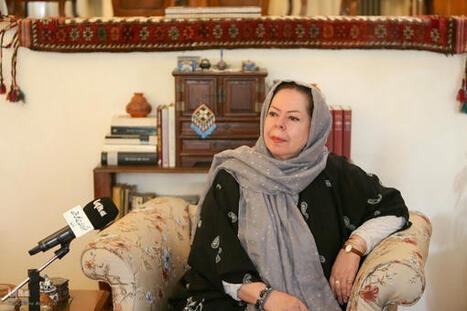







"La traduction du Shahnameh en espagnol était une quête mystique
June 07, 2025
IQNA-Pour la première fois en plus de mille ans, le chef-d’œuvre de Ferdowsi, le Shahnameh, a été intégralement traduit en espagnol.
Cette prouesse est l’œuvre de Beatriz Salas, professeure de littérature espagnole, installée en Iran depuis près de trente ans. Pour elle, cette aventure a été bien plus qu’un simple travail académique : une véritable expérience mystique.
Beatriz Salas, née d’un père vénézuélien et d’une mère espagnole, a suivi son époux originaire du Khorasan du Sud en Iran, où elle a enseigné pendant trois décennies à l’Université de Téhéran et à l’Université islamique Azad. C’est au détour d’un appel du ministère iranien des Affaires étrangères, relayé par l’UNESCO, que le projet a vu le jour. D’abord hésitante face à l’ampleur de la tâche, elle accepte de lire l’œuvre. Dès les premières lignes, elle est saisie : "Le Shahnameh est comme une forteresse que ni le soleil ni le vent ne peuvent ébranler."
La traduction du Shahnameh, qui s'étend sur sept volumes, aura nécessité près de dix ans, entrecoupée par la pandémie. Salas l’a réalisée en prose, avec l’aide précieuse de son mari pour la prononciation, d’une ancienne étudiante pour la saisie de près de 4 000 pages, et du soutien logistique d’anciens diplomates et universitaires. Malgré des moyens limités, le premier volume a été publié en édition de luxe par l’ambassade du Venezuela, avant que Salas ne poursuive seule l’aventure, convaincue de la portée universelle de ce récit.
Le Shahnameh, épopée monumentale de 50 000 distiques, traverse les siècles en abordant des thèmes intemporels : loyauté, honneur, quête de justice, respect familial. Pour Salas, cette œuvre est une leçon de vie : "Ferdowsi enseigne comment être un meilleur humain, père, fils, membre de la société." Elle raconte comment, dès son arrivée en Iran, elle découvre la force culturelle du Shahnameh à travers deux enfants jouant Rostam et Sohrab dans un village du Khorasan. "En Espagne, on ne voit pas deux enfants jouer Don Quichotte," dit-elle avec tendresse.
Salas affirme avoir repéré de nombreuses influences du Shahnameh dans la littérature mondiale, de Cervantès à Shakespeare, et même dans des séries modernes comme Game of Thrones, dont certains éléments visuels et narratifs semblent directement inspirés de Ferdowsi.
Aujourd’hui, elle sillonne le monde hispanophone pour faire connaître l’épopée perse, multipliant les conférences, notamment auprès des jeunes. Son objectif : rendre cette œuvre vivante et accessible. Dans un monde numérique, elle compare même le Jam-e Jam, la coupe mythique du Shahnameh, à nos téléphones portables : puissants mais nécessitant des cœurs purs pour ne pas en faire un mauvais usage.
Pour Salas, "le Shahnameh est un cadeau de Dieu au peuple". Elle y voit un rempart contre l’oubli de la langue et de l’identité perse, et une source inépuisable de sagesse pour le monde entier. Une œuvre d’âme et de résistance, traduite avec foi, passion… et amour."
IQNA
June 07, 2025
https://iqna.ir/fr/news/3492454/la-traduction-du-shahnameh-en-espagnol-%C3%A9tait-une-qu%C3%AAte-mystique
#metaglossia_mundus