 Your new post is loading...

|
Scooped by
Charles Tiayon
May 17, 11:03 AM
|
Jason M. Baxter: Dante loves the art of word play: rhetorical tropes and schemes from classical rhetoric that we find repellent, he adores. "The Trials of Translating Dante
By Jason M. Baxter
SATURDAY, MAY 17, 2025 Flannery O’Connor once said this about writing novels: “Writing a novel is a terrible experience, during which the hair often falls out and the teeth decay. I’m always irritated by people who imply that writing fiction is an escape from reality. It is a plunge into reality and it’s very shocking to the system.” I don’t know of a better description of what it’s felt like as I translated Dante’s Purgatorio, which was just released by Angelico Press. Every morning, during the final six-month stage of this project, I followed the same routine: wake up, get coffee, and build up some psychic reserves of energy for the massively depleting experience. Then I went upstairs, spread out my Italian text and commentaries, and attempt – over and over again – to render in English Dante’s dense web of music and meaning. And, for this reason, for six months (maybe longer: ask my wife), I’ve been a zombie, looking with eyes that don’t see, listening with ears that don’t hear. Why is translating Dante so psychically depleting? Everyone knows that his poem is an inspiring journey from a “dark wood” that soars up to the Beatific Vision and God Himself. But his language is always working in multiple dimensions. On the most basic and obvious level, Dante is a musician, who wrote in hendecallyables (eleven-syllable long lines) captured well, by iambic verse that’s not too stuffy. Dante also uses rhymes, of course, which Dorothy Sayers went all out to capture. In addition to the rhymes, however, Dante used all kind of dense word play, which he can do, in part, because he’s working with an inflected language: he can leave the root stable – like an Aristotelian substance – while varying the accidents of his inflections. But then, he also loves to use, on occasion, a maddeningly difficult syntax, a gnarled, thorny wood of grammar often made even more complicated because of the learned circumlocutions he employs. In all fairness, he warned us about such maddeningly difficult syntax and entangled cosmological grammar: Reader, I know you see that I am raising
my subject, and thus you will not marvel”
if now I use more art (più arte) to reinforce my poem.
(Purg. 9:70 72) And what does this look like? Dante loves word play and word art. Those rhetorical tropes and schemes from classical rhetoric that we find repellent, he adores. For instance, at one point, when Dante is being interrogated by Beatrice, “when, by her eyes, my eyes were struck” (33:18), the figure Dante quite deliberately uses is anadiplosis (a rhetorical “doubling back”). A modern translation, to make this line feel more natural for us, kills the rhetorical scheme by translating it: “when her piercing eyes met mine.”
Elsewhere, Dante uses chiasmus, an X-like pattern that sets one word on one side of the scale and then balances it out by putting a variant of it on the other side. For instance, at one point, Virgil has intuited that the pilgrim had within him more questions, and then generously proceeds to encourage him to speak forth those hidden doubts. Dante puts it this way: he “by speaking made me bold to speak.” (Purg. 18:7–9). That chiasmus becomes this in one recent translation: “that true father. . ./ spoke and gave me courage to speak out.”
But what is extraordinary is that Dante has the inverse tendency as well. After passing through the “refining fire” that cleanses the distorted love of the lustful, for instance, Dante, Virgil, and Statius have to pause to wait out the night, resting on the steps of a steep stairwell that goes right up the mountain: And just like goats in tranquil rumination,
who had been rowdy, capricious among
the hills before they’d found repast, but now in shade are quiet while the sun is hot,
now guarded by the shepherd, who leans upon
his staff and stands to watch their rest; or like the watchman who sleeps outdoors
and spends the night beside a somnolent herd
and watches lest a beast should scatter them; just so were we, all three together. And I
was like the goat: and they, the shepherds.
Flanked by walls of lofty rock on either side. There, little of the outside world could be seen,
except a tiny patch where I could see the stars,
much brighter and larger than is their usual habit. While ruminating on them and marveling at them,
I was overcome by sleep, the sleep that often
knows the news before it even happens. (27:76–95) This passage is extraordinary. Not only does it introduce a beautiful, prophetic dream, but uses concrete, bodily metaphor to describe what is, for us, merely an intellectual act. Dante “ruminates” (ruminando) on the beauty of the stars, feeds on them, tastes them, and draws their nourishment into his being by means of “marveling” at them, just as sheep and goats crop, chew, swallow, and digest grass. In other words, Dante here feeds on “the fire of love,” tastes it, chews it, ruminates on it, to absorb the nutritive power of beauty into his being. This use of concrete, embodied metaphors for intellectual acts is something I have labored to bring out in this translation. Too often, even well-loved, best-selling translations of the Comedy, made by eminent scholars, have inadvertently killed these metaphors and thereby turned Dante’s poetry into something disembodied: too much in the head and too little rooted in the nerves and heartbeat. One admired translation renders the passage I cited above by replacing the unusual and arresting metaphor of “ruminating” by means of “marveling” with this: “Amidst such sights and thoughts / I was seized by sleep.” At another point, the pilgrim tells his master that the answers he has received are so good that they create within him more questions: “Your words. . .have helped me to dis-cover love, / but this has made me pregnant with more doubts!” (Purg. 18.40-42). An eminent translator has rendered that line: “But that has left me even more perplexed.” What was in the body – the “womb” of Dante’s mind was “pregnant” with doubts – turns into an intellectual phenomenon, all in the head (“perplexed”). On another occasion, when Dante is speaking with Marco Lombardo, who is disgusted by the world’s greed, the old cavalier experiences a visceral, bodily reaction upon merely hearing Dante’s question: Deep sighs emerged, squeezed out by sorrow,
into an “Ohh!” then said: “Brother, the world
is blind. It’s clear you’ve come from it.”
(Purg. 16:64–66) This somatic utterance is rendered by one modern translator: “He heaved a heavy sigh, with grief wrung to a groan.” Dante’s onomatopoeic, bodily grunt of pained exclamation turns into an objective description. In another place, Dante says that what we could call our “curiosity” is sometimes not content until in confronts the truth eye to eye: This put into my will a burning eagerness
to contemplate the one who spoke to me,
a will that cannot rest until it’s face-to-face.
(Purg. 17:49–51) A respected translator puts it this way: “a will that cannot rest short of its goal.” When Dante answers Guido del Duca obliquely, about where he’s from, the puzzled soul replies: “If I have sunk my teeth (accarno) into your meaning
with my intellect,” the one I heard at first
replied to me, “you’re talking of the Arno.”
(Purg. 14:22–24) The shocking word – accarno – was simply too perfect in Italian: it makes the whole argument in two words, by means of rhyming with the feral, brutal, savage “Arno.” An admired translator renders it this way: “If my wit has truly grasped your meaning.” And finally, Dante says that, when they arrived within the unfamiliar landscape of purgatory, they “looked about confused, like someone tasting something new” (2:53-54), which a professional translator has put this way: “as though encountering new things.” I could list at least two dozen more: Dante doesn’t “get answers,” he harvests truth or plucks good fruit from words. Meanwhile, because a particularly beautiful song makes him “g[i]ve birth” inside his heart to a mixture of joy and sorrow (23:12: as opposed to “[bring] … delight”); his conscience “bites” and he struggles to “disentangle” himself from the net of error. As one Italian scholar matter-of-factly puts it: “Dante’s usual practice is to use a concrete verb in order to express moral or psychological conditions.” The point here is not to put down other translators, who are as scholars, in many ways, my betters (I didn’t cite the examples above: don’t look them up!); rather, my point is that I want to help my readers feel how rooted Dante’s poetry is in the humble experience of the body. In sum, Dante wants a lofty, classical syntax (see 22:127–29), but he also wants a poetry that is embedded in the small, the lowly, the humble. For this reason, his poetry is like some Bach fugue, in which the chords in the right hand are ascending while those in the left hand are descending. Or maybe even better, what you would get if you mixed the Roman epic poet Statius and the Franciscan poet Jacopone da Todi. In any case, this is the glory of Dante. It’s also why translators find it so hard, and also why I lost so much hair and so many teeth. Jason M. Baxter
Jason M. Baxter is a college professor..."
https://www.thecatholicthing.org/2025/05/17/the-trials-of-translating-dante/ #metaglossia_mundus

Researchers across Africa, Asia and the Middle East are building their own language models designed for local tongues, cultural nuance and digital independence
"In a high-stakes artificial intelligence race between the United States and China, an equally transformative movement is taking shape elsewhere. From Cape Town to Bangalore, from Cairo to Riyadh, researchers, engineers and public institutions are building homegrown AI systems, models that speak not just in local languages, but with regional insight and cultural depth.
The dominant narrative in AI, particularly since the early 2020s, has focused on a handful of US-based companies like OpenAI with GPT, Google with Gemini, Meta’s LLaMa, Anthropic’s Claude. They vie to build ever larger and more capable models. Earlier in 2025, China’s DeepSeek, a Hangzhou-based startup, added a new twist by releasing large language models (LLMs) that rival their American counterparts, with a smaller computational demand. But increasingly, researchers across the Global South are challenging the notion that technological leadership in AI is the exclusive domain of these two superpowers.
Instead, scientists and institutions in countries like India, South Africa, Egypt and Saudi Arabia are rethinking the very premise of generative AI. Their focus is not on scaling up, but on scaling right, building models that work for local users, in their languages, and within their social and economic realities.
“How do we make sure that the entire planet benefits from AI?” asks Benjamin Rosman, a professor at the University of the Witwatersrand and a lead developer of InkubaLM, a generative model trained on five African languages. “I want more and more voices to be in the conversation”.
Beyond English, beyond Silicon Valley
Large language models work by training on massive troves of online text. While the latest versions of GPT, Gemini or LLaMa boast multilingual capabilities, the overwhelming presence of English-language material and Western cultural contexts in these datasets skews their outputs. For speakers of Hindi, Arabic, Swahili, Xhosa and countless other languages, that means AI systems may not only stumble over grammar and syntax, they can also miss the point entirely.
“In Indian languages, large models trained on English data just don’t perform well,” says Janki Nawale, a linguist at AI4Bharat, a lab at the Indian Institute of Technology Madras. “There are cultural nuances, dialectal variations, and even non-standard scripts that make translation and understanding difficult.” Nawale’s team builds supervised datasets and evaluation benchmarks for what specialists call “low resource” languages, those that lack robust digital corpora for machine learning.
It’s not just a question of grammar or vocabulary. “The meaning often lies in the implication,” says Vukosi Marivate, a professor of computer science at the University of Pretoria, in South Africa. “In isiXhosa, the words are one thing but what’s being implied is what really matters.” Marivate co-leads Masakhane NLP, a pan-African collective of AI researchers that recently developed AFROBENCH, a rigorous benchmark for evaluating how well large language models perform on 64 African languages across 15 tasks. The results, published in a preprint in March, revealed major gaps in performance between English and nearly all African languages, especially with open-source models.
Similar concerns arise in the Arabic-speaking world. “If English dominates the training process, the answers will be filtered through a Western lens rather than an Arab one,” says Mekki Habib, a robotics professor at the American University in Cairo. A 2024 preprint from the Tunisian AI firm Clusterlab finds that many multilingual models fail to capture Arabic’s syntactic complexity or cultural frames of reference, particularly in dialect-rich contexts.
Governments step in
For many countries in the Global South, the stakes are geopolitical as well as linguistic. Dependence on Western or Chinese AI infrastructure could mean diminished sovereignty over information, technology, and even national narratives. In response, governments are pouring resources into creating their own models.
Saudi Arabia’s national AI authority, SDAIA, has built ‘ALLaM,’ an Arabic-first model based on Meta’s LLaMa-2, enriched with more than 540 billion Arabic tokens. The United Arab Emirates has backed several initiatives, including ‘Jais,’ an open-source Arabic-English model built by MBZUAI in collaboration with US chipmaker Cerebras Systems and the Abu Dhabi firm Inception. Another UAE-backed project, Noor, focuses on educational and Islamic applications.
In Qatar, researchers at Hamad Bin Khalifa University, and the Qatar Computing Research Institute, have developed the Fanar platform and its LLMs Fanar Star and Fanar Prime. Trained on a trillion tokens of Arabic, English, and code, Fanar’s tokenization approach is specifically engineered to reflect Arabic’s rich morphology and syntax.
India has emerged as a major hub for AI localization. In 2024, the government launched BharatGen, a public-private initiative funded with 235 crore (€26 million) initiative aimed at building foundation models attuned to India’s vast linguistic and cultural diversity. The project is led by the Indian Institute of Technology in Bombay and also involves its sister organizations in Hyderabad, Mandi, Kanpur, Indore, and Madras. The programme’s first product, e-vikrAI, can generate product descriptions and pricing suggestions from images in various Indic languages. Startups like Ola-backed Krutrim and CoRover’s BharatGPT have jumped in, while Google’s Indian lab unveiled MuRIL, a language model trained exclusively on Indian languages. The Indian governments’ AI Mission has received more than180 proposals from local researchers and startups to build national-scale AI infrastructure and large language models, and the Bengaluru-based company, AI Sarvam, has been selected to build India’s first ‘sovereign’ LLM, expected to be fluent in various Indian languages.
In Africa, much of the energy comes from the ground up. Masakhane NLP and Deep Learning Indaba, a pan-African academic movement, have created a decentralized research culture across the continent. One notable offshoot, Johannesburg-based Lelapa AI, launched InkubaLM in September 2024. It’s a ‘small language model’ (SLM) focused on five African languages with broad reach: Swahili, Hausa, Yoruba, isiZulu and isiXhosa.
“With only 0.4 billion parameters, it performs comparably to much larger models,” says Rosman. The model’s compact size and efficiency are designed to meet Africa’s infrastructure constraints while serving real-world applications. Another African model is UlizaLlama, a 7-billion parameter model developed by the Kenyan foundation Jacaranda Health, to support new and expectant mothers with AI-driven support in Swahili, Hausa, Yoruba, Xhosa, and Zulu.
India’s research scene is similarly vibrant. The AI4Bharat laboratory at IIT Madras has just released IndicTrans2, that supports translation across all 22 scheduled Indian languages. Sarvam AI, another startup, released its first LLM last year to support 10 major Indian languages. And KissanAI, co-founded by Pratik Desai, develops generative AI tools to deliver agricultural advice to farmers in their native languages.
The data dilemma
Yet building LLMs for underrepresented languages poses enormous challenges. Chief among them is data scarcity. “Even Hindi datasets are tiny compared to English,” says Tapas Kumar Mishra, a professor at the National Institute of Technology, Rourkela in eastern India. “So, training models from scratch is unlikely to match English-based models in performance.”
Rosman agrees. “The big-data paradigm doesn’t work for African languages. We simply don’t have the volume.” His team is pioneering alternative approaches like the Esethu Framework, a protocol for ethically collecting speech datasets from native speakers and redistributing revenue back to further development of AI tools for under-resourced languages. The project’s pilot used read speech from isiXhosa speakers, complete with metadata, to build voice-based applications.
In Arab nations, similar work is underway. Clusterlab’s 101 Billion Arabic Words Dataset is the largest of its kind, meticulously extracted and cleaned from the web to support Arabic-first model training.
The cost of staying local
But for all the innovation, practical obstacles remain. “The return on investment is low,” says KissanAI’s Desai. “The market for regional language models is big, but those with purchasing power still work in English.” And while Western tech companies attract the best minds globally, including many Indian and African scientists, researchers at home often face limited funding, patchy computing infrastructure, and unclear legal frameworks around data and privacy.
“There’s still a lack of sustainable funding, a shortage of specialists, and insufficient integration with educational or public systems,” warns Habib, the Cairo-based professor. “All of this has to change.”
A different vision for AI
Despite the hurdles, what’s emerging is a distinct vision for AI in the Global South – one that favours practical impact over prestige, and community ownership over corporate secrecy.
“There’s more emphasis here on solving real problems for real people,” says Nawale of AI4Bharat. Rather than chasing benchmark scores, researchers are aiming for relevance: tools for farmers, students, and small business owners.
And openness matters. “Some companies claim to be open-source, but they only release the model weights, not the data,” Marivate says. “With InkubaLM, we release both. We want others to build on what we’ve done, to do it better.”
In a global contest often measured in teraflops and tokens, these efforts may seem modest. But for the billions who speak the world’s less-resourced languages, they represent a future in which AI doesn’t just speak to them, but with them."
Sibusiso Biyela, Amr Rageh and Shakoor Rather
20 May 2025
https://www.natureasia.com/en/nmiddleeast/article/10.1038/nmiddleeast.2025.65
#metaglossia_mundus

"Geoffrey Chaucer is known as the "Father of English Literature" or the "Father of English Poetry" for his medieval classic "The Canterbury Tales," a work that encouraged writers of his time to write in Middle English rather than French.
Over six centuries later, Francis So (蘇其康) released in October the first complete Chinese translation of "The Canterbury Tales" by a Taiwanese translator.
In an interview with CNA in late November, So said Chaucer wrote during a period when French still dominated literary culture.
The publication of "The Canterbury Tales" helped popularize Middle English, while its poetic techniques shaped later writers, including Shakespeare, he said.
So hopes the new edition will inspire more young researchers to build and carry forward Taiwan's tradition of medieval Western literary studies.
Reliving the pilgrimage
So noted that "The Canterbury Tales," written in the late 14th century, depicts a pilgrimage of 30 Christians traveling from London to Canterbury to venerate St. Thomas Becket.
The pilgrims take turns telling stories along the way, forming the work's narrative frame.
Although Chaucer originally planned 120 tales -- two for each pilgrim on both the outward and return journeys -- only 24 survive, preserved mainly in two manuscripts.
So based his translation primarily on the more complete Ellesmere manuscript and consulted the Hengwrt manuscript, which scholars believe reflects the earlier state of Chaucer's text.
So said he adopted "fidelity" as his guiding principle, preserving original syntax, word order and imagery whenever possible.
"If the original uses a noun, I try to translate it as a noun. Sometimes reversing the sentence order makes the Chinese more fluent, but it weakens fidelity to the text," he said.
To help contemporary Taiwanese readers navigate the unfamiliar medieval world, So included extensive annotations, particularly on material culture and institutional structures -- a key feature distinguishing his version from the earlier translations.
So credits his sensitivity to historical and cultural nuance to the rigorous comparative-literature training he received in the United States, where he studied multiple languages and took courses in translation studies.
Born in 1948, So earned his bachelor's degree at National Taiwan University's Department of Foreign Languages and Literatures and later received a Ph.D. in comparative literature from the University of Washington in Seattle.
He is currently an emeritus professor at National Sun Yat-sen University, where he has taught since 1983.
So said translation involves far more than "looking up words in a dictionary."
To better reconstruct the medieval pilgrimage, he visited the British Museum in 2023 to consult historical materials and traveled portions of the route described in the text.
This fieldwork, he said, helped him handle place names and cultural references with greater accuracy.
Tradition and legacy
So said "The Canterbury Tales" continues to resonate today, noting that contemporary British writer Zadie Smith drew inspiration from "The Wife of Bath's Tale" for her play "The Wife of Willesden."
Elsewhere, J.K. Rowling has also acknowledged that "The Tale of the Three Brothers" in "Harry Potter and the Deathly Hallows" is an allusion to "The Pardoner's Tale."
Reflecting on his academic career in Taiwan, So said there were no scholars specializing in medieval literature when he studied at NTU, and he resolved to help establish the discipline when he undertook graduate studies in the U.S.
"When we founded the Taiwan Association of Classical, Medieval and Renaissance Studies (TACMRS) in 2007, that meant the establishment of a tradition," he said.
The association's annual conference has since become a key event for domestic scholars and students in the field.
Nearly two decades after the founding of TACMRS, So said he is heartened to see more emerging scholars entering the field.
He hopes the new translation will lower the barrier of entry for readers and encourage more people to pursue medieval literary studies."
INTERVIEW/New translation of 'The Canterbury Tales' marks milestone in Taiwan medieval studies
12/22/2025 12:11 PM
By Chao Yen-hsiang, CNA staff reporter
https://focustaiwan.tw/culture/202512220006
#Metaglossia
#metaglossia_mundus

"MUSCAT: The Bait AlGhasham–DarArab International Translation Prize on Sunday announced the shortlists for its 2026 cycle across three categories — Translators, Authors and Omani Publications — following the completion of all judging stages and final reviews.
The 2026 shortlists reflect a cycle marked by wide participation and notable diversity, spanning multiple literary genres and a broad range of geographic backgrounds. This year also saw submissions from translators based outside the Arab world, underscoring the Prize’s expanding regional and international reach.
Shortlist – Translators Category in alphabetical order by English title
Angel of the South, translated by Peter Theroux — by Najem Wali
Cairo Marquette, translated by Katherine Van de Vate — by Tareq Imam
People and Lizards, translated by Osama Hammad and Marianne Dhenin — by Hassan Abdel Mawgoud
Things Are Not in Their Place, translated by Zia Ahmed — by Huda Hamad
Village of the Hundred, translated by Enas El Torky — by Rehab Luay
Shortlist – Authors category, alphabetical order by Arabic title
Abad Ghayr Mariyya — Short-story collection by Mustafa Mallah
Al Matador — Novel by Majdi Daibes
Jibal Al Judari — Novel by Abd Al Hadi Shaalan
Jarash Jarash — Novel by Wael Raddad
Kain Ghayr Sawi — Novel by Tahir Al Noor
Shortlist – Omani publications category, alphabetical order by Arabic title
Tahta Zill Al Zilal — Novel by Mohammed Qart Al Jazmi
Arous Al Gharqa — Novel by Amal Abdullah
Qawanin Al Faqd — Short-story collection by Mazen Habeeb
The shortlists were selected by independent judging panels operating under the supervision of the Prize’s Board of Trustees, chaired by Marilyn Booth, an internationally recognised translator and scholar of Arabic literature. Board members also include Mohammed al Yahyaei, a writer and cultural historian, and Sawad Hussain, an award-winning Arabic-to-English translator.
The Translators Category jury comprised of Dr Samaher al Dhamen, a specialist in comparative literature and cultural studies; Marcia Lynx Qualey, founder of ArabLit and a leading advocate of Arabic literature in translation; and Dr Luke Leafgren, an Arabic-English literary translator and two-time recipient of the Saif Ghobash Banipal Prize.
The Authors and Omani Publications categories were judged by Dr Amir Taj Al Sir, a widely translated novelist and physician; Bushra Khalfan, a prominent voice in contemporary Omani literature; and Yas al Saeedi, an Iraqi poet, novelist and playwright whose work has garnered multiple Arab and international awards.
According to official figures, the 2026 cycle received 346 submissions in the Authors Category, 34 in the Translators Category and 10 in the Omani Publications Category.
Launched three years ago through a partnership between the Bait AlGhasham Foundation for Press, Publishing and Advertising and DarArab for Publishing & Translation, the Prize is administered by DarArab and funded by the Bait AlGhasham Foundation. It aims to support Arabic literature and expand its global circulation through translation and international publishing.
The Prize carries a fund of £70,000 (approx), allocated across financial awards and professional support for translation, editing, publishing and international promotion. The winning works will be announced in conjunction with the Muscat International Book Fair 2026."
Bait AlGhasham–DarArab Translation Prize unveils 2026 shortlists https://share.google/sF1u9XSkllOvVs5kX
#Metaglossia
#metaglossia_mundus

"Massachusetts Mayor Can’t Understand English, Needs Translator In Court
Mayor Brian DePena immigrated to the United States in the 1980s.
Massachusetts Mayor Brian DePena made waves for requesting the assistance of a translator during a court appearance on Friday.
DePena requested that his personal assistant act as a translator during the proceedings, which the judge overseeing the hearing denied due to concerns that the staffer had not been independently verified. Because the judge and opposing counsel do not speak Spanish, it was determined that mistranslations could negatively affect the case, either intentionally or unintentionally, per The Post Millennial...
The incident occurred during a Peace Officer Standards and Training (POST) Commission and quickly went viral. It’s been revealed that DePena hails from the Dominican Republic and immigrated to New York in the early 1980s before moving to Lawrence, Massachusetts, in 1989.
The hearing concerned former Lawrence Police Chief William Castro, who lost his policing credentials after a 2024 police chase and subsequent false report. Castro was accused of driving the wrong way down a city street during the chase. He later filed a report saying he was responding to an armed bank robbery. In reality, he had been going after someone who had allegedly cashed a bad check.
Documents uncovered by the NBC10 Boston Investigators revealed that DePena tried to curtail the investigation into the acting police chief, who is a political ally of the Lawrence mayor.
Social media users have been reacting strongly to the clip, saying it’s shocking that an elected official is not able to speak fluent English.
“How is this even real life?” one response said.
“This is absurd. We live in a parody world,” another person echoed.
“If you can’t speak English, you shouldn’t even be eligible for citizenship, much less public office,” a third commenter wrote. “How are you supposed to represent Americans if you can’t even understand our language?”
Per census data, Lawrence, Massachusetts, is over 82% Hispanic."
By Amanda Harding
Dec 22, 2025 DailyWire.com
Massachusetts Mayor Can’t Understand English, Needs Translator In Court https://share.google/6M7wEZvqLahawEta9
#Metaglossia
#metaglossia_mundus

"... The accurate use of all official languages in public communications is important in our multicultural society. Government agencies are encouraged to communicate in the relevant official languages to better serve and engage diverse communities.
The National Translation Committee (NTC) under the Ministry of Digital Development and Information has been working to address concerns like those raised by Mr Meyyappan through several initiatives.
To facilitate accurate translation of government communications materials, the NTC has identified a list of experienced translation providers that government agencies can engage to accurately translate, vet and proofread translations in all the official languages, including Tamil.
On the issue of gibberish Tamil text caused by software and printing errors, the NTC has also issued guidelines and conducted briefings for government agencies and their vendors on using correct encoding and compatible computer operating systems, as well as having a proper verification process, including careful checks, before the translated materials are printed.
More than 3,000 people have also signed up as citizen translators to help us flag translation errors in public spaces. This is one of the reasons why we started the Citizen Translators Project.
We receive an average of 15 reported errors each year, which allows us to immediately alert the relevant entity, whether government or otherwise, to rectify them.
Members of the public can also bring such errors to our attention through the NTC webpage.
We appreciate the care and pride that Singaporeans like Mr Meyyappan have for our official languages.
Together, we can work towards upholding standards for all our official languages in public spaces.
Mayna Teo
Director, Translation Department
Ministry of Digital Development and Information"
"Published Dec 22, 2025, 05:00 AM
We thank Mr Muthalagu Meyyappan for his letter “Clearer guidelines needed to ensure accuracy in languages used in public communications” (Dec 17).
https://www.straitstimes.com/opinion/forum/forum-guidelines-and-resources-for-translation-accuracy-in-official-languages-provided
#Metaglossia
#metaglossia_mundus
Discover how Time to Edit (TTE) redefines translation quality, offering a human-centric metric for AI efficiency and real-world translation improvement.
"...Traditional metrics like BLEU, once the gold standard for assessing translation quality, are increasingly seen as inadequate in capturing the true effort required to refine machine-generated translations to human standards. This is where “Time to Edit” (TTE) emerges as a game-changer. TTE is a human-centric metric that accurately measures the real-world effort needed to edit AI-generated translations, offering a clearer picture of translation performance and return on investment (ROI). For enterprise localization managers and CTOs, understanding and implementing TTE can lead to significant improvements in translation quality and efficiency. By focusing on the practical application of TTE, businesses can leverage Language AI, TranslationOS, and custom localization solutions to achieve measurable outcomes. This article delves into the limitations of traditional metrics and explores how TTE provides a more accurate and insightful approach to translation quality assessment, positioning it as the new standard in the industry..."
Time to Edit (TTE): The New Standard for Translation Quality - Translated
Find out more👇🏿👇🏿 https://translated.com/resources/time-to-edit-the-new-standard-for-translation-quality
#Metaglossia
#metaglossia_mundus
"Upcoming Translation Events (Virtual & In-Person): January 2026
Tuesday, January 13:
Simón López Trujillo and Robin Myers | Join the Transnational Literature Series at Brookline Booksmith for a virtual event with Simón López Trujillo, a Chilean author and translator, and Robin Myers, a Mexico City-based Spanish-to-English translator and poet, to discuss and honor the release of Pedro the Vast. The event is ticketed. Virtual. Hosted by Brookline Booksmith. More info here. Starts at 7:00 p.m. (ET)
Thursday, January 15:
White Moss Translated: From Mentorship to Publication | Join Irina Sadovina, translator of White Moss and alumna of NCW’s Emerging Translator Mentorships Programme (2021), as she discusses her journey in bringing Anna Nerkagi’s novel to English-language readers. She will be joined by her translator-mentor Oliver Ready and Rory Williamson, editor at Pushkin Press, who will share further insight into Sadovina’s translation process and how an initial pitch became a forthcoming publication. Virtual. Hosted by the National Centre for Writing. More info here. 2:00 p.m. - 3:00 p.m. (ET)
..."
Columbia University School of the Arts
2960 Broadway · New York, NY 10027
Lenfest Center for the Arts
615 W 129th St · New York, NY 10027
Contact
soaadmissions@columbia.edu
https://arts.columbia.edu/content/upcoming-translation-events-virtual-person-january-2026
#Metaglossia
#metaglossia_mundus
"“Saudade”, “Sehnsucht” : les mots des autres pour dire la nostalgie
Dans le dernier numéro de l’année de “Courrier international”, nous nous intéressons à la vague de nostalgie qui semble avoir emportée la planète entière. Mais, d’une langue à l’autre, du turc au chinois, du polonais au portugais, la notion de nostalgie ne recouvre pas tout à fait les mêmes réalités suivant les langues. Voici un petit inventaire des mots dans différentes langues consacrés à ce passé qui nous manque et qui nous hante.
Publié le 21 décembre 2025 à 13h33
Les mots pour suggérer la nostalgie en plusieurs langues. Courrier international
Article à retrouver dans le numéro “Nostalgie chérie” de Courrier international, disponible dans les kiosques du 18 décembre 2025 au 7 janvier 2026, ou en ligne
Grèce — De nostos, “retour”, et algos, “douleur, chagrin”
Tout vient du grec. Le terme “nostalgie”, νοσταλγία, est formé des mots nostos, “retour”, et algos, “douleur, chagrin”. Il exprime le désir mélancolique de retourner chez soi. Si le mot a été inventé et conceptualisé par le médecin alsacien Johannes Hofer en 1688 dans le cadre de sa thèse, il reste profondément attaché et ancré dans la culture grecque. “La nostalgie n’est ni innocente ni irrationnelle. C’est une tentative de restaurer l’unité, dans un monde qui conditionne notre mémoire à fonctionner comme un flux continu”, décrit le poète Yiannis Antiochou, dans un texte publié par l’hebdomadaire To Vima.
Mais l’“obsession du passé est omniprésente et toujours paralysante. Plus encore, c’est une force fondamentalement conservatrice, une tendance à fixer notre regard sur un hier factice et construit, à mépriser le présent et à refuser, ou être incapable, d’imaginer l’avenir”, regrette la chercheuse Katerina Lambrinou.
Turquie — Un manque qu’on espère que l’avenir comblera
En turc, özlem traduit la notion de nostalgie mais de façon un peu un peu plus neutre..."
La suite👇🏿👇🏿
https://www.courrierinternational.com/article/linguistique-saudade-sehnsucht-les-mots-des-autres-pour-dire-la-nostalgie_238149
#Metaglossia
#metaglossia_mundus
"Ces mots français venus du Moyen-Orient et de Méditerranée
Des milliers de mots de la langue française proviennent de contrées lointaines de l’Hexagone. Parmi eux, des centaines ayant des liens directs ou indirects avec l’arabe mais également, à une moindre échelle, le persan.
Publié le : 21/12/2025 - 12:04
Modifié le : 22/12/2025 - 10:10
Le mot français bougie provient de la ville algérienne éponyme aujourd’hui appelée Béjaïa. REUTERS/KIM HONG-JI
Par :bAnne Bernas
Monsieur Jourdain ignorait qu’il faisait de la prose, mais Molière savait-il que de nombreux mots dont il usait provenaient de contrées moyen-orientales et méditerranéennes ?
L’arabe est la sixième langue la plus parlée au monde et est utilisée quotidiennement par plus de 400 millions de personnes, dont 200 millions de locuteurs natifs, selon les données des Nations unies. Une « Journée mondiale » lui est également consacrée chaque 18 décembre, date coïncidant avec le jour où, en 1973, l'Assemblée générale de l’ONU a adopté l'arabe comme sixième langue officielle de l'Organisation par la résolution 3190.
D’une infinie richesse, l’arabe, classique mais aussi dialectal, a transmis à de nombreuses langues indo-européennes une somme de mots considérable. « Il y a beaucoup plus de mots d’origine arabe dans la langue française que de mots d’origine gauloise ! » rappelait en 2022 l’académicien Erik Orsenna.
Plus de 800 références
Dans le dictionnaire français, pas moins de 400 mots sont d’origine arabe, 200 autres sont des mots dérivés et quelque 800 portent la marque de la langue arabe. Depuis le Moyen Âge, des mots arabes voyagent jusqu’en France, par la terre et la mer, en faisant parfois escale dans d’autres pays. À ce titre, le mot « amiral », rang le plus élevé dans la marine française, provient de « Amir al-bahr», le « chef de la mer ». La dissémination de mots d’origine arabe se poursuit lors des conquêtes coloniales du XIXᵉ siècle en Afrique du Nord et jusqu'à plus récemment avec le langage des jeunes de banlieues.
Pourtant, comme le rappelle Salah Guemriche, auteur du Dictionnaire des mots français d'origine arabe (Seuil, 2007), de nombreux mots français d’origine arabe n’ont pas toujours été « assumés » par Paris, à la différence des mots d’origine persane. « Aux XVIᵉ et XVIIᵉ siècles, l’origine ne dérangeait pas, elle était sans arrière-pensée idéologique, ce qui change au XIXᵉ, à l’heure de la colonisation. Comment voulez-vous dire d’un côté “on va apporter la civilisation” et de l’autre dire que la langue française contient déjà des mots arabes, des Arabes qu’on est allé coloniser. »
Les termes issus de l’arabe sont si nombreux qu’il est impossible d’en dresser une liste, mais parmi les plus connus, dans le domaine des sciences et des mathématiques, à côté des centaines de noms d’étoiles, notons les célèbres « zéro », « chiffre », « zénith », etc. Mais aussi « algèbre », provenant de l'arabe « al-jabr »,« restauration » ou « réunion ». Ce mot figure initialement dans le titre d'un ouvrage du IXᵉ siècle consacré à la résolution d'équations, écrit par le savant persan Muhammad ibn Musa al-Khwarizmi, installé à Bagdad, et dont dérive le mot « algorithme ».
Plus terre à terre. Le sud de l’Hexagone est réputé pour sa culture des abricots (« al barbuk »), mais les Bretons, dont l’artichaut est l’un de leurs symboles de fierté, savent-ils que ces « épines de la terre » se disent en arabe « ardi chawk » ? Savent-ils que l’arsenal de Brest puise son origine de l’arabe « dar al-sina » ou « maison de fabrication ». Et que dire du caban breton, mais aussi des écharpes, chemises, jupes, gilets, parfois en coton, lui aussi issu de l’arabe « kutun ».
« Le français n'est pas français »
À l’heure des vacances de fin d’année, certains pourraient être tentés de partir faire un safari, dont le terme vient de l’arabe « safar » signifiant « voyage », pour découvrir les girafes (de l’arabe « zarafa ») et les gazelles (« ghazal ») au milieu des baobabs ( « abu hibab »). Un voyage sans grosses tempêtes pour les voyageurs de l’océan Indien puisque la saison des moussons est terminée. La mousson provient de l’arabe « mausim », « saison ». Il arrive dans le vocabulaire français à la fin du XVIᵉ siècle après être passé par le néerlandais, le portugais et l’espagnol sous différentes formes.
Pour fêter la fin de l’année, certains feront la nouba (de l’arabe algérien) et trinqueront avec un verre d’alcool, mot venant du mot « al-khol ». Il signifie à l’origine une fine poudre noire de sulfure de plomb et d’antimoine, un produit de beauté mais aussi un produit d’alchimistes. À la Renaissance, le chimiste allemand utilise le terme « alcohol vini » pour désigner « l’esprit de vin », le « produit d’une distillation de vin ». Quoi qu’il en soit, pour se remettre de toutes ces émotions, rien ne sera plus efficace qu’un petit « caoua ».
D’autres mots sont directement entrés dans le vocabulaire, par exemple bougie (de la ville algérienne éponyme aujourd’hui appelée Béjaïa), casbah (directement venu d’Alger), bled, barda, chouia, et plus près de nous kiffer, dawa ou encore seum. Et puis il y a des « mots arabes clandestins » tels que les nomme le lexicographe Roland Laffitte qui raconte l’exemple de l’épithète « romaine » accolé à une balance, la fameuse balance romaine. « Romaine » vient de l’arabe rumāna signifiant « grenade ». Car cette balance possède sur un bras un dispositif d’équilibre qui lui ressemblait.
La langue arabe, la plus parlée des langues sémitiques et la quatrième source d’emprunts de notre langue, après l’anglais, l’italien et l’allemand, a permis un dialogue des cultures le long des routes de la soie, de la côte de l'Inde à la Corne de l'Afrique. Les empires arabes successifs, après la fondation de l’islam, régnèrent sur un territoire qui s’étendait du Maroc à l’ouest jusqu’aux frontières de ce qui est aujourd’hui la Chine. La langue nous a rapporté d’Inde le mot sucre, issu du sanskrit et qui se dit en arabe « sukkar »...
« À travers les siècles, l’arabe a été au cœur des échanges entre les continents et entre les cultures », déclarait Audrey Azoulay, ex-directrice générale de l’Unesco. La langue, ajoutait-elle, a été « maniée par tant de grands poètes, penseurs, scientifiques et savants ».
Il n’y a pas de hasard (du mot arabe « az-ahar », « dé à jouer »), le génie de la langue française tient beaucoup à ces innombrables apports multiculturels. « Le français n'est pas français », s’amusait à dire le linguiste de renom et historien de la langue française Alain Rey. De quoi y perdre son latin.
« Les mots ont beaucoup voyagé »
À une moindre échelle, de nombreux mots issus du persan - tulipe, divan, nénuphar, babouches, bazar, etc.- ont enrichi le vocabulaire français depuis le Moyen Âge. Explications avec Agnès Lenepveu-Hotz, maître de conférences au département d'études persanes de l’université de Strasbourg.
RFI : Comment expliquer que le nombre de mots français issus du persan (0,7%), langue plus ancienne que l’arabe, soit très inférieur à celui des mots issus de l’arabe (5%) ?
Agnès Lenepveu-Hotz : On trouve moins de mots français issus du persan que de l’arabe pour des raisons historiques. Les royaumes arabes dans le sud de l'Espagne ont par exemple engendré des contacts et donc l'espagnol, comme le français du Sud- Ouest, a emprunté des termes à l'arabe.
Aussi, beaucoup de mots persans ne sont pas arrivés directement jusqu’à nous. Assez souvent, ces mots ont transité par l'arabe, le turc, parfois le hindi. Quand le mot a été emprunté de l'anglais au hindi, il est parfois repassé en français, et souvent le hindi l'avait emprunté au persan avant. Ainsi, les mots ont beaucoup voyagé, comme le mot « châle ». Ce mot a été emprunté par les Anglais au hindi, mais l’hindi l'avait emprunté au persan. Le mot « orange » est passé par l'arabe et même par l'espagnol, mais au départ, c'est un mot persan.
Pour certains mots, on peine vraiment à savoir si l’origine est d’abord persane ou arabe. Pour d'autres, c'est beaucoup plus clair, comme pour le mot « kiosque ». Ce mot est attesté dès le moyen perse, donc bien avant les emprunts que le persan a fait à l'arabe. Ce mot signifie « palais », « pavillon », « kiosque ». Le mot « bakchich », lui, a transité par le turc, mais c'est un verbe en persan qui veut dire « donner ». Le français l'a ensuite emprunté du turc, mais l'arabe et le turc l'avaient emprunté au persan."
https://www.rfi.fr/fr/moyen-orient/20251221-ces-mots-fran%C3%A7ais-venus-du-moyen-orient-et-de-m%C3%A9diterran%C3%A9e
#Metaglossia
#metaglossia_mundus

"A disabilities advocate and vice-president of the Barbados Horizon Deaf Charity (BHDC), Scott Williams is calling for greater access to education for the deaf, including more interpreters and the introduction of deaf-led sign language instruction in schools.
Williams, who became deaf as a child, said his early exposure to sign language came from hearing individuals who, while well intentioned, did not fully understand the lived experiences of deaf people. As a result, he is advocating for more deaf educators to teach sign language.
“With a hearing person, who is teaching a language that is not theirs, how do you know when they are teaching sign language correctly? It is better for a deaf person to teach the language because deaf people, we know our own sign language,” Williams told Barbados TODAY, while stressing the importance of accuracy and cultural understanding.
He further explained that while learning from hearing people has its place, deaf people should be leading the instruction of their own language.
“We learn English from hearing people and that’s fine, it’s your language, just like with a deaf person their language is ASL. So yes, we should have ASL taught in schools, but it would be beautiful to have deaf teachers or deaf teacher’s assistants, having a deaf person there that can make sure the language is being taught correctly.”
Williams said his advocacy extends beyond children in classrooms, noting that access to education for deaf people at all stages of life remains limited in Barbados.
“Learn sign language. That is not the first time we have said that. Just learn the basics.”
He said people who find it difficult to learn sign language can also use gestures to communicate with the deaf.
“Some deaf people can read lips pretty well; some deaf people can talk. Just try to find ways to communicate. Move your hands, use gestures, like you would with a drinking cup or a bag, or telling someone to come here. It’s easy. It doesn’t have to be complicated…”
Willams explained that education is just one of several challenges facing the deaf community.
“Some of the biggest challenges that we face are communication, education, access to interpreters, employment, and finances,” he said.
“At BHDC we recognize they are some of the challenges the deaf community faces, so we are working together trying to create solutions. We don’t have government support yet, but we’re still figuring it out.”
He also sought to dispel common misconceptions about deaf and disabled people, saying stigma often prevents meaningful inclusion.
“Hearing people tend to view us as charity cases, ‘oh you poor thing.’ They perceive us as if we can’t do things. We can’t have quality access. We don’t need to have that because we’re deaf. It’s not only deaf people that face this, but I would also say it’s people with disabilities. We are one big family,” he said.
Williams appealed for broader support to help disabled people achieve their goals, particularly in employment and funding opportunities.
He said the lack of employment opportunities remains a pressing concern for the deaf community.
“If a person with a disability is looking for a job, give them a job. If they need funding, let’s support that. Whatever a deaf person or a person with a disability needs. If they have a dream, it should be supported. We don’t want any more discrimination.”
“There are a lot of deaf people in Barbados who really need access to jobs and right now we don’t have that,” Williams said.
https://barbadostoday.bb/2025/12/20/deaf-advocate-calls-for-greater-access-to-education-and-interpreters/
#Metaglossia
#metaglossia_mundus
"Plein feu sur (i)elles : visibiliser le genre en traduction. Gender in the Spotlight: (In)Visibility in Translation (Sorbonne nouvelle)
Date de tombée (deadline) : 01 Mars 2026
À : Université Sorbonne Nouvelle, Paris, France
Publié le 19 Décembre 2025 par Marc Escola (Source : Amanda Murphy)
Appel à contributions
Plein feu sur (i)elles : visibiliser le genre en traduction
Gender in the Spotlight: (In)Visibility in Translation
L’épineuse notion de la visibilité et son pendant négatif, l’invisibilité, hantent depuis longtemps la traduction. Selon Kate Briggs, Helen Lowe-Porter — la traductrice de Thomas Mann vers l’anglais — décrivait sa mission traductive comme celle d’un « instrument inconnu, un outil utile pour le service qu’il fournit, occupé à déshabiller puis à rhabiller avec précaution le texte d’art littéraire afin qu’il convienne à un nouveau marché ; comme une femme de chambre » (Briggs 2018 : 36, notre traduction). Et de fait, c’est ce que déplorait déjà Lawrence Venuti en 1998, à l’encontre d’une traduction « vitre » (Kratz & Shapiro 1986), que la voix de l’auteur sacralisé serait censée traverser sans que l’on décèle qu’elle a changé de système linguistique, de culture-cible, ou même de geste écrivant. Venuti rappelle que c’est justement parce que la traduction est « stigmatisée en tant que forme d’écriture, découragée par les lois sur le droit d’auteur, minimisée au sein du monde universitaire, exploitée par les maisons d’édition et les entreprises, les États et les organisations religieuses » (Venuti 1998 : 1, notre traduction) que les traductaires doivent adopter des stratégies de visibilisation. Ces stratégies de résistance visent à contrer le projet hégémonique et homogénéisant mené par l’Occident, qui n’a fait, pendant les 25 dernières années et avec l’avènement de la traduction automatique, que devenir plus productiviste.
Dans une industrie de la traduction contemporaine où les femmes et minorités de genre représentent 78% des traductaires en activité (Gilbert : 2025), la question de la visibilité se pose à l’intersection de celle du genre. Depuis les années 1970, la traduction trouve sa place au sein des débats sur le genre, grâce notamment à des traductrices militantes féministes canadiennes telles que Barbara Godard et Lori Chamberlain. Ces dernières soulignent le caractère perçu comme secondaire et ancillaire de la traduction, supposément soumise à l’original. Dans son article phare de 1988, Chamberlain démontre notamment que les métaphores genrées, omniprésentes dans le discours portant sur la traduction (telles les “belles infidèles”), contribuent à inscrire la traduction dans un cadre patriarcal. La traduction, considérée comme féminine et dérivative, se devrait ainsi de servir un texte source masculin et autoritaire. Aujourd’hui encore, la figure de la traductrice — envisagée au sens large et incluant l’ensemble des minorités de genre — demeure discrète, et son éthique traductive est souvent régie par l’injonction à la transparence.
Dans un entretien, la poétesse québécoise Nicole Brossard évoque pourtant l’idée que l’écriture permet de « faire exister ce qui existe ». Elle engendre « du réel inédit, qui n’avait pas d’existence à l’intérieur de l’univers patriarcal ». Ainsi, « lancer sur la page quelques énoncés, prendre le risque d’affirmer quelque chose qui n’avait pas droit de cité, bousculait, à mon sens, la loi » (Karim Larose et Rosalie Lessard : 2012). La traduction peut être directement liée à cette idée, en tant que pratique qui, par définition, fait exister dans la langue d’arrivée quelque chose qui n’existait pas dans la langue de départ. Cependant, tout ne trouve pas le droit d’exister à tout moment dans toutes les langues : les écritures du matrimoine ont été et continuent d’être négligées par le canon littéraire. Comme la traductologie nous le montre, les langages de l’inclusivité se développent différemment selon les langues, tandis que certains textes d’autrices tardent à voir le jour, et que d’autres sont sujets à des suppressions ou altérations ne donnant pas toujours au public cible les moyens de pleinement percevoir les enjeux du texte source.
Le tournant représenté par le féminisme canadien des années 1970 donne lieu à une nouvelle conception de la traduction, sous-tendue par des travaux théoriques comme ceux de Luise von Flotow et de Sherry Simon, ainsi que des pratiques féministes de traductrices telles que Barbara Godard et Susanne de Lotbinière-Harwood. La traduction y est désormais envisagée comme geste symbolique et politique qui met en avant et exploite le pouvoir performatif du langage. Réciproquement, on peut dire que les discours féministes et queer sont traduction. Comme l’explique Godard, la traduction est un élan vers l'altérité ; elle est « mouvance et pluralité » (Lamy, 1979 dans Godard, 1989). « Je suis une traduction », écrira Lotbinière-Harwood (1989), qui dans son ouvrage Re-Belle et Infidèle/The Body Bilingual (1991) expose ses pratiques traductives hétérodoxes. Par exemple, écrire « amante » et le traduire par « lovher » (Barbara Godard, 1986), ou encore écrire « auteure » et le traduire par « auther » (de Lotbinière-Harwood 1995) sont des gestes créatifs s’inscrivant dans une démarche de développement d’un véritable lexique. Il s’agit de rendre visible et dicible l’expérience des femmes et de toute autre minorité de genre, là où les langues et leur historicité tendent à les invisibiliser.
Plus de 50 ans après le numéro “Femme et langage” de la revue littéraire d’avant-garde La barre du jour (1975), nous ne pouvons donc que saluer la tenue de colloques internationaux tels que « Les mots du genre » en partenariat avec le très pertinent Dictionnaire du genre en traduction, ou « L’émancipation par la traduction ? Trajectoires féminines en Europe centrale et orientale », ainsi que de publications telles que Gender and Translation: Understanding Agents in Transnational Reception (2018), le Routledge Handbook of Translation, Feminism and Gender (2020) ou encore la traduction française de l’ouvrage fondateur de Sherry Simon : Le Genre en traduction. Identité culturelle et politiques de transmission (2023). Citons enfin l’émergence du groupe de recherche Feminist Translation Network à l’université de Birmingham, ou la création de la revue Feminist Translation Studies en 2024.
Le colloque Plein feu sur (i)elles : visibiliser le genre en traduction aura lieu du 22 au 23 octobre 2026 à la Maison de la Recherche de la Sorbonne Nouvelle (4, rue des Irlandais 75005 Paris, Salle Athéna). Il s’inscrit dans une lignée de recherche féministe cherchant à remettre au centre de la scène les voix de praticiennes et de chercheuses. Cet évènement est organisé en collaboration avec le laboratoire PRISMES et le groupe de recherche TRACT (Université Sorbonne Nouvelle), le laboratoire IMAGER (Université Paris-Est Créteil) et l’université d’Oxford Brookes. Il s’inscrit dans le programme de recherche HERMES « Les écritures du matrimoine à l’ère du numérique : (re)découverte, découvrabilité et reconnaissance » de la Sorbonne Nouvelle et a le soutien de l’Institut du Genre.
Le colloque sera ouvert par nos deux premières conférencières, Luise von Flotow (University of Ottawa) et Charlotte Bosseaux (University of Edinburgh).
Axes de réflexion :
On pourra, dans le cadre des contributions, s’interroger sur de nombreux aspects de la visibilité des traductrices, et sur les processus de visibilisation et d’agentivité qui s’offrent à elles.
Inclusion et visibilité : Quelles stratégies pratiques, granulaires, professionnelles ou artistiques permettent la visibilisation des femmes et autres minorités de genre dans les travaux de traduction féministe ? Quelles sont les spécificités des traductions littéralement visibles, quoique pas toujours visibilisées, comme la traduction en langue des signes, la traduction audiovisuelle, ou les formes d’interprétation performées et incarnées ? En quoi les jeux sur les contraintes formelles (écriture inclusive, néologismes, subversion des normes typographiques, etc.) peuvent-ils constituer autant de gestes de résistance féministe et/ou queer ? Quelle influence peut avoir la traduction dans la résistance politique, à l’intersection des questions féministes, queer, postcoloniales et éco-critiques ? Comment pratiquer, penser, enseigner la traduction au prisme du genre, dans un rôle de passeuse interculturelle ? Quelle est la place aujourd’hui de pratiques interventionnistes telles que le « hijacking » (von Flotow 1991), par exemple dans le cas de femmes traduisant des hommes ? La correction elle-même peut-elle contribuer à invisibiliser le sexisme du texte source de façon contre-productive (Zoberman 2014) ?
La traductrice dans le monde professionnel : Comment les femmes et autres minorités de genre se voient-elles représentées dans les métiers de la traduction et le monde de l’édition aujourd’hui ? Dans quelle mesure sont-elles agentes de leur propre stratégie de visibilité lors de traductions commissionnées par un·e client·e ou un·e éditeur·rice? Quel rôle jouent les instances de légitimation (prix, jurys, collections, festivals...) dans la reconnaissance ou, au contraire, l’invisibilisation des traductrices et de leurs choix de traduction ? Quid de l’interprétation et de l’audiovisuel, où le travail de la traductrice est littéralement visible et audible ? Sans oublier l’impact que peut avoir la généralisation de la traduction automatique et de la post-édition, et plus récemment de l’intelligence artificielle avec son lot de biais genrés, sur les conditions de travail, la visibilité et la reconnaissance des traductrices.
Nouveaux enjeux de visibilisation des traductrices : Quels sont les nouveaux lieux, acteurs, formats et procédés de visibilisation de la traductrice aujourd’hui ? Quels rôles jouent la collaboration, les tiers-lieux, les nouveaux outils de cette visibilité et de ces échanges ? On pourra réfléchir, par exemple, à la multiplication des collectifs de traduction indépendants et engagés, tels que UnderCommons ou Cases Rebelles. On pourra aussi s’intéresser à la multiplication de mémoires de traduction sur la scène littéraire, tel A Ghost in the Throat de Doireann Ní Ghríofa, ou encore à l’utilisation des réseaux sociaux pour visibiliser le processus traductif, comme l’a fait Emily Wilson sur Twitter tout au long de sa traduction de l’Odyssée et de l’Iliade. On pourra également s’interroger sur le rôle des paratextes (préfaces, postfaces, notes de bas de page, quatrièmes de couverture, entretiens, etc.), et sur la façon dont les maisons d’édition, rééditions et nouveaux supports numériques (bibliothèques, corpus en ligne…) redéfinissent la place accordée à la traductrice dans ces espaces.
La traductrice-créatrice : Comment mettre en valeur le rôle actif de création qu’opère la traductrice ? En quoi cette dimension créatrice peut-elle contribuer à rendre la traductrice plus audible ? On pourra notamment s’interroger sur les pratiques d’auto-(re)traduction, ainsi que sur les formes de traduction performative et incarnée (lectures, performances scéniques, surtitrage en direct, etc.), où le corps et la voix de la traductrice deviennent partie intégrante du geste créateur. On pourra également explorer les apports de la recherche-création ou de la transcréation, ainsi que le rôle des outils de conservation (anciens et nouveaux) des archives de traductrices dans la préservation et mise en lumière de leurs processus créatifs.
Cartographies et réceptions de la traduction féministe : Comment les pratiques de traduction féministe et queer se déploient-elles dans des contextes non occidentaux et/ou dans des langues minorisées ? Quels récits critiques, médiatiques, universitaires ou militants se construisent autour de ces traductions ? On pourra par exemple explorer dans quelle mesure les circulations transnationales des traductions féminines et féministes (particulièrement sud–sud et sud–nord) redessinent les hiérarchies entre langues et aires culturelles. On pourra également s’interroger sur la façon dont les attentes et les goûts des différents publics contribuent à orienter, encourager ou au contraire freiner certaines pratiques traductives féministes ou interventionnistes dans différents contextes culturels.
Le colloque Plein feu sur (i)elles : visibiliser le genre en traduction accueillera des présentations et intervenant·e·s variées. Nous acceptons des propositions de communications de recherche (20 minutes environ), en anglais ou en français, mais aussi des propositions hétérodoxes comme, entre autres, des témoignages de praticien·ne·s en traduction, en édition ou au sein de collectifs transcréatifs ; des lectures performatives de traduction ; des propositions de table-rondes ; des ateliers sur les pratiques de féminisation ou de queerisation de la langue, sur la traduction et la diffusion numérique de matrimoines, etc.
Les propositions de 300 mots et les courtes bio-bibliographies correspondantes seront envoyées avant le 1er mars 2026 aux trois organisatrices, Pauline Jaccon, Enora Lessinger et Amanda Murphy, à l’adresse suivante colloquegenretraduction@gmail.com. Les propositions peuvent être rédigées en anglais ou en français.
—
Call for Papers
Gender in the Spotlight: (In)Visibility in Translation
Plein feu sur (i)elles : visibiliser le genre en traduction
The complex question of visibility and its counterpart, invisibility, has troubled the study and practice of translation for a long time. According to Kate Briggs, Thomas Mann’s English translator Helen Lowe-Porter described her own task as that of an “an unknown instrument: a tool to be used, a service provider, engaged in undressing and carefully redressing the literary work of art for the purposes of a new market … Like a lady’s maid” (Briggs 2018: 36). This fantasy of invisibility, whereby the voice of the sanctified author would be expected to pass through a translational “glasspane” (Kratz & Shapiro 1986) into a new language without the reader becoming aware that the text has been transformed through linguistic, cultural and stylistic shifts, is a phenomenon that Venuti already rose against in 1998. Venuti reminds us that if translators must adopt strategies of visibility, it is precisely because translation is “stigmatized as a form of writing, discouraged by copyright law, depreciated by the academy, exploited by publishers and corporations, governments and religious organisations” (Venuti 1998: 1). These strategies of resistance aim to counter the homogenising and hegemonic project of the West, which has only grown more productivist in the past 25 years with the advent of machine translation.
In today’s translation industry, where women and other gender minorities account for 78% of practising translators (Gilbert 2025), the question of visibility directly intersects with that of gender. Since the 1970s, translation has found its place in gender debates, for example through the works of feminist activist translators such as Barbara Godard and Lori Chamberlain. These translators have highlighted the perceived secondary and ancillary status of translation, supposedly subordinate to the original. In her seminal 1988 article, Chamberlain demonstrates that gendered metaphors – such as the so-called “belles infidèles” – are pervasive in translation-related discourse, and contribute to anchoring translation within a patriarchal framework. Translation, construed as feminine and derivative, is then expected to serve a masculine, authoritative source text. The figure of the translator, The figure of the translator, and especially a translator belonging to a gender minority, remains discreet even today, and translational ethics is often governed by the pressure to be “transparent”.
In an interview, the Québecoise poet Nicole Brossard touches on the idea that writing allows one “to bring into existence what already exists”. Writing generates “a new kind of reality, one that had no existence within the patriarchal universe”. Thus, “casting a few sentences onto the page, taking the risk of asserting something that had no right to exist, was, in my view, a way of disturbing the law” (Karim Larose and Rosalie Lessard 2012, our translation). This statement largely applies to translation too, as a practice that literally brings into existence something that did not previously exist in the target language. However, not every text is granted the right to exist at any given time in every language: many works by women and gender minorities have been and are still neglected by the literary canon. As demonstrated by Translation Studies, languages of inclusivity develop differently across languages, while some texts written by women take longer to emerge, or undergo suppressions and alterations that fail to give the target audience the means to fully grasp the source text in all its complexity.
The shift brought about by Canadian feminism in the 1970s introduced a new conception of translation, underpinned by theoretical works such as that of Luise von Flotow and Sherry Simon, as well as feminist practices by translators like Barbara Godard and Susanne de Lotbinière-Harwood. Translation was then redefined as a symbolic and political gesture foregrounding and making use of the performative power of language. Conversely, feminist and queer discourses are arguably translations in and of themselves: in Godard’s words, translation is an impetus towards the other; it is both “movement and plurality”. “I am a translation,” wrote de Lotbinière-Harwood (1989) in Re-Belle et Infidèle/The Body Bilingual (1991), where she analyses her own dissident translational practices, such as writing “amante” and translating it as “lovher” or translating “auteure” as “auther”, a creative gesture that contributes to building a visibly gendered vocabulary. These practices aim to give a voice and visibility to the experiences of women and all other gender minorities, when languages and their histories tend to erase them.
More than 50 years after the special issue “Femme et langage” of the avant-garde journal La barre du jour (1975), we can only welcome the organisation of international conferences such as “Les mots du genre”, in partnership with the World Gender IRN, or “L’émancipation par la traduction? Trajectoires féminines en Europe centrale et orientale”, as well as publications such as Gender and Translation: Understanding Agents in Transnational Reception (2018), the Routledge Handbook of Translation, Feminism and Gender (2020), and the recent translation into French of Sherry Simon’s foundational Gender in Translation (2023). Equally encouraging are the creation of the Feminist Translation Network at the University of Birmingham and the Feminist Translation Studies journal in 2024.
The conference Gender in the Spotlight: (In)Visibility in Translation, to be held on 22–23 October 2026, is part of this lineage of feminist research aiming to (re)centre translation around the voices of women and queer practitioners and scholars, and more generally to give more visibility to gender minorities. This event is supported by PRISMES and TRACT at the Sorbonne Nouvelle University, IMAGER at Paris-Est Créteil University and Oxford Brookes University. It is part of the HERMES research programme “Les écritures du matrimoine à l’ère du numérique: (re)découverte, découvrabilité et reconnaissance” at the Sorbonne Nouvelle and has the support of the Institut du Genre.
The conference will feature two keynote presentations by Luise von Flotow (University of Ottawa) and Charlotte Bosseaux (University of Edinburgh).
Possible themes and topics:
Inclusion and visibility
Participants may wish to explore the many aspects of the visibility, visibilisation and empowerment of translators belonging to gender minorities. What practical, professional or artistic strategies enable the visibility of women and other gender minorities in feminist translation practices? What specificities emerge for translations that are literally visible, though not always visibilised, such as sign language translation, audiovisual translation, or any form of performed and corporeal interpretation? How can formal innovation (inclusive writing, neologisms, subversion of typographical norms, etc.) be a feminist and/or queer act of resistance? How can translation influence political resistance at the intersection of feminist, queer, postcolonial, and ecocritical concerns? How can translation be practised, conceptualised, and taught through a gendered lens? How much scope is there today for interventionist practices such as “hijacking” (von Flotow 1991) – for instance in the case of women translating men? Might interventionism itself contribute to the counter-productive invisibilisation of sexism in the source text (Zoberman 2014)?
Translation as a professional practice
How are women and gender minorities represented in translation and publishing industries today? To what extent do they act as agents of their own strategies of visibility when working on translations commissioned by clients or publishers? What role do official and awarding bodies such as juries or festivals play in either recognising or invisibilising translators and their translational choices? What about interpreting and audiovisual translation, where the translator’s work is literally visible and audible? Also crucial to consider is the impact of machine translation, post-editing, and more recently artificial intelligence with its well-documented gendered biases, on translators’ working conditions, visibility, and recognition.
New forms of visibilisation
What are the new sites, actors, formats and processes impacting translators’ visibility today? What, in particular, is the role of collaboration, marginal and collective spaces, and new digital tools in this work of visibilisation? Participants might want to examine the rise of independent translation collectives (such as UnderCommons or Cases Rebelles); the emergence of translation memoirs (among many others, Doireann Ní Ghríofa’s A Ghost in the Throat); or the use of social media to make one’s translational process more visible, as Emily Wilson did on Twitter during her translation of The Odyssey and The Iliad. Papers addressing the question of paratexts (prefaces, afterwords, notes, book-jackets…) are also welcome, as well as those exploring how publishers are redefining the translator’s place within these spaces, and how new digital platforms can develop the visibilisation of their work (online corpus, online libraries…).
Feminist translation as creation
Recognising the translator’s active agency and creativity is equally central to making the translator more visible and her voice more audible. Participants may want to explore self-(re)translation, performative and embodied forms of translation (readings, stage performances, live surtitling…), in which body and voice become integral to the creative gesture; the contributions of practice-based research and transcreation; or the role of archives and conservation tools in bringing to light creative processes often rendered invisible.
Reception and transnational mapping
How do feminist and queer translation practices unfold in non-Western contexts and/or in minority languages? What narratives emerge among critics, activists or in the media around these translations? Contributors may examine how transnational circulations – particularly south–south and south–north – reshape linguistic and cultural hierarchies, or how audience expectations and tastes shape or hinder feminist or interventionist translation practices across cultural contexts.
Guidelines for submission
The conference Gender in the Spotlight: (In)Visibility in Translation will take place on 22–23 October 2026 at the Maison de la Recherche of the Sorbonne Nouvelle (4, rue des Irlandais 75005 Paris, Salle Athéna) and aims to welcome a wide range of presentations and speakers. We accept 20-minute research papers (in English or French), as well as less traditional forms of contributions such as practitioner testimonies, performative readings, roundtables, workshops, etc.
Abstracts (300 words) and short bios should be sent before 1 March 2026 to colloquegenretraduction@gmail.com, in English or in French.
Comité d’organisatrices/Organizing Committee:
Pauline Jaccon (Maîtresse de conférences, IMAGER, LanguEnact, Université Paris-Est Créteil)
Enora Lessinger (Senior Lecturer, Oxford Brookes University, CIOL)
Amanda Murphy (Maîtresse de conférences, PRISMES, TRACT, Université Sorbonne Nouvelle)
Comité scientifique/Scientific Committee:
Charles Bonnot, Université Sorbonne Nouvelle
Olga Castro, Universitat Autònoma de Barcelona & University of Warwick
Audrey Coussy, McGill University
Amélie Florenchie, Université Bordeaux-Montaigne
Anne-Isabelle François, Université Sorbonne Nouvelle
Hepzibah Israel, University of Edinburgh
Julie Loison-Charles, Université Sorbonne Nouvelle
Jean-Charles Meunier, Université Paris-Est Créteil
Lily Robert-Foley, Université de Montpellier
Sara Ramos Pinto, University of Leeds
Sara Salmi, ESIT Paris
María Laura Spoturno, Universidad Nacional de La Plata & Oxford Brookes University
Bibliographie indicative/Bibliography:
Álvarez Sánchez, P. (Ed.). (2022). Traducción literaria y género: estrategias y prácticas de visibilización, Editorial Comares, Universidad de Alcalá
Arrojo, Rosemary (1993). "A Tradução Passada a Limpo e a Visibilidade do Tradutor," Tradução, Desconstrução e Psicanálise. Rio de Janeiro, Ática, pp. 71-89
Arrojo, Rosemary (1994) “Fidelity and the gendered translation”. TTR, 7(2), 147–163
Bosseaux, Charlotte et Lee Ling (dir.) (2023) Surviving Translation, A Multilingual Documentary, University of Edinburgh. https://ethicaltranslation.llc.ed.ac.uk/full-online-versions/
Bosseaux, Charlotte (2025) ‘Surviving Translation: why we need feminist ethics in translation research and practice’, Feminist Translation Studies, 2(1), pp. 91–98. doi: 10.1080/29940443.2025.2561561.
Briggs, Kate (2018). This Little Art, Fitzcarraldo Editions: London.
Castro, Olga, & Ergun, Emek (Eds.) (2017). Feminist Translation Studies: Local and Transnational Perspectives, Routledge.
Castro, Olga, Ergun, Emek, von Flotow, Luise, & Spoturno, María Laura (2020). Towards transnational feminist translation studies. Mutatis Mutandis. Revista Latinoamericana de Traducción, 13(1), 2–10. https://doi.org/10.17533/udea.mut.v13n1a01.
Chamberlain, Lois (2018). “Gender and the Metaphorics of Translation”. In Rethinking Translation (pp. 57-74), Routledge.
DeLisle, Jean (2022). Portraits de traductrices, Ottawa, coll. « Regards sur la traduction », Les Presses de l'Université d'Ottawa.
Dictionnaire du genre de la traduction. (n.d.). World Gender [CNRS]. https://worldgender.cnrs.fr/.
von Flotow, Luise (1991). Feminist translation: Contexts, practices, and theories. TTR: Traduction, terminologie, rédaction, 4(2), 69-84. https://doi.org/10.7202/037094ar.
von Flotow, Luise, & Kamal, Hala (Eds.). (2021). The Routledge handbook of translation, feminism and gender, Routledge.
Gilbert, Marion (2025). Analyse de l’enquête sur les conditions de travail en traduction d’édition de l’ATLF, www.atlf.org.
Godard, Barbara (1989). “Theorizing feminist discourse/translation”, Tessera, 6, pp. 42-53.
Hildalgo, Marian Panchón (2026). “(In)visibilised women translators: recovery through the use of archives”, Parallèles, issue 38:1 (à paraître).
hooks, bell (1990). Yearning, South End Press.
hooks, bell (1994). Teaching to Transgress: Education as the Practice of Freedom, Routledge.
Kratz, Dennis (1986). “An Interview with Norman Shapiro,” Translation Review 19: pp. 27–28.
Larose, Karim, & Lessard, Rosalie (2012). Entretien avec Nicole Brossard, Voix et Images, 37(3), pp. 13-29. https://doi.org/10.7202/1011281ar.
López Isis Herrero, Alvstad Cecilia, Akujärvi Johanna et Lindtner Synnøve Skarsbø (Eds) (2018), Gender and Translation: Understanding Agents in Transnational Reception, Montréal : Vita Traductiva.
Lotbinière-Harwood, Susanne de (1991). Re-belle et infidèle / The body bilingual: Translation as a rewriting in the feminine, Women’s Press.
Robert-Foley, Lily (2018). “Vers une traduction queere”, Revue Trans- [En ligne], https://journals.openedition.org/trans/1864.
Simon, Sherry (2023). Le Genre en traduction. Identité culturelle et politiques de transmission, trad. par Corinne Oster, Artois, Artois, Presses Université.
Spivak, Gayatri Chakravorty (2008). Outside in the Teaching Machine, Routledge.
Venuti, Lawrence (1998). The Translator’s Invisibility: A History of Translation, 2nd Edition, Routledge : New York.
Waquil, Marina Leivas (2025). Traducción literaria y género: estrategias y prácticas de visibilización: édité par Patricia Álvarez Sánchez, Albolote, Spain, Editorial Comares, 2022, Feminist Translation Studies, 2(1), pp. 99–101.
Zoberman, Pierre (2014). "“Homme” peut-il vouloir dire “Femme”? Gender and Translation in Seventeenth-Century French Moral Literature." comparative literature studies 51.2: 231-252.
Responsable :
Pauline Jaccon, UPEC; Enora Lessinger, Oxford-Brookes; Amanda Murphy, Université Sorbonne Nouvelle
Url de référence :
https://gendertrad.sciencesconf.org/
Adresse :
Université Sorbonne Nouvelle, Paris, France"
https://www.fabula.org/actualites/131710/plein-feu-sur-i-elles-visibiliser-le-genre-en-traduction-gender.html
#Metaglossia
#metaglossia_mundus

"The debate between anime dubs (English voiceovers) and subs (subtitled versions in the original Japanese) has been a long-standing topic among anime fans, often dividing the community. Supporters of dubs argue that they make anime more accessible, especially for casual viewers or those who find reading subtitles distracting. Over the years, dubbing quality has improved dramatically, with talented voice actors, better localization, and greater respect for the source material.
That said, there’s no denying that some poorly handled dubs have left lasting scars on the anime community. Ultimately, the choice between dubs and subs comes down to personal preference, but the history of poorly executed dubs has shown why some fans remain fiercely loyal to subtitles..."
Read more 👇🏿👇🏿
https://comicbook.com/anime/list/7-worst-anime-english-dub-translations-that-ruined-the-original-sub/
#Metaglossia
#metaglossia_mundus

"Renowed Maltese poet, author and translator Alfred Palma has died at the age of 86.
Palma remains mostly known for his complete and rhymed translation of Dante's Divine Comedy for which he was honoured with the title of Cavaliere dell’Ordine della Stella d’Italia by Italian president Sergio Mattarella in 2021. He also translated Shakespeare's 38 plays.
He was awarded the Ġieħ ir-Repubblika in 2009..."
https://timesofmalta.com/article/translator-poet-alfred-palma-dies-aged-86.1121490
#Metaglossia
#metaglossia_mundus

Interview with Yair Frank on how the Bible Society in Israel modernized the Hebrew Bible into contemporary Hebrew while preserving meaning and literary depth.
"From Hebrew to Hebrew: How the Bible got a new language in Israel
Bridging the gap: Modernizing the Hebrew Bible's ancient text for today’s Israeli readers – An interview with Yair Frank, the project leader
Izraelinfo Staff | Published: December 20, 2025
What does it mean to "understand" the Bible in Israel today? The Bible Society in Israel has worked for five years to make the text of the Hebrew Bible speak in modern Hebrew – without losing its meaning, its layering, or its cultural weight.
We spoke with Yair Frank, the project leader, about where the line lies between translation and interpretation, why the new text did not end up as "street language," and why this edition could be crucial even for those who haven’t opened the Bible since their high school final exams.
Interview by Judit Kónya, Izraelinfo:
Could you introduce yourself in a few words? What do you do?
I have been working at the Bible Society in Israel for over eleven years; currently, I manage the Society's larger projects. For the past five years, our most important work has been the modernization of the Hebrew Bible – that is, transplanting the text into today's modern Hebrew language.
Previously, I led the revision of the Hebrew translation of the New Testament. That is a completely different field: there, we had to translate ancient Koine Greek text into Hebrew. In summary, I manage all projects at the Society that are directly related to the text of the Bible.
My professional background: I studied Tanakh – at is, the Hebrew Bible – and the History of the Jewish People at the Hebrew University.
In the name of the Bible Society, does "kitvei ha-kodesh" – "holy scriptures" – refer to the Hebrew Bible and the New Testament together?
Yes. The Bible Society in Israel was established in 1948, the year the state was founded. Before the establishment of the State of Israel, during the British Mandate, the British and Foreign Bible Society operated an office here, which became an independent, local society in parallel with the founding of the state.
Which religion or church is the organization affiliated with?
Just as in other countries around the world, the Bible Society in Israel is not tied to any single church or denomination. The Society's goal is to disseminate the Bible, meaning to make the biblical text accessible to everyone regardless of linguistic, cultural, or religious background.
At the same time, the historical background is clearly rooted in Christianity: the international movement of Bible Societies originated from that sphere. We make the Bible – both the Old and New Testaments – equally available.
The staff of today's Bible Society in Israel are local Jews, the majority of whom are Messianic Jews. Accordingly, we accept both the Old Testament and the New Testament as holy scripture.
There are Bible Societies in most countries of the world, but where is the "head" of the organization? Who coordinates the operations of the local societies?
There is no "head." One of the most interesting features of the system is that it is not built hierarchically, but operates like a network. For example, I know some staff members of the organization in Hungary, I know who works there, but beyond that, there is no institutional connection between us. Every local society is completely autonomous and independent, makes its own decisions, and operates with its own responsibility.
This year, in December 2025, the Bible Society in Israel published the text of the Bible transposed into modern Hebrew. This is a "bilingual" edition, correct?
Not exactly. The volume is monolingual, but it contains two texts. The Masoretic text based on the Leningrad Codex appears in one column, and on the same page, the version transposed into modern Hebrew can be read.
So, the text of the Hebrew Bible and its modernized version stand side by side – meaning you translated the Hebrew Bible into Hebrew.
Actually, this is not a classic translation, but an intra-lingual modernization.
Who worked on the project?
At least twelve people participated in the work with varying degrees of intensity.
Are they all Israelis and Messianic believers?
Not everyone. For instance, the linguistic editor of the modern Hebrew text is not a Messianic believer: he is an atheist Jew who also works with the Academy of the Hebrew Language (*HaAkademia LaLashon HaIvrit*), and he participated in this project with great joy.
Can the contributors be named?
A decision was made within the Bible Society that the names of the contributors would not appear in the publication. The book contains neither my name nor anyone else's – only the text. If this decision changes, the names may be published later. My role is known regardless of this.
What was your specific task?
Coordinating the work of the entire team. In the first phase of the work, we transposed the biblical text into modern Hebrew. This was followed by a second, research phase: we examined the finished text verse by verse and checked, using philological tools, how faithful the modernized version was to the original meaning, and to what extent the translators followed the source text.
I participated actively in this phase myself.
Did the translators have linguistic competence to interpret Greek, Latin, and other Bible translations?
The translators are professional translators who have been working in the profession for twenty to thirty years. They translate from other languages into Hebrew; Hebrew is their mother tongue. Furthermore, they have all read the biblical Hebrew text for many years, know it well, and use it on a daily basis.
So they do not have a background in biblical studies.
No. Biblical studies is not their field of expertise.
But they know biblical Hebrew deeply.
Yes. They grew up on it, they read it, and they use it every day.
Is that why the second phase was necessary?
Exactly. That is why it was important that in the second phase of the work, experts who are researchers in various fields of biblical studies worked on the text. They went through the translated text verse by verse, and where the translators misunderstood the text, they corrected the translation.
Every translation is actually an interpretation, and here it is worth discussing the Christian background of the project again. Interpreting the text of the Bible is a theologian's task. To what extent do you consider this modernized text to be theologically thought-out?
Indeed, every translation is interpretation. Therefore, one of the basic principles of the project was to approach the text with the greatest possible philological fidelity. We consciously had no prior theological goal or direction that would have influenced the translation.
We performed philological work: we tried to reproduce the meaning of the text accurately in modern Hebrew without "conveying" any theological message. We paid special attention to this during the work.
I looked at a few biblical passages on the Bible Society's website – for example, the psalm beginning "By the rivers of Babylon we sat and wept..." [Ps. 137:1], and the Song of Songs – and I see that the changes are primarily lexical. You intervened in the text where a Hebrew word is now unintelligible or its meaning has changed over time. For example, in the modernized version of the cited psalm, they do not hang a "kinor" [Heb., in modern sense: "violin"] on the willow tree, but a lyre [Heb. lira]. Was this the goal?
Yes. It was a fundamental criterion for us to preserve the original meaning of the biblical text while making it accessible in modern Hebrew. To do this, we often had to swap words, but the sentence structure also differs fundamentally in biblical Hebrew, so we had to change almost every sentence. If the meaning of a word has become obscured or changed by today, we had to use a different expression so that the reader truly understands what the text originally meant.
Like in the case of "kinor," the meaning of which has changed in the meantime.
Yes.
I found another interesting example in the Song of Songs [Song of Songs 1:5]: the tent cloth [Heb. yeriot] of Solomon's tents appears as curtains – vilonot – in the modernized text. What justified this solution? The word yeriot is indeed difficult to understand today, but how did you arrive at the interpretation of vilonot?
We strove to find the most accepted interpretation of rare words – or even hapax legomena, expressions that occur only once in the Bible – one that the majority of biblical scholars also accept.
In this case, based on the historical context, the text refers more to the interior spaces and curtains of Solomon's palace, not to tent cloths. That is why we chose the term vilonot.
Here, the role of Greek, Latin, and other translations comes in as well. But then, is the source text for the modernization not only the Hebrew Bible but also these translations?
No, because it was a fundamental stipulation for us that the source text be exclusively the Leningrad Codex.
At the same time, other translations and commentaries are still needed to interpret the text, aren't they?
Of course, but this [the Codex] was the base, with all its faults. The Leningrad Codex does have clear textual problems.
Are you referring to errors stemming from text copying?
Yes. We translated these errors as well, but where it was clearly visible that the text was damaged or problematic, we indicated in a footnote, for example, that "the Septuagint translates it this way," or we indicated other text variants, such as the different readings of the Dead Sea Scrolls.
However, the translation itself is consistently based on the text of the Leningrad Codex.
What provided the most work: the lexical, syntactic, or stylistic changes?
All of them, but perhaps the lexical questions took up the most time. We worked for long months, even years, to find the right words. Additionally, however, the text had to be stylized. When the modernized Hebrew version was completed, it was an important criterion that it should not sound like street language, but rather high-level, literary Hebrew.
For example, you kept the word hinne [Heb. "behold"].
Yes. You can feel that you are reading a carefully formulated, understandable text that also has literary value.
What kind of reader did you imagine?
We didn't think of a single, well-defined reader. The goal was for the text to be understandable to as many readers as possible. To readers for whom Hebrew is their mother tongue and who have finished elementary school – so that even a teenager could understand the text.
Israeli society is extremely complex, with many new immigrants whose Hebrew language skills are not necessarily at a high level. We knew that for them, this text might still pose a challenge because we placed the linguistic standard above their level. We tried to set this standard so that the text reaches as many people as possible, while also being aware that it is impossible to speak to everyone at once.
So you are providing a text of literary value that is nonetheless accessible. Where is the modernized Bible available? Are you distributing it in book form as well?
The printed volumes arrived from the press about a week or a week and a half ago. The text is also available online, and the book can be purchased at the Bible Society's three local bookstores – in Tel Aviv, Haifa and Jerusalem.
In addition, we are already working on getting the edition to major book distributors as well.
So there is an intention for the text to be physically present before people.
Definitely. The goal is for it to become common knowledge in Israeli society: a modernized text exists.
Have there been reactions to the text yet?
Yes, there is feedback, and so far it is specifically enthusiastic. Those who have a principled problem with us touching the text of the Bible won't pick up the book in the first place.
It is quite certain that there will be negative reactions as well. At the same time, it is important to see that we did not invent the idea of modernizing the Hebrew Bible. The necessity of this work is self-evident, as the Bible is a collection of books that are more than two thousand years old.
Already in the early 2000s, a similar initiative was born: the Yediot Aharonot publishing house launched the Tanakh Ram project (תנ”ך רם), in which they transposed the Torah and the Early Prophets into modern Hebrew. However, the work was left unfinished, partly due to professional criticism. The translation was the work of a Bible teacher, but professionally it did not stand up to scrutiny.
They also started from the premise that there is a need to modernize the biblical Hebrew text.
They reached a point – the narrative books are relatively easier to transpose – but the truly difficult parts are the prophetic books, wisdom literature, and similar texts.
Has your relationship with the Bible changed during these five years? Am I right to think that dealing with the text took up most of your workday?
Absolutely. I grew up on the Bible and it is no coincidence that I studied this at university as well. I taught Bible and history for a few years, but when I embarked on this project, from then on, I literally woke up and went to bed with it. Day in and day out, I dealt only with the text. One learns an enormous amount this way; newer and newer layers of the text are revealed.
You now know the Bible as few do.
Yes, that is true.
Was your connection to it not as close before, or am I mistaken?
My connection was always very close. I read it continuously, I dealt with the text constantly. I moved to Israel at the age of sixteen, learned Hebrew, and barely a year later I already had to take my matriculation exam (*Bagrut*) in Tanakh. It was then that I decided I would no longer read the Bible in Hungarian. I already knew the Hungarian translation well, but I was increasingly interested in what was in the original text. From then on, I dealt with this continuously; I know and love the text. In this sense, my relationship hasn't changed, only deepened: for the past five years, I have dealt with this eight hours a day.
Is distribution also your task, meaning does it also depend on you how this text – on which twelve people worked for five years – reaches as many readers as possible? This is a work of huge volume.
This is not a one-person task, but the work of the entire Bible Society. Naturally, I have influence on how we do it, but the whole thing does not rest on my shoulders.
With what feeling would you go to your university professors with this volume? What would you say to them?
Just earlier this week I was at the Hebrew University, and I went in to see one of my former lecturers. I gave him the book, told him I worked on it – and he even asked for a dedication.
He was very curious; we leafed through the book and looked at a few specific translation decisions, precisely in the topic he was writing an article about at the time. The initial reaction was specifically positive.
At the same time, I am sure there will be critical feedback as well. I await with curiosity how academic circles will react and whether they will point out places where they think it could have been translated better.
The text can always be revised.
So you are waiting for the criticism?
Of course. I welcome it. Let them show the errors, and if we indeed made mistakes, we will change them. The main thing is that the translation is finished and is laid on the table.
What is the most important thing for you in this project?
When the thought of modernizing the Hebrew Bible first arose within the Society, I was the only one who received it with reservations. Precisely because I love the text of the Bible very much: it is extremely layered, rich, and beautiful, and not all the treasures and subtleties of the original text can be fully preserved in a modernized version.
For a long time, I argued that perhaps there is no need for this. Then I realized that yes, there is. Because the vast majority of people do not understand the text on first reading and cannot enjoy reading it.
The Hebrew Bible is not just a religious text, but in a cultural sense, it is the foundational text, the charter of the Jewish people – the text upon which we stand as a people and as a nation. Zionism, which brought us back to this land and made the founding of the state possible, is also deeply rooted in the Bible. If this text is not accessible to modern Hebrew speakers, then there is a serious deficiency there that must be corrected.
We cannot expect people to invest years in mastering the biblical language just so they can read without problems the book upon which this entire culture is built. I taught Bible in high school, and I saw with my own eyes how difficult it is for modern Hebrew-speaking students – young and old alike – to interpret, or even simply enjoy, the text.
That was when I understood that I had to put aside my own reservations, and yes, the text must be transposed into modern Hebrew. Knowing as well that the Masoretic text is not disappearing: it stays here with us, anyone can learn it, can delve into it. But regardless, there is a need for an accessible, modern text of literary quality that faithfully returns the original meaning.
And since the original text, the Hebrew Bible, is also included in the edition, it is conceivable that some readers will encounter it for the first time in this very way.
In Israel, everyone takes matriculation exams in the Bible, but after the exams, most put it aside and never look at it again because a large part of the text is unintelligible to them.
They still get it in the army, right?
Yes. They receive it for the swearing-in ceremony.
But not so they actually read it.
No. Even though it is a beautiful, extremely rich text. Independent of questions of religion and faith, it is of enormous value in a cultural sense, one of the foundational works of Jewish culture, which everyone should read at least once. The modernized Hebrew Bible provides an opportunity for exactly this.
The interview was first published here and is republished with permission.
The text of the Contemporary Hebrew Bible is available on the website..."
An interview with Yair Frank, the project leader
Izraelinfo Staff | Published: December 20, 2025
https://allisraelnews.com/from-hebrew-to-hebrew-how-the-bible-got-a-new-language-in-israel
#Metaglossia
#metaglossia_mundus

"Language-specific Neurons Do Not Facilitate Cross-Lingual Transfer
Mondal, Soumen Kumar ; Sen, Sayambhu ; Singhania, Abhishek ; Jyothi, Preethi
Abstract
Multilingual large language models (LLMs) aim towards robust natural language understanding across diverse languages, yet their performance significantly degrades on low-resource languages. This work explores whether existing techniques to identify language-specific neurons can be leveraged to enhance cross-lingual task performance of lowresource languages. We conduct detailed experiments covering existing language-specific neuron identification techniques (such as Language Activation Probability Entropy and activation probability-based thresholding) and neuron-specific LoRA fine-tuning with models like Llama 3.1 and Mistral Nemo. We find that such neuron-specific interventions are insufficient to yield cross-lingual improvements on downstream tasks (XNLI, XQuAD) in lowresource languages. This study highlights the challenges in achieving cross-lingual generalization and provides critical insights for multilingual LLMs.
Publication:
eprint arXiv:2503.17456
Pub Date: March 2025 DOI:
10.48550/arXiv.2503.17456
arXiv: arXiv:2503.17456 Bibcode: Keywords:
Computation and Language; Artificial Intelligence; Machine Learning
E-Print Comments: Accepted (oral) at NAACL 2025 (InsightsNLP)"
https://ui.adsabs.harvard.edu/abs/2025arXiv250317456M/abstract
#Metaglossia
#metaglossia_mundus

"...As AI becomes ubiquitous, how will the UN ensure that its software is secure — using encryption, for example — given the many options that are now available? What about workflows, staff training and best practices covering quality control, intellectual property, data privacy and cybersecurity?
One current use of AI internally involves creating multilingual content. For example, AI is being used to take several sources of information — press releases as well as audio from conference summaries enhanced with background material from across the UN ecosystem. This content is used to whip a story into shape. It is also being used to create content around UN observances and international days. This creation involves risk as errors can happen when the content is further translated through AI.
UN language experts routinely using transcription and auto-translation are best positioned to assess the quality of producing content through AI. Since its early days, these teams, especially in the Department of Global Communications, have seen notable improvements in translating such material from several languages into English. Yet, there are many exceptions. Translating content from English into Arabic, Chinese and Russian remains imperfect; and French and Spanish only slightly better. The work of professional translators and communications experts often fill the gaps that AI cannot cover.
Indeed, some major media outlets have told the UN that they are leery about wholesale use of AI and only green-light it for limited fact-checking but not content production.
Meanwhile, the UN plays a leading global role in forging international AI governance and exploring regulatory frameworks for responsible use while bridging the digital divide.
In August 2025, Secretary-General António Guterres established an independent scientific panel on AI — 40 experts serving as a technical body conducting research similar to that of the UN Intergovernmental Panel on Climate Change. The new panel will synthesize AI research and policymaking in annual reports, guiding a global dialogue on AI governance launched in September and beginning work in 2026 with sessions on the sidelines of the annual AI for Good Summit, hosted by the International Telecommunications Union to be held in July in Geneva.
These steps kickstart the search for an international framework in which all countries can participate and benefit. The panel acts as an early-warning system and evidence engine, providing scientific foundation while the “dialogue” handles policy discussion. The big-tent approach allows all countries and the private sector to participate, and many parties taking part from the global South are hopeful that it will bridge the digital divide and break the United States-China stranglehold on AI.
In September, the Stanford Institute for Human-Centered Artificial Intelligence warned the UN Security Council that AI progress is concentrated among just a few companies and countries, limiting global benefits.
“When only a few have the resources to build and benefit from AI, we leave the rest of the world waiting at the door,” said Yejin Choi, who heads the Stanford center. She urged stronger linguistic and cultural diversity representation, noting that leading models underperform for non-English languages and reflect narrow cultural assumptions.
At the same time, Guterres told the Security Council that AI had become a daily reality and warned that without guardrails, it could be weaponized. He noted the closing window to develop useful regulatory frameworks and tasked his tech envoy, Amandeep Singh Gill, to lead.
AI use in a political organization offers advantages but can miss nuances, be manipulated and cause other problems. While irresponsible AI threatens journalism principles and feeds disinformation, misinformation and hate speech, UN member states lack consensus on how to use it in communications, translation and other sectors.
At the November committee meeting with Fleming, the United Kingdom lamented growing threats to information integrity fueled by AI, distorting truth and sowing division. The European Union representative at the meeting characterized AI for translation and multilingualism as promising. The group of friends of Spanish flagged that AI allows enormous possibilities with risks and challenges and that nothing the Department of Global Communications does in the name of budgetary constraints should undermine multilingualism.
The Group of 77 and China didn’t say anything at all about use of AI but cautioned about the need to reduce the disparity in the use of official languages.
South Africa was a lone voice warning against over-reliance on AI for UN reports and summaries, given the technology’s early-development inaccuracies and potential manipulation. Several countries remain concerned about a world of AI haves and have-nots.
The contradiction is stark: While the UN establishes global AI governance frameworks emphasizing transparency and human oversight, it lacks clear, approved internal guidelines for its own AI use in critical communications and translation functions. Many UN leaders have pushed to embrace AI, which can offer apparent quick wins, especially amid downsizing and slashed budgets.
AI is a fact of life — but “human oversight” is a loaded term that still demands a sizable cohort of language professionals with appropriate skills to manage the use of AI, and the UN cannot rush into it if it wants to lead with thoughtful internal governance.
This is an opinion essay."
https://passblue.com/2025/12/17/the-double-edged-sword-of-ai-use-by-the-un/
#Metaglossia
#metaglossia_mundus
"Digital health tools hold enormous promise. For pregnant women and new mothers navigating the physical and emotional challenges of the perinatal period, websites and apps offer the potential for instant support, accessible information, and a vital connection to care. In theory, these resources should break down barriers, providing a lifeline to women anytime, anywhere.
However, for many migrant women, this digital promise is not being met. Instead of building bridges, these tools can inadvertently erect new walls, reinforcing feelings of isolation and exclusion at a time when support is most critical. These failures are not just about cultural missteps; they are symptoms of a digital health ecosystem that overlooks the complex social and structural realities—from digital literacy gaps to the profound need for privacy—that shape a migrant mother's life.
New research led by Monash University researchers including Dr. Areni Altun, Dr. Rochelle Hine, Professor Andred Deussens, Dr Levita D'Souza, Professor Helen Skouteris and Associate Professor Jacqueline A. Boyle, reveals significant systemic barriers limiting the uptake of digital mental health tools among migrant women. The qualitative study of Chinese, Arabic, and Indian-language speaking mothers in Australia provides powerful, and often surprising, insights into why. By listening to their lived experiences, we can see exactly where well- intentioned digital design goes wrong. Here are the top five most impactful takeaways from their stories.
Takeaway 1: By the Time Help Arrives, It's Already Too Late
One of the most consistent findings was a critical mismatch in timing. Digital mental health resources are typically introduced to women postpartum, a period when new mothers are physically exhausted, emotionally overwhelmed, and consumed with caring for a newborn. Compounding this, many participants noted that after childbirth, the healthcare system’s focus shifts almost exclusively to the infant, leaving their own wellbeing unaddressed.
One mother articulated this frustrating reality perfectly:
"Because after delivery you’re not going to actually use those [websites], you really don’t have the time. I guess when you’re pregnant, I remember I had a good pregnancy, if I was given those resources at that time, I would have sat and read. I would have gone through those websites, I would have at least known.” (Indian Focus Group C).
This is a profound "missed opportunity" in the healthcare system. The ideal time to introduce these resources is during pregnancy, when women are actively seeking information and have more capacity to engage. By waiting until after birth, the system fails to provide support when it is most likely to be effective.
Takeaway 2: Language Access Is Often an Illusion
While some digital health platforms offer translated content, participants revealed that this access is frequently an illusion. The good intention is to offer multilingual support. The reality is a design that makes this support functionally invisible, rendering the intention meaningless. Language selection tools are often hidden behind unintuitive icons or buried in menus, making them nearly impossible to find for someone who cannot already read English.
A participant described the design failure on one prominent website:
“This website …my observation is about the language selection. It's not obvious to select Chinese language and you have to find this icon, that looks like a globe... But for someone who does not understand English we cannot read or speak English, it’s very difficult or inconvenient to find the language selection menu. It could feel inaccessible or too complex.” (Chinese Focus Group B).
This isn't a minor UX issue; it is a gatekeeping mechanism that locks out vulnerable users before they even begin. The consequences are significant: the study found that when faced with inaccessible local resources, women often default to health websites from their home countries, driving them toward information that may be irrelevant to the Australian healthcare context. It is a failure of digital hospitality at the most fundamental level.
Takeaway 3: "Inclusive" Imagery Can Feel Tokenistic and Erode Trust
Authentic representation is crucial for building trust, yet the well-intentioned goal of ‘inclusive’ marketing often backfires when it relies on tokenism. Participants observed a stark contrast between the "relatable, like someone next door" Caucasian women and the inauthentic depiction of women from their own backgrounds.
This powerful quote highlights the disconnect:
“The Caucasian women look relatable, like someone next door. The CALD women don’t always feel authentic. When they use faces of CALD women... they use supermodels... not relatable” (Indian Individual Interview).
But the problem runs deeper than unrelatable faces. Participants expressed a desire for imagery that demystifies an unfamiliar system, showing what help actually looks like, who provides it, and where it happens. This failure in representation sends a clear message that users are not truly seen or understood. To foster a genuine connection, digital resources must use imagery that reflects the reality of everyday mothers and visually explains how to access care.
Takeaway 4: When 'Professional' Design Feels Like a Funeral
This study uncovered a surprising and critical insight: seemingly neutral design choices can carry deeply negative cultural associations. A clean, "clinical" colour palette of grey and white, often used to convey professionalism, was perceived very differently by some participants from a Chinese background.
As one woman explained, the colours evoked a powerful and unintended negative feeling:
“...if you’re looking at black and white, sometime in Chinese culture, we use black and white in funerals. So … it’s not very culturally sensitive to us because when I was looking at that I was thinking about a negative thought.” (Chinese Focus Group A).
This finding underscores the vital importance of cultural humility in design. What is considered calming or professional in one cultural context may be stressful, inappropriate, or even frightening in another. Without deep cultural understanding, even the most well-intentioned design can inadvertently alienate the very people it is meant to support.
Takeaway 5: The Smartphone Is More Than a Convenience—It's a Safe Space
For many migrant women, the primary value of using a smartphone to access health information is not just convenience—it is privacy and emotional safety. Phones offer a discreet way to learn about sensitive topics like mental health, which is crucial in cultural contexts where stigma may be high or within shared family homes where privacy is limited.
The power of this discretion was summed up perfectly by one participant:
“Mobile is... more discreet. Just hit the button and the screen is black” (Chinese Individual Interview).
This insight reframes mobile-first design from a technical choice to a vital feature for user safety and empowerment. However, this safe space is not available to everyone. The study makes it clear that owning a device does not equate to being connected or confident. Significant barriers related to the cost of data, inconsistent internet access, and varying levels of digital literacy prevent many women from benefiting at all, potentially widening the equity gap for the most marginalized mothers.
Conclusion: Building Digital Bridges, Not Just Websites
The experiences of these women reveal a clear and consistent theme: good intentions are not enough. The evidence is clear: designing for migrant mothers cannot be an afterthought. It requires a fundamental shift from ‘translate and tolerate’ to ‘co-design and celebrate.’ Creating effective digital health tools demands deep cultural understanding, genuine community partnership, and thoughtful integration into trusted healthcare pathways.
We must demand that digital health equity becomes a non-negotiable metric of success for any tool that claims to support maternal health. As digital tools become central to healthcare, how can we ensure they are built not just to be looked at, but to be truly seen by every mother they are meant to serve?"
https://www.monash.edu/medicine/news/latest/2025-articles/beyond-translation-why-digital-health-tools-are-failing-new-migrant-mums
#Metaglossia
#metaglossia_mundus

"IALA announces 2025 creative writing and literary translation grant recipients
International Armenian Literary AllianceDecember 18, 2025Last Updated: December 18, 2025
The International Armenian Literary Alliance (IALA) has awarded $2,500 to Nevdon Jamgochian for his work-in-progress, Intercessoress of Snakes, and $3,000 each to Maral Aktokmakyan to translate Heranoush Arshagyan’s Lusnyag «Լուսնեակ», Rupen Janbazian to translate Souren Chekijian’s Half-Drawn «Անաւարտ դիմանկար» and Nazareth Seferian to translate Secret of the Dragon Stone: Stone’s End «Վիշապաքարի գաղտնիքը․ Քարի վերջը» by Artavazd Yeghiazaryan.
IALA has also announced runners up for its 2025 Creative Writing Grant – applicants who hold great promise: Karen Babayan and Lena Dakessian Halteh.
Nevdon Jamgochian is an artist whose practice in painting, film and text explores cross-cultural narratives, memory and heritage. He holds an MFA in Painting with Outstanding Achievement from SCAD. His work has been exhibited internationally for over two decades, including at the Museum of Modern Art in Yerevan. His film was featured at Lincoln Center’s Armenians in Film series, and his writing has appeared in Hyperallergic and the Journal of the Society for Armenian Studies, among other publications.
Jamgochian maintains a practice as an icon painter for the Armenian Apostolic Church while teaching fine art in West Africa, Europe, South and Southeast Asia, and currently East Asia. His current projects include oil paintings, short stories, a television series and a traveling exhibit that critically examines Turkish and Western perspectives of Anatolia. He can be found at @nevdon.bsky.social and @nevdonjamgochian on Instagram.
December 17, 2025
Maral Aktokmakyan is a scholar, writer and translator whose work centers on Western Armenian literature and its enduring creative legacy. She contributes to this legacy through her original writing, crafting essays, analysis and creative works that illuminate overlooked voices and literary traditions. In addition, she makes Armenian literature accessible to wider audiences through her translations (to and from Armenian, English and Turkish), preserving the nuance and richness of the original texts. Her research appears in both academic and literary venues, where she examines how literature carries memory, imagination and identity into new contexts. Through her writing, scholarship and translation efforts, Dr. Aktokmakyan is committed to expanding the visibility, vitality and future possibilities of Western Armenian literary art.

Rupen Janbazian is a writer, editor and translator from Toronto, currently based in Yerevan. He is the editor of Torontohye, a bilingual Armenian-English community print newspaper in Toronto, and the former editor of the Armenian Weekly. He writes in both English and (Western) Armenian, and his work often explores questions of homeland-diaspora, identity and community life between Canada and Armenia.
Janbazian has translated, co-translated and edited a range of literary works, memoirs, articles and short fiction. He is currently working on several original writing and translation projects. Among these is an English translation of his late friend Souren Chekijian’s novel Անաւարտ դիմանկար, for which he was awarded the 2025 IALA Israelyan Western Armenian Translation Grant. The novel is a Toronto-set Western Armenian work that examines exile, aging, desire and the inner world of a Lebanese-Armenian painter in Canada.
He lives in Yerevan with his partner, Araz, and their dog, Srjeni.
Nazareth Seferian was born in Canada, grew up in India and moved to Armenia in 1998, where he has been living ever since. His university education has not been specific to translation studies, but his love for languages led him to this work in 2001. He began literary translations in 2011 and his published works include translations of novels and short stories by Gurgen Khanjyan, Mushegh Galshoyan, Susanna Harutyunyan, Grig, Karine Khodikyan, Aram Pachyan, Levon Shahnur, Armen of Armenia (Ohanyan), Areg Azatyan, Avetik Mejlumyan, Anna Davtyan, Arman Aghlamazyan and more. Seferian’s typical work week includes activities in a completely different sector combined with several pages of translation. Driven by his desire to promote greater availability and recognition of Armenian culture for English speakers worldwide, one of Seferian’s dreams is to play a key role as the translator when an Armenian author wins a major international literature prize.

Karen Babayan is a multidisciplinary artist, writer and playwright. Born in Iran, she moved to the UK in 1978. Her well-established art career includes exhibitions in the UK, Armenia, Canada and Japan, and work in many public and private collections.
Her first book of short stories on the Armenians of Iran, Blood Oranges Dipped in Salt (2012) was born out of a Ph.D. in Contemporary Art Practice. Her first full-length theater production based on her second book of short stories, Swallows and Armenians (2019), toured venues in London and Leeds this year. It champions the Anglo-Armenian family from Aleppo who inspired English author Arthur Ransome to write a classic of children’s literature.
She is currently working on her first novel, set in historic Western Armenia/Eastern Turkey. Babayan lives near the English Lake District. Learn more at karenbabayan.com or on Substack at @karenbabayan and @babayan1654 on Instagram.

Lena Dakessian Halteh is a San Francisco–based writer, visual artist and storyteller. She holds a B.A. in English Literature and Art History and an M.J. in Journalism, all from the University of California, Berkeley. Her writing and artwork have appeared in the San Francisco Chronicle, Al Jazeera’s AJ+, Chariot Press, Hyebred Magazine and Noor Magazine. She is a former multimedia reporting fellow at Al Jazeera’s AJ+. In 2019, she founded Pom + Peacock, an art and paper goods company showcasing her original fine art and illustrations. A dedicated performer and arts educator, Dakessian Halteh has trained and performed with ARAX Dance for two decades and now serves as the program’s artistic director. She is currently at work on her first novel. Alongside raising her three little ones, she continues to pursue storytelling across a range of literary and visual arts media. Learn more at lenahalteh.com or on Instagram at @lenahalteh.
The International Armenian Literary Alliance’s 2025 Creative Writing Grant, now in its fourth year, was awarded for a work of fiction. In previous years, IALA has also offered writing grants for poetry and creative nonfiction. The 2025 grant was judged by Chris McCormick, and was made possible by a generous donation from author Aline Ohanesian.
IALA’s 2025 Israelyan Eastern Armenian Translation Grant was awarded for a work of literature (in any literary genre) written in Eastern Armenian and published any time after 1915, including the Modernist and Contemporary periods. It was judged by Dr. Margarit Ordukhanyan, and was made possible by a generous donation from Souren A. Israelyan.
IALA’s 2025 Israelyan Western Armenian Translation Grant was awarded for a work of literature (in any literary genre) written in Western Armenian from any period. The grant was judged by Dr. Tamar Marie Boyadjian and Dr. Jennifer Manoukian, and was made possible by a generous donation from Souren A. Israelyan.
IALA also offered the 2025 Israelyan English Translation Grant, judged by Arevik Ashkharoyan and Dr. Shushan Avagyan, and made possible by Souren A. Israelyan. Based on IALA’s review criteria, however, the judges chose not to award the grant this year."
https://armenianweekly.com/2025/12/18/iala-announces-2025-creative-writing-and-literary-translation-grant-recipients/
#Metaglossia
#metaglossia_mundus

"A Nigerian-American Engineer and Entrepreneur, Omolabake Adenle, is breaking ground in preservation of African languages through cutting-edge Artificial Intelligence (AI).
As founder and Chief Executive Officer (CEO) of AJALA.ai, formerly known as AJA.LA Studios, she is developing voice automation systems that give under resourced languages a place in the global digital space.
Her company builds automatic speech recognition and speech synthesis software for Yoruba, Hausa, Igbo, Kiswahili, and Kinyarwanda, helping businesses connect with people in their native languages.
The technology is already enhancing customer engagement, security processes, and operational efficiency for organisations serving both urban and rural populations. One of her standout products, the SpeakYoruba app, has earned global commendation for making Yoruba learning simple and accessible in a Duolingo style format.
Adenle was born and raised in the United States to Nigerian parents and followed a demanding academic path that prepared her for a career at the intersection of engineering and advanced technology.
She earned a doctorate in Bayesian Signal Processing from the University of Cambridge in the United Kingdom, where she specialised in high level computational techniques. Her academic excellence was recognised early through awards such as the National Science Foundation Graduate Research Fellowship and the Tau Beta Pi Honors Fellowship.
After completing her PhD, Adenle moved into the finance sector and rose to become Vice President of Quantitative and Derivative Strategies at Morgan Stanley.
It was during her years on Wall Street that her interest in developing natural language processing tools for African languages deepened, driven by the need to digitise dialects often overlooked by global tech companies.
She later left the financial world to establish AJALA.ai, focusing on building scalable voice technologies for education, business, and daily communication across Africa.
Adenle’s groundbreaking work has earned her international acclaim. In 2021, she received the Diversity, Equity, and Inclusion in Voice Award from Women in Voice for her role in creating the SpeakYoruba app. The app was also shortlisted for the Innovation Prize for Africa in 2017.
In 2025, she was selected as a Leshner Fellow by the American Association for the Advancement of Science, a platform through which she promotes public understanding of artificial intelligence and its growing influence on African enterprises.
Through her efforts, Adenle continues to champion linguistic diversity and digital inclusion, ensuring that African languages remain vibrant and relevant in the future of global technology."
By Efa Sunday
https://newspeakonline.com/meet-nigerian-american-engineer-preserving-african-languages-with-cutting-edge-ai/
#Metaglossia
#metaglossia_mundus

"Language is the soul of a people. It is not merely a tool for communication but the living essence of identity, culture, and belonging.
Our mother tongues weave the intricate fabric of who we are, shaping worldviews, preserving histories, fostering solidarity, and transmitting traditions across generations.
When we speak our indigenous languages, we affirm our heritage and connect deeply with our communities.
Yet, when foreign tongues supplant them, the consequences are profound: eroded identities, uprooted generations, and a lingering sense of cultural dislocation.
The intimate bond between language and identity is undeniable. As Frantz Fanon, the revolutionary thinker and Pan-Africanist, powerfully argued, a colonized people’s adoption of the colonizer’s language internalizes their worldview, breeding inferiority complexes and hindering genuine liberation.
Mastering the oppressor’s tongue often means embracing their standards, while suppressing indigenous languages constitutes profound cultural theft.
True decolonization, Fanon asserted, demands reclaiming native tongues to rebuild authentic selfhood and collective power.
This insight remains as urgent today as during the struggles against colonialism.
In stark contrast, Europe exemplifies linguistic pride through multilingualism, a cornerstone of the European Union.
The EU’s Charter of Fundamental Rights guarantees citizens the right to interact with institutions in any of its 24 official languages, safeguarding linguistic diversity as a pillar of unity and identity.
Africa, however, has often undervalued its own rich tapestry of over 2,000 languages.
Colonial legacies have fostered tribal divisions, viewing speakers of different tongues as outsiders or aliens.
This self-imposed fragmentation undermines continental integration and perpetuates elusive dreams of true liberation and unity.
Nonetheless, a beacon of hope emerges from the African Union (AU).
In a landmark move aligned with its Year of Reparatory Justice, the AU has appointed Kim Poole, a distinguished founding fellow of the Teaching Artist Institute from Baltimore, United States, to the African Languages Week Coordinating Committee (ALWCC).
Poole, renowned for her innovative work in arts, education, and cultural advocacy, brings international acclaim to this vital role.
Her mission: to lead the revitalization of African languages across the continent and diaspora as an essential act of reparatory justice.
Operating under the African Academy of Languages (ACALAN), the AU’s dedicated body for linguistic promotion, the ALWCC seeks to decolonize education, governance, and cultural expression.
Poole views language restoration as holistic reparations: “Reparations isn’t just about financial restitution, but about restoring everything that was stripped from us”.
For her, language is a pathway to healing and empowerment.
“Language is how we tell our stories,” she declares. “If we are serious about reparatory justice, we must ensure that our stories are told in our own tongues.”
Poole’s efforts will culminate in African Languages Week 2026, a milestone event uniting artists, educators, and leaders to deploy creative strategies for revival.
Initiatives include embedding African languages in music, theatre, literature, and digital platforms, developing community-based education programmes, and leveraging arts to spread global awareness.
This appointment marks a historic bridge between the African Diaspora and the continent, positioning Poole as a pivotal force in reclaiming linguistic sovereignty.
The challenges are immense. Africa’s publishing sector starkly illustrates neglect: 95% of books produced are textbooks, starving readers of fiction and poetry that nurture imagination and creativity.
Building indigenous languages into vehicles for knowledge, science, education, and professionalism demands deliberate political and cultural investment.
Africans must actively learn one another’s languages, granting them the currency needed for pan-African communication and solidarity.
The persistent elevation of colonial languages rests on a debunked myth: that Western tongues alone embody modernity and civilization.
Counterexamples abound in the Global South – China and Singapore have modernized spectacularly while centring their indigenous languages, proving decolonization and progress can coexist.
Africa stands at a crossroads. We must develop our languages into instruments of prosperity and innovation, or remain shackled by colonial tyranny.
Indigenous languages, intertwined with native knowledge, values, and histories, form the unfinished package of postcolonial liberation.
Restoring them is not nostalgia, but revolutionary justice.
By reclaiming our tongues, we reclaim our future, fostering a united, empowered “Africa We Want” where cultural pride fuels continental renaissance."
Abdelmonem Fawzi
https://egyptian-gazette.com/op-ed/the-africa-we-want-the-urgent-call-to-restore-african-languages-for-true-liberation/
#Metaglossia
#metaglossia_mundus

"What is it like to teach at an international school, surrounded by different languages, cultures and educational traditions? The World Teachers Programme (WTP), a profile within the teacher training programme at ICLON Leiden University, offers students the opportunity to experience this.
The bilingual profile prepares future teachers for a career at international and bilingual secondary schools. In addition to an internship at a bilingual or international school in the Netherlands, students have the option of doing a few weeks' internship abroad.
Charlotte van Beek: ‘In 2022, I studied at ICLON to become a biology teacher and I chose to participate in the WTP. For my international internship, I went to Curaçao with a classmate (and friend). We taught at a bilingual havo/vwo school. Since the island is part of the Dutch Antilles, the school system there is identical to the one in the Netherlands...
The WTP broadens your perspective on education. I truly believe it makes you a better teacher, especially in today’s society. On top of that, I wouldn’t have wanted to miss the adventure I described above. It was awesome.
I’m still enjoying a career in education. I love my job, even though it’s hard work. If you have a passion for education, enjoy helping and supporting teenagers and want to make a positive impact on the world, become a teacher! We need more (good) teachers!'
Leipzig: from internship to new home base
Malou den Dekker’s international internship took her to the Leipzig International School (LIS) in Germany for two weeks. This school, without her knowing it at the time, would become her home for the next three years.
‘I followed the Teacher Education Programme and the WTP programme at ICLON to become a Social Studies teacher and I loved it. I was looking forward to going abroad, though I initially worried that two weeks would be too short to really get a sense of a school. Upon arrival in Leipzig, however, I was quickly immersed in school life: I taught a wide range of classes (from Grade 6 Individuals & Societies to Grade 12 Geography) and was welcomed into department meetings.
One seemingly small difference with the school I had been teaching at – the fact that every lesson lasted at least 75 minutes – felt daunting at first. The benefits of this schedule quickly became clear to me, and I found it deeply rewarding to explore how much was possible in a longer lesson. I also appreciated the curriculum’s flexibility, particularly in secondary school, where there was a lot of scope to develop our own guiding questions and learning goals.
What stood out most in those two weeks was a collaborative planning meeting with the Individuals & Societies team. The department was developing a new cross-disciplinary unit on empire. I loved watching the concept-based teaching we had been taught at ICLON in Vakdidactiek come to life. There were discussions on the meaning of the concept and how students could approach it from multiple perspectives. With my broad academic background, this interdisciplinary approach suited me well..."
19 December 2025 text: Louise de la Motte image: pictures courtesy of the interviewees https://share.google/r0Gu8uittf37HH0Y2
#Metaglossia
#metaglossia_mundus

"AUGUSTA COUNTY, Va. (WHSV) - A new translation device is helping bridge language barriers for patients and families at Augusta Health.
The technology, called Pocketalk, is a translation device that supports more than 90 languages. Ty Cashatt, patient advocate for Augusta Health, said it has already been making everyday conversations easier.
“The patient experience piece is what we’re really leaning towards with this,” Cashatt said. “Can we fill in that gap of not just your clinical visit, but was your family taken care of in the waiting room? Did they get that cup of coffee while they were waiting on you to get out of surgery that maybe they wouldn’t have been able to ask for before?”
Cashatt said that since Pocketalk’s rollout earlier this year, the system has already been used nearly 25,000 times.
“It has been hot and heavy. It is well received with the practices,” Cashatt said. “It’s really nice to take something out to train people, where the nursing team wants to learn, that the front desk team wants to learn. Everybody wants to huddle up and figure out how to use it.”
Cashatt added that more industries should use this device, not just in health care, as it helps connect the community to each other.
Copyright 2025 WHSV. All rights reserved"
Mason Willett
Dec. 20, 2025
https://www.whsv.com/2025/12/19/new-translation-device-bridges-language-gap-augusta-health/
#Metaglossia
#metaglossia_mundus

"A man who recently quit his job at the Maine Bureau of Motor Vehicles (BMV) says that translator services are helping illegal aliens cheat to get state driver’s licenses despite a lack of English proficiency or understanding the rules of the road, and without even taking a road test.
John Morin, who worked for the BMV as a license examiner for more than a decade, said that he watched as translating services helped migrants cheat on driver’s exams by directly providing the migrants with the answers to the tests, not just offering to help them understand the questions during their exam, Maine Wire’s Steve Robinson reported.
“I had to quit that job because of all of the cheating going on with people from overseas that was happening regularly. I would witness up to 10 or 12 Class C permits a day being issued by us,” said Morin, who worked for the BMV from 2013 to 2024.
Morin noted that migrants using translators passed their tests at a 100 percent rate, compared to the only 70 percent pass rate of English-speaking drivers. Migrants, Morin says, are buying licenses, not translation services.
The former DMV employee also says that he repeatedly alerted his bosses to the cheating schemes, but his bosses ignored the warnings. In fact, he says he was punished for raising the concerns.
“I wrote him up and sent a referral for criminal prosecution to our detectives at BMV, and I was written up for writing him up,” Morin said. “This was after many, many attempts by me to clean up the cheating over the course of my time at BMV.”
“Examiners over my time there have brought this up with our superiors many, many times only to be told that there is no cheating going on, or ‘How do we know that there is cheating going on?’” Morin explained. “All examiners who deal with this in person, day-to-day know that there is cheating going on.”
“The Secretary of State’s office, which runs the BMV, will always cover for these illegal and unsafe practices,” he added. “I saw this personally from the time that Matt Dunlap was Secretary of State to Shenna Bellows’ time there.”
State officials have denied that cheating has occurred and have insisted that an investigation failed to find any substantive proof. They also claimed that whistleblowers are never punished for reporting problems.
Morin’s whistleblowing in Maine comes amid reports from across the country of multiple road accidents at the hands of illegal aliens who have been given driver’s licenses by blue state authorities. Many of these incidents have resulted in the deaths of Americans, deaths that could have been prevented if left-wing Democrats had not prioritized the welfare of illegal migrants over Americans.
Warner.Todd.Huston, Truth Social @WarnerToddHuston, or at X/Twitter @WTHuston"
https://www.breitbart.com/immigration/2025/12/20/maine-whistleblower-translator-services-helping-illegal-aliens-to-cheat-on-drivers-exam/
#Metaglossia
#metaglossia_mundus
"AI video translation is not yet a perfect substitute for human translation, according to new research from the University of East Anglia.
The new study, "Generative AI for Video Translation: Consumer Evaluation in International Markets" published in the Journal of International Marketing, shows that AI tools can be useful when speed and clarity are priorities.
But human translators remain crucial for tone, cultural nuance and for sounding natural.
Jiseon Han, a lecturer in digital marketing at UEA's Norwich Business School, said, "As brands race to reach global consumers on platforms like TikTok, Instagram, and YouTube, a new question has emerged—can generative AI truly replace humans in video translation?
"We decided to put it to the test."
How the research happened
Researchers examined how consumers in different countries respond to marketing videos translated by generative AI tool HeyGen compared to videos translated and performed by human speakers.
In two experiments, one with Indonesian consumers and another with US and UK consumers, participants watched marketing videos delivered either by native human speakers or by AI-translated versions.
The AI-generated videos automatically converted language, voice, and even lip movements to match the target language—replicating what many global marketers are now testing in real campaigns.
The results reveal a mixed picture.
AI less natural
Jiseon Han, a lecturer in digital marketing at UEA's Norwich Business School, said, "We found that viewers consistently found AI-translated videos less natural and less native-sounding than those performed by humans.
"However, AI performed better on language comprehension when translating into English, likely reflecting the greater availability of English-language training data in AI models.
"Interestingly, these perceptual differences did not affect engagement intentions that participants were just as likely to like, share, or comment on AI-translated videos as they were on human ones."
These insights suggest that AI video translation is not yet a perfect substitute for human translation, but it already offers practical value.
"For marketers, AI can be a great choice when speed and straightforward messaging matter most, but when it comes to capturing tone, personality, and cultural context, human expertise is still irreplaceable," she added.
"Generative AI can already handle parts of video translation that once required entire production teams," said the lead author Risqo Wahid from the University of Jyväskylä, Finland.
"But consumers still notice when something feels off. The human touch still matters, especially in how a message sounds and feels," he added.
As AI models evolve, the study provides a timely benchmark for understanding how consumers perceive AI-translated content today, highlighting both the opportunities and the limits of automation in global marketing communication."
by University of East Anglia
edited by Sadie Harley, reviewed by Andrew Zinin
More information: Risqo Wahid et al, EXPRESS: Generative AI for Video Translation: Consumer Evaluation in International Markets, Journal of International Marketing (2025). DOI: 10.1177/1069031x251404843
https://techxplore.com/news/2025-12-ai-video-humans-edge.html
#Metaglossia
#metaglossia_mundus

"On February 12, the annual Albertine Translation Prize Ceremony returns, honoring translators and American publishers of English translations of contemporary French works.
This year, Villa Albertine is partnering with the Colloquy Series at World Poetry Books to celebrate the art of translation in a new and exciting way.
Bringing together translators and readers, the evening will feature translation jousts: two translators and a moderator will engage in a lively discussion of their different renderings of the same French texts, one a work of fiction, the other a poem. Through the translation jousts, the creativity, nuance, and choice behind each translation choice will be highlighted, and the often-invisible labor behind the books we read will be displayed.
Representing emerging trends across a variety of genres, including fiction, non-fiction, and comics, the Albertine Translation Fund helps cover publishing and translation costs for U.S. publishers of works translated from French to English.
We will announce the winner of the 2025 Albertine Translation Prize at the end of the evening.
We look forward to celebrating to the 2025 laureate with you!
The lists of titles supported by the program this year are available here (session 1) and here (session 2) (TBA).
To attend for the ceremony, please RSVP HERE.
The Albertine Translation Prize is made possible through the generous support of The Florence Gould Foundation and Albertine Foundation."
https://villa-albertine.org/va/events/albertine-translation-prize-ceremony-february-2026/
#Metaglossia
#metaglossia_mundus
|


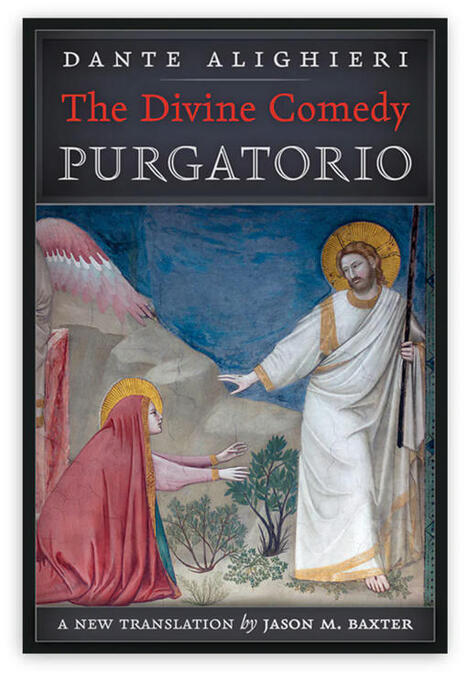







"The Trials of Translating Dante
By Jason M. Baxter
SATURDAY, MAY 17, 2025
Flannery O’Connor once said this about writing novels: “Writing a novel is a terrible experience, during which the hair often falls out and the teeth decay. I’m always irritated by people who imply that writing fiction is an escape from reality. It is a plunge into reality and it’s very shocking to the system.” I don’t know of a better description of what it’s felt like as I translated Dante’s Purgatorio, which was just released by Angelico Press.
Every morning, during the final six-month stage of this project, I followed the same routine: wake up, get coffee, and build up some psychic reserves of energy for the massively depleting experience. Then I went upstairs, spread out my Italian text and commentaries, and attempt – over and over again – to render in English Dante’s dense web of music and meaning. And, for this reason, for six months (maybe longer: ask my wife), I’ve been a zombie, looking with eyes that don’t see, listening with ears that don’t hear.
Why is translating Dante so psychically depleting? Everyone knows that his poem is an inspiring journey from a “dark wood” that soars up to the Beatific Vision and God Himself. But his language is always working in multiple dimensions. On the most basic and obvious level, Dante is a musician, who wrote in hendecallyables (eleven-syllable long lines) captured well, by iambic verse that’s not too stuffy. Dante also uses rhymes, of course, which Dorothy Sayers went all out to capture. In addition to the rhymes, however, Dante used all kind of dense word play, which he can do, in part, because he’s working with an inflected language: he can leave the root stable – like an Aristotelian substance – while varying the accidents of his inflections.
But then, he also loves to use, on occasion, a maddeningly difficult syntax, a gnarled, thorny wood of grammar often made even more complicated because of the learned circumlocutions he employs. In all fairness, he warned us about such maddeningly difficult syntax and entangled cosmological grammar:
Reader, I know you see that I am raising
my subject, and thus you will not marvel”
if now I use more art (più arte) to reinforce my poem.
(Purg. 9:70 72)
And what does this look like? Dante loves word play and word art. Those rhetorical tropes and schemes from classical rhetoric that we find repellent, he adores. For instance, at one point, when Dante is being interrogated by Beatrice, “when, by her eyes, my eyes were struck” (33:18), the figure Dante quite deliberately uses is anadiplosis (a rhetorical “doubling back”). A modern translation, to make this line feel more natural for us, kills the rhetorical scheme by translating it: “when her piercing eyes met mine.”
Elsewhere, Dante uses chiasmus, an X-like pattern that sets one word on one side of the scale and then balances it out by putting a variant of it on the other side. For instance, at one point, Virgil has intuited that the pilgrim had within him more questions, and then generously proceeds to encourage him to speak forth those hidden doubts. Dante puts it this way: he “by speaking made me bold to speak.” (Purg. 18:7–9). That chiasmus becomes this in one recent translation: “that true father. . ./ spoke and gave me courage to speak out.”
But what is extraordinary is that Dante has the inverse tendency as well. After passing through the “refining fire” that cleanses the distorted love of the lustful, for instance, Dante, Virgil, and Statius have to pause to wait out the night, resting on the steps of a steep stairwell that goes right up the mountain:
And just like goats in tranquil rumination,
who had been rowdy, capricious among
the hills before they’d found repast,
but now in shade are quiet while the sun is hot,
now guarded by the shepherd, who leans upon
his staff and stands to watch their rest;
or like the watchman who sleeps outdoors
and spends the night beside a somnolent herd
and watches lest a beast should scatter them;
just so were we, all three together. And I
was like the goat: and they, the shepherds.
Flanked by walls of lofty rock on either side.
There, little of the outside world could be seen,
except a tiny patch where I could see the stars,
much brighter and larger than is their usual habit.
While ruminating on them and marveling at them,
I was overcome by sleep, the sleep that often
knows the news before it even happens. (27:76–95)
This passage is extraordinary. Not only does it introduce a beautiful, prophetic dream, but uses concrete, bodily metaphor to describe what is, for us, merely an intellectual act. Dante “ruminates” (ruminando) on the beauty of the stars, feeds on them, tastes them, and draws their nourishment into his being by means of “marveling” at them, just as sheep and goats crop, chew, swallow, and digest grass. In other words, Dante here feeds on “the fire of love,” tastes it, chews it, ruminates on it, to absorb the nutritive power of beauty into his being.
This use of concrete, embodied metaphors for intellectual acts is something I have labored to bring out in this translation. Too often, even well-loved, best-selling translations of the Comedy, made by eminent scholars, have inadvertently killed these metaphors and thereby turned Dante’s poetry into something disembodied: too much in the head and too little rooted in the nerves and heartbeat.
One admired translation renders the passage I cited above by replacing the unusual and arresting metaphor of “ruminating” by means of “marveling” with this: “Amidst such sights and thoughts / I was seized by sleep.” At another point, the pilgrim tells his master that the answers he has received are so good that they create within him more questions: “Your words. . .have helped me to dis-cover love, / but this has made me pregnant with more doubts!” (Purg. 18.40-42). An eminent translator has rendered that line: “But that has left me even more perplexed.”
What was in the body – the “womb” of Dante’s mind was “pregnant” with doubts – turns into an intellectual phenomenon, all in the head (“perplexed”). On another occasion, when Dante is speaking with Marco Lombardo, who is disgusted by the world’s greed, the old cavalier experiences a visceral, bodily reaction upon merely hearing Dante’s question:
Deep sighs emerged, squeezed out by sorrow,
into an “Ohh!” then said: “Brother, the world
is blind. It’s clear you’ve come from it.”
(Purg. 16:64–66)
This somatic utterance is rendered by one modern translator: “He heaved a heavy sigh, with grief wrung to a groan.” Dante’s onomatopoeic, bodily grunt of pained exclamation turns into an objective description.
In another place, Dante says that what we could call our “curiosity” is sometimes not content until in confronts the truth eye to eye:
This put into my will a burning eagerness
to contemplate the one who spoke to me,
a will that cannot rest until it’s face-to-face.
(Purg. 17:49–51)
A respected translator puts it this way: “a will that cannot rest short of its goal.”
When Dante answers Guido del Duca obliquely, about where he’s from, the puzzled soul replies:
“If I have sunk my teeth (accarno) into your meaning
with my intellect,” the one I heard at first
replied to me, “you’re talking of the Arno.”
(Purg. 14:22–24)
The shocking word – accarno – was simply too perfect in Italian: it makes the whole argument in two words, by means of rhyming with the feral, brutal, savage “Arno.” An admired translator renders it this way: “If my wit has truly grasped your meaning.”
And finally, Dante says that, when they arrived within the unfamiliar landscape of purgatory, they “looked about confused, like someone tasting something new” (2:53-54), which a professional translator has put this way: “as though encountering new things.”
I could list at least two dozen more: Dante doesn’t “get answers,” he harvests truth or plucks good fruit from words. Meanwhile, because a particularly beautiful song makes him “g[i]ve birth” inside his heart to a mixture of joy and sorrow (23:12: as opposed to “[bring] … delight”); his conscience “bites” and he struggles to “disentangle” himself from the net of error.
As one Italian scholar matter-of-factly puts it: “Dante’s usual practice is to use a concrete verb in order to express moral or psychological conditions.” The point here is not to put down other translators, who are as scholars, in many ways, my betters (I didn’t cite the examples above: don’t look them up!); rather, my point is that I want to help my readers feel how rooted Dante’s poetry is in the humble experience of the body.
In sum, Dante wants a lofty, classical syntax (see 22:127–29), but he also wants a poetry that is embedded in the small, the lowly, the humble. For this reason, his poetry is like some Bach fugue, in which the chords in the right hand are ascending while those in the left hand are descending. Or maybe even better, what you would get if you mixed the Roman epic poet Statius and the Franciscan poet Jacopone da Todi.
In any case, this is the glory of Dante. It’s also why translators find it so hard, and also why I lost so much hair and so many teeth.
Jason M. Baxter
Jason M. Baxter is a college professor..."
https://www.thecatholicthing.org/2025/05/17/the-trials-of-translating-dante/
#metaglossia_mundus