Your new post is loading...

|
Scooped by
Roland Schegg
April 16, 1:58 AM
|
Die Restaurant-Branche steht mitten in einer Transformation, die in ihrer Tiefe und Geschwindigkeit historisch ist. Was jahrzehntelang als relativ stabiles Geschäftsmodell galt – ein physischer Ort, an dem Menschen essen, trinken und soziale Erfahrungen teilen – wird durch Technologie, neue Ernährungslogiken und veränderte Konsumentenerwartungen fundamental infrage gestellt. Eine aktuelle Analyse von McKinsey zeichnet das Bild einer Branche, die sich nicht schrittweise, sondern sprunghaft transformiert. Automatisierung, künstliche Intelligenz und datengetriebene Geschäftsmodelle verändern nicht nur Abläufe, sondern das Wesen des Restaurants selbst.
|
|
Scooped by
Roland Schegg
April 13, 11:34 AM
|
Artificial intelligence (AI)-powered commercial operating system Lighthouse has launched The Hotels Network app, offering direct booking for hotels inside ChatGPT.
The app is powered by Lighthouse’s Connect AI engine, open to all hotels including chains, groups and independent properties. Lighthouse acquired The Hotels Network last April for an undisclosed sum.
"AI is the biggest shift in how travelers plan their trips and discover hotels since Google," said Juanjo Rodriguez, head of direct booking at Lighthouse, adding that online travel agencies (OTAs) have already made the leap to AI discovery.
Launched last June, Lighthouse’s Connect AI is built on model context protocol, which other industry players such as Mirai have identified as a connector that will help hotels compete in the AI era.
|
|
Scooped by
Roland Schegg
March 27, 2:11 AM
|
On 16 March 2026, the European Commission webinar ‘Stay green, shine on the market: how the EU Ecolabel brings environmental excellence to your tourist accommodation’ dived deep into what the EU Ecolabel offers for the sector.
The timing could not be better: according to Eurostat, the number of overnight stays in the EU in 2025 came to 3.1 billion, a 2 % increase from 2024, indicating the push for greener accommodation is not simply a trend, it will have a tangible and positive impact.
|
|
Scooped by
Roland Schegg
February 26, 5:33 AM
|
Wie wird man von KI-Systemen gefunden? Seit ChatGPT online ist, beschäftige ich mich intensiv mit genau dieser Frage. Wer jetzt eine einfache Checkliste für den sofortigen Erfolg erwartet, liest am besten gar nicht weiter. Es gibt klare Hebel für eure Sichtbarkeit. Aber ihr könnt euch nicht mit ein paar losen Aktionen zur perfekten Antwort auf alle Fragen machen. Das erfordert Struktur, neue Strategien und Zeit!
|
|
Scooped by
Roland Schegg
February 23, 5:29 AM
|
Leisure travel planning in 2025 appears less like a traditional sales funnel and more like a web of channels and pathways.
In this evolving booking environment, travel marketers face both tactical challenges and strategic opportunities. Marketing effectiveness now depends on aligning inspiration, relevance, and conversion across multiple platforms.
A new research report from Skift and Amazon Ads reveals key indicators signaling a significant mindset shift among U.S. travelers. It examines in depth how travel marketers and advertisers can capitalize on opportunities in the evolving marketplace.
|
|
Scooped by
Roland Schegg
February 10, 10:34 AM
|
Laut einer Studie des unabhängigen Marktforschungsinstituts WALR, im Auftrag der Simon-Kucher-Unternehmensberatung, wird der Reisemarkt zunehmend von der Gruppe der 14- bis 31-Jährigen dominiert. Rund die Hälfte der Gen Z und der Millennials hat 2025 mindestens zwei Reisen über fünf Tage unternommen. Mehr als 50 Prozent der Befragten geben an, ihr Reisebudget 2026 erhöhen zu wollen.
|
|
Scooped by
Roland Schegg
January 16, 3:22 AM
|
Now firmly in the back half of the 2020s, one megatrend that we’re all aware of is how the experience economy has caused a mushrooming of luxury hospitality. There are now innumerable brands in this space, so much so that to wrap our heads around it we’re niching luxury into traditional, experiential, uber, ultra, wellness and other modifiers.
|
|
Scooped by
Roland Schegg
January 8, 9:01 AM
|
"Mobilität als touristisches Schlüssel-Handlungsfeld
Der Tourismus steht beim Thema Mobilität unter Druck: Rund 60-80 % seiner Emissionen entstehen durch Verkehr – An- und Abreise machen den Löwenanteil aus. In Österreich reisen noch immer 78 % der Gäste mit dem Auto an – und dieser Pkw-Individualverkehr hat negative Auswirkungen auf die Tourismusakzeptanz. Auf der anderen Seite sind bereits knapp 50% der Wiener und Berliner Haushalte autofrei. Gleichzeitig investieren laut dem aktuellen Trendreport von "Point&" nur 5 % der europäischen Mobilitätsinnovationen in touristische Anwendungen."
|
|
Scooped by
Roland Schegg
January 5, 10:39 AM
|
S’ils répondent à une vraie tendance, les bains thermaux doivent trouver le bon modèle d’affaires, définir leur positionnement et soigner les collaborations pour rester rentables face à une concurrence croissante. Prise de température en Valais.
|
|
Scooped by
Roland Schegg
December 3, 2025 3:27 AM
|
Travelers heading into 2026 are shifting away from conventional holidays and embracing more personal, purposeful, and experience-rich journeys. According to the report from Skyscanner that underpins the article, this means trips shaped not just by destinations, but by what travellers want to feel and discover: local beauty rituals, everyday food culture, high-altitude escapes, and more meaningful connections with places. The article argues that travel in 2026 will be defined by authenticity, personal rhythm, and a desire for deeper experiences rather than surface-level tourism. Overall, travel is becoming more intentional, grounded, and reflective of individual values and desires.
|
|
Scooped by
Roland Schegg
November 15, 2025 1:21 AM
|
Seit jeher prägen Archetypen das Verhalten von Reisenden. Der Psychologe Carl Gustav Jung beschrieb sie als universelle Muster, die unser Handeln beeinflussen. Für Hotels bedeutsam: Wer erkennt, welchen Archetyp ein Gast verkörpert, versteht dessen Bedürfnisse besser, sagt Valentina Clergue, EHL, PhD in Konsumverhalten.
Zehn Reisetypen im Überblick
1. Der Kulturmensch
Sucht authentische Begegnungen, regionale Küche und geschichtsträchtige Orte. Laut Skift «European Travel Insights 2025» zählen rund 38 Prozent der Reisenden zu diesem Typus.
2. Der Abenteurer
Erlebt gerne Neues – ob Wüste oder Bergwelt. Laut Skift umfasst dieses Segment rund 32 Prozent. Viele suchen Natur und Abstand zum Massentourismus. Auch der Explorertyp fällt darunter, mit Fokus auf Perspektivenwechsel und kalkulierte Risiken.
3. Der Luxusreisende
Erwartet Komfort, Exklusivität und persönliche Betreuung. Laut Skift gehört rund 17 Prozent der globalen Reisenden zu dieser Gruppe. Oft wird Luxus mit Ruhe und Nachhaltigkeit verbunden.
4. Der Wellnessgast
Stellt mentale und körperliche Erholung ins Zentrum. Der Markt wächst: Das Global Wellness Institute prognostiziert bis 2029 ein Volumen von 1,1 Billionen US-Dollar.
5. Der Umweltbewusste
Bevorzugt transparente Nachhaltigkeit und glaubwürdige Konzepte. Gemäss Skift sind es rund 17 Prozent. EHL-Forschungen unterscheiden sieben Untergruppen – von regionalitätsorientierten bis zu Green Enthusiasts.
|
|
Scooped by
Roland Schegg
October 30, 2025 1:29 PM
|
Est-ce que le tourisme est vraiment le meilleur moyen de répondre aux besoins des parties prenantes d’un territoire ou d’une destination ?
Pas forcément… et c’est justement ce qui rend la question si intéressante.
Dans cet épisode avec Sarah Balet, experte en durabilité, nous interrogeons la capacité du tourisme régénératif à répondre aux besoins uniques de chaque territoire. Un sujet vaste, essentiel, qui touche au cœur de nos choix de société. Au-delà des modèles standardisés, nous parlons de transition écologique et sociale, de responsabilité partagée et d’un leadership régénératif qui ouvre des chemins porteurs de sens. Une conversation essentielle pour imaginer le tourisme de demain.
|
|
Scooped by
Roland Schegg
October 29, 2025 10:09 AM
|
Travel and hospitality is a huge industry, estimated at $955.9 billion in 2025, according to our research. It is also one that’s changing rapidly, with online travel bookings projected to account for 75% of all revenue by 2029. That’s why we’ve put together industry insights in our e-book, Decoding Online Shopping: Travel and Hospitality Consumer Trends for 2025.
What is clear from our research is that Gen Z is quickly reshaping the online travel journey. They are doing things differently than previous generations, from where they find inspiration to why they abandon a cart and how they view personalization. And that has big implications for travel brands.
|
|
|
Scooped by
Roland Schegg
April 13, 11:42 AM
|
The future of travel may be shaped less by technology itself and more by who controls trust, data and access to the traveler.
A report from Phocuswright and ITB Berlin highlights predictions made during the jointly hosted Leadership Exchange, which took place on March 3, 2026 at ITB Berlin. During interactive working groups, travel leaders opined on the structural shifts that will define travel over the next two decades.
The findings are organized around four central questions: who owns trust in 2046, where value sits in an artificial intelligence (AI)-native industry, whether travel is a right or a privilege and whether the travel market is set to consolidate or fragment.
Across these themes, a consistent pattern emerges: AI is accelerating efficiency across the travel ecosystem, but redistributing power. Control is shifting away from traditional intermediaries and toward those that own data, operate intelligent agents or maintain direct relationships with travelers.
|
|
Scooped by
Roland Schegg
April 12, 6:25 AM
|
Kulinarik gehört zum Urlaub dazu. Nicht nur, weil man auch im Urlaub isst, sondern weil Kulinarik ein essenzieller Teil des Urlaubserlebnisses ist und für immer mehr Gäste sogar ein Grund, sich für die jeweilige Destination zu entscheiden.
Wie stark ausgeprägt ist dieser Effekt? Das und mehr verraten zwei neue Studien der Österreich Werbung. Sie betrachten den Markt USA sowie die wichtigen europäischen Herkunftsmärkte Deutschland, Niederlande, Schweiz und Belgien.
Nach Europa wegen Kulinarik
Ein spannendes Bild zeichnet sich in den USA. Hier spielt Kulinarik für Europa-Reisende eine zentrale Rolle. Genauer: Für 82 Prozent der Befragten hat sie eine Bedeutung bei der Wahl des Reiseziels, für mehr als ein Drittel ist sie sogar entscheidend bei der Destinationswahl.
In Europa spielt Kulinarik in der Planungsphase ebenfalls eine Rolle. Je nach Markt zwischen 44 Prozent und 58 Prozent der Befragten nennen Kulinarik als Faktor in der Reiseplanung. Aber nur eine vergleichsweise kleine Gruppe sagt, dass sie sich gezielt aufgrund des kulinarischen Angebots für ihr jeweiliges Reiseziel entscheidet. Kulinarik ist hier ein Faktor von vielen. Zumindest in Europa gilt also: Kulinarik ist in der Reiseplanung je nach Markt mal mehr, mal weniger wichtig – aber für die Destinationswahl ist sie selten ausschlaggebend.
|
|
Scooped by
Roland Schegg
March 4, 2:25 PM
|
A study by Google and Alvarez & Marsal forecasts that global travel demand will expand dramatically through 2050, with international trips potentially reaching 3.5 billion annually. Rising incomes, expanding middle classes, and demographic shifts will bring hundreds of millions of new travelers into the market. At the same time, the way people discover, plan, and book travel will change significantly as AI agents begin to mediate search and booking decisions. For hotels, the opportunity is substantial — but capturing that demand will depend increasingly on digital visibility, distribution strategy, and data readiness
|
|
Scooped by
Roland Schegg
February 26, 5:29 AM
|
Leider hört man es immer wieder: „Kurz vor der Urlaubssaison ist für viele Tierheime Hochsaison“ – darauf weisen Tierschutzorganisationen regelmäßig hin. Warum schieben Tierbesitzer:innen ihre Lieblinge vor dem Urlaub ab? Vermutlich vielfach aus der Annahme heraus, Reisen mit Hund sei kompliziert oder kaum möglich. Dabei zeigt die Sommerpotenzialstudie 2025 der Österreich Werbung und des NIT: Genau das Gegenteil ist der Fall. Reisen mit Hund liegen im Trend und eröffnen neue Perspektiven für Gäste wie für den Tourismus.
|
|
Scooped by
Roland Schegg
February 12, 2:38 AM
|
Trotz steigender Preise, geopolitischer Spannungen und wirtschaftlicher Unsicherheiten wächst der weltweite Tourismus weiter. Die neuesten Zahlen von UN Tourism zeigen eindrücklich: Internationale Reisen bleiben für Millionen Menschen kein Luxus, sondern ein fest verankerter Bestandteil moderner Lebens- und Wirtschaftssysteme. Wachstum ist die dominante Konstante – wenn auch mit regional unterschiedlichen Ausprägungen und zunehmenden Risiken. Hotel Inside beleuchtet die Hintergründe.
|
|
Scooped by
Roland Schegg
February 2, 4:20 AM
|
"Travel booking behavior is undergoing a meaningful shift as travelers increasingly prioritize emotional outcomes over specific destinations. New research from ALL Accor and Globetrender shows that a growing share of travelers want to search for trips based on how they want to feel, not where they want to go. This change challenges long-standing assumptions built into hotel distribution, content, and discovery systems. It also reframes the role of technology from directing choices to quietly enabling more meaningful experiences.
Key takeaways
Mood-driven discovery gains traction: One in four travelers now prefer searching by emotional state rather than destination, signaling a fundamental shift in how travel intent is formed and expressed.
Emotions become more specific: The research identifies eight distinct “vibes” shaping travel decisions, reflecting a move from generic experience-seeking to targeted emotional self-regulation through travel."
|
|
Scooped by
Roland Schegg
January 13, 3:26 AM
|
"The demand for wellness continues to grow with investors and operators keen to push the boundaries of what can be delivered in the space available. Enhancing facilities with considered, sustainable design is good business sense and correctly done can significantly improve revenue and return on investment.
Acoustic wellness and silent architecture
Spas are increasingly considering sound-absorbing architecture as part of the overall design to create calm spaces. Think soft organic forms, luxe furnishings, wall hangings and rugs natural soundscapes (like water). This was a trend identified by the Global Wellness Institute (GWI) and will be a growing consideration for properties in the coming years. As guests are looking for a quiet, cocooned experienced, elevated by luxury, sound design will be a priority. The GWI highlights the importance of reducing mechanical noise and implementing acoustic zoning to support deep relaxation and mental clarity. Effective acoustic design includes balancing overall sound levels, integrating soundproofing within treatment rooms, creating quiet zones in public areas, and using insulation to minimise sound transmission between spaces."
|
|
Scooped by
Roland Schegg
January 8, 1:32 AM
|
"With aviation still searching for real climate solutions, fewer luxury seats, fuller flights, and faster fleet upgrades have been proposed as ideas to help reduce emissions.
Airlines could immediately cut carbon emissions by as much as 50% by taking just three steps: eliminating premium seating, flying newer aircraft, and maximizing seat occupancy, according to a new study that analyzed more than 27 million flights.
Thinking in these terms is an important shift from reliance on sustainable aviation fuel, according to Stefan Gössling, professor of Tourism Research at Linnaeus University, who led the study.
SAF, which the aviation industry predicts could reduce emissions by up to 70%, only accounts for 0.8% of jet fuel. Projections are that there won't be enough for airlines to meet their 2050 net-zero goal."
|
|
Scooped by
Roland Schegg
December 4, 2025 6:48 AM
|
The pace of travel is accelerating in unexpected ways. Consumer expectations shift almost daily, new technologies scale quickly, and global events continue to reshape demand without warning. In this environment, travel leaders are expected to interpret emerging signals early and act with clarity and purpose.
At the same time, airlines, hospitality groups, and other travel brands now operate without a true off-season. Guest engagement, operations, and service delivery constantly evolve, and the organizations that succeed are the ones that anticipate change, experiment, and stay ahead of traveler needs.
|
|
Scooped by
Roland Schegg
November 20, 2025 3:59 AM
|
HRS hat seinen zweiten „State of Sustainability in Corporate Travel“-Report veröffentlicht. Die jährliche Studie untersucht, wie Unternehmen Nachhaltigkeit in ihren Geschäftsreiseprogrammen verankern und wie sich Hotelanbieter anpassen, um diesen Anforderungen gerecht zu werden. Die Ergebnisse wurden auf der Europe Conference der Global Business Travel Association in Hamburg vorgestellt.
Nachhaltigkeit bleibt Top-Priorität trotz wirtschaftlicher Turbulenzen
Der Bericht erscheint in einer Zeit, die von volatilen wirtschaftlichen Rahmenbedingungen, sich verändernden geopolitischen Prioritäten sowie Kosten- und Compliance-Druck geprägt ist. Ungeachtet dieser Turbulenzen belegt der Report, dass Nachhaltigkeit für fast 90 Prozent der Unternehmenskunden von HRS weiterhin eine der drei Top-Prioritäten darstellt.
Die UN hatten erst kürzlich festgestellt, dass die Staaten weiterhin „weit davon entfernt sind, die Ziele des Pariser Abkommens von 2015 zur Begrenzung der Erwärmung zu erreichen“.
|
|
Scooped by
Roland Schegg
November 5, 2025 10:20 PM
|
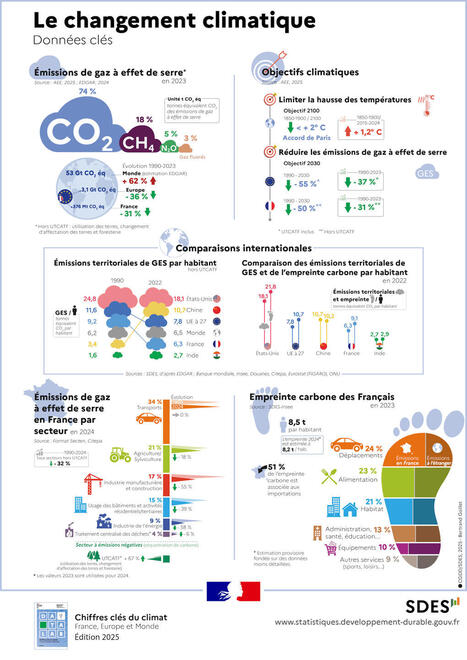
"L’équilibre climatique est perturbé essentiellement par les émissions de gaz à effet de serre (voir glossaire). Les conclusions de la communauté scientifique, synthétisées par le Giec (voir glossaire), font désormais consensus sur le rôle des activités humaines dans ce changement. De nombreux indicateurs, tels que l’augmentation des températures à la surface de la Terre ou l’élévation du niveau moyen des océans, mettent en évidence un changement du climat depuis le siècle dernier. Une sélection d’observations de ce changement et de ses conséquences sont présentées, à l’échelle du monde puis de la France. Cette partie présente également des projections des conséquences du changement climatique selon différents scénarios."
|
|
Scooped by
Roland Schegg
October 30, 2025 5:16 AM
|
Drei globale Studien – von Booking.com, Trip.com & Google sowie Hilton – zeigen ein klares Bild des Reisejahres 2026: Reisen wird persönlicher, bewusster und technischer. Künstliche Intelligenz wird zum Reisebegleiter, Sinnsuche ersetzt Konsumtourismus, und Stille wird zum neuen Luxus. Die Branche steht an der Schwelle zu einer Ära, in der Technologie und Achtsamkeit Hand in Hand gehen. Hotel Inside fasst die wichtigsten Erkenntnisse, Thesen und Trends zusammen:
|


 Scoop.it!







![[PODCAST] Tourisme régénératif : une vraie réponse pour nos territoires ? | Innovation and trends in tourism | Scoop.it](https://img.scoop.it/J2L4aCLOA1GO0-WrxOU32jl72eJkfbmt4t8yenImKBVvK0kTmF0xjctABnaLJIm9)