This thoroughly revised guide offers the current and next generation of supply chain professionals a clear explanation of the fundamentals of planning and MRP systems in today’s volatile and complex supply chains. Long considered the industry standard, Orlicky's Material Requirements Planning is an indispensable tool for manufacturing practitioners and candidates preparing for certification exams including CPIM, CSCP, DDPP and MRPFP.
TLS = Open TOC + Good Lean + Good Six Sigma. Presentation by Philip Marris at the TOCICO annual congress in Frankfurt in June 2013. It is argued that TLS ...
Client testimonial by Circor Aerospace & Defense Managing Director Frédéric Grehal, Raphael Ensinger and Michael Benmoussa. [...] The project durations were reduced, and the projects finished on time. The efficiency and throughput of the New Product Development also increased. Following the success of the pilot projects, they then rolled out the Critical Chain Way on their entire portfolio. ...
The following two-minute dialogue between Jeffrey Liker and British consultant John Seddon has caused a stir in the US, primarily for Seddon’s saying “…all this respect for people stuff is horseshit…” Note: For a video of the full 45-minute session from which it is excerpted, see Panel discussion – Lean Ísland 2012 (08). The third participant […]
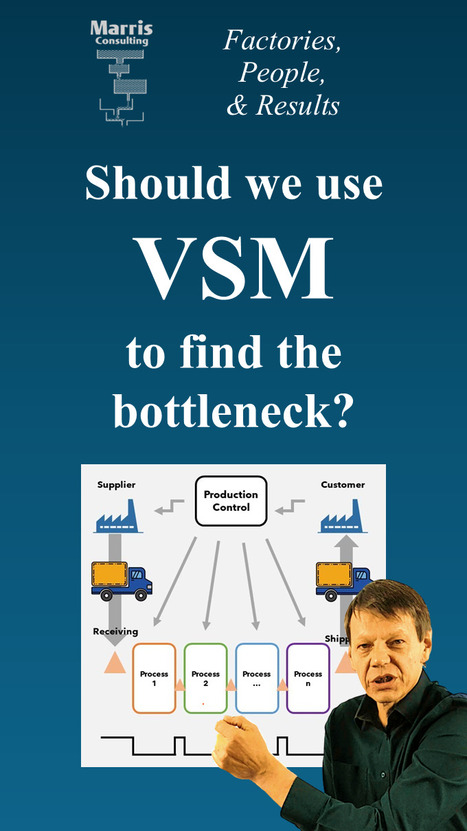
Why you should not use VSMs (Value Stream Mapping) to try and find the bottleneck in your factory. VSM is a powerful and widely used tool. It can be used to improve the speed and efficiency of the production of one product. But is is not the right tool to identify the bottleneck or capacity constraint in a production system. This short video explains why.
Bob Sproull and Bruce Nelson, both Systems Improvement Consultants lay out how they improve the profitability of organizations from all industry types.
Came across Bob Sproull and Bruce Nelson's book as Systems Improvement Consultants in 2010. They lay out how you too can improve the profitability of organizations of all types of industrial applications. -- I wasn't able to verify if it worked as advertised until I worked at Meggitt (an Aviation, Aerospace & Defense Firm) when I was the Senior Manufacturing Engineer (the only Mfg Engineer) for the Maintenance, Repair & Overhaul (MRO) Shop. -- We implemented and verified its applicability and value add when we used this methodology, along with Don Reinertsen's 2nd Generation Lean Six Sigma Product Flow Practices (another great Product & Process Improvement Book, that I highly recommend), and then we added in TRIZ a Systematic Innovation tools to make sure that we got all the systems, up the S-Curve of Performance, Functionality and at lower operating cost..." Bringing the Magic Together"...Got an annualized $8.16M in ROI for the shop...the MRO manager, Bobby Padilla, and Bernie Watson, the Factory GM, were astounded...It completely overturned the status quo POV of the Corporate Meggitt Continuous Improvement folks, where they considered what we did as a new BKM for Meggitt...Obviously, they had no idea that combining Lean Six Sigma methods could be improved.
Taking on an A3 can be daunting, and Eric Ethington is here to remind you that this is normal but preventable. He has five great steps for you that will make the process easier from the start to the first draft of your A3.
Book review of the book "The Goal" by Eliyahu Goldratt. Sold in over 10 million copies in over 30 languages. The story in a "business thriller" format of saving a factory in 90 days by using the Theory Of Constraints.
Marris Consulting has reached 600 videos and 750,000 views it’s YouTube channel. The videos are mostly about TOC + Lean + Six Sigma, the Theory Of Constraints, Critical Chain Project Management, and the Thinking Process. There are also many videos about Lean including a series with an ex-VP of Toyota Motor Manufacturing. Many tutorials. Dozens of conference recordings. Etc.
In this presentation Etienne Lecerf, Managing Consultant at Marris Consulting, explains how to apply proven delivery principles from Agile, Lean, and the Theory of Constraints to improve flow, reduce friction, and deliver more consistently — across projects, teams, and functions.
You will understand: - how to fix the orga. root causes leading to projects delays, - how to manage bottlenecks in a project portfolio, - how to scale Agile without heavyweight frameworks.
Many solutions proposed to improve operational performance are aimed at the manufacturing sector. The specific constraints of food and agribusiness companies are too often overlooked. In this webinar, Philip Marris shares his perspective on how to adapt traditional operational excellence to this sector.
The graphic edition of the international best seller "The Goal". Based on the business novel "The Goal" by Eliyahu M. Goldratt and Jeff Cox, this book is a graphic novel. It is an original and pertinent introduction to the Theory of Constraints. The story is basically unchanged: same story line, sames messages, sames characters, etc. The original text version has now sold over 11 million copies in 32 languages which makes it the N°1 bestseller if you accept it as a management textbook.
This is my second post on the excellent Fendt Cabin Plant in Asbach-Bäumenheim, which impressed me a lot with their efficiency and general organization.In my... [...] As always, I tried to estimate the percentage of value-added time (i.e., what percent of the time the worker at the assembly line adds value, and what percentage of the time was wasted with walking, waiting, searching, transporting, and so on). The results positively surprised me. According to my estimation, their total value-adding percentage was 56%. While this would put the plant in the middle of all my observations, they had this for a takt time of 9 minutes (540 seconds). The longer the takt time, the more difficult it is to become efficient, and for this takt time, their efficiency sticks out quite a bit. They were also more efficient than their main plant for the tractor assembly in Marktoberdorf. Below is the plot of percentage value-adding time versus takt time, with the Fendt plant in Asbach-Bäumenheim highlighted.
There is so much information on Demand Driven Materials Requirements Planning (DDMRP) out there in the public domain, it is difficult for somebody to know where to start their research. So, I have created a document to assist you to take the first steps on your Demand Driven journey. Download document from this link. https://lnkd.in/dHcpg7zx
If you work in manufacturing, sooner or later you will find someone who claims that lean manufacturing is all about Zero Defects. Or Zero Inventory. Or Zero Lead Time. Or Zero Whatever. This is bollocks!Zero Defects was a management fad from the 1960s that pops up regularly every now and then again. In this post we will look at what Zeros there really are in lean manufacturing – if any.
Practical demonstration of how the Theory of Constraints (TOC) can help you to improve your business. Three identical bottles of water flowing at different rates. The challenge is to maximize the flow through your bottleneck and to do it in a spirit of calmness. The Oiled Wheels approach gives you both simultaneously.
This is the original video by Arrie van Niekerk R.I.P. There are unfortunately now lots of illegal copies of this great video.
"The principal advantage of this approach is that the developers themselves have a close relation with the clients. This results in high motivation, flexibility and low overhead. It is a proven technique and has been in use on software projects for at least 10 years." i.e. since 1973! This is 20 years before Scrum, 13 years before the 'New New Product Development Game' HBR article and is 52 years ago.
Operational excellence in the agri-food industry. A lot of the solutions proposed to improve operational excellence are aimed at the manufacturing industry. The specific constraints of the food industry are too often ignored. Philip Marris presents how to adapt classical Operational Excellence to this industry, perspective supported by numerous missions in this industry over the past 20 years. ...
This is about the motivation for the chart and its math. We shouldn’t ask manufacturing professionals to apply a technical tool without explaining its purpose and its theory.
However, without doing either, the SPC literature promotes the use of the chart to detect changes in the fluctuations of measured variables, along with charts for changes in their means. The books provide recipes for using these charts, but no explanation.
To use in-process measurements for quality control 100 years ago, Walter Shewhart proposed the Xˉ−σXˉ−σ charts. It entailed arranging workpieces in rational subgroups, summarizing measurements by subgroup into means and standard deviations, charting both, and checking new values against control limits. When Harold Dodge tried to implement the Xˉ−σXˉ−σ charts at Western Electric, the engineers balked at calculating sample standard deviations with paper, pencils, and slide rules. To gain acceptance, Dodge let them use sample ranges and plot them in RR charts instead. While easier to understand and to use daily, sample ranges are mathematically more complex and more sensitive to extreme values than standard deviations. ...
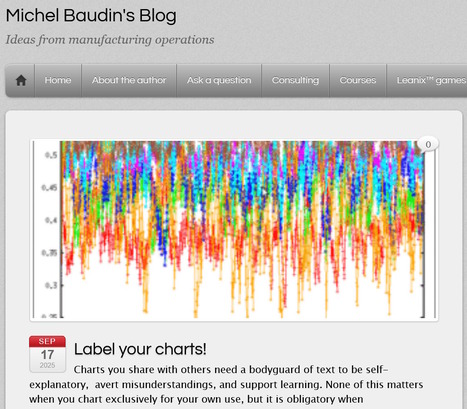
Charts you share with others need a bodyguard of text to be self-explanatory, to avert misunderstandings, and to support learning. None of this matters when you chart exclusively for your own use, but it is obligatory when communicating with a team or making a case to management.
Generating an informative, actionable chart can take hours; documenting and labeling it should take minutes, yet we encounter charts with missing or unclear labels in business documents, published articles, and even textbooks.
Depuis 20 ans, Marris Consulting applique la Théorie des Contraintes, le Lean et le bon sens pour améliorer les performances des entreprises. En 2020, Marris Consulting à célébré ses 15 ans d'existence.
A cette occasion, Philip Marris, son fondateur, à partagé 15 cas, parmi les plus de 350 cas de sa carrière, d'amélioration des performances dans des entreprises de secteurs industriels très variés.
The "2 for 1" rule to reduce Work In Progress and accelerate flow. A webinar hosted by Philip Marris, the founder and CEO of Marris Consulting. [...] The "2 for 1" rule is very simple: a new unit (such as a production order, an order, or a project) can only be launched into the system if two units have been previously released (finished).
Stop starting and start finishing!
The emphasis is on completing activities already underway before starting new work. [...]
About the speaker: Philip Marris Philip started his Lean and Theory Of Constraints journey in 1984. He worked with Eliyahu Goldratt, the founder of TOC and author of the worldwide bestseller “The Goal”. He is also a recognized Lean expert and combines Lean (Manufacturing/Engineering/Management) with TOC. ...
This is the first of several posts about my personal history with manufacturing quality. While I have never had the word “quality” in my job title, and it has never been my exclusive focus, I can’t name a project I have worked on in the past 44 years that didn’t have a quality dimension.
Controversial views about quality have earned me rebukes from quality professionals, who gave me reading lists. To see the error of my ways, all I had to do was study the complete works of Walter Shewhart, W. Edwards Deming, and Donald J. Wheeler. It never occurred to them that I might be familiar with these authors.
There are also other authors on quality that my contradictors ignored or dismissed, like J.M. Juran, Kaoru Ishikawa, or Douglas Montgomery. I didn’t see them as any less worthy of consideration than the ones they were adamant about. ...
Philip Marris's insight:
Michel Baudin's articles are always thought provoking. And you always learn a lot.
Via this blog, I share insights of particular interest to CxOs, other senior business managers, and development folks more generally – into the always exciting, often frustrating and sometimes downright opaque world of knowledge work, i.e. software and product development.
I am often asked to tell my story of how I increased the performance of a 1,000 person factory in only 15 minutes. The factory was located in the middle of Mexico. It produced alternators for the automobile industry. It was a major supplier not only of the USA but also the rest of the continent. ...
To get content containing either thought or leadership enter:
To get content containing both thought and leadership enter:
To get content containing the expression thought leadership enter:
You can enter several keywords and you can refine them whenever you want. Our suggestion engine uses more signals but entering a few keywords here will rapidly give you great content to curate.


 Your new post is loading...

















Recommended: An updated classic that integrates DDMRP, TOC, Lean and Six Sigma.