Via this blog, I share insights of particular interest to CxOs, other senior business managers, and development folks more generally – into the always exciting, often frustrating and sometimes downright opaque world of knowledge work, i.e. software and product development.
I am often asked to tell my story of how I increased the performance of a 1,000 person factory in only 15 minutes. The factory was located in the middle of Mexico. It produced alternators for the automobile industry. It was a major supplier not only of the USA but also the rest of the continent. ...
Wanting to get to grips with the particulars around the Theory of Constraints? Our handy guide covers the 5 focusing steps.
Key Points :
The TOC is one of the more popular process methodologies.
There are 5 focusing steps to make this process work.
The next time you are on the hunt for a process improvement methodology that looks explicitly for bottlenecks, the answer is the Theory of Constraints. This system enables organizations to achieve both their financial goals and their consumer goals by keeping their entire supply chain moving. The Theory of Constraints is often associated with the analogy “no chain is stronger than its weakest link.”
To reduce rapidly and simply the level of WIP (Work In Progress) and thereby reduce production lead times the "2 for 1 rule" is very pertinent. An organisation (for instance a factory) only allows itself to launch one new item into production after it has finished 2 items.
There are several ways of doing this; one of the most common is to control the number of Work Orders. A new Work Order can only be launched if 2 Work Orders have been completed (and closed).
Philip Marris summarizes in 4 minutes the Drum-Buffer-Rope production scheduling technique. "DBR" consists in launching the Work Orders according to the capacity of the bottleneck (the "Drum"), but also in such a way so as to ensure the parts arrive in advance in a queue feeding the bottleneck (the "Rope"). Such a controlled queue (the "Buffer") protects the bottleneck from upstream variability to make sure that it is never starved of work..
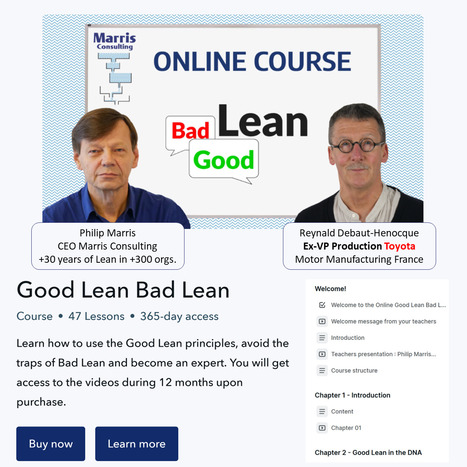
“Good Lean” is presented by Reynald Debaut-Henocque, ex-VP Production of Toyota Motor Manufacturing France. 20 years with Toyota. Vast and recent (2000 to 2021) experience of doing good Lean outside of Japan.
“Bad Lean” is presented by Philip Marris, CEO of Marris Consulting, +30 years of applying Lean worldwide in +300 organisations in all kinds of industries.
This course is designed to provide you with the tools and strategies needed to achieve successful “Good Lean” outcomes and avoid the traps of Bad Lean.
"Today’s manufacturing systems have become more automated, data-driven, and sophisticated than ever before. Visit any modern shop floor and you’ll find a plethora of IT systems, HMIs, PLC data streams, machine controllers, engineering support, and other digital initiatives, all vying to improve manufacturing quality and efficiencies.
Philip Marris, a leading authority in the fields of Lean / Toyota Way and the Theory of Constraints (TOC) describes how and why he combines these 2 approaches. With decades of experience and a track record of success, Philip shares invaluable insights into the powerful synergy between the Toyota Way and TOC methodologies. He talks not only about production, but also [...] Critical Chain Project Management and the Logical Thinking Process or Toyota's long term development of partnerships with suppliers. [...] He illustrates how TOC's laser focus on identifying and eliminating constraints complements Lean's waste reduction efforts, resulting in accelerated performance improvements and sustainable growth.
Welcome! You are invited to join a meeting: TOCPA - Celebrating Eli's life: join a get-together of the TOC oldies . After registering, you will receive a confirmation email about joining the meeting.
31 March this year Eli Goldratt would have turned 79 going on to 80. At TOCPA, we are dedicating this year to celebrating Eli’s life. We have developed a special framework of the year-long online multi-session 53rd TOCPA Conference. Within this framework we will conduct webinars, master-classes, get-togethers, Q&A meetings, discussions of Eli’s books and articles, presentations of new TOC developments and publications. The attendance is free of charge, based on registration. We are opening the 53rd online year-long Conference on the day of Eli’s birthday, 31 March 2026 at 18:00 Israeli time, with a get-together of TOC oldies to speak about their time with Eli, and Eli’s impact on their lives. It is “Eli and I” gathering. We invite you to join our gathering, and celebrate Eli’s life with us.
The VAT factory types are the Theory Of Constraints’ powerful classification system of the different kinds of industrial manufacturing systems, they determine how plants should be analyzed and how they should be managed. The VAT system was developed in the 1980s at the time of Creative Output when Eliyahu Goldratt and his team were selling a scheduling software system called OPT based on differentiating between bottlenecks and non-bottlenecks.
The letters represent visually the Bill Of Materials but where the flow is from bottom to top (the opposite of most representations of flow). The raw materials and purchased components are at the bottom and the Finished Goods are at the top. Products flow upwards. The V-Plant has very few ...
The graphic edition of the international best seller "The Goal". Based on the business novel "The Goal" by Eliyahu M. Goldratt and Jeff Cox, this book is a graphic novel. It is an original and pertinent introduction to the Theory of Constraints. The story is basically unchanged: same story line, sames messages, sames characters, etc. The original text version has now sold over 11 million copies in 32 languages which makes it the N°1 bestseller if you accept it as a management textbook.
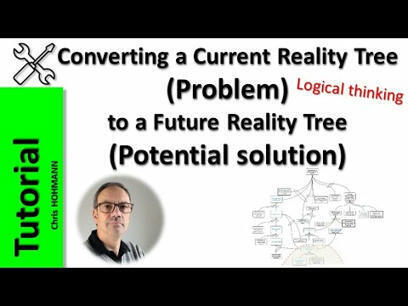
In this series of posts I check if the Logical Thinking Process and its tools can help to “navigate the storm”, created by unpredictable and/or irrational decisions of a competitor or adversary. After the Goal Tree and the Current Reality Tree, I’ll challenge the Future Reality Tree. Spoiler alert: it may be the most useful of the toolkit.
Efrat Goldratt-Ashlag, author and daughter of Eliyahu M. Goldratt the author of the global bestseller THE GOAL is interviewed on the occasion of the launch of the French edition of her bestselling book "Goldratt's Rules of Flow" / "The principles of THE GOAL applied to projects." In this conversation [...] the story behind the writing of the book, [...] identifying common obstacles to flow in projects, such as multitasking, lack of full-kit readiness, and local versus global optimization.
Efrat shares an example from a hospital environment and the management of the Operating Room as an example [...] a lively Q&A session with participants from around the world.
Whether you're a seasoned TOC practitioner or new to the approach, this session offers valuable insights, practical tips, and inspiration to rethink the way your organization manages projects.
There is a phase in the maturation of a manufacturing process where one-piece flow is the key to improving quality. Once the defective rate is low enough, one-piece flow reduces it by up to a factor of 10. The magnitude of the improvement often surprises managers. The cause-and-effect relationship is not obvious, and the literature on manufacturing quality is mute on the subject. We explore it here.
TLS = Open TOC + Good Lean + Good Six Sigma. Presentation by Philip Marris at the TOCICO annual congress in Frankfurt in June 2013. It is argued that TLS ...
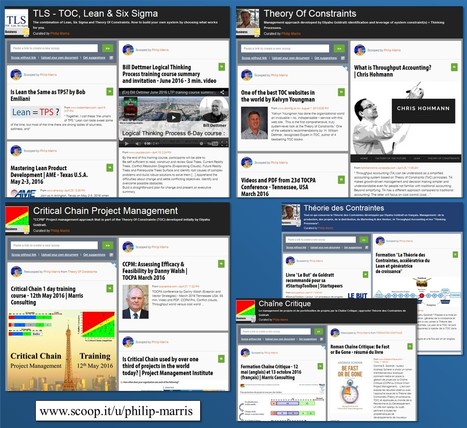
Philip Marris curates 5 different permanent news websites: 1) (This one) TLS - TOC + Lean + Six Sigma 2) Theory of Constraints 3) Critical Chain Project Management 4) Théorie des Contraintes (in French) 5) Chaîne Critique (in French)
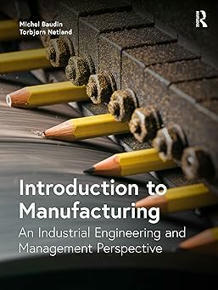
This Introduction to Manufacturing focuses students on the issues that matter to practicing industrial engineers and managers. It offers a systems perspective on designing, managing, and improving manufacturing operations. On each topic, it covers the key issues, with pointers on where to dig deeper.
Many projects fail due to unrealistic promises, multitasking overload, and poor workflow management. [...] To address these issues, we propose a three-level control system. - Portfolio management ensures the system is not overwhelmed with too many projects. - Critical Chain Project Management eliminates excessive safety margins by using a shared buffer, improving predictability. - Execution management uses Kanban and Agile techniques for efficiency. ...
TOC in Production Online Course extract: The 5 Focusing Steps. A Marris Consulting online service.
This course, that we launched one year ago, has been a great success. We continue to add to it continuously by enriching the appendices with more and more recent examples drawn from our unique experience of implementing the Theory Of Constraints in over 350 organisations throughout the world.
In the latest issue of The Management Brief, Jeffrey Liker urges the lean community to move beyond tools and templates—because lean is a way of thinking. Lasting transformation requires integrating lean’s technical, social, and scientific dimensions while developing people who can learn their way forward.
Philip Marris delivers a "Crash Course on the Theory of Constraints". The manufacturing analogy makes it easier for beginners to grasp the notions of bottleneck, buffer protection, Throughput... before transposing it to Project Management.
To get content containing either thought or leadership enter:
To get content containing both thought and leadership enter:
To get content containing the expression thought leadership enter:
You can enter several keywords and you can refine them whenever you want. Our suggestion engine uses more signals but entering a few keywords here will rapidly give you great content to curate.


 Your new post is loading...


![[Recommended] 40 Years of Lean Observation: a Conversation with Art Byrne | Lean Enterprise Institue Podcast | TLS - TOC, Lean & Six Sigma | Scoop.it](https://img.scoop.it/MHmQ9R8aUifCHvFBIcNgZzl72eJkfbmt4t8yenImKBVvK0kTmF0xjctABnaLJIm9)