Drum -EWAB Flow Technology automatically balances the flow around the "drum […] Time Buffer - […]in front of one or several machines that is the current constraint […] but only to a degree that is set by the "length of the rope". […]
Project management
EWAB Project Managers are applying Critical Chain Project Management (CCPM) rather than the Critical Path Method. […]
Throughput accounting
Lean manufacturing thinking is necessary but it is not sufficient. […]
Lean or Anorexic
One piece flow […] Cell manufacturing has many draw backs. […] The ever-changing variation of the Takt time […] Extremely flexible working patterns is also required to achieve the goal. […] In both these cases it is not possible to introduce continuous flexible flow […] Misunderstandings and pre-assumptions may lead to anorexia […] The Quality aspect of Lean Manufacturing have its roots in the 1940´s and 50´s and were originally developed by E.Deming and J.Juran […]
A 17 page/slide transcription of a Business901 podcast Joe Dager of Business901 had with Bob Sproull, author of the Ultimate Improvement Cycle in 2011 (and more recently author of the Epiphanized TLS bestseller with Bruce Nelson).
The challenge: How can a non-profit implement Toyota's legendary production system (TPS) to increase the number of meals distributed to people who are still affected by Superstorm Sandy? Watch this movie - and help us do even more. thank you, and always be KAIZEN
The basics of TPS applied to a non-profit organization distributing food. A well produced video. Maybe useful to show how TPS applies to a great variety of problems.
The Theory of Constraints is a methodology for identifying the most important limiting factor (i.e. constraint) that stands in the way of achieving a goal and then systematically improving that constraint until it is no longer the limiting factor. In manufacturing, the constraint is often referred to as a bottleneck.
[...] Misconception No. 1: “People heard that Lean is a cost-cutting exercise,” Womack said. In reality, the production methods Womack’s MIT team studied were geared to producing more output, with less waste […] “People think it’s a headcount reduction system,” he complained. “People heard the less, but they didn’t hear the more.”
Misconception No. 2: When Womack and two co-authors produced The Machine that Changed the World, about the Toyota Production System, ”People thought it was a book about factories,” […] “You have to read the other four-fifths of the book.”
Misconception 3: […] Lean works best when supply-chain partners team up to squeeze out inefficiencies and maximize flow. “It is impossible for you to get very far when the people in your value stream don’t get any better,” he said.
Misconception 4: […]Lean requires continual co-operation at all levels, with upper management building two-way communications and trust with staff, restructuring to support decision-making at lower levels, shepherding investment in Lean projects, and generally championing Lean initiatives.
e2v a semiconductor manufacturer for high tech applications in space, aero., health, etc. has a plant in Grenoble France that has been using the Theory of Constraints for over 6 years now. Recently, they redesigned their execution system around the realization that their human capabilities had become their constraint (and not the equipment). This was featured in the main French Industry magazine “l’Usine Nouvelle” on October 10th 2013.
In this significantly expanded second edition, Jim [Womack] draws on his most recent gemba walks to reflect on the past 30 years of lean, and assess the current state of lean today.
The course helps participants to reach their goals through a process called Strategic Navigation 2013™. The process is based on a dynamic five steps change design and management approach called the constraint management model (CMM). The Strategic Navigation course is designed to provide executives and system managers an effective method for designing organizational strategy, planning its deployment, evaluating its effectiveness, and making corrections as needed in the shortest possible time.
A brief 5 minute summary of how one applies the Theory of Constraints in a production environment. It covers: the axiom of the unbalanced plant, the existence of bottlenecks, the Drum – Buffer – Rope flow control mechanism and the improvement strategy (the 5 focusing steps).
Eiji Toyoda, who died on Sept. 17 at age 100, was the symbol of the manufacturing spirit of Toyota Motor Corp., supporting the company in its pioneering years and helping it develop into one of the world's leading automakers. [...] When the late Taiichi Ohno led efforts to introduce the Toyota Production System, including the renowned "just-in-time production" methods, it was Toyoda's support that was crucial in establishing the system. [...] For all his innovative business approaches, Toyoda was conservative in some aspects, such as a reduction in working hours for his employees. "Not working means becoming poor," he said. [...] "Manufacturing means creating new values, and it is the origin of civilization," Toyoda said in 1989. "Given the condition of the U.S economy, it is clear that once the manufacturing industry hollows out, restoring it will not be easy.
Toyota pioneered modern lean manufacturing and created a highly efficient and reliable manufacturing system that the rest of the world sought to adopt with huge variations in success. A main thrust of Lean philosophy is to closely examine manufacturing processes, find unnecessary steps and eliminate them. The same philosophy suggests that we should only allow room for value adding steps – in terms of value perceived by the customer – as this drives up efficiency and enables us to manufacture simpler and faster. It is said that accumulating work-in-progress through the process ties-up resources and can obscure problems and is therefore deemed to not add value, so conventional Lean thinking is to eliminate this wasteful step.With this thinking comes a generally held view that Lean manufacturing and Accumulation cannot coexist....
The gist of this article is that you should hold just enough WIP to meet your production requirements with the changeover times you currently have and protect your bottlenecks against malfunction in other resources.
So far, this is stating the obvious, and a visit to a Toyota plant or even dealership is enough to see that the Toyota system is not one with zero inventory. You see shelves of stampings, bins of bolts, and trees of wire harnesses. The Kanban system involves some inventory, and, in fact, the only approach that doesn't is just-in-sequence.
What is considered waste is not all inventory, but unnecessary inventory, accumulated for no valid reason anyone can explain. The article, however, goes further and asserts that it is cheaper to accumulate WIP than to expose and solve the problems that make it necessary, which is a return to the mass-production thinking that was prevalent in pre-Lean operations management.
What the Lean successes of the past decades have shown is (1) that the overall costs of WIP were understated and (2) that the ingenuity of production people and engineer was underestimated. You operate today and next week with the resources that you have, dysfunctional as they may be, and you hold WIP as needed to sustain production. As you do this, however, as an organization, you keep working at solving your problems so that you need less and less WIP month by month and quarter by quarter. This perspective is missing from the article.
The "Center for AutoSocratic Excellence" website by Michael Round contains a mix of subjects inspired by Eliyahu Goldratt and W. Edwards Deming but also Bruce Lee, Robert Pirsig, etc. The TOC Thinking Processes are often used.
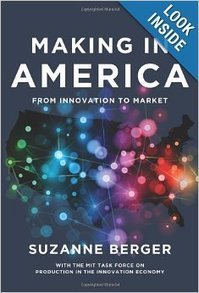
This is in many ways another book like MIT’s 1990 “The Machine That Changed The World” bestseller that gave birth to the Lean Manufacturing movement.
MIT scientists, engineers, social scientists, and management experts visited more than 250 firms in the United States, Germany, and China. In companies across America--from big defense contractors to small machine shops and new technology startups--these experts tried to learn how we can rebuild the industrial landscape to sustain an innovative economy. At each stop, they asked this basic question: "When you have a new idea, how do you get it into the market?" They found gaping holes and missing pieces in the industrial ecosystem. Critical strengths and capabilities that once helped bring new enterprises to life have disappeared: production capacity; small and medium-size suppliers; spillovers of research, training, and new technology from big corporations. […] Even in an Internet-connected world, proximity to innovation and users matters for industry. Making in America describes ways to strengthen this connection, including public-private collaborations, new government-initiated manufacturing innovation institutes, and industry-community college projects.
Implement demand driven smart metrics to drive and sustain dramatic gains in flow and improve ROI performance […] In today's volatile, globally competitive environment, new decision-making tools are required to monitor, measure, and improve total organizational performance. […] Cowritten by internationally recognized experts in the field, Demand Driven Performance explains why current measurement forms must be replaced. The authors present a demand driven blueprint and the smart metrics to maximize flow and ROI. […] "The methods described in this book worked in one of the most complex manufacturing operations that you can imagine with very effective results." -- From the Foreword by Dan Eckermann, former President and CEO, LeTourneau Technologies, Inc. […]
"People are so used to batch and queue, it seems normal and the default choice, finishing a job that you started seems a luxury that couldn’t possibly work in the real world, it’s inefficient and silly.
But the truth is counter intuitive, as always, and it’s quicker to only handle a piece of work when you’re doing it, rather than repeatedly during hand offs, picking it up and putting it down again."
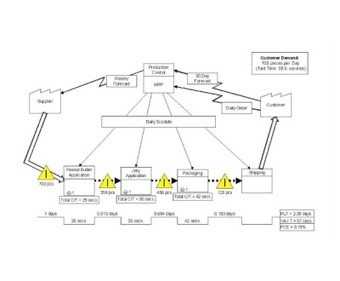
I have been wondering where this tool actually comes from. In the introduction to Learning to See, Mike Rother describes it as a minor tool known within Toyota as “Material and Information Flow” mapping. I have many books about TPS in English and Japanese, of vintages ranging from 1978 to 2009. They contain all sorts of charts and flow maps, but nothing that resembles a VSM.
Marris Consulting is a consulting firm dedicated to manufacturing companies based in Paris France. We are Theory Of Constraints + Lean experts. This YouTube channel contains a series of videos on: TOC, TLS, Critical Chain Project Management, ...
Mike Rother wrote a book called Toyota Kata, and that book is near the top of the list of essential reading for anyone with aspirations of leading a truly lean enterprise.
The official Theory Of Constraints community organization (TOCICO) has launched a series of webinars that are freely accessible to both non-members and members. They are hosted by the world’s top TOC experts.
At the time of writing this post (28th Sept. 2013) the program is:
Two Types of Clouds - by Kelvyn Youngman
The Variety Dilemma - by Eli Schragenheim,
Journey Starts with Chaos - by Avraham Mordoch
Time or attention constraints - by Dr. Lisa Ferguson
The Project Manifesto - by Robert Newbold
Achieving a breakthrough in healthcare - by Alex Knight
By focusing on the “soft” side of lean and Six Sigma initiatives, leading global companies gain substantial, scalable, and sustainable advantages. A McKinsey Quarterly article.
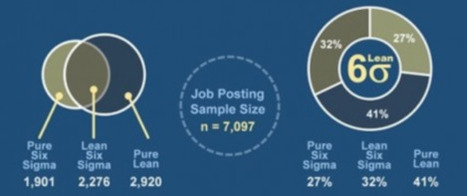
[...] LEAN eliminates waste from your processes [...] Six Sigma reduces variation in your processes [...] Although there is a lot of synergy between LEAN and Six Sigma, a study from “The Avery Point Group” shows that since a couple of years companies are looking more for LEAN talents than for Six Sigma talents. There are four good reasons for that. [...] in 2013 the demand for LEAN talents exceeds the demand for Six Sigma talents by 24% and the demand for LEAN talents has been even stronger in the previous three years. There are four good reasons for this effect [...] It looks like Six Sigma is beaten by LEAN, but this might be a temporary impression. More and more of the world becomes automated. Processes become more and more complex. This will automatically lead to more complex problem solving and break through strategies … and Six Sigma will be back as complementary part of LEAN.
Interesting but it is not clear what geography this data was gathered in; USA I guess. I beleive in the rest of the world the Six Sigma phenomena is a lot less widespread.
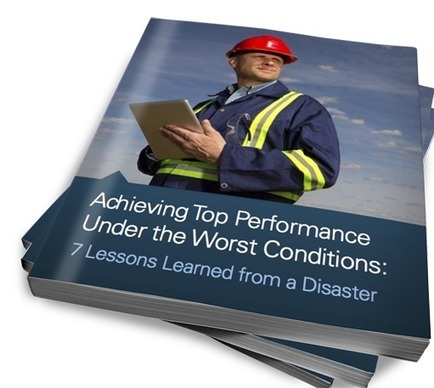
How by using and applying the Theory of Constraints and Lean Manufacturing mrinciples, Pinnacle Strategies helped the Company and Contractors in Charge of Cleaning Up the 2010 Oil Spill in the Gulf of Mexico, by Doubling the Supply of Skimmers, Boom and Other Critical Resources, and in Doing So Saved More than $700 Million. The mission: Improve supply lines and performance for one of the largest oil spill cleanup efforts in history.
To get content containing either thought or leadership enter:
To get content containing both thought and leadership enter:
To get content containing the expression thought leadership enter:
You can enter several keywords and you can refine them whenever you want. Our suggestion engine uses more signals but entering a few keywords here will rapidly give you great content to curate.


 Your new post is loading...