


|
Scooped by
Philip Marris
onto TLS - TOC, Lean & Six Sigma November 13, 2021 12:32 PM
|
 Scoop.it!

Sign up to comment

|
|
Scooped by
Philip Marris
onto TLS - TOC, Lean & Six Sigma November 13, 2021 12:32 PM
|
Scoop.it!

 Your new post is loading...
 Your new post is loading...
Your new post is loading...
Scoop.it!

From
youtu

Is 'TLS' – the integration or combination of TOC (T) with lean (L) and six sigma (S) – a good idea? What does it mean exactly? How do they reinforce each other? What are the incompatibilities? What are the case studies? Is it an opportunity or a threat for the TOC movement? Industrial improvement efforts over the past 20 years have been handicapped by quarrels concerning the relative merits of the different approaches and of the supposed incompatibilities or fundamental differences among them. TLS considers, on the contrary, that we should seek to combine them thereby creating a system that contains the best aspects of each movement.
Scoop.it!
Philip Marris was awarded the TOCICO Lifetime Achievement Award in 2026 during the annual Theory Of Constraints summit in Manchester UK. The award is in recognition for the significant contribution to the TOCICO community to advance the TOC body of knowledge. He is recognized as a key actor in developing the the combination of TOC and Lean. This is a 4-minute recording of part of the awards ceremony.
Scoop.it!

Most manufacturing executives recognize that value-based pricing is superior to the standard cost-based approach. But because cost-based (or cost-plus) pricing is so firmly entrenched in organizational processes (and in executives’ minds), it’s almost impossible to migrate an established organization to this superior pricing approach during any reasonable timeframe. To address this problem, here’s a carefully designed (and battle-tested) procedure that will enable your organization to transition to value-based pricing in five days flat.
Scoop.it!

From
toyotatimes
An official article from the Toyota Times about how Toyota got involved in growing and serving coffee (!)
The Thai Royal Family and the Toyoda family have long shared a deep bond. [...] I tasted the coffee from the café run by the Royal Family, and it was excellent. When I said I wanted to serve it at Toyota dealerships as well, I was told that bean production was not keeping up with demand. So, I offered to use Toyota's know-how to help improve productivity. Things moved quickly from there.
Scoop.it!
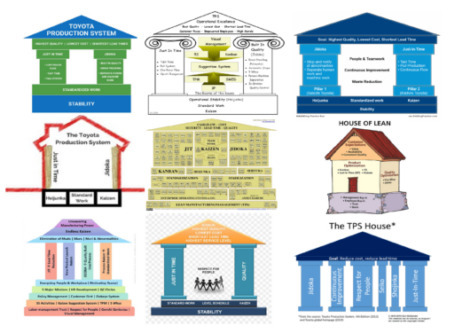
The “House of TPS,” is popular in the US and Europe as a summary of the Toyota Production System. We trace its origins and review its design and components in a 2007 version from Toyota Europe. Nigel Thurlow posted in on LinkedIn and says he was in the room when his Toyota colleagues drew it. We explore why the Greek temple theme was adopted, and suggest it may have been to make TPS appear less foreign to Americans. Once stripped of the temple, it is a stack diagram, and we review the content of the boxes from bottom to top. While popular and widely copied in multiple variants by American consultants, the only Houses of TPS I could find in Japanese are translations of Jeffrey Liker’s. While the House of TPS resonates with Americas, even the version developed within Toyota fails to provide more than a list of keywords, while leaving out key elements. The best it can do is motivate the reader to dig deeper.
Scoop.it!
From
www
Stemming from the Theory of Constraints, the Logical Thinking Process consists of a structured way of reasoning and a set of tools or processes to help executives and system managers to design their organizational strategy, to plan its deployment, to evaluate its effectiveness, and to make corrections as needed in the shortest possible time.
Scoop.it!
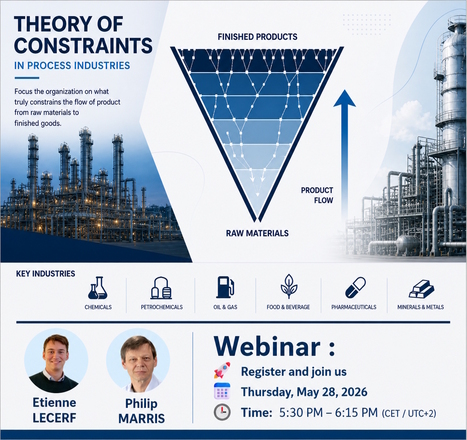
📅 Webinar : Theory Of Constraints in process Industries and V-plants. 👉 In many process industries — such as metallurgy, steel-making, foundry, plastics, and chemicals — industrial flows follow a V-shaped model: limited raw materials on the input side, but a wide diversity of products on the output side. 👉 This model, combined with highly capital-intensive environments and low-flexibility resources, makes operations management particularly complex. Traditional approaches such as MRP quickly reach their limits, leading to well-known consequences: large batch production, excess inventory, lack of agility… and sometimes even a critical paradox — warehouses full of finished goods, yet dissatisfied customers. This webinar offers a perspective on managing flows in V-shaped environments, based on real-world industrial experience. 🎯 Objective: gain better control over your flows to reduce inventory, improve customer service, and sustainably enhance overall operational performance.
Scoop.it!
From
www
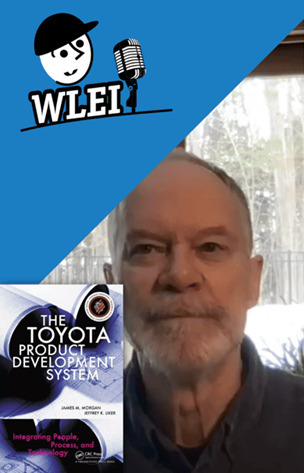
In this special edition of the WLEI Podcast, [...] former product development executive Jim Morgan to explore the lasting impact of The Toyota Product Development System: Integrating People, Process, and Technology, the groundbreaking book he co-authored with Jeff Liker. Two decades after its release, the insights that revealed Toyota’s unique approach to product development remain a cornerstone for any organization striving to become a great product company.
Scoop.it!

This is my second post on the excellent Fendt Cabin Plant in Asbach-Bäumenheim, which impressed me a lot with their efficiency and general organization.In my... [...] As always, I tried to estimate the percentage of value-added time (i.e., what percent of the time the worker at the assembly line adds value, and what percentage of the time was wasted with walking, waiting, searching, transporting, and so on). The results positively surprised me. According to my estimation, their total value-adding percentage was 56%. While this would put the plant in the middle of all my observations, they had this for a takt time of 9 minutes (540 seconds). The longer the takt time, the more difficult it is to become efficient, and for this takt time, their efficiency sticks out quite a bit. They were also more efficient than their main plant for the tractor assembly in Marktoberdorf. Below is the plot of percentage value-adding time versus takt time, with the Fendt plant in Asbach-Bäumenheim highlighted.
Scoop.it!

TOC4Finland has invited Philip Marris, CEO of Marris Consulting and a renowned expert in the Theory of Constraints and Lean, to their next meeting in March 2026. This is the continuation of Philip Marris' collaboration with the TOC community in Finland that dates back to his first conference in Helsinki in 2017.
The event brings together several international experts who will present advancements in the use of the Theory of Constraints, particularly with Artificial Intelligence, and case studies of the implementation of the Theory of Constraints and Critical Chain:
1) Case study: How Goldratt's rules were implemented at Fingrid (electricity transmission system operator), by Rami Saajoranta (in Finnish)
2) Case studies: Goldratt's Rules of Flow and Critical Chain by Georgijs Buklovskis (in English)
3) Relevance of the Theory of Constraints when using AI, by Sari Torkkola (in Finnish)
4) Combining the Theory of Constraints and Lean: 1 + 1 = 3, by Philip Marris (in English)
Scoop.it!
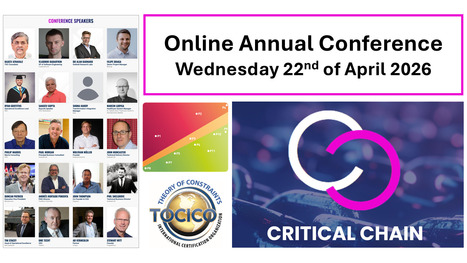
The Critical Chain Conference is the leading event for professionals applying Critical Chain Project Management (CCPM) and the Theory of Constraints to improve project delivery.
Critical Chain Annual Conference - April 22nd, 2026. Critical Chain 2026 brings together practitioners and leaders for a focused, one-day online event dedicated to improving how projects are executed. The event features practitioner-led sessions, peer-level discussion, and applied insight centered on improving execution performance across complex project environments.
Scoop.it!
From
www
Today’s leading performance improvement methodologies are Lean (a systematic approach to eliminate waste), six sigma (a rigorous, data-driven process to eliminate defects), and constraints management (a.k.a. theory of constraints – a breakthrough methodology to identify and manage a system’s constraints). Proper integration of these methodologies results in a very structured, focused approach to process and performance improvement with system-level impact. ... the integration of lean and six sigma with constraints management often yields 10 to 20 times greater returns than by implementing lean and six sigma in isolation.
Scoop.it!
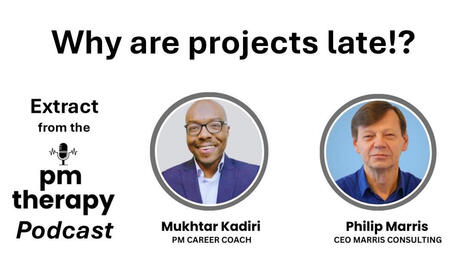
Mukhtar Kadiri the host of the "PM Therapy Podcast" invited Philip Marris to discuss the challenges of project management. This is an extract where they discuss the main reasons why projects are late.
|
Scoop.it!

For me, the conversation Roberto Priolo and I had with Jean-Christophe carries special meaning. For more than a decade I had the privilege of working at Michelin, an organization I consider my great school of management.
Scoop.it!
The TOC Innovation Summit 2026 brings together practitioners and leaders applying the Theory of Constraints to improve flow, focus, and outcomes in real organizations.
Scoop.it!
From
www
In this presentation for the PMI Space Coast Chapter, Lean Six Sigma Master Black Belt Jerry DeFranco demonstrates how to integrate Lean, Six Sigma, Theory of Constraints (TOC), and Agile frameworks [...] Agile: Applying iterative frameworks and scientific thinking (Plan-Do-Check-Act) to manage improvement projects.
Scoop.it!
From
youtu
The best-seller “The Goal” by Eliyahu Goldratt described in the form of a novel how the Theory Of Constraints (TOC) could save a factory by quickly boosting its performance. But how exactly should one implement TOC (combined with Lean) in production? Philip Marris [...] presents the guiding principles: the 5 focusing steps. He presents 2 difference examples: one in the automotive industry and another in the aeronautics industry.
Scoop.it!

Today, many industrial companies are considering the reorganization of their workshops, the relocation of equipment, or significant investments aimed at expanding capacity and reinforcing operational capabilities. Whether the project involves a full redesign, the deployment of a new production line, or the transfer of assets from one site to another, such transformations require disciplined planning and precise execution.
These initiatives often involve major constraints: moving heavy machinery, coordinating infrastructure works, aligning internal and external stakeholders, and, […] all under highly compressed timelines. In many situations, every hour matters, as interventions on production facilities frequently require production to be stopped or disrupted.
To address these constraints, manufacturers need a proven way to reduce project timelines, ensure the reliability of key stages, and limit deviations that could generate significant unplanned costs. […] It is with this in mind that Marris Consulting supports industrial sites facing this type of challenge, notably by leveraging Critical Chain Project Management. Derived from the Theory of Constraints, this approach […] During this webinar, Philip Marris explains how Marris Consulting deploys this method several times a year all over the world. […] The presentation combines the fundamental principles of the TOC and CCPM with feedback from assignments carried out in different sectors, including aeronautical parts manufacturing, chemical industries, medical devices and pharmaceutical production and logistics warehouses.
Date: Tuesday 21st of July 2026 Time: 5:30pm to 6:15pm (CET / Paris) 11:30am to 12:15pm (EDT / New York) Free webinar in English
Scoop.it!
From
www
The long name of the Theory Of Constraints should be: the Theory Of Constraints and of the management of uncertainty. TOC has always included buffers to absorb uncertainty and variability. This is especially important in project Management (Critical Chain) where there is intrinsically a lot of uncertainty.
Scoop.it!

4 minute video. On July 21 2022 Taiichi Ohno was inducted in the Automotive Hall of Fame. Ohno, a Japanese engineer and former Toyota executive, helped establish the fabled Toyota Production System (TPS), which revolutionized not only the Japanese automotive industry, but global vehicle manufacturing as well. Chris Nielsen, executive vice president of product support and chief quality officer for Toyota Motor North America, attended the event in Detroit, saying: “TPS has not just transformed automotive manufacturing; its reach goes far beyond and knows no bounds in having a positive effect on society.
Scoop.it!
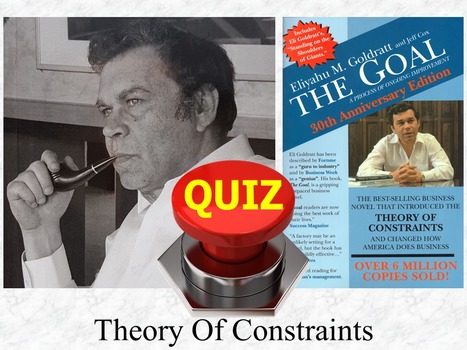
Test your knowledge of The Theory of Constraints! Via Philip Marris
Scoop.it!

Webinar presented by Philip Marris, CEO of Marris Consulting, and Theory Of Constraints and Lean expert, sharing his experience supporting numerous aerospace equipment manufacturers in their ramp-up projects.
Aeronautical OEMs: How to produce more despite a stressed-out Supply Chain. [...] Often singled out are the OEMs - Original Equipment Manufacturers -, who are struggling to keep up with the steep ramp up in demand. And the entire supply chain is impacted: lack of materials, but also often a lack of capacity and resources with rare skills. [...] This webinar provides you with the keys to successfully increasing production rates and delivery volumes, while simultaneously improving working conditions.
Scoop.it!
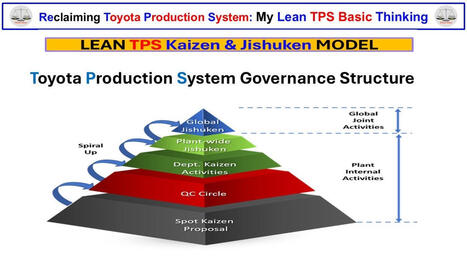
By the mid-1980s, Kaizen had been formalized, named, and exported as a standalone improvement practice. In that transition, Kaizen ceased to operate as a governed mechanism inside the Toyota Production System and began operating independently of the system that originally constrained and verified it

Richard Platt's curator insight,
February 7, 5:17 PM
By the mid-1980s, Kaizen had been formalized, named, and exported as a standalone improvement practice. In that transition, Kaizen ceased to operate as a governed mechanism inside the Toyota Production System and began operating independently of the system that originally constrained and verified it
Scoop.it!

The "2 for 1" rule to reduce Work In Progress and accelerate flow. A webinar hosted by Philip Marris, the founder and CEO of Marris Consulting. [...] The "2 for 1" rule is very simple: a new unit (such as a production order, an order, or a project) can only be launched into the system if two units have been previously released (finished).
Scoop.it!
From
tocpractice
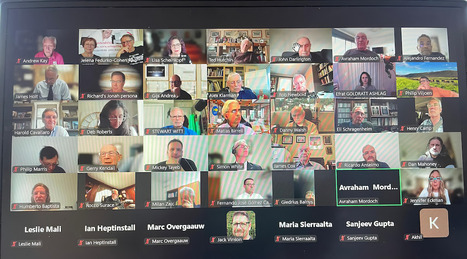
An online conference of over 20 TOC oldies to speak about their time with Eliyahu Goldratt, and Eli’s impact on their lives. The link includes time stamping to go to a specific testimonial.
|




