Your new post is loading...
Software bugs cost the global economy an average of $312 billion a year. Yet there is a virtually ignored unemployed population of systematic, methodical, hard-working, team spirited individuals out there desperate to progress in careers. Perhaps marrying the great swathes of jobless ex-military with the need for rigorous global software testing could achieve an extremely socially responsible and lucrative system? Alex is 27. His suit is exceptionally well pressed. His shoes shine so hard you could check your teeth in them. As he firmly shakes your hand, his gaze is clear and steady. This is a man who understands routine and processes, respects authority implicitly and can be relied upon to systematically take any task right through to the bitter end. But Alex is the same as the millions of ex-military personnel discharged annually around the world; once he returned to civilian life, despite being anxious to find a career, he struggled to even find a job.
A 2012 US survey of new veterans from Prudential, Inc. showed that 60% of those spoken to reported that “translating their military service to the civilian job market was a significant challenge”. Whilst in China this month the China Legal Aid Foundation launched a special fund for soldiers who left the armed-services, stating that tens of thousands of ex-military personnel face problems in finding employment following release from service.
However, the world over, the army teaches discipline, following procedure and leadership, all qualities that certain aspects of the corporate world craves. As Shane Robinson wrote for Forbes “At 18 I was placed in charge of $5M worth of classified equipment. I have colleagues who in their 20s were appointed interim governors of entire towns.” Irrespective of the political charge to these roles, the people who perform them have an incredible skillset which appears to be being ignored.
Now Karen Ross, the business owner of internet technology and consulting firm, Sharp Decisions, in New York City may have come up with a solution. Her scheme is aimed specifically at post 9/11 veterans in the US, but it perhaps has potential for ex-military around the world. Ross’ scheme started six months’ ago and involves paying those selected for two weeks’ intensive training, grouping them into small teams and then placing them as quality assurance analysts/ testers. Could this be the perfect fit?
Click headline to read more--
AZAMAT KULYENOV, a 26-year-old train driver, slid the black-knobbed throttle forward, and the 1,800-ton express freight train, nearly a half-mile long, began rolling west across the vast, deserted grasslands of eastern Kazakhstan, leaving the Chinese border behind.
Dispatchers in the Kazakh border town of Dostyk gave this train priority over all other traffic, including passenger trains. Specially trained guards rode on board. Later in the trip, as the train traveled across desolate Eurasian steppes, guards toting AK-47 military assault rifles boarded the locomotive to keep watch for bandits who might try to drive alongside and rob the train. Sometimes, the guards would even sit on top of the steel shipping containers.
The train roughly follows the fabled Silk Road, the ancient route linking China and Europe that was used to transport spices, gems and, of course, silks before falling into disuse six centuries ago. Now the overland route is being resurrected for a new precious cargo: several million laptop computers and accessories made each year in China and bound for customers in European cities like London, Paris, Berlin and Rome.
Click headline to access hot link to the NYT's article--
The dollarisation of the economy allowed mobile operators to improve their operations through expanding network capacity and broadening product offering to end users.
Subscriber Identity Modules (Sim) cards, that were at one point treasured as gold, became readily available.
Their pricing again normalised from as high as US$100 to the current levels of US$1 if not 50 US cents in some instances.
Data products were also introduced over the period with the rollout of broadband services. Conducting business transactions through mobile phones became popular again.
There has been a remarkable growth in the number of subscribers over the past four years. However, market share distribution has remained skewed in favour of Econet which accounts for 75%.
Econet's dominance in the sector relies greatly on the first mover advantage it has commanded since dollarisation. Telecel is next in line with 16% while NetOne holds the remaining 9%.
What is currently interesting in the mobile phone industry however, is the level of cut-throat competition.
Click headline to read more--
In early May, news reports gushed that a quantum computation device had for the first time outperformed classical computers, solving certain problems thousands of times faster. The media coverage sent ripples of excitement through the technology community. A full-on quantum computer, if ever built, would revolutionize large swaths of computer science, running many algorithms dramatically faster, including one that could crack most encryption protocols in use today.
Over the following weeks, however, a vigorous controversy surfaced among quantum computation researchers. Experts argued over whether the device, created by D-Wave Systems, in Burnaby, British Columbia, really offers the claimed speedups, whether it works the way the company thinks it does, and even whether it is really harnessing the counterintuitive weirdness of quantum physics, which governs the world of elementary particles such as electrons and photons.
Most researchers have no access to D-Wave’s proprietary system, so they can’t simply examine its specifications to verify the company’s claims. But even if they could look under its hood, how would they know it’s the real thing?
Verifying the processes of an ordinary computer is easy, in principle: At each step of a computation, you can examine its internal state — some series of 0s and 1s — to make sure it is carrying out the steps it claims.
A quantum computer’s internal state, however, is made of “qubits” — a mixture (or “superposition”) of 0 and 1 at the same time, like Schrödinger’s fabled quantum mechanical cat, which is simultaneously alive and dead. Writing down the internal state of a large quantum computer would require an impossibly large number of parameters. The state of a system containing 1,000 qubits, for example, could need more parameters than the estimated number of particles in the universe.
And there’s an even more fundamental obstacle: Measuring a quantum system “collapses” it into a single classical state instead of a superposition of many states. (When Schrödinger’s cat is measured, it instantly becomes alive or dead.) Likewise, examining the inner workings of a quantum computer would reveal an ordinary collection of classical bits. A quantum system, said Umesh Vazirani of the University of California, Berkeley, is like a person who has an incredibly rich inner life, but who, if you ask him
Click headline to read more--
Rain – in effect, evaporated ocean – fell in such colossal quantities during the Australian floods in 2010 and 2011 that the world’s sea levels actually dropped by as much as 7mm.
Rainwater normally runs swiftly off continental mountain ranges, pours down rivers, collects in aquifers and lakes and then winds across floodplains into the sea. But Australia, as any Australian will proudly claim, is different.
Rain that falls in the outback of the largest island – also the smallest continent – tends to dribble away into inland waterways and seemingly get lost, without ever making it to the coast, or to collect in shallow inland seas and stay there till it evaporates.
“It is a beautiful illustration of how complicated our climate system is”, says John Fasullo, of the US National Centre for Atmospheric Research. “The smallest continent in the world can affect sea level worldwide. Its influence is so strong that it can temporarily overcome the background trend of rising sea levels that we see with climate change.”
Fasullo and colleagues outline the drama of the vanishing sea levels in Geophysical Research Letters. Although there are daily, seasonal and annual variations, sea levels worldwide have been creeping up by 3mm a year on average, as a consequence of ocean warming and glacial melting.
But in 2010, sea levels mysteriously began to drop by 7mm, and stayed lower than expected for 18 months. This really was unexpected: global average temperatures had not dropped, greenhouse emissions had continued to increase, glaciers had continued to melt.
Click headline to read more--
The UK's Independent newspaper today had an "exclusive" article, in which they claim that documents from Ed Snowden's leaks revealed a secret internet surveillance base in the Middle East run by the UK government.
There's just one problem. While the article implies (though does not state) that it got those documents from Snowden, Snowden says he's never talked to nor given anything to The Independent.
Instead, he argues, that he's worked carefully with key journalists (namely, Glenn Greenwald, Laura Poitras, and Barton Gellman) to make sure that the things they publish don't reveal anything that might put anyone in danger. Snowden suggests, instead, that this is the UK government itself releasing this information in an attempt to "defend" the detention of David Miranda.
Click headline to read more--
In three years, if you happen to be 3,000 meters (9,800 ft) beneath the surface of the ocean, keep an eye out for the Cyclops. No, not the hairy giant, but the 5-passenger submersible. Once it’s commercially available in 2016, it should be “the only privately owned deep-water manned submersible available for contracts.” As for why it’s called the Cyclops, just check out its one-big-eye-like 180-degree borosilicate glass observation dome.
The Cyclops is currently being developed under a contract issued to submersible manufacturer OceanGate Inc., Boeing Research & Technology, and the Applied Physics Laboratory at the University of Washington. Yesterday it was announced that the sub’s initial hull design has been completed – so don’t go expecting to see anything more than renderings of the finished product just yet.
That 7-inch-thick hull will be made of carbon fiber, in which individual strips of pre-impregnated fiber are individually placed within the carbon fiber matrix. Developed by Boeing, this technique is said to offer finer production control than the more traditional filament winding process, and should allow the Cyclops to withstand the 4,300 psi (300 bar) of water pressure it will encounter at its maximum diving depth – the earlier-mentioned 3,000 meters.
The use of carbon fiber should also help keep its weight down. Unlike remotely-operated vehicles (ROVs), the human-crewed Cyclops won’t require any data or power cables linking it to the surface – its onboard life support systems should allow for dive times of up to eight hours.
Click headline to read more and watch video clip--
Workers at Japan's crippled Fukushima nuclear plant on Thursday scrambled to check hundreds of tanks storing highly radioactive water, after one sprang a leak that is feared to have seeped into the Pacific.
Around 300 tonnes of toxic liquid was believed to have escaped from one of the tanks that hold water used to cool the broken reactors, while operator Tokyo Electric Power Co (TEPCO) warned some of it might have flowed into the ocean.
"We are hurriedly checking if some 300 tanks of the same type holding contaminated water have the same leak problem," a TEPCO spokesman said.
"We have finished pumping out water from the troubled tank, while we have continued removing the soil soaked by the water," he said. Spokesman Tsuyoshi Numajiri said Wednesday that traces of radioactivity were detected in a drainage stream.
"We cannot rule out the possibility that part of the contaminated water flowed into the sea," he said.
On Wednesday, nuclear regulators said the leak represented a level-three "serious incident" on the UN's seven-point International Nuclear Event Scale (INES), which measures radiation accidents.
Click headline to read more--
By the time you read these words, much of what has appeared on the screen of whatever device you are using has been dictated by a series of conditional instructions laid down in lines of code, whose weightings and outputs are dependent on your behaviour or characteristics.
We live in the Age of the Algorithm, where computer models save time, money and lives. Gone are the days when labyrinthine formulae were the exclusive domain of finance and the sciences - nonprofit organisations, sports teams and the emergency services are now among their beneficiaries. Even romance is no longer a statistics-free zone.
But the very feature that makes algorithms so valuable - their ability to replicate human decision-making in a fraction of the time - can be a double-edged sword. If the observed human behaviours that dictate how an algorithm transforms input into output are flawed, we risk setting in motion a vicious circle when we hand over responsibility to The Machine.
For one British university, what began as a time-saving exercise ended in disgrace when a computer model set up to streamline its admissions process exposed - and then exacerbated - gender and racial discrimination.
Click headline to read more--
It began with bubbles. Bubbles of gas throughout the bayou. Nothing to get hysterical about. But it kept getting worse.
So residents of Bayou Corne, Louisiana, turned to state regulators, who in the summer of 2012 determined that it wasn't naturally occurring swamp gas, according to Mother Jones. And the U.S. Geological Survey also found that there was increased seismic activity.
What could it be? With bubbling getting worse, the suggestion was floated that it could be the beginnings of a sinkhole, perhaps caused by the mining of a salt dome beneath the town. The company in charge of the mining, Texas Brine, told state officials a sinkhole was highly unlikely.
Then, on August 3, 2012, crude oil began gushing out of a gaping pit nearby. That afternoon, governor Bobby Jindal ordered residents of the small town to evacuate.
Texas Brine drilled a relief well, only to find that the wall of the salt dome, which they were mining, had collapsed. "The breach allowed sediment to pour into the cavern, creating a seam through which oil and explosive gases were forced up to the surface," Mother Jones noted. It was previously thought that it was impossible for salt domes to collapse from the side in this manner, illustrating a lack of knowledge about the geology of these formations and the effects of mining them.
Today, the sinkhole in Bayou Corne covers 24 acres and is 750 feet deep—and keeps growing, according to news reports. Many of the town's residents have evacuated, while some have defied the order and remained. Earlier this month, the state of Louisiana sued Texas Brine LLC for environmental damages, according to the Times-Picayune.
Click headline to read more--
Microsoft has integrated Outlook.com with Skype in several countries, including the U.S., the U.K., and Germany, offering users the ability to tap Skype functions and contacts from within the interface of the webmail application.
The link between the two products lets Outlook.com users do Skype video chats, audio calling and instant messaging. Other countries where this is now available are Brazil, Canada and France. Microsoft plans to offer this integration worldwide "in the near future," the company said in a blog post on Monday.
Microsoft is pursuing this integration because email exchanges are often escalated to audio and video communications, so bridging the interface gap between Outlook.com and Skype makes sense, the company said.
"Email is an important and personal tool for most people, but there are moments when you want to be able to speak live or chat face-to-face," wrote Dawn Martynuik, group product manager of Outlook.com, in the blog post.
Ironically, Outlook.com already has links with Facebook, Google, LinkedIn and Twitter.
Outlook.com hit a rough patch last week, when it malfunctioned in various ways for an undisclosed number of users between Wednesday and Sunday. The glitches affected mobile access to the inbox and the ability to share SkyDrive files via email.
Outlook.com has had other stability, availability and performance problems in recent months, including a high-profile outage in mid-March.
Click headline to read more--
Now that the media kerfuffle surrounding Elon Musk's Hyperloop transit system proposal has settled down to a dull roar, it's a good time to step back and consider in detail some of the real innovations and difficult issues raised through analysis of the 57-page Hyperloop plan.
The shortest description of the Hyperloop is Musk's own bon mot: "It's a cross between a Concorde, a rail gun, and an air hockey table."
A slightly more complete description of the concept is that of an elevated, reduced-pressure tube that contains pressurized capsules driven within the tube by a number of linear electric motors. These capsules move with very little friction or drag owing to air bearings that ride on the inner surface of the tube, and a combination of active and passive means to reduce the negative effects of choked airflow on the transportation system.
In this article I am only considering the science and engineering aspects of the Hyperloop. While acknowledging that political issues may actually determine its fate, what concerns us here is whether or not it could work.
Click headline to read more--
Next month’s Privacy Identity Innovation conference (pii2013) in Seattle will be preceded by our new Global Data Protection policy workshop on September 16th, and one of the key areas we’ll be looking at during the workshop is the European Commission’s proposed data protection rules. International privacy and security attorney Françoise Gilbert will moderate an afternoon panel titled Rethinking Privacy Rights & Responsibilities: Preparing for the E.U.’s Proposed Data Protection Rules. Along with Françoise, the panel will feature Lothar Determann, a partner with Baker & McKenzie who teaches data privacy law both at UC Berkeley Law School and at Freie Universität in Berlin; San Francisco attorney Christina Gagnier of Gagnier Margossian LLP; Ira Rubinstein, a senior fellow at NYU Law School’s Information Law Institute and former associate general counsel for Microsoft; and Reputation.com.’s chief privacy officer and general counsel Chris Sundermeier. The session description is below and you can learn more about the workshop here.
Click headline to read more--
|
Google is weighing building its own line of self-driving cars independent of the automakers, according to new report by Amir Efrati on JessicaLessin.com. Efrati doesn’t name his sources, but he’s a veteran Google reporter formerly of the Wall Street Journal so I have little reason to doubt them. But it does raise an interesting question: Can a tech company — even one with the resources and innovation drive of Google — build an automobile from scratch?
First the details of the report: Efrati’s sources said Google is making no headway with the entrenched automakers over partnerships to build self-driving vehicles. So it’s opted to go around them, talking to auto-components designers Continental and Magna International about having them build cars to Google’s design. (German paper Frankfurter Allgemeine also reported Continental has struck a deal with both Google and IBM.)
Efrati’s report added that Google might use these cars as part of a “robo-taxi” service that prowls cities picking up passengers on demand.
Click headline to read more--
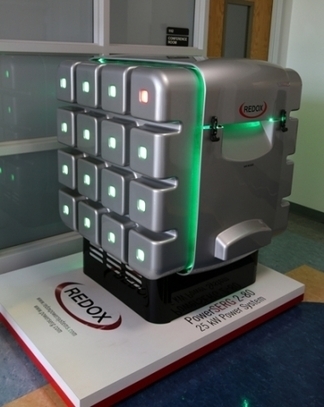
Redox Power Systems, a Fulton, MD-based start-up company founded last year, sealed the deal on a partnership with researchers at the University of Maryland to commercialize a potentially game-changing distributed generation technology.
Redox says that it plans to bring to market a fuel cell that is about one-tenth the size and one-tenth the cost of currently commercial fuel cells by 2014.
The breakthrough solid oxide fuel cell technology is the brainchild of Eric Wachsman, the director of the University of Maryland’s Energy Research Center.
Redox says that it will provide safe, efficient, reliable, uninterrupted power, on–site and optionally off the grid, at a price competitive with current energy sources.
The promise is this: generate your own electricity with a system nearly impervious to hurricanes, thunderstorms, cyber attacks, derechos, and similar dangers, while simultaneously helping the environment.
Click headline to read more--
Deep beneath Fukushima’s crippled nuclear power station a massive underground reservoir of contaminated water that began spilling from the plant’s reactors after the 2011 earthquake and tsunami has been creeping slowly toward the sea.
Now, 2 1/2 years later, experts fear it is about to reach the Pacific and greatly worsen what is fast becoming a new crisis at Fukushima: the inability to contain vast quantities of radioactive water.
The looming crisis is potentially far greater than the discovery earlier this week of a leak from a tank used to store contaminated water used to cool the reactor cores. That 300-ton (80,000 gallon) leak is the fifth and most serious since the disaster of March 2011, when three of the plant’s reactors melted down after a huge earthquake and tsunami knocked out the plant’s power and cooling functions.
But experts believe the underground seepage from the reactor and turbine building area is much bigger and possibly more radioactive, confronting the plant’s operator, Tokyo Electric Power Co., with an invisible, chronic problem and few viable solutions. Many also believe it is another example of how TEPCO has repeatedly failed to acknowledge problems that it could almost certainly have foreseen — and taken action to mitigate before they got out of control.
It remains unclear what the impact of the contamination on the environment will be because the radioactivity will be diluted as it spreads further into the sea. Most fishing in the area is already banned, but fishermen in nearby Iwaki City were hoping to resume test catches next month following favorable sampling results. Those plans have been scrapped after news of the latest tank leak.
“Nobody knows when this is going to end,” said Masakazu Yabuki, a veteran fisherman in Iwaki, just south of the plant where scientists say contaminants are carried by the current. “We’ve suspected (leaks into the ocean) from the beginning … TEPCO is making it very difficult for us to trust them.”
Click headline to read more--
Smart Grid projects in Europe: Lessons learned and current developments" is most current and comprehensive inventory of smart grid and smart metering projects in Europe. It includes 281 smart grid projects and 90 smart metering projects.
Full rules were used to choose projects for inclusion: --Smart grid (new technologies) projects were included
--New generation projects were included if grid integration was involved
--Projects using only conventional approaches are excluded
--Projects lacking sufficient information were excluded
Since information was shared on a voluntary basis without any audit, the report may have a bias towards positive results. In addition, the report lacks a common framework for data sharing and analysis. You can track data on the JRC smart grid website and on the smart-grid project portal developed by the JRC and the European electricity industry association (EURELECTRIC).
Click headline to read more and access hot link to download the report--
As Techdirt has reported, the attempts to extradite Kim Dotcom from New Zealand to the US have turned into one of the most catastrophically bungled legal cases in a long while.
One of the biggest scandals to emerge was that New Zealand citizens had been wiretapped in an effort to gain evidence against Dotcom, since domestic spying was forbidden there just as it is in the US (oh, wait...).
Unfortunately, rather than rapping knuckles and telling the local spooks not to do it again, the New Zealand government has instead just brought in new legislation to make it legal in the future.
But it seems that the revelations in the Dotcom case aren't over yet. A story on the Australian site ITnews drawing on a blog post by Keith Ng has the following remarkable claim:
Click headline to read more--
Estonian design firm Architect 11 has unveiled a new prototype modular housing unit, dubbed Passion House M1. Intended to be the first (and smallest) in a series of forthcoming similar structures, Passion House M1 can be assembled within a couple of days, and is billed as a suitable home for Nordic regions.
Passion House M1 could serve as guesthouse, summer cottage, beach house, or primary home. The one-bedroom prefab unit is delivered with furniture already installed, and features modern amenities like a shower, kitchen, and even optional sauna.
The house is constructed primarily from wood, with internal walls built from cross-laminated timber panels, and an outer stone facade. Mineral wool insulation helps keep out the elements, and the home includes a fully automated ventilation system.
Click headline to read more--
More than 300,000 people across Sudan have been affected by floods that have killed nearly 50 people in August, the World Health Organization has said.
It said the region around the capital Khartoum had been particularly badly hit and was experiencing the worst floods in 25 years.
One of the major risks to health was the collapse of more than 53,000 latrines, the WHO added.
A UN official in Sudan described the situation as "a huge disaster".
In a report, the WHO said that 48 people had been killed and 70 injured in the floods. It warned of increasing trends of malaria cases in the past two weeks.
Meanwhile, Sudan Interior Minister Mahmoud Hamed put the confirmed death toll at 53, according to the AFP news agency.
The WHO also said property had been damaged in 14 of Sudan's 18 states.
Click headline to read more--
On their face, Edward Snowden's revelations about the National Security Agency's secret mass electronic data surveillance system should have created a political firestorm for the Obama administration and the U.S. Congress. Not only have PRISM and related programs been used systematically to collect information about Americans with the cooperation of most major Internet and telephone companies, but when news of the program leaked, government officials first insisted that the programs had only tangential domestic implications because they targeted foreigners outside the United States -- reassurances that were quickly undone by further revelations. In other words, the government outright lied to the public and was caught in its own lies.
Despite anger at Snowden and apocalyptic claims by government officials that he had gravely undermined their ability to protect Americans from terrorist attacks, it turned out that the "secret" he revealed appeared to be one of the most broadly shared secrets in the world. The White House knew, members of the Senate and House intelligence committees knew, and major U.S. allies like Britain and Germany not only knew but in some cases collaborated in the effort. Companies like Apple, Google, and Microsoft may not have known everything, but unquestionably they knew something. The only group that did not know about PRISM was the general public.
And yet, apart from some voices from the antiwar left and the libertarian right (on foreign policy there is considerable overlap between the Tea Party and the Occupy movement), the reaction from this deceived public for the most part has been strangely muted. It is not just the somewhat contradictory nature of the polls taken this summer, which have shown the public almost evenly split on whether the seemingly unlimited scope of these surveillance programs was doing more harm than good. It is akso that, unlike on issues such as immigration and abortion, much of the public outrage presupposed by news coverage of the scandal does not, in reality, seem to exist.
Click headline to read more--
One day about eight years ago, chef of the famed restaurant at in the Hudson River Valley got a FedEx package from someone he didn't know.
Inside were two cobs of corn and a letter.
The handwritten note explained that the corn was an heirloom variety called New England Eight Row Flint (or Otto File, by its Italian name), and that it was a taste that was nearly lost to history.
Native Americans cultivated this variety hundreds of years ago. The corn caught on with settlers in New England because it was hearty and nutritious.
Then, in the 19th century, the grain was exported to Italy, where it was prized as a stunningly flavorful polenta corn.
Barber was curious. So he got in touch with the man who had sent the FedEx package, a grain enthusiast named . He had tracked down Eight Row Flint corn seed from a and grown some.
"It was phenomenally flavored," Roberts told me. "The flavors were bounding out of the polenta." He was eager to revive the corn here in the U.S.
If you listen to my story, you'll hear how chef Barber made an arrangement to start growing the New England heirloom corn at the farm next to his restaurant. And for the past eight years, farmer has overseen its cultivation.
During my visit, Algiere showed me one of the golden-hued cobs still growing on the stalk. "It will turn a golden orange when it's dry," Algiere said.
Click headline to read more and listen to this NPR radio segment--
Google is making good on its promise to make its Maps app more comprehensive and useful following its acquisition of mapping company Waze, with some new traffic update features going live Tuesday.
Users of the Maps app on Android- and iOS-based devices will have access to real-time incident reports from Waze users, Google Maps vice president Brian McClendon said in a Tuesday blog post. That means that when people report accidents, construction, road closures and more on Waze, those updates will also appear within the Google Maps app in Argentina, Brazil, Chile, Colombia, Ecuador, France, Germany, Mexico, Panama, Peru, Switzerland, the U.K. and the U.S., Google said.
The integration between the two products is significant, said John Jackson, an industry analyst with IDC. While the new features for Google Maps probably will not attract new users in droves, they represent Google's attempts to add richness to its mapping products and provide more context to users, he said.
Click headline to read more--
There is a lot of promise from the growing industry of 3D printers and manufacturing products through their use as well as new 3D scanners. This technology is providing a second industrial revolution in the United States as well as globally.
Both large and small companies are developing custom approaches to manufacturing anything from hard-to-find car parts, to dental implants, jewelry, jet parts, bio-medical parts and everything in-between.
The 3D printers required to make these one-off custom products are not expensive anymore and because of that “affordable pricing”, there are many start-ups creating new niche markets everyday as well as well-established large manufacturers looking at a whole new level of intricate customization and affordability in making prototypes.
The intelligent amenity needed in real estate to support this new technology is bandwidth and lots of it. Most in commercial real estate don’t realize that their properties are probably obsolete. In the last several years, corporate site selection committees that didn’t even know what broadband connectivity was a decade ago, now have it in their criteria list as one of the top three attributes a property must have.
Click headline to read more--
How can we support and improve Innovation in Africa?
Supporting innovation in Africa is no easy task. Political instability, civil wars, terrorism, and uncertainty often disturb the ecosystem of progress and sustainable development. I meet with three of Africa's most innovative young women entrepreneurs who share their thoughts on how to improve and support innovation. Often, we find that when discussing innovation in Africa, such discussions normally don't include young African voices, particularly that of women and girls. But their voice matters and without the inclusion of African women and girls in such discussions, whether of that involving technology, sustainable development, or innovation -- change cannot happen.
Research conducted by the African Development Bank (AfDB) shows an increase ranging from 10 to 30 percent in the number of women-led enterprises over the last decade. In Uganda alone, women account for 40 percent of businesses (EIU, 2010). As the number of women entrepreneurs and innovators increase, their voices can no longer be ignored. African women and girls have a significant role to play in Africa's economic and innovative transformation.
Nkem Uwaje, Managing Director of FutureSoft Nigeria and winner of the 2012 Etisalat Nigeria Prize for Innovation states, "We can improve innovation in Africa by supporting people with innovative ideas and I think that competitions and contests are a good way to start. African governments and the private sector need to work together to launch more contests and competitions that focus on innovation."
Innovation needs an enabling environment. This means creating hubs where innovators can meet, share ideas, and collaborate. We [youths] need a space where ideas can be incubated and where prototypes can be developed. Without this, we are bound to fail as a continent. In addition, ICT development is very important to Africa's innovation ecosystem and future. ICT is vital to ensuring that Nigeria and Africa will not be left behind. Everyone keeps talking about the digital divide, but instead of bridging it, it keeps on getting bigger. We need government policies that ensure that technology is not a privilege but a basic amenity. My company, Futuresoft is playing its part in making ICT more accessible through our iConnect project."
Click headline to read more--
|