Your new post is loading...
Most smartphone traffic already runs over WiFi, and Musk is planning a terrestrial network. Telcos may keep carrying the traffic while losing the customer. During SpaceX’s Q3 2026 earnings call, Elon Musk made a comment that should concern mobile operators. “We will also have direct-to-cell, high-bandwidth direct-to-cell capability, and we will be building out our terrestrial network.” He was not describing Starlink as a satellite-only mobile service. He was describing a future network that combines space and ground infrastructure, with broad connectivity anywhere SpaceX is allowed to operate.
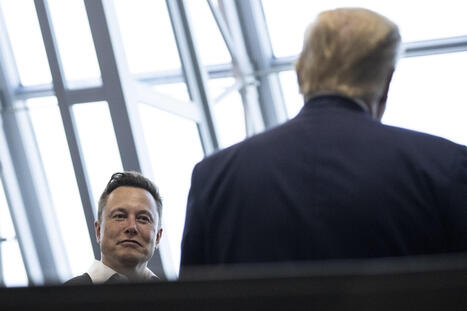
The root cause of Elon Musk’s ascent to de facto defense secretary is the federal government’s practice of contracting out the work it had formerly done itself. This week, The Wall Street Journal reported that the decision to block Ukraine from the high-speed Starlink satellite alerts that enabled it to intercept Russian missiles and drones was made by SpaceX owner Elon Musk, either in conjunction with President Trump or in advance of Trump’s support for the action. Whichever version is more correct, Musk is either making or carrying out a fundamental shift in U.S. foreign and military policy—something that no private citizen has ever done in our 250-year history. Winchester made rifles, but it didn’t order the army to use them against native tribes. Boeing made the B-29s, but it didn’t order them to destroy Hiroshima and Nagasaki. Once the army purchased the Winchesters, and the Air Force, the B-29s, their manufacturers weren’t at the table or in the room where government leaders decided where, when, how—and in the case of Ukraine and Russia, why—they would or wouldn’t be deployed. They weren’t part of the kind of fundamental reorientation of foreign policy that Trump has wrought, in which his narcissistic and thuggish impulses have eclipsed the democratic affinities by which the U.S., at its all too intermittent best, has dealt with other nations. This month, that has meant Musk has played a key role in attempting to turn the tide in Russia’s favor in its war on Ukraine. This reductio ad absurdum of contracting out is also the result, of course, of the mind-meld between Trump and Musk, who, as New York Times columnist Jamelle Bouie pointed out last week, is every bit as racist, xenophobic, and self-interested as our president.
Once again, Consumer Reports finds that the top Internet service providers are independently-owned, locally-owned, or publicly-owned ISPs. The magazine’s 2026 survey of its 105,000 members found that “a handful of [I]nternet service providers (ISPs) received stellar ratings and earned CR’s Recommended badge. But that was the exception, especially when it comes to value.” Of the 68 companies ranked, most "received middling or worse marks" with the "low scorers includ(ing) some of the country’s biggest ISPs, such as Cox, Optimum (Altice), Spectrum (Charter), and Xfinity (Comcast).” Consumer Reports finds that the top Internet service providers are independently-owned, locally-owned, or publicly-owned ISPs. Among the top 10 rated ISPs were Firefly Fiber Broadband, a subsidiary of the Central Virginia Electric Cooperative offering fiber-to-the-home (FTTH) service to roughly 48,000 rural households in its region.
U.S. corporate journalism is actively, enthusiastically invested in lying to you.
That's the only conclusion you can draw after the U.S. press spent the last week helping white supremacist huckster Elon Musk sell the public on the idea of a flying car that simply doesn't exist.
Musk Corp recently "demonstrated" what it claimed was a flight-capable Tesla Roadster at a SpaceX stage in McGregor, Texas. The demonstration featured a "car" accelerating vertically up a Hot Wheels-esque ramp before using thrusters to flip over and descend to the ground. To be clear there is no actual flying car. There is absolutely no evidence that Tesla has solved any of the engineering, physics, regulatory, safety, or design hurdles of strapping rockets to the back of extremely heavy electric vehicles. We are simply repeating history (see: The Lady and The Dale documentary).
Freeze frame photos show what appears to be a lightweight hollowed out car shell prop, likely using magnets, suction, and compressed gas to help the country's richest nazi once again lie to the gullible American public and boost the valuation of a car company that stopped being innovative more than a decade ago.
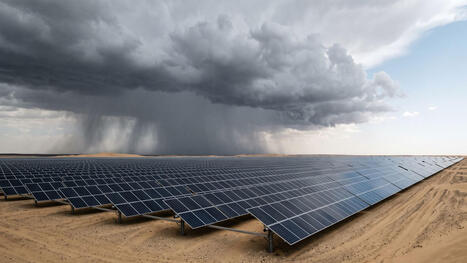
A recent study has found an unexpected benefit from the undisputed king of the renewable energy sector as solar panels are creating rain clouds in the desert. What the researchers actually did This is not a thing anyone has watched happen, and that matters. In 2018, Yan Li, Eugenia Kalnay and colleagues published a study in the journal Science using a climate model with living, growing vegetation built into it. They filled more than 9 million square kilometers of the Sahara with imaginary wind and solar farms. The solar half alone would have generated about 79 terawatts of power. So the simulated farm produces roughly four times everything humanity uses, which tells you the scale we are talking about. Then they let the model run, and the desert started raining.
The plan would connect smartphones directly to satellites under European governance. Four of Europe’s biggest mobile operators have joined forces to explore launching satellite-to-mobile services that could challenge Elon Musk's Starlink, as the EU pushes for greater technological independence from US firms. Deutsche Telekom, Orange, Telefónica and Vodafone said on Monday they had signed a letter of intent to explore a joint bid for satellite spectrum that would enable compatible smartphones to connect directly to satellites without relying on traditional mobile towers. Under the plan, the four companies would establish the ground infrastructure needed to support satellite-to-mobile services while partnering with a satellite operator to provide connectivity from space, without investing directly in a satellite constellation. The satellite partner has yet to be selected.
Nearly half the world's reef-building coral species are at risk of extinction according to a global assessment released Thursday. Researchers warn that the accelerating climate crisis is making the danger even worse than the most recent data shows.
DES MOINES, Iowa (AP) — Iowa is facing a budget deficit, high costs and economic strain from trade disputes that have squeezed farmers. But problems that have simmered for decades — water quality and cancer rates — have been forced to the forefront of state politics this year. They are the focus of debate questions, roundtable events and campaign advertisements for candidates from both parties, up and down the ballot. The issue has historically been politically taboo to avoid pointing fingers at the powerful agricultural industry in Iowa, one of the country’s top producers of corn, soybeans and hogs. Chemical fertilizers and animal waste contain nitrates and phosphorus that can get washed with rain or snowmelt into the state’s web of rivers.
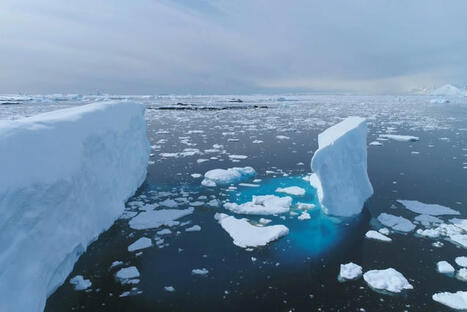
Satellite imagery revealed a huge hole in ice caused by extreme weather conditions such as intense atmospheric rivers and marine heatwaves. A study has revealed how a hole almost the size of the landmass of Portugal opened up in Antarctica’s sea ice in Breid Bay in August 2024. This type of hole has not been observed in this area since 1979. Extreme weather conditions, including a series of intense atmospheric rivers, known as ‘rivers in the sky’, and marine heatwaves, caused the hole – known as a polynya. Atmospheric rivers transported large amounts of moisture from lower latitudes into the Antarctic region, alongside strong winds that caused a phenomenon known as ‘Ekman suction,’ bringing warmer water to the surface. In addition, marine heatwaves further contributed to sea ice not freezing.
Up until a couple years ago, data center cooling was just like cooling your computer. When it gets hot, a fan comes on to blow cool air across the hot chips. In cold places, that might come from outside. In hot places, it might require air conditioning. But AI is using more and more power, and chips are getting jammed into tighter and tighter spaces, all in the name of harder better faster stronger computations. All of which makes more heat. “The heat flux is going to be, in the near future, too high for air cooling to always be a satisfactory solution,” said Jonathan Boreyko, a professor of mechanical engineering at Virginia Tech.
A company developing technology for compact fusion energy machines announced plans Thursday to manufacture them in the Tri-Cities area, potentially creating hundreds of permanent jobs in the long term. Avalanche Energy Designs and the Tri-City Development Council signed a letter Thursday outlining their intent to work together to select a site for Avalanche’s first plant, work on needed permits, prepare infrastructure, develop a regional supply chain and develop the specialized skilled workforce that will be needed.
Alaska’s salmon crisis raises a question about who bears the cost of conservation, while healthcare finds new ways to collect. Alaska pollock supplies fish sticks, imitation crab, and McDonald’s Filet-O-Fish. It supports an enormous commercial fishery, one NOAA has long held up as an example of sustainable management. But a fishery can be successful at harvesting the fish it wants while still causing harm to the fish, and people, caught alongside them. In reporting published Friday, the Associated Press followed the pollock fleet into the Bering Sea, where nets also bring up salmon. Those salmon are “bycatch,” the term for animals caught while fishing for something else. The fight over that incidental catch has become especially painful for Alaska Native communities whose own access to salmon has been severely restricted.
Explore Nigeria's 2026 connectivity report covering broadband market dynamics, 5G migration, rapid fiber growth, and key infrastructure initiatives. Over the past three years, Nigeria saw regulatory reforms, infrastructure investment, and the rollout of next‑generation technologies. These developments led to the clean-up of inactive mobile SIMs, expansion of the fiber market, and improved network performance. This article examines these market changes, evaluates their impact on overall network performance, and outlines government plans to develop the telecom infrastructure further.
|
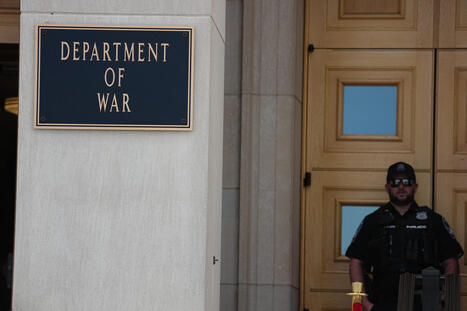
The Trump administration’s campaign to compel hundreds of billions of dollars of new military appropriations out of Congress has been stalled in the Senate for months. The Trump administration’s campaign to compel hundreds of billions of dollars of new military appropriations out of Congress, citing new materiel needs downstream of its unsanctioned Iran War, has been stalled in the Senate for months. But one unexpected winner has emerged from the congressional stalemate over defense spending: an obscure investment office in the Pentagon known as the Economic Defense Unit (EDU). Earlier this year, Deputy Secretary of Defense Stephen Feinberg stood up the EDU and appointed George Kollitides, a one-time executive at Feinberg’s former private equity firm, Cerberus Capital Management, who recently was the subject of a ProPublica investigation for his role in steering a $350 million Department of Defense contract to a consulting firm where he was a partner until just weeks ago. The office was created by way of a memo from the deputy secretary, and has been operating without congressional authorization for months, taking center stage in the administration’s multi-billion-dollar effort to prop up domestic military and energy supply chains. Those deals have been heavily scrutinized for the ways they’ve favored well-connected Wall Street firms and have been set up to benefit the president and his inner circle.
A federal court in New York definitively ruled that the Office of Personnel Management violated the law when it disclosed millions of federal employee records to DOGE agents. The court will decide the remedy at a later date.
As electricity demand surges, data centers proliferate, utilities seek major infrastructure investments, and households confront higher bills, our states and systems are woefully unprepared. Consumers are rightfully wondering who will pay for, benefit from, and make decisions about the evolving U.S. electricity system. States have multiple policy options to meet consumer demands for affordability, agency, and accountability — but they are leaving too many of those options on the table. Almost every state earned a failing grade on ILSR’s 2026 Community Power Scorecard, which grades all 50 states and D.C. on policies that give communities and individuals greater control over their energy sources and protect ratepayers from abuses of utility monopoly power.
Sales reveal how many cars people actually bought, but not how many they actually wanted. Prices, on the other hand, show how demand is changing. Within three months of the U.S. and Israeli strikes on Iran on Feb. 28, 2026, the average price of gasoline for American drivers climbed from US$2.94 to $4.35 a gallon. If there was ever a moment for Americans to switch to electric vehicles, this was it. From March to May 2026, in fact, sales of hybrid electric vehicles were 18% higher than over the same months in 2025. But sales of fully electric vehicles were 16% lower from March to May 2026 compared with the same months in 2025. Some observers took that as evidence that high gas prices alone wouldn’t push Americans toward fully electric cars, but that conclusion misses half the story. I study car buyers and their preferences, and there is an important distinction between what consumers want and what they can actually buy. Sales reveal what cars people actually bought, but not necessarily what they actually wanted. When the supply of some kinds of cars can’t keep up with demand, prices rise, and that’s exactly what happened for electric vehicles in 2026.
The European Commission Decision In a world first, the European Commission will require cell phone radiation to be measured the way we actually use phones today, in a pocket, tucked into clothing, or held directly against the body. As detailed by Phonegate Alert, the European Commission adopted the decision to require 0 mm radiation testing for cell phones and other portable devices on as published in the Official Journal of the European Union on September 7, 2026. Companies will be able to use the older standard that allows 5 mm separation distance during a transition period ending March 7, 2028 “to allow manufacturers sufficient time” to adapt their equipment. RF radiation is a form of invisible, non-ionizing electromagnetic (EMF) radiation emitted by cell phones. It penetrates into our bodies. Governments set limits for how much RF radiation people may be exposed to. Before phones can be sold, they must therefore pass pre-market tests to ensure they do not exceed a country’s allowable RF exposure limits.
The Trump administration reduced the number of planned US weather satellites and removed key tools. Experts say it will set our weather forecasts back nearly a decade, especially for extreme weather events. This finding comes from a new report released Friday from the Government Accountability Office, and a letter sent to the National Oceanic and Atmospheric Administration on Monday from Democratic lawmakers. The GAO report details ramifications from budget cuts made to the program for developing new geostationary weather satellites. These large satellites orbit the Earth at a fixed distance, centered over specific spots on the planet. They take the imagery of swirling clouds and storm systems that people see on the evening news or on their weather app each day. The data gathered by these satellites are crucial to issuing accurate weather forecasts.
In August of 2023, a series of wildfires broke out across Maui, killing more than 100 people, destroying thousands of homes, and causing billions in damage. Noelani Ahia, who is Kanaka Maoli and co-founder of Maui Medic Healers Hui, helped mobilize nearly 600 volunteers in Lāhainā, including doctors, nurses, and therapists. Three years later, the housing and health crises remain acute. Maui Medic Healers Hui runs a free clinic, but Ahia wishes it had 10 more to address the community’s needs. “The fire may be out, but the catastrophe is not over by any stretch of the imagination,” she said. Researchers are examining how fires affected a community already harmed by plantation agriculture, development, and colonialism.
AI agents from multiple providers accessed personal data and confidential material at Indian organizations during research and testing, India’s cybersecurity agency said Thursday. The Indian Computer Emergency Response Team (CERT-In) said it had received “multiple voluntary disclosures from AI model providers” whose models, during research and evaluation runs on the open internet, “had reached the live systems of Indian organizations.” The agents got in through credentials and connection settings left exposed in app configurations, public code repositories, and overly permissive cloud roles.
The iron and steel industries are among the biggest polluters in the world. Plenty of startups have tried to cut the industry’s emissions, mostly by developing new ways to make the metals. Helix Carbon thinks those startups have been going about it all wrong. “Any attempt to decarbonize the steel industry without dealing with the blast furnace is not going to work,” David Brown, Helix Carbon’s co-founder and CEO, told TechCrunch. A blast furnace is the giant furnace that turns iron ore into the iron used to make steel. Rather than replace blast furnaces, Helix wants to clean them up. Its approach promises to slash the steel industry’s carbon emissions while boosting profit margins for iron producers, a rare win-win for a dirty industrial process.
Lula’s loss will be a disaster for the Amazon rainforest, and could accelerate global warming dramatically. On October 25, Brazilians will vote in the second round of their presidential elections. The matter might not be all that suspenseful. The far right-wing candidate, Flávio Bolsonaro, is widely favored to defeat the incumbent, President Lula da Silva, especially after Bolsonaro’s unexpectedly strong showing in the first round, which found both him and the members of his far-right movement broadly in the ascendance. His victory will be a catastrophe for many reasons, but there’s one looming disaster that will extend far beyond Brazil’s borders: The fate of the Amazon rainforest, the world’s largest, hangs in the balance. Its stepped-up destruction will likely dramatically accelerate global warming. What’s more, Donald Trump has personal ties to one of the Brazilian oligarchs who is most directly responsible for the ongoing destruction of the Amazon, and Trump actually hosted him in the White House on August 20.
Advocates call for stricter regulation of Eversource's vegetation management plan as state officials review environmental impacts. “We share the concerns raised by the communities surrounding the WT-11 project,” Maria Hardiman, spokesperson for the Executive Office of Energy and Environmental Affairs, wrote in an email. “We’re urging Eversource to make every effort to minimize tree clearing and impacts to the environment as much as possible.” The comments come after Western Mass Towns for a Responsible Grid announced a campaign in which it would send a letter to Gov. Maura Healey asking her to intervene with the Transmission Right-of-Way Reliability Program, specifically the possible clear-cutting of 278 acres in 11 communities, most of them in Franklin and Hampshire counties.
President Trump has compared himself to Caesar, but there's one aspect of the emperor's legacy the president doesn't seem interested in: public transportation. The administration is sitting on $7 billion in transit funding, which includes a grant to upgrade the MBTA's Green Line. Our developer-in-chief mimics only the ostentatious aspects of Roman architecture: a 250-foot arch that would make the Arc de Triomphe look puny, the proposed Versailles-ification of Dulles Airport, and the combustibly contentious White House ballroom, among others. But he has stalled new transit projects under the auspices of a program called Capital Investment Grants. Trump has further sought to freeze grants for works in progress, which, like so much else the president does, has triggered judicial scrutiny. At last count, the administration was sitting not just on its thumbs, but $7 billion of congressionally designated transit funding.
|