Your new post is loading...
Canada's Rogers Communications has launched Rogers Satellite, a direct-to-device service that is initially connected to Starlink's LEO satellite constellation, with Lynk Global on deck. About six months after the start of beta trials, Rogers Communications has pushed ahead with the commercial launch of Rogers Satellite, a direct-to-device (D2D) service that is being marketed to Rogers' own mobile customers and consumers who get mobile services from other Canadian carriers. Rogers Satellite is initially connecting via Starlink's growing constellation of low-Earth orbit (LEO) satellites. Rogers is also partnered with Lynk Global for the D2D service but has not announced when that part will be activated.
Colorado officials are vowing to fight the Trump administration's attack on climate research at NCAR with every legal tool. Will dismantling this renowned scientific facility jeopardize our ability to predict severe weather events and protect lives? The decision is seen as blatantly retaliatory and a dangerous move against science.
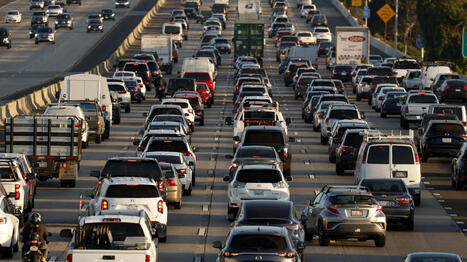
Proponents of driverless cars often tout them as a safer alternative to cars with human drivers—but such claims don’t appear to be holding up so far in the case of Tesla’s Robotaxis. A Monday report from Elektrek found that Tesla Robotaxis are crashing much more frequently than cars driven by humans, as the company has now reported eight crashes of its driverless taxi fleet in Austin, Texas to the National Highway Traffic Safety Administration since July.
- A new study found that 75 streams in Alaska’s Brooks Range have turned orange due to thawing permafrost, which releases metals like iron, aluminum and cadmium that exceed U.S. Environmental Protection Agency safety thresholds for aquatic life.
- The contamination threatens fish populations, with aluminum concentrations at one location reaching nearly five times the safe limit, and the study suggests this may help explain recent crashes in chum salmon returns that Indigenous communities depend on for food and income.
- The pollution flows hundreds of miles downstream to coastal communities like Kivalina, where residents who rely on traditional fishing face threats to food security as some tributaries of rivers like the Wulik have begun turning orange.
- Scientists warn that this climate change impact is irreversible and spreading across the Arctic, with no cleanup options, as these remote watersheds contain hundreds of contamination sources.
-
See All Key Ideas The writer John McPhee once described Alaska’s Salmon River as having “the clearest, purest water” he’d ever seen. Today, that same river runs orange with toxic metals unleashed by thawing permafrost. “During the summer of 2019, the clear waters of the Salmon turned distinctly orange and have remained discolored and turbid since,” according to a new study published in the Proceedings of the National Academy of Sciences. The Salmon River’s transformation represents a much larger crisis. In Alaska’s Brooks Range,75 streams have “recently turned orange and turbid,” the study found. “This is what acid mine drainage looks like,” said Tim Lyons, a biogeochemist at the University of California, Riverside, and co-author of the study. “But here, there’s no mine. The permafrost is thawing and changing the chemistry of the landscape.”
Most of the incentives and regulatory requirements that spurred carmakers to build more EVs are gone. But there are more EVs on American roads than ever.
The shifts in the automaker's electric vehicle strategy will cost the Detroit automaker up to $1.9 billion in expenses and write-downs.
The startup built a compact solar-battery combo that connects directly to key household appliances, is easy to plug in, and requires no special permits.
An analysis for the Ministry of the Interior highlights the reach of US laws. According to it, data stored in the EU is also not secure.
WASHINGTON (AP) — A federal judge on Monday struck down President Donald Trump’s executive order blocking wind energy projects, saying the effort to halt virtually all leasing of wind farms on federal lands and waters was “arbitrary and capricious” and violates U.S. law. Judge Patti Saris of the U.S. District Court for the District of Massachusetts vacated Trump’s Jan. 20 executive order blocking wind energy projects and declared it unlawful. Saris ruled in favor of a coalition of state attorneys general from 17 states and Washington, D.C., led by New York Attorney General Letitia James, that challenged Trump’s Day One order that paused leasing and permitting for wind energy projects.
BOSTON – A federal judge has thrown out an order from President Trump blocking the development of wind energy. They said the effort to halt virtually all leasing of wind farms on federal lands and …
Often overlooked in traditional emergency management, women play a critical role in preparedness, risk reduction, and building resilient communities. On February 26, 1852, the HMS Birkenhead struck a cluster of rocks off the coast of South Africa. With only a few lifeboats for the 638 people aboard, Captain Robert Salmond ordered the women and children to board first while the men stayed behind, attempting to stabilize the ship. The Birkenhead disaster helped cement what became known as the “Birkenhead drill,” widely invoked in the Victorian era as the origin of the “women and children first” maritime code. While practical in its moment, the ethos helped entrench a stereotype: in times of crisis, women are the ones who are helped, not the helpers. Yet history, sociology, and contemporary disaster risk reduction (DRR) practices show the opposite. Women are not only capable responders but often possess critical knowledge and leadership skills essential to community resilience.
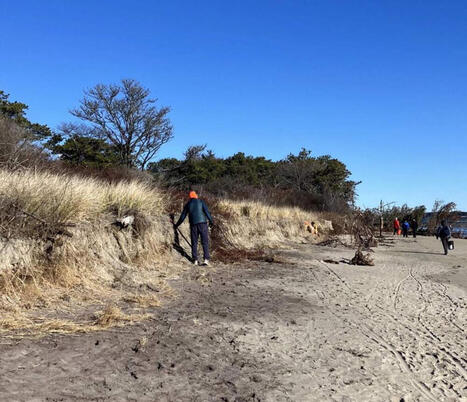
The popular park is the fastest-eroding beach in Maine. The rapid erosion has prompted state officials to take a deeper look at the long-term sustainability of the park facilities at Popham Beach.
Environmental and economic justice advocates are urgently calling on Congress to stop the Trump administration's reckless push for massive AI data centers, despite overwhelming local opposition. Will we stand by as communities suffer skyrocketing electricity costs, job losses, and environmental devastation?
|
Many Gulf Coast refiners have a stake in the future of Venezuelan oil exports, as they've spent billions to process the country's heavier crude.
Rising home insurance costs are making life unaffordable for both homeowners and renters. Robust climate policy and public disaster insurance could save many households’ finances.
Climate and human rights advocates are outraged by the European Parliament's approval of a deregulation package that weakens corporate sustainability rules.
The revisions raise questions about the quality of climate-related data and the efficacy of America’s voluntary reporting system. A large majority of S&P 500 companies revise their annual greenhouse gas emissions disclosures, raising serious questions about the quality of climate-related data and the efficacy of America’s voluntary reporting system. More than 135 million tons of emissions went unreported, more than the annual total for many countries. While there is no federal regulation in sight, states and foreign countries are pressing forward with their own rules, which threaten to create a patchwork regulatory environment for many of the world’s largest companies. Meanwhile, the market demand for emissions data is unlikely to subside.
Ford is ending production of the fully-electric F-150 Lightning as part of a broader companywide shakeup of its electric vehicle plans, the company announced Monday. In its place, Ford will sell what’s known as an “extended range electric vehicle” version of the truck, which adds a gas generator that can recharge the battery pack to power the motors for over 700 miles. The company did not share when the new F-150 Lightning will go on sale, or how much it will cost. The pivot will come with a substantial price tag for Ford.
Between now and the end of the century, climate change will trigger a cascade of rapid, irreversible environmental changes that will make it impossible for people to establish a sense of place, writes Frederick Hewett.
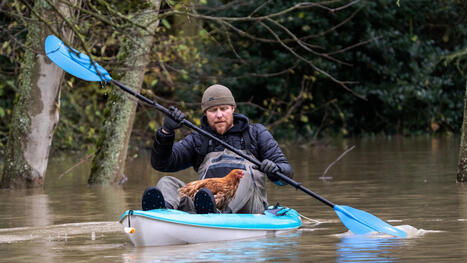
BURLINGTON, Wash. (AP) — Record floodwaters began slowly receding in Washington state on Friday after triggering evacuations, inundating communities and prompting dramatic rescues from rooftops and vehicles. But authorities warned that waters would still be high for days, and that danger from potential levee failures remained. “This is not just a one- or two-day crisis,” Gov. Bob Ferguson said at a news briefing. “These water levels have been historic, and they’re going to remain very high for an extended period of time.” President Donald Trump has signed the state’s request for an emergency declaration, Ferguson said. An unusually strong atmospheric river dumped a foot (30 cm) or more of rain in parts of western Washington over several days and swelled rivers. No deaths have been reported, Ferguson said.
Florida Sen. Stan McClain comes off as an affable guy — the type of person you might like to get a beer with. But after seeing the legislation he’s filed ahead of the 2026 Legislative Session, you may want to…
Between September and November, 2.41 inches of rain fell -- more than what typically falls in the desert landscape in one year. An ancient lake that once existed at Death Valley National Park has reemerged after record rainfall in the region. Several inches of water have formed in Badwater Basin, which lies at 282 feet below sea level, the lowest point in North America, according to a press release from the National Park Service. During the Ice Ages, the basin -- colloquially known as Lake Manly -- was once a lake with depths of up to 700 feet.
A recent paper by three leading economists specializing in tax and energy/climate policy (”Who Bears the Burden of Climate Inaction?,” by Kimberly Clausing, Christopher Knittel and Catherine Wolfram) looks at how the physical effects of climate change are affecting US households. The authors find that costs are already going up—particularly for low-income households, and particularly in hotter and more disaster-prone areas of the country. It’s a narrow study in some ways: the authors focus only on home insurance premiums, home energy costs, and smoke effects on mortality, because those are cost increases that can be rigorously measured. They find that, today, climate-driven changes in those costs add up to about $400-$900 per household per year, with much higher costs—upward of $1,300 a year—in the hardest-hit places.
Hello and welcome to The Associated Press Climate Watch newsletter. I’m Douglas Glass, an editor for AP’s climate and environment team, and today I’m going to tell you about a book you won’t likely find on all those recommended gift lists bouncing around this time of year (but maybe you should).
HYANNIS – NOAA Fisheries has announced two new slow zones for right whales, including Cape Cod Bay. The restrictions are in place through December 20th after the whales were discovered last Friday.…
|