


Students in South Korea will soon be learning from pixel instead of paper, as the government plans to digitize the country's entire school curriculum by 2015.

 Your new post is loading...
 Scoop.it! Students in South Korea will soon be learning from pixel instead of paper, as the government plans to digitize the country's entire school curriculum by 2015. 
No comment yet.
Sign up to comment
Scoop.it!

Creative thinking techniques are to innovation what two espressos are to waking up. They help, but you don't necessarily want to depend on them. BELIEVE IT or not, it's actually possible to start your day without coffee! You could, for example, get enough rest. Or, hold the sugar, exercise! In the same way, it's possible to be a creative superstar at work without ever using a creative thinking technique. How? By adding one or more of the following CREATIVE PICK-ME-UPS to your daily routine. They're simple. They're fun. And they may just be the spark you need to unlock your inner genius.
Scoop.it!

"Middlebury? The military? Beauty school? How do 18-year-olds in 2011 see the rest of their lives?" Via Dennis Richards
Scoop.it!

Crowdsourcing of some aspect of the creation of online learning content seems like a foregone conclusion. At some point in the not-too-distant-future, I believe that many jobs, maybe even a majority of jobs, will be performed online as we move towards a crowdsourced world. We will work with a distributed network of people, who we may never meet, to create things for other people who we may never meet. Via Nik Peachey
Scoop.it!

Fast Company asked several of the most creative ad agencies in the world to rebrand baby girls. Their mock campaigns recast girls as the No. 1 choice for consumers from China to the U.S.
These ads would make for very interesting English or Social Studies or Family Living classes. -JL Via Carole Maurage, Peter Verschuere
Scoop.it!

Designing learning experiences can be a demanding task, particularly if you’re devoted to coming up with creative strategies to engage your audience while facilitating learning. Via Peter Verschuere
Scoop.it!

This article was written a year ago yet its so for today as this memes are beginning to take momentum. If you are serious about learning the rules for the new economy its a must.
This highly philosophical piece seeks to decouple the connection between wealth and money; positing a new form of economic organization. -JL Via Ferananda, Martin (Marty) Smith

Martin (Marty) Smith's comment,
November 26, 2011 9:36 AM
Thanks to Jim for sharing this very important piece. One thing is clear in our "new" economy - money isn't the only or even most important currency (or curren-see). It is possible to spend large sums and have no one care whatsoever. I'm not sure if this new realism locating and supporting authentic (or the seemingly authentic) things is Internet created or merely communicated and sped up and, in the end, it doesn't matter. Attention, hearts and minds are new currencies more important than paper money. Our new currencies are so fast moving the old one has trouble even keeping up. How do you "value" Facebook, Wikipedia or Google? Not very well as it turns out, or not synced in time very well (always over or under). Paper currency is too slow by half and incapable, by itself, of delivering results. This makes the greatest de-valuation of paper money the Internet not inflation.
Scoop.it!
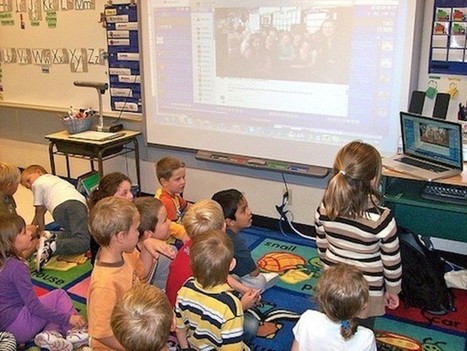
In the video below, Justin Reich describes the ability of online learning environments to record and retain real-time learning interactions between teachers, students and peers, and to open up possibilities for new forms of K-12 assessment. Here are just a few highlights from the video, but the full interview (below) is flush with analytical insights from this former social studies teacher.
Scoop.it!

Just how good is the video camera on the iPhone 4S?
If a short video from Benjamin Dowie is any indication, we’re going to chalk it up to “amazing.”
Dowie shot the footage just after getting his iPhone 4S and as he writes on Vimeo, “Couldn’t believe it came out of a phone.” Looking at the footage, we’re inclined to agree.
Dowie gives strong marks to the automatic stabilization, but what really caught our eye was the amazing depth of field.
The DoF on my Panasonic GF-1 with a 20mm prime lens just barely outpaces the iPhone 4S — and that’s really saying something. Via Robin Good
Scoop.it!

Loosely based on the idea of combining face-to-face education with online instruction, the blended model of schooling is growing in popularity.
Scoop.it!

Scoop.it!
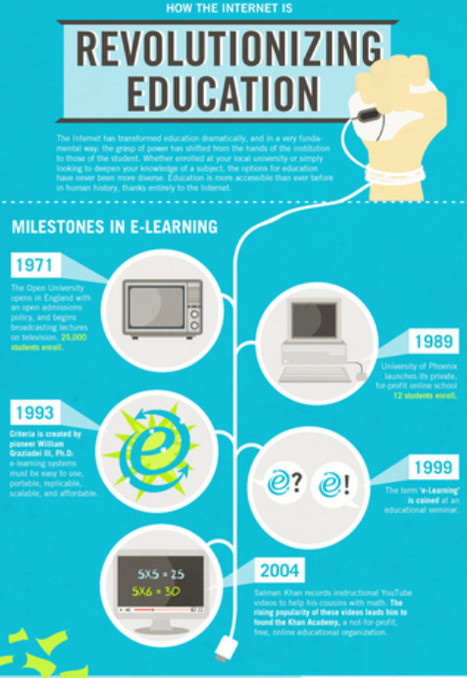
The Internet has transformed education dramatically, and in a very fundamental way: the grasp of power has shifted from the hands of the institution to those of the student.
Scoop.it!

By Darren Draper
I recently had the opportunity of touring a number of live classrooms in a nearby school. The recommendations I made to that school community follow, based entirely upon what I did and didn't see. My guess is that these recommendations also apply to most schools around the globe.
|
Scoop.it!

The way you learn is about to change. At least Knewton, the makers of an innovative Adaptive Learning Platform, would like that to be true, and they just got a lot of money to help them make it happen. Pearson, the world’s largest publisher of print and online textbooks, and Founders Fund just forked over $33 million to Knewton in Series D financing.
This latest injection adds to venture funding previously raised by Knewton totaling $18.5 million.
What is it exactly that these groups are investing in? Knewton’s Adaptive Learning Platform takes the material in textbooks and reorganizes it in a way that best suits the students’ learning style. Mastered material is skipped, which makes for a less boring study time. And material that used to be just pages in a textbook are combined with multimedia for maximum engagement. But the truly remarkable aspect of the technology is its iterative aspect. Through exercises and quizzes the program learns what the student’s strengths and weaknesses are, and adjusts the material in real time. Instead of subjecting all students to the same curriculum, Knewton’s technology shapes the material so that each student receives a personalized education that meets their unique needs.
Scoop.it!

Want a culture of innovation? Choose a few of the following guidelines and make them happen. If not YOU, who? If not NOW, when?
Scoop.it!
This paper explores some new challenges facing universities in a global multimediated Internet-based environment, as they seek alternative paradigms and options to remain true to their core business. At a time of rapid technological change, and contested, complex concepts associated with globalisation, knowledge is becoming a primary factor of production in a global economy. Via Nik Peachey
Scoop.it!
In his new book, the New York Times columnist explores how the U.S. fell from industrial, political and academic glory after the Cold War. "Just when we needed to be lacing up our shoes and running faster, we put our feet up," he says.
Scoop.it!

Creativity and innovative thinking are not genetic traits. What makes people great innovators is not their genetic makeup, but a set of skills and behaviors. The good news: anyone can learn, practice, and master the skills necessary to become a disruptive innovator. Via Peter Verschuere
Scoop.it!

I enjoy a lot of what Steve Denning writes and his series in nine parts on “Why Amazon Can’t Make a Kindle in the USA” (start here http://onforb.es/oK1Cxh ) has really hit home on the seriousness we are facing in Western countries over innovation capabilities. He mentions the “decades of outsourcing manufacturing have left U.S. industry without the means to invent the next generation of high-tech products that are key to rebuilding its economy”, as noted by Gary Pisano and Willy Shih in a classic article, “Restoring American Competitiveness” (Harvard Business Review, July-August 2009). Via Peter Verschuere
Scoop.it!

The conservative Thomas B. Fordham Foundation offers policy proposals regarding teachers and financing education in the digital age.
Scoop.it!
From
vimeo

We are in the beginning of a new era. All is changing. Economy is changing. Practical things you should be considering for you and your communities. Via Ferananda
Scoop.it!

From the article:
I know whenever I first find a video and get interested in the creator's channel, I like to find the most-viewed videos first and work my way through their greatest hits.
If those creators construct a playlist of those particular videos, it makes it easier to navigate.
...most channels are not going to be that consistent. It's good to have a "portfolio" of what represents the best work, or keeps a specific audience tuned in with a particularly compelling theme.
...playlists can help improve your standing in the mystical YouTube algorithm."
Find put more: http://www.reelseo.com/create-youtube-playlists-to-curate-content/ Via Robin Good
Scoop.it!

For the first time in history, the majority of the earth’s population lives in cities. How can we think about creating meaningful change in the developing world's cities? Organized by Smithsonian’s Cooper-Hewitt, National Design Museum, this project (on view at the United Nations) brings together 60 projects, proposals, and solutions that address these complex issues. The "Design with the Other 90%: Cities" website brings together some of these projects with an interactive "Solutions" map on the homepage. Visitors can click on the various locations to learn about the projects in each major urban area, some of which include water reclamation projects and low-cost housing units. Also, the homepage includes some featured themes such as "Access", "Adapt", and "Exchange". Here visitors can learn about solutions that improve access to water, sanitation, electricity, health, transportation, and education. Visitors can also join the discussion of such issues via the forums here, or also offer their comment on the blog.
Scoop.it!

By Leah Miller and Lisa Nielsen (Image is the flag of the Independent Student Union of Nepal)
16-year-old Leah Miller is [a]... former student who has chosen to opt out of high school so she could acquire an education that was best personalized to her learning goals. To follow is her story complete with the presentation she put together to convince her parents she was making the right decision.
Scoop.it!

Designing and Orchestrating Online Discussions
David L. Baker
Abstract
This author’s position is that asynchronous online discussions face an array of resolvable pedagogical and course management challenges. Online discussions can transform mere course chatter into a cyber forum of student-centered learning through meticulous planning, designing and orchestrating. After introducing common issues, a literature review summarizes the contributions that online discussions bring to distance learning. The author then addresses pedagogical and managerial issues that plague online discussions with strategies that instructors may readily employ. In the pedagogical realm, these include insights on organizing online discussions, using groups to facilitate interactions, establishing discussion parameters, and ensuring that the course syllabus introduces online discussion details. In the managerial realm, approaches are offered regarding overseeing discussion windows, using icebreakers, assessing student performance, ongoing communications, maintaining an online presence, netiquette, and a variety of other online discussion tips. In support of online instructors, the article weaves in relevant literature with the hard learned lessons from the author’s ongoing attempts to improve online discussions. It concludes by urging instructors to cultivate improvement continuously through candid self-critique supplemented by student feedback.
Keywords: Asynchronous learning; distance learning, online pedagogy, online groups; online discussions; and discussion assessment.
|





