This collection has been gathered to raise awareness about concerns related to high-stakes standardized tests and related assessments and as a research tool to organize online content. There is a grey funnel shaped icon at the top right corner of the screen (in desktop view mode) where one can enter keyword searches of content (such as PARCC, SBAC, Smarter Balanced, CAASPP, SAT, Pearson, validity, etc.). The following is the link for the Smarter Balanced (SBAC) subset of posts: https://www.scoop.it/topic/testing-testing?q=SBAC. Readers are encouraged to explore related links within each post for additional information. Views provided here are for information only and do not necessarily constitute an official position of the curator nor her employer. For more updates, see Educator Resources tab at http://EduResearcher.com [Links to external site].
"WASHINGTON, D.C., November 11—In a statement released today, the American Educational Research Association (AERA) advises those using or considering use of value-added models (VAM) about the scientific and technical limitations of these measures for evaluating educators and programs that prepare teachers. The statement, approved by AERA Council, cautions against the use of VAM for high-stakes decisions regarding educators.
In recent years, many states and districts have attempted to use VAM to determine the contributions of educators, or the programs in which they were trained, to student learning outcomes, as captured by standardized student tests. The AERA statement speaks to the formidable statistical and methodological issues involved in isolating either the effects of educators or teacher preparation programs from a complex set of factors that shape student performance.
“This statement draws on the leading testing, statistical, and methodological expertise in the field of education research and related sciences, and on the highest standards that guide education research and its applications in policy and practice,” said AERA Executive Director Felice J. Levine.
The statement addresses the challenges facing the validity of inferences from VAM, as well as specifies eight technical requirements that must be met for the use of VAM to be accurate, reliable, and valid. It cautions that these requirements cannot be met in most evaluative contexts.
The statement notes that, while VAM may be superior to some other models of measuring teacher impacts on student learning outcomes, “it does not mean that they are ready for use in educator or program evaluation. There are potentially serious negative consequences in the context of evaluation that can result from the use of VAM based on incomplete or flawed data, as well as from the misinterpretation or misuse of the VAM results.”
The statement also notes that there are promising alternatives to VAM currently in use in the United States that merit attention, including the use of teacher observation data and peer assistance and review models that provide formative and summative assessments of teaching and honor teachers’ due process rights.
The statement concludes: “The value of high-quality, research-based evidence cannot be over-emphasized. Ultimately, only rigorously supported inferences about the quality and effectiveness of teachers, educational leaders, and preparation programs can contribute to improved student learning.” Thus, the statement also calls for substantial investment in research on VAM and on alternative methods and models of educator and educator preparation program evaluation.
About AERA The American Educational Research Association (AERA) is the largest national professional organization devoted to the scientific study of education. Founded in 1916, AERA advances knowledge about education, encourages scholarly inquiry related to education, and promotes the use of research to improve education and serve the public good. Find AERA on Facebook and Twitter.
"Last week the House of Representatives voted overwhelmingly to jettison penalties for schools, districted and states mandated by the Bush era No Child Left Behind law. NCLB was signed into law by George Bush in 2002 and was supposedly designed to expose and solve "achievement gaps" in American education. It did this by mandating the continuous testing of students and required that all gaps be eliminated by 2014. While the testing industry has overwhelmed American schools, achievement gaps have not disappeared. The Senate is expected to pass the new bill, known as the Every Student Succeeds Act or ESSA, this week, maybe as early as Tuesday.
In the last fifteen years a lot of children have been left behind. A recent study published by the National Center for Education Statistics based on 2011 middle school math tests found that Black student performance was significantly lower than the performance by White students and the gap increased for Black students who attended racially segregated schools with large numbers of children from poor families. The scoring gap between Hispanic and White non-Hispanic students was not as high, but it continued to be large. NCLB forced almost every state to apply for a series of waivers from requirements because they could not possibly ensure that no child was left behind.
In 2009, President Barack Obama signed the American Recovery and Reinvestment Act that established his signature educational program, Race to the Top. Obama-EDpromised states educational grants if they imposed Common Core-aligned skill-based tests on public schools and used student scores to evaluate students, teachers, schools, and school districts. To get the competitive federal grants states made impossible promises that stirred up deep resentment from teachers and led to open rebellion by parents opposed to the high-stakes testing regime. It also became an excuse not to address the fundamental problems causing poor academic performance by Black and Latino youth, racial and ethnic segregation, persistent poverty and unemployment in their communities, and inadequate school funding. Even the federal Department of Education had to concede that RTTP was not working. In 2015, student performance declined on math tests for the first time since 1990.
Finally, with bipartisan support in Congress, there is a new educational miracle drug, the Every Student Succeeds Act. There are, however, three very quick questions I need to ask. (1) In the highly charged partisan politics dividing the United States as it enters a Presidential election year, how can any bipartisan bill be more than a conglomeration of pay-offs that will have very little impact on education or the achievement gap? (2) Why are supporters of the bill pretending that every student is ever suddenly going to succeed and what are they going to succeed at? (3) Will there ever be national discussion of what is important for students to know and why or what is meant by college and career readiness?
Major provisions of the ESSA include repeal of annual federal yearly progress reports that will be replaced by individual state-designed accountability systems. ESSA transfers responsibility to states to identify and provide support for struggling schools and prohibits the federal government from interfering in state and local decisions. There will be continuing annual, statewide assessments in reading and math in grades 3 through 8 and once in high school and science tests three times between grades 3 and 12, but states will develop their own standards and have greater "flexibility to develop and implement innovative assessments." Basically, under ESSA states are free to develop pretend standards and assessments while the federal government kicks in dollars to support teacher development and improved education for at-risk students, but there will be minimal to no oversight how states spend the funds. I will be glad to see NCLB left behind and RTTT stopped, but I do not see how ESSA is a victory for education in the United States. Does anyone believe that low-funded poorly performing states like Alabama, Mississippi, and Louisiana, New Mexico, and West Virginia will create meaningful accountability systems and tests that will expose the low quality public education they offer Black and Latino students?
Other problems emerge as well when you do a close read of the bill. Buried in the new law is a provision lobbied for by private and religious schools. State education officials will be required to set aside funds for "equitable services" for eligible children who attend private and religious schools. The bill also requires that state education departments create an ombudsman position to ensure private and religious schools get what they consider to be their fair share of federal dollars.
Kenneth Zeichner, a professor of teacher education at the University of Washington at Seattle, believes that ESSA lowers the standard for teacher preparation. He uncovered provisions in the legislation for establishing "teacher preparation academies" designed to promote "entrepreneurial programs like those funded by venture philanthropists. These include fast-track teacher education programs such as Teach For America, Relay and TNTP, which place individuals in classrooms as teachers of record before they complete certification requirements."
In her blog, Mercedes Schneider points out that ESSA largely keeps the high-stakes testing regime in place and poses a new threat to parents and communities that want to opt-out of the testing. According to Schneider "ESSA pushes for that 95-percent-test-taker-completion as a condition of Title I funding and leaves states at the mercy of the US secretary of education to not cut Title I funding in the face of parents choosing to refuse the tests."
ESSA, as did NCLB and RTTT, avoids any discussion of meaningful content so as not "offend" rightwing ideologues and religious fundamentalist. The biggest criticism of American education may be the gaggle of Republican Presidential candidates who do not believe in science, reject global climate change, and argue positions on economic policy, immigration, and war without any apparent need for supporting evidence. But an even bigger criticism may be that people actually plan to vote for them.
Teacher unions endorsed ESSA praising new federal flexibility but mostly they welcome changes in how their members will be evaluated. I suspect they will abandon opposition to high-stakes testing once teachers will no longer be penalized. TheNational Council for the Social Studies is ecstatic that there may be more money to support social studies education and is rallying its membership to support authorization, but has not addressed other issues. The National Governors Association supports ESSA, but they also took credit for Common Core.
Civil Rights activists have been much more wary about ESSA and share many of my concerns. According to a coalition of civil rights groups, including the Southern Poverty Law Center and the New York chapter of the NAACP Legal Defense and Educational Fund, federal oversight of education will be much too weak to ensure education for Black and Latino students in many of the "red states' and ESSA does not address disparities in school discipline procedures and suspension policies that target minority boys. Gary Orfield, an education and law professor at the University of California-Los Angeles, who has documented increasing racial segregation in United States schools, charges that "Now we're going to get something that's much worse -- a lot of federal money going out for almost no leverage for any national purpose.
"Let's be clear," a catchphrase frequently used by President Obama, this is not a law that will improve education in the United States. It is a mishmash of compromises between political parties that agree on almost nothing. It rewrites bad laws that made things worse, but offers little that will make education better and hidden in the recesses of the 1061-page law are new toxic arrangements, some that may take years to completely emerge.
I am not a fan of Common Core and a big opponent of the high-stakes testing regime, but I suspect in the end ESSA will stand for Excusing States for Student Abandonment."...
"I am currently working in a turnaround school. A turnaround school is a public school that has been deemed "failing" by policy makers. The policy makers inflict draconian, fascist measures on such schools in an effort to turn them around - aka - increase test scores. If they don't increase test scores they bring the hammer down harder by firing teachers, handing the school over to a charter, or closing the school, and so on.
Turnaround schools are not failing. Rather, the truth is that the policies are the failures. The racist, classist, sexist policies are based on lies and false realities meant to create compliant worker bees who do as they are told to increase test scores, while ultimately allowing the corporate reformers to push forward other measures which increase profit, increase the privatization of our public schools, and finally, increase the power of the privileged. That's it in a nutshell.
However, the factual process of turnaround in no way reveals to the public how this brutal takeover goes down. How to articulate the process has been at the forefront of my mind for the last five months as I found myself thrown head first into this madness. And indeed, it is a madness like no other - a combination of insane asylum and prison. As I tried to articulate it to a dear friend of mine, she said, "Peggy, you are being gaslighted." I had never heard the term gaslighting. I immediately began to read about it. I owe much gratitude to this friend who has given me a framework I can use to explain this process.
My point in writing this blog is to expose the turnaround process for what it can be (not all turnarounds are necessarily as I describe), and allow those in the midst of this to figure out how to move forward. This is not a feel good blog with a happy ending. Ultimately, I don't know how it will end for me, but I believe that the only way we will end the bigger picture of corporate education reform is through educating the public and educating ourselves so that together, we can form a plan of action to fight back. Gaslighting is designed to keep you in fight/flight mode - so it's important to step back, understand it, and think it through, in order to determine your next step.
Gaslighting is such an insane reality to live in that it becomes incredibly difficult to focus on anything else except the ability to get through the day- it is designed intentionally so.
So let's try to take a look at what's really happening.
The first stage of Gaslighting is described as disbelief. Strange events, behaviors, and actions by others begin to occur. Perhaps you are told something that doesn't seem true to you or simply just sounds bizarre. Perhaps someone you trusted speaks to you in a manner that seems fake, or staged.
In my case, the "disbelief" began with the supposed root cause of our turnaround status.
We were told: Students experienced lower-quality and less rigorous instruction that did not accelerate them to proficiency and beyond, because the CCSS was not used to guide instruction in all content areas.
Now, for someone like myself, who has spent hours upon hours researching and advocating for the end of corporate education reform this "root cause" at first, is quite laughable. We know that standards - good, bad, and ugly, in no way increase student achievement. Quite honestly, there's no correlation whatsoever between standards and student test scores. This has been clearly confirmed by looking at NAEP scores and the standards used in the various states. So, simply put, it's a lie."...
For full post, please click on title above or here:
"AUGUSTA, Maine — After its debut year, Maine appears to be on the path to dumping its brand new statewide test meant to measure what students have learned. That means whatever state assessment comes next would be the third that Maine schools have seen in as many years.
On Monday, members of the Legislature’s Education and Cultural Affairs Committee voted unanimously in favor of LD 1276, An Act To Improve Educational Assessments of Maine Students, which seeks to end the state’s membership in the Smarter Balanced Assessment Consortium. The Department of Education would issue a request for proposals to provide new tests.
“For more than a year, we have heard stories as to the pitfalls of the test, as well as the errors in it that confuse students and make taking the test a stressful and frustrating event,” said Lois Kilby Chesley, president of the Maine Education Association. She said her organization was “ecstatic” about the vote.
The bill now goes to the House and Senate for votes.
“The committee understood that Smarter Balanced contract wouldn’t be renewed by the governor under any circumstance, and the political turbulence around testing this year is intense,” Rep. Brian Hubbell, D-Bar Harbor, said Monday night in an email explaining the committee’s vote.
Smarter Balanced officials said Monday night that they were “disappointed” by the committee vote. “Maine has been a leader in Smarter Balanced with hundreds of Maine teachers building the assessment,” said Tony Alpert, executive director of the assessment company. “States all over the country use Smarter Balanced because it measures critical thinking and problem solving and colleges and universities have given the test their stamp of approval. In the first year of deployment, there are always bumps in the road. We worked with Maine as issues arose and believed Maine was in an excellent position to continue giving an online, high-quality assessment like Smarter Balanced.”
This spring, the Smarter Balanced consortium issued its first official Maine test, replacing the New England Common Assessment Program, a test that Maine students in grades three through eight had been taking in reading and math since 2009. It also replaced the SAT, which had been used to test 11th-graders since 2006.
The Smarter Balanced contract was $2.7 million in its first — and possibly only — year, with $900,000 in annual dues, according to acting Education Commissioner Tom Desjardins. Desjardins said there is no financial penalty for withdrawing from the consortium.
Smarter Balanced has come under fire in other states for major failures and bugs that delayed testing. In Montana, for example, a series of widespread technical problems caused the state to make the testing optional in its debut this spring. North Dakota and Nevada also reported problems.
While Maine hasn’t experienced any “major statewide disasters,” according to Desjardins, representatives of the Maine Education Association say some districts or parents have reported that students experienced “freezes” while taking the test, lost work “for no explainable reason,” or struggled with “vague and poorly worded questions.”...
"Have You Heard heads to Philadelphia to talk to African American parents who are opting their kids out of standardized tests. We listen in as they share their perspectives about a movement that’s been characterized as wealthy, white and suburban."...
"About 71 percent of students eligible to take new Smarter Balanced standardized tests administered last spring recorded usable scores, according to data released by state education officials Monday.
The testing was plagued by glitches and scoring problems in Montana and two other states that used Measured Progress as a vendor for the test. Officials have cautioned against drawing conclusions from the test, which isn’t comparable to previous statewide assessments, while saying that results will be used as a baseline to compare future scores to.
“Whether we put validity into those scores on a statewide level remains to be seen,” said Superintendent of Public Instruction Denise Juneau during a Monday morning conference call with reporters."
About 38 percent of students scored proficient or above in math and 45 percent in reading statewide. The tests are widely considered to be more rigorous than previous standardized assessments, and most states have seen significant drops in measured proficiency compared to their previous tests.
Smarter Balanced is working with the New Hampshire-based Center For Assessment to conduct a validity study of results, which isn’t finished yet.
If the study shows the scores aren't valid, the state will reassess their usefulness, Juneau said.
“We sort of have to take what we have,” she said. The scores will not be used for federal accountability purposes. Montana was granted an accountability waiver after Juneau let schools opt out of testing — 142 schools didn’t test students.
In School District 2, most schools have results from more than 90 percent of their students. As a district, about 36 percent of students scored proficient or above in math, and about 40 percent of students scored proficient or above in reading.
There was wide variation between proficiency levels at different schools, especially at the elementary level, a continuation of a trend seen with the previous standardized tests."...
"Tallahassee, FL – This week, the Florida Association of District School Superintendents (FADSS) met with Commissioner Pam Stewart regarding concerns with testing and the accountability system. At the conclusion of the meeting, FADSS indicated they would consider her comments and provide a statement reflecting the universal agreement of the organization.
The superintendents of Florida acknowledge the Commissioner’s role and the difficulty of the tasks set before her. Florida superintendents have consistently defended and supported accountability, the new Florida Standards, and the need to accurately measure student performance. At this time, FADSS is compelled to provide a position regarding the recent actions of the Department of Education (DOE) and the State Board of Education (SBE).
Florida district school superintendents have lost confidence in the current accountability system for the students of the State of Florida.
As was stated in the recently released validity study by Alpine: “The precise magnitude of the problem is difficult to gauge with 100% accuracy, but the evaluation team can reasonably state that the spring 2015 administration of the FSA did not meet the normal rigor and standardization expected with a high-stakes assessment program like the FSA.” (Independent Verification of the
Psychometric Validity for the Florida Standards Assessment Executive Summary, Findings, page 11)."...
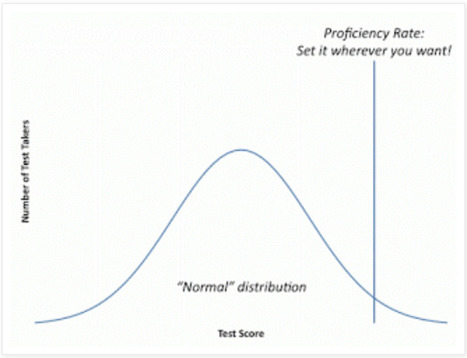
..."In a normal distribution, most students get average scores: that's why the highest point in the curve is in the middle. As we move to the right from the middle, the test scores go up, but fewer and fewer students get those higher scores. Likewise, as we move to the left from the center, fewer students get the lowest scores.
How does this happen? Well, to start, and as testing expert Daniel Koretz has explained, we only test students on what we reasonably expect them to be able to do. We don't test fourth graders on trigonometry because we know most of them can't solve those kind of problems and wouldn't be able to even if we drilled them on it repeatedly. Similarly, we don't test high school juniors on adding one-digit numbers because we know that would be too easy.
Are there fourth graders that know the difference between a sine and a cosine? Are there juniors who can't add 5 and 4? Of course there are, but we know they are far away from the norm; we don't set our standards based on these outliers. Because we like to see ourselves as normally distributed, we create standards and tests that give us normal distributions.
This can't be stressed enough in the testing debates: we design tests not based on objective criteria, but on socially constructed frameworks that assume some of us are above average, some of us are below, and most of us are in the middle.
Now, sometimes we design a test that is "too hard" or "too easy." What does that mean?
Here's a test where many students got high grades; it's skewed negative, meaning many students got grades close to the top of the test's scale. In fact, the "right tail" of the curve is cut off: a good number of students got the highest grade possible. This is a "ceiling effect," and many people, including the NJDOE and other authorities in education, do not like this distribution. They think the test is "too easy," because they assume that students must be normally distributed.
Hence the shift to tests like the PARCC, which reformy folk say is testing "higher order thinking" and "real world problem solving" and so on. Frankly, if you can find a real world situation where people use phrases like "constant of proportionality," I'd be surprised. What's really going on is that the questions are more difficult so the test can lose its skewness and return a normal distribution.
The irony here is that the promoters of standardized testing are using an argument against inequity to insist on the continued use of these tests (if not their expansion), and to shame those who are opting their children out of these tests as perpetuators of race and class injustices.
We'll leave aside the point for the moment that these same people also refuse to actually provide the funds the law -- based on a large and growing body of empirical research -- says are needed to equalize the test-based goals they've set out.
Instead, let's look at the logic of their argument. Somehow, everyone has to be "college and career ready" (as if that is an objective criterion), and we're going to insist that everyone perform at the highest possible levels. But we're going to use a test that forces a normal distribution; and if that test actually shows that many students are meeting a high standard, we'll declare the test "too easy," and redesign it so we get back the bell curve we crave.
Does everyone see the problem here? We're insisting that all children demonstrate high performance on a test that, by design, only allows a few children to demonstrate high performance."...
"There’s big trouble in Florida — and it’s not a hurricane.
A battle over Florida’s public education system may be reaching a tipping point, with school superintendents revolting against the state’s school accountability system and editorial boards of major newspapers now weighing in on their side. One, the Sun-Sentinel in South Florida, is warning against the collapse of that system.
The Florida Association of District School Superintendents issued a statement on Sept. 25 saying that superintendents have “lost confidence” in the current accountability system for students and schools, which is based on the scores students receive on the controversial Florida Standards Assessments. The superintendents called for a suspension of the accountability system and a full review.
The assessments — given to Florida students for the first time this past spring — are aligned to the Florida Standards, which were adopted in 2014 to replace the Common Core State Standards but strongly resemble the Core. Florida also dropped the Common Core test known as the PARCC, which was created by a multi-consortium funded by the Obama administration to develop new exams aligned to the Core. The administration of the new exams was marred by severe technological problems, frustrating superintendents, teachers and students.
The Miami Herald published an editorial on Sept. 28, with the headline, “State fails its own school district,” that said in part:
The long-festering dispute between local school districts and an unreasonable Florida Department of Education turned into open revolt last week as superintendents across the state finally declared that they’ve lost confidence in the state’s testing and grading system.
The well-justified howl from the districts follows years of mounting frustration with a flawed system that unfairly affects schools and students, and the refusal of state education leaders to acknowledge the damage.
Essentially, the superintendents declared that they’ve had it with a so-called “accountability system” that shortchanges the teachers, students and parents across Florida, regardless of what Education Commissioner Pam Stewart and her allies in Tallahassee may think.
And the Sun-Sentinel ran an editorial [see full text below] on Sept. 29, which succinctly explains what is going in Florida, where Jeb Bush, as governor, launched education reforms from 1999-2007 that were adopted by many states around the country. As the editorial notes, Bush’s standardized test-based accountability system was a model only in the sense that people followed it, not because it was good."...
BOULDER, CO (October 30, 2015) – For 15 years, journalists, advocates and policymakers have cited scores on international tests, such as the Program for International Student Assessment (PISA), to conclude that American student achievement “lags woefully behind” other nations, threatening our future and suggesting an urgent need for education reform.
A brief published today by the National Education Policy Center at the University of Colorado Boulder explores such policy analyses and claims around PISA as well as a second prominent international test, the Trends in International Mathematics and Science Study (TIMSS).
In International Test Score Comparisons and Educational Policy: A Review of the Critiques, Stanford education professor Martin Carnoy focuses on four main critiques of analyses that use average PISA scores as a comparative measure of student achievement.
The ranking is misleading, Carnoy asserts, because:
Students in different countries have different levels of family—not just school—academic resources;
The larger gains reported on the TIMSS, which is adjusted for different levels of family academic resources, raise questions about the validity of using PISA results for international comparisons.
PISA test score error terms—the difference between measured achievement and actual achievement—are considerably larger than the testing agencies acknowledge, making the country rankings unstable.
The Shanghai educational system is held up as a model for the rest of the world on the basis of data on a subset of students that is not representative of the Shanghai student population as a whole.
Professor Carnoy also assesses the underlying social meaning and education policy value of international comparisons. First, he describes problems with claims that average national math scores are accurate predictors of future economic growth. Second, he explains that using scoring data in this manner has limited use for establishing education policy, due to the lack of causal inference analysis. This is the well-known “correlation is not causation” problem.
Third, there is a conflict of interest arising from the Organization for Economic Cooperation and Development (which administers the PISA) and its member governments acting as a testing agency while simultaneously serving as data analyst and interpreter of results for policy purposes.
Fourth, Carnoy questions the usefulness of nation-level test score comparisons with regard to countries such as the United States with such diverse and complex education systems. The differences between states in the U.S. are so large that employing state-level test results over time to examine the impact of education policies would be more useful and interesting.
Despite such compelling critiques of international testing, Carnoy concludes that these tests will not go away, nor will they stop being wrongly applied to shape educational policy. However, he says, “there are changes that could be made to reduce misuse.” He concludes with five policy recommendations, including reporting test results by family academic resource subgroups of students with different levels of resources.
In a companion report released today by the Economic Policy Institute (EPI), Carnoy and co-authors Emma García and Tatiana Khavenson provide detailed analyses explaining how and why comparisons using data at the level of U.S. states are more useful than comparing the U.S. with other countries for understanding and improving student performance.
The mission of the National Education Policy Center is to produce and disseminate high-quality, peer-reviewed research to inform education policy discussions. We are guided by the belief that the democratic governance of public education is strengthened when policies are based on sound evidence. For more information on NEPC, please visithttp://nepc.colorado.edu/.
This policy brief was made possible in part by the support of the Great Lakes Center for Education Research and Practice (greatlakescenter.org).
"For those of us who worry that Google might be making us stupid, and that, perhaps, technology and education don’t mix well, here’s a new study to confirm that anxiety.
The Organization for Economic Cooperation and Development (OECD) looked at computer use among 15-year-olds across 31 nations and regions, and found that students who used computers more at school had both lower reading and lower math scores, as measured by PISA or Program for International Student Assessment. The study, published September 15, 2015, was actually conducted back in 2012, when the average student across the world, for example, was using the Internet once a week, doing software drills once a month, and emailing once a month. But the highest-performing students were using computers in the classroom less than that."...
"NEW YORK—Teacher John Garuccio wrote a multiplication problem on a digital whiteboard in a corner of an unusually large classroom at David A. Boody Intermediate School in Brooklyn.
About 150 sixth-graders are in this math class—yes, 150—but Garuccio’s task was to help just 20 of them, with a lesson tailored to their needs. He asked, “Where does the decimal point go in the product?” After several minutes of false starts, a boy offered the correct answer. Garuccio praised him, but did not stop there.
“Come on, you know the answer, tell me why,” Garuccio said. “It’s good to have the right answer, but you need to know why.”
A computer system picked this lesson for this group of students based on a quiz they’d taken a day earlier. Similar targeted lessons were being used by other teachers and students working together, in small groups, in an open classroom the size of a cafeteria. The computer system orchestrates how each math class unfolds every day, not just here, but for about 6,000 students in 15 schools located in four states and the District of Columbia.
As more schools adopt blended learning—methods that combine classroom teachers and computer-assisted lessons—some are taking the idea a step further and creating personalized programs of instruction. Technology can help teachers design a custom lesson plan for each student, supporters say, ensuring children aren’t bored or confused by materials that aren’t a good fit for their skill level or learning style.
At David A. Boody (I.S. 228)—a public school in a Brooklyn neighborhood where five of every six students qualify for free or reduced-price lunch—teachers use a program called Teach to One: Math. It combines small group lessons, one-on-one learning with a teacher, learning directly from software, and online tutoring. A nonprofit in New York City, New Classrooms Innovation Partners, provides the software and supports the schools that use it. New Classrooms evolved from a program created several years earlier at the New York City Department of Education."...
[Press Conference on SBAC Testing: Opt Out Movement Biggest in Seattle's History recorded April 7, 2015 at the Seattle NAACP Headquarters in Seattle, WA.]
[Segment starts at 7:00Minutes from original video] ..."The SBAC testing in Seattle has been an unmitigated disaster. We have had reports across this city of absolute testing meltdown in building after building. You're going to hear today from some of the people who have experienced that first hand. They've experienced the technological gliches that have wasted hours of instructional time. They've experienced their computer labs and their libraries shut down for weeks at a time and unable to be used for research. And they've experienced the human disaster of labeling kids failing and seeing the impact that that has on children and crushing their spirits, turning them off to education... and you'll hear that I think in graphic detail.
But, I want to make one thing clear today. Teachers in the Seattle Public schools are not against tests. In fact teachers invented tests and we rely on assessment to understand our students' thought process and help scaffold their understanding to the next level of their development in a given subject. And to that end the teachers Garfield High School have built a partnership with the New York Performance Based Assessment Schools. And you're going to hear more about that partnership from a colleague of mine so you can really understand what authentic assessment means.... what the leaders in research across the country will tell you about authentic assessment and a little bit about the project that Garfield is undergoing to replace these tests with truly authentic measures... things that get at critical thinking skills, because I think we have made a grave error in our society today. We are training our nation of youth to believe that wisdom is the ability to eliminate a wrong answer choice rather than to think critically, to question, to be creative, to imagine, to collaborate, to identify a problem in your community and work together with someone else to solve it, that's what our schools should be about, not bubbling in a,b,c, or d.
I want to say that these tests are invalid... the SBAC test is invalid. That's a bold statement. How can I make that claim? It's not based on my own estimation. It's based on the SmarterBalanced Consortium itself. The SmarterBalanced Consortium has acknowledged in a memo, that the test has not been proven to be externally valid. And yet our state rushed to implement this test all across the state?"....
In the United States almost all recent designs of teacher evaluation systems rely on standardised tests of student achievement as a substantial part of, or all of the teacher evaluation process. These tests have one characteristic that makes them completely inappropriate for this purpose; namely, they are remarkably insensitive to teacher behaviour. Standardised achievement tests instead reflect demographic characteristics of the students who are tested. In this lecture Professor Berliner will explore how teachers impact individual students enormously, but affect standardised test results only a little.
Professor David C. Berliner David C. Berliner is Regents' Professor of Education Emeritus at Arizona State University. He has also taught at the Universities of Arizona and Massachusetts, at Teachers College and Stanford University, and at universities overseas.
He is a member of the National Academy of Education, the International Academy of Education, and a past president of both the American Educational Research Association (AERA) and the Division of Educational Psychology of the American Psychological Association (APA).
Professor Berliner has authored more than 200 published articles, chapters and books. Among his best known works is the book co-authored with B. J. Biddle, The manufactured crisis, and the book co-authored with Sharon Nichols, Collateral damage: How high-stakes testing corrupts American education. He co-edited the first Handbook of educational psychology and the books Talks to teachers, and Perspectives on instructional time. His most recent co-authored book is: 50 Myths and Lies That Threaten America's Public Schools (available at http://store.tcpress.com/0807755249.shtml)
Our friends over at Politics K-12 have you covered on all the policies and provisions—from accountability to standards to school turnarounds—that made it in to the legislative language officially released Monday. So far, reaction has been mostly positive.
But what about one of the key issues that mostly didn't make it into the newly dubbed Every Student Succeeds Act?
Congress largely punted on student data privacy, declining to include in the ESEA reauthorization amendments that would have updated the country's major federal student-data-privacy law or created a special committee to consider the best way forward on the issue. The changes there were included don't represent any big shifts in policy, but do signal Congress' attention to the issue.
A number of bills to overhaul the Family Educational Rights and Privacy Act, or FERPA, have been introduced in the past year, including a proposal authored by the bipartisan leadership of the House education committee. There had been some hope that work would get folded into ESEA, but the sense from observers was that it proved too complex an issue to try to add to an already cumbersome proposal.
"At some point, it was decided strategically that ESEA couldn't be any more complicated," said Amelia Vance, the director education data and technology for the National Association of State Boards of Education.
"But we obviously know from past statements that [Reps. John Kline, R-Minn. and Bobby Scott, D-Va., the chair and ranking member of the education and workforce committee] have made that they are committed to student data privacy," Vance said. "This could indicate that they have a plan for dealing with this issue in the future."
Many want to see the 40-year old FERPA law updated to better encompass digital records, among other modernization efforts.
On the committee idea, meanwhile, Rachel Anderson, a senior associate of policy advocacy at the nonprofit Data Quality Campaign, was among those disappointed that an amendment originally introduced by U.S. Sens. Orrin Hatch, R-Utah, and Edward Markey, D-Mass. didn't win approval.
"There was a lot of support, but not quite enough," Anderson said.
Not all was lost for those hoping to see federal movement on the issue, however.
Every Student Succeeds does include language that specifies that states and districts can use federal Title II funds for "supporting and developing efforts to train teachers on the appropriate use of student data to ensure that individual student privacy is protected."
Such professional development is "absolutely essential," Vance said, because "you can have all the policies in the world, but if you don't include ways for teachers to be trained how to protect and use the data, the policies won't be of any help."
Such uses of those funds were not disallowed before, but there was some confusion among states and districts that would be cleared up if the bill is signed into law.
Every Student Succeeds also includes non-binding language that offers a "sense of Congress" on the issue, basically saying that student data privacy is important and suggesting that the U.S. Education Secretary "should review all regulations addressing issues of student privacy, including those under this Act, and ensure that students' personally identifiable information is protected."...
"CLOSED FOR CLASS: The doors are closing for Pearson’s learning management systems, LearningStudio and OpenClass, reports Phil Hill of e-Literate. Both tools were the result of acquisitions for which the company paid hundreds of millions of dollars.
By 2018, OpenClass, which Pearson once touted as a free alternative to open-source learning management systems like Moodle, will no longer be supported. LearningStudio, used by an estimated 110 institutions and 1.2 million students, will also be shuttered within three years.
According to Hill’s interview with Curtiss Barnes, Managing Director of Technology Products for Pearson Global Higher Education, “the decision to get out of the LMS category was based on Pearson’s continuing efforts to reorganize and streamline the diversified company, and being competitive in the LMS market just doesn’t help meet corporate goals.”
Citing data from Edutechnica, Inside Higher Ed notes that Pearson’s learning management systems were used by only five to 10 percent of higher-ed institutions."...
"A moratorium on the state’s standardized testing frenzy would provide the funding needed to maintain critically important education and human service programs for Connecticut’s most vulnerable children.
As Connecticut policymakers confront a large and growing state budget deficit, veteran Hartford educator James Mulholland correctly recommends that the $17 million in taxpayer funds that are being wasted on the unfair, inappropriate and discriminatory Common Core Smarter Balanced Assessment Consortium (SBAC) testing scheme should be used, instead, to stop the disastrous cuts that will actually hurt and limit opportunities for Connecticut’s poorest children.
James Mulholland writes:
"As Connecticut’s lawmakers wrangle with the budget in the coming days, one area of the budget they have not yet considered for cuts is the state’s SBAC testing program. The state estimates it will spend $17 million developing and administering standardized tests during the 2015 and 2016 fiscal years. Advocates of standardized testing in general, and the SBAC in particular, have provided two primary justifications for the testing. The first is to identify underserved subgroups and thereby better address their educational needs. Advocates contend that the disparity in test scores, often referred to as the “achievement gap,” provides political leverage and forces politicians and other stakeholders to respond to the needs of historically underserved subgroups such as African-American, Hispanic, and low-income students.
Although the final numbers are still being debated, the state’s recent proposed budget cuts as reported by the CT Mirror include almost $24 million from the Office of Early Childhood and the departments of Social Services, Mental Health and Addiction Services, Public Health, and Children and Families. In addition $16.3 million would be cut from the Department of Education, including a $6 million cut in funding for magnet schools. (http://ctmirror.org/2015/11/16/in-departure-democratic-lawmakers-recommend-cuts-in-social-services-education/)
At the start of November, officials at the State Department of Education proposed eliminating a program that provides about 300 New Haven elementary students from low-income families with after-school homework help and access to extracurricular activities, such as African drumming, cooking and archaeology. Funding for separate after-school and summer camps that focus on engineering would also be eliminated. That cut would affect programs in Bloomfield, Bridgeport, Bristol, Danbury, Hartford, Meriden, Milford, Newington, New Britain, New Haven, Norwalk, Stamford and Waterbury. Other programs for which funding would be eliminated include: a family literacy program at John C. Clark Elementary and Middle School in Hartford; the extended day program at Lincoln-Bassett School in New Haven; and funding for reading instructional supports in some of the state’s lowest-performing schools would be cut by $250,000. (http://ctmirror.org/2015/11/04/education-department-reluctantly-identifies-4-5-million-in-cuts/)
What is the purpose of identifying underserved subgroups if the state is then going to turn around and cut funding for programs that address the educational needs of those students?"...
"Two-thirds of enterprises are failing to meet best practice standards for data control, an IDC study has revealed. Keeping enterprise data both safe and accessible is a complex balancing act made all the more difficult by the geometric growth rate of production data, which is difficult to keep track of, let alone protect.
Each added physical copy increases the surface area of attack for this data, creating additional opportunities for the wrong people to get access. The problem still persists throughout the vast majority of enterprises, despite well-publicised high-profile security breaches or data leaks.
In IDC’s survey of senior executives at 429 mid-to-large scale enterprises, two-thirds of respondents were failing to meet best practice standards for data control, and few were likely to be consistent across the full spectrum of data security policies.
More than three quarters (77%) of those surveyed also failed to mask sensitive data during the test-development phase, which significantly increases the threat of a data breach. Government was the best-performing sector at implementing data control policies, while education was the weakest.
Meanwhile, it was found that a typical organisation holds 375 data copies, with each copy carrying sensitive information and therefore an increased risk of attack. And the CIO was cited as central to the implementation of data control and security policies, which were only found to be applied on an ad-hoc basis 34% of the time.
The enterprise copy data access problem is simply too large and broad for IT organisations to handle manually. By 2018, IDC estimates copy data will be cost IT organisations $50.63 billion and currently consumes up to 60% of the IT storage hardware and infrastructure budget.
“Our research clearly identified two major challenges faced by IT executives: the copy data proliferation problem and the copy data access problem,” said Phil Goodwin, research director at IDC. “Copy data is costly, and introduces risk when it needs to be accessed. Organisations need solutions that can automate copy data management and subsequently reduce risk and cost in the enterprise and public sector environments – manual efforts are simply insufficient.”
Ash Ashutosh, CEO of Actifio, which commissioned the study, added, “The truth is most companies have no idea how many copies of a given data set are floating around in their infrastructure or in the cloud. If you don’t know how many copies you have, you don’t know where they are – and if you don’t know where they are, you can’t tell who has access to them.”...
"In Seattle, protest against the Common Core test is catching on. Meet one high school teacher who has led a boycott against standardized tests as educational assessment, and who educates his students on their right to opt out. Gwen Ifill reports."...
To view report and original video interview, click on title above or here
"After years of avoiding the public beatings that other technology companies have endured over the ways their educational products may threaten student privacy, Microsoft Corp. is suddenly taking heat.
At issue is the company's newly unveiled operating system, Windows 10. Privacy experts and media outlets alike have raised the alarm over what they see as overly aggressive data collection.
One big example: Windows 10 appears to collect extensive data about the Web addresses that users visit, then sends that information back to the company's servers for storage. In one test conducted by a computer engineer at the request of Education Week, an individual student's login and password for a popular online educational service were among the data sent back to Microsoft."...
"Students across the nation are taking tests that are redundant, misaligned with college- and career-ready standards, and often don't address students' mastery of specific content, according to a long-awaited report that provides the first in-depth look at testing in the nation's largest urban school districts.
The comprehensive report by the Washington-based Council of the Great City Schools examines testing in 66 of the council's 68 member school districts, looking at the types of tests administered, their frequency, and how they are used. The findings are expected to add hard numbers and evidence to the fractious national debate around whether U.S. students are being overtested.
The study found, for instance, that 8th grade students in an urban district spent an average of 4.22 school days taking mandatory tests last school year—the most test-taking time of any grade level. That's not counting optional tests and those given periodically by teachers to gauge student progress. And the results of mandated tests were often returned to districts months after they had been taken, reducing their usefulness for classroom instruction."...
"Glenn Greenwald was one of the first reporters to see — and write about — the Edward Snowden files, with their revelations about the United States' extensive surveillance of private citizens. In this searing talk, Greenwald makes the case for why you need to care about privacy, even if you’re “not doing anything you need to hide."
"A parents group claims a Los Angeles County school district failed to notify parents of their right to opt their children out of Common Core-aligned tests in a lawsuit filed this week.
Concerned Parents of California filed the lawsuit against Walnut Valley Unified School District in Los Angeles Superior Court, saying that parent letters excluded information on opting out of Smarter Balanced assessments, according to the suit. Walnut Valley Unified, east of Los Angeles, has 14,500 students in kindergarten through 12th grades.
Matt Witmer, assistant superintendent for educational services at Walnut Valley Unified, declined to comment about the lawsuit because district officials had not received it as of Thursday morning.
But Witmer said the district “complied fully with the law” and followed the California Department of Education’s guidance when notifying parents about the Smarter Balanced assessments before they were given for the first time in the spring.
But Walnut Valley was chosen for the lawsuit because he knew parents in that district who received notices that excluded information about opting out, Dacus said."
To get content containing either thought or leadership enter:
To get content containing both thought and leadership enter:
To get content containing the expression thought leadership enter:
You can enter several keywords and you can refine them whenever you want. Our suggestion engine uses more signals but entering a few keywords here will rapidly give you great content to curate.


 Your new post is loading...















See also the American Statistical Association statement on VAM: http://sco.lt/6sqwFN.