


"Testing, Testing, 1, 2, 3..."
20.8K views |
+0 today
This collection has been gathered to raise awareness about concerns related to high-stakes standardized tests and related assessments and as a research tool to organize online content. There is a grey funnel shaped icon at the top right corner of the screen (in desktop view mode) where one can enter keyword searches of content (such as PARCC, SBAC, Smarter Balanced, CAASPP, SAT, Pearson, validity, etc.). The following is the link for the Smarter Balanced (SBAC) subset of posts: https://www.scoop.it/topic/testing-testing?q=SBAC. Readers are encouraged to explore related links within each post for additional information. Views provided here are for information only and do not necessarily constitute an official position of the curator nor her employer. For more updates, see Educator Resources tab at http://EduResearcher.com [Links to external site].
Curated by
Roxana Marachi, PhD
 Your new post is loading...
 Your new post is loading...
Your new post is loading...
 Scoop.it!

From
patch

"An administrative law judge said this week that New Jersey education officials may have broken the law in deciding to use PARCC as the new high school exit exam.
For full post, click title above or here: http://patch.com/new-jersey/morristown/find-out-why-parcc-may-not-matter-so-much-anymore-0 
Scoop.it!

By Michelle Strater Gunderson "I worked the work of three people this week. I do not say this to be congratulated or slapped on the back. I have never been one of those people who brag about being tired because I do too much. I say this because it is true.
This past week the students at my school were taking the PARCC exam. All of the special education teachers were pulled from servicing the children in my classroom in order to accommodate children who were testing.
I teach first grade in a neighborhood school for the Chicago Public Schools. The PARCC exam begins in the third grade, but even though my students did not take the test, their schedules and learning were still disrupted and negatively affected by the tests. There are 5 wonderful children in my classroom with Individual Education Plans (IEPs), and most of these plans are quite extensive (as they should be). Our room works in a co-teaching model where an education specialist, teaching assistant, and I work together to bring everyone’s Free and Appropriate Public Education (FAPE) to life. Our speech pathologist, occupational therapist, and social worker filter in and out of the room to serve the children per their IEPs.
It works perfectly until the supports are taken away, and last week facing this work alone with my teaching assistant I felt like the rug was pulled out from under me – and so did the children. Now, it would be wrong of me to paint the picture of my classroom last week as chaos. That was not the case. I am very good at what I do. Yet the quality of my teaching was affected, as was the amount of energy I had for each child. To a casual observer it would seem that everything was going well. The part that needs to be explained is what was missing from our classroom this past week:
One of my students was so distressed by the break in her routine that she followed me around each day pulling on my sleeve every 10 minutes asking when her teacher was going to come. She then began scratching her arm until she broke the skin before I could notice.
There is no way anyone could say that these children received their Free and Appropriate Public Education this past week. And this was just one classroom in a system of more than 300,000 children.
And why did the Chicago Schools do this? Because the PARCC test is a state mandated test that supposedly aligns with the Common Core State Standards. It is a measurement instrument that by any standard of research would be considered worthless. The data is not received in a timely matter so that it is actionable, many passages of the tests are written above grade level so the test becomes a guessing game not a measure, and the test takes way too long to administer keeping children away from classroom learning.
So in other words, the learning lives of Chicago’s children were put on hold for no reason – and I would posit that harm was done. I am writing this a week after the Chicago Teachers Union one day historic strike asking for fair funding and education justice – part of which is a reduction of standardized testing. In response to the strike both our governor and mayor stated that the Chicago teachers were interrupting the education of children, and that our actions were shameful.
Mayor Emanuel and Governor Rauner, you are the grand interrupters of our children’s education.
This is what I know for certain – my classroom last week would have brought every education reformer there is begging to their knees. There is no reason to put an entire school on hold just to serve their “measure to manage” agenda, and this needs to stop.
Michelle Strater Gunderson is a 29 year teaching veteran who teaches first grade in the Chicago Public Schools. She is a doctoral student at Loyola University in Curriculum and Instruction.
Scoop.it!
"Advanced technologies enabled us to collect tons of data and use them for business purposes. Certain mobile apps collect user’s contacts, Facebook friends’ lists and log in locations. Same goes for social networks like Facebook, who store people’s likes and interests and use them for audience targeting on their ads platforms. Generally, companies often store big data on their servers, and this huge lists of files often contain various sensitive information, including their customer’s personal info and credit card numbers. That’s why companies need to keep customer’s data safe, especially taking into consideration the significant rise of cybercrime rates. These are some of the worst data breaches that happened recently:
Security Problems Big Data Can Cause A company whose networks contain 20,000 IP addresses, needs to process more than 50 terabytes of data each day. All this data needs to be securely handled and stored, for lowering the possibility of a data breach that can cause a huge hit on company’s reputation. As we saw in previous paragraphs, companies who store big piles of data are the best targets for cyber criminals. That’s why entrepreneurs need to implement complicated security measures for guarding their customer’s data. This means the end of under-skilled security teams who are protecting company’s data with outdated and unpatched security software. Security Solutions Big Data Analysis Provides On the other hand big data analytic tools are becoming more advanced and intelligent each day, and their analytic capabilities can also be used in dealing with cyber security threats. Automated intelligence from big data analytic tools is quickly becoming contextual and situational aware. It is also capable of connecting several different security systems and informing them about the detected threats in real time. Here’s an example from an ordinary company’s computer. When a worker opens an email and downloads a file infected with Trojan, and a firewall or some other anti-virus tool detects the threat, it shares this information in a big data repository that’s unique for the whole company’s network. This way, security tools on all company computers have the information and are able to block emails from that specific sender, or mark them unsafe. Same thing happens when a company’s employee downloads a malware file from an unsecure website. Development of big data analytics and pairing it with standard anti-virus programs enabled developers to create new generation security software, that’s highly efficient for guarding big corporate systems."
For full post, click here: https://datafloq.com/read/Organizations-Improve-their-Big-Data-Security/1819?ref=quuu
Scoop.it!

"Failed log-ins. Frozen screens. Server crashes. Service denials Students, teachers and administrators recall all too well the woes that plagued Florida's most ambitious attempt at computerized testing last spring. As this year's testing season approaches, they're working to avoid a repeat. "We'll have a first glimpse of whether or not the issues have been resolved" when Florida Standards Assessments in writing begin Feb. 29, said Gisela Feild, research and assessment director Miami-Dade schools. "We hope we won't see the same problems again." The Florida Department of Education, its testing vendor American Institutes for Research, along with districts and schools, have taken several steps to prevent such troubles. Those include expanding bandwidth, upgrading defenses against outside attacks and improving testing software. Even with such moves, though, the department warned that students still might encounter interruptions beyond their control. And that, said FairTest public education director Bob Schaeffer, could hurt some children. Imagine the impact when the screen goes blank for a seventh-grader taking a civics test required to get out of middle school, Schaeffer said. "For an emotional adolescent to experience that, it's a scary situation." Yet there's almost no way to guarantee trouble-free computerized testing on a stage as large as Florida's, experts said. That's because the undertaking is "not just a test, but a massive technology project" that involves so many moving parts in a decentralized system, said Doug Levin, founder of EdTech Strategies, a consulting firm. The tests originate at the vendor's servers, move over the Internet through district providers, and enter schools with varying levels of networks, hardware and infrastructure. "Some of the devices are going to be quite old. Some of the school networks won't be as strong," said Levin, who helped develop the nation's first education technology plan in 1996. "Inherently, it is a somewhat challenging endeavor." No test is foolproof, whether on computers or paper, noted Marianne Perie, director of the University of Kansas Center for Educational Testing and Evaluation. "The same year that we were hit by a cyber attack, UPS also lost a batch of Scantron answer sheets off the back of their truck," Perie said. "They were returned to us torn, dirty, soaked in motor oil and covered in tire tracks. We had to throw several dozen out because they were unreadable, and had to rebubble hundreds of others to get them to go through the machine." Paper tests also can be more susceptible to cheating, more expensive to administer and less nuanced in depth, said Greg Cizek, a testing expert at the University of North Carolina. Still, many Florida educators have called for a return to paper and No. 2 pencil as a less time-consuming and less glitch-ridden way to check student knowledge. They have yet to see the value in moving to computers, which were sold as a way to make testing go more smoothly and deliver results more quickly. Neither has happened in Florida. "At present, there is just no way to get around the problems, the way technology currently is and the way schools are equipped to handle technology," Cizek said. Florida has experienced interruptions since it first introduced computerized testing to a handful of students retaking the FCAT a decade ago. Regardless of which vendor, test or system was used, the state has seen servers crash, providers implement unsupported changes, even construction crews accidentally cut cables to schools. And Florida is not alone. Earlier this month, Tennessee canceled its computerized testing after one day amid major testing platform outages across the state. It is now sending all schools paper tests instead, at its vendor's expense. "Despite the many improvements to the system in recent months, we lost confidence in the system's ability to perform consistently," said Tennessee Department of Education spokeswoman Chandler Hopper. Indiana, Minnesota, Virginia and Montana are among several states that had computer testing interruptions in the past year. "The fact that this has happened so often in Florida and around the country should be a wake-up call to policymakers to go slow on computerized testing and have backups available," Schaeffer said. "Be prepared would be our warning." The state and districts are trying to prepare. Florida Department of Education spokeswoman Meghan Collins provided a list of actions the state has taken to prevent problems. It improved its testing servers to combat cyber attacks, developed a system to warn students before a large amount of text is deleted, and enabled students to restore past versions of their responses. "This is not an exhaustive list of improvements," Collins said via email. "But we hope that it does serve as a reassurance that we take very seriously the concerns expressed last year." The state's testing vendor, AIR, declined to comment."... For full post, click on title above or here:
Scoop.it!

By Leslie Postal "A group of parents opposed to high-stakes testing in Florida schools say they are delivering red clown noses to state leaders today in Tallahassee. Their "smell the baloney" campaign aims to draw attention to what they call the state's flawed school accountability system. "We want a fair and valid education accountability system that holds not only schools and teachers accountable, but policy makers, as well. We think our current system is accountabaloney and we are inviting policy makers to join us in our campaign to call out the baloney when you smell it," said Sue Woltanski, a Monroe County parent and co-founder of the education blog “Accountabaloney,” in a statement.
So they might not be persuaded by the "smell the baloney" kits, which were to include the small, red, foam noses and literature about the group's views on bills the Florida Legislature is considering. The kits were to be delivered to all state lawmakers, Gov. Rick Scott, Education Commissioner Pam Stewart and members of the Board of Education. "The Accountabaloney movement is asking for a complete re-evaluation of the current education accountability system, which relies on standardized test scores, often with questionable validity," the group said." For full post, click on title above or here: For the Accountabaloney website: https://accountabaloney.wordpress.com/
Scoop.it!
Doug McRae, Ph.D. 8/9/2016 "This document updates my July 7 “Initial Observations” commentary on the California Peer Review submission to ED with initial observations from the Smarter Balanced Peer Review Submission that I received from the CA Dept Educ on August 1. To provide appropriate context, I’ll provide the July observations first, with the August Smarter Balanced Peer Review Submission updates following, for each of the six elements covered by the ED Peer Review template." ... ___________________________________________
To download full document, click on title above or here:
Scoop.it!

By Maestra Malinche "I am a public school teacher in California and I am opting my 5th grader out of the Smarter Balanced Assessment Consortium (SBAC) Tests this year.
The tests will not help my child’s teacher know my child’s academic strengths and weaknesses. Test scores will not be out until the summer. My child’s current teacher will not be able to use the information to improve instruction in any way for my child this year. My child will lose many hours of instruction in order to prepare for and take the SBAC tests. This time could be used for more meaningful instruction, such as doing an interesting reading project, a social studies, math, art, music or science research project or doing an end of the school year play.
Standardized tests do not help poor, minority, English language learner and special ed students.These groups of students historically score low on standardized tests, in addition to particularly bright students who will often “overthink” answers. Low scores on standardized tests have created schools serving large numbers of these students into reward and punishment test prep centers, with fewer opportunities for enrichment and engaging lessons that higher socio-economically advantaged students have access to. More and more African American and other educators are defending the Opt Out Movement as an antidote to the systematic racism in our society in which poor and minority children receive fewer educational dollars and resources, and are viewed as “deficient”. Check out these powerful articles: this article or this article or this article or my own blog post on the issue. Barack and Michelle Obama, along with many other well-educated and wealthy parents, have opted their children out of the national standardized tests by sending their children to private schools. Private schools offer smaller class size, enriching project-based curriculum, individual learning plans and a well-rounded education that includes humanities, arts, sciences, maths, world languages, physical education, extensive field trips, and community projects. Teachers and parents in these schools are not requesting that students take more standardized tests such as the SBAC, and they do not publish the scores of the tests that they do take. Public school students should have access to the same educational models that our most advantaged citizens have. Here is the beautiful Sidwell Friends school that the Obama children attend. My child’s teachers may be rated on the outcome of how their students perform, regardless of school demographics and regardless of how much I believe my child has learned (or hasn’t). Although my child’s teachers will never see my child’s test to learn from it, they will need to take time from other essential instruction to teach students to perform on this test. Educational researchers have stated that the tests should for diagnostic purposes only, and should not be used to rank and sort teachers. Race to the Top (RTTT) mandated under the Obama administration coerced states into accepting a teacher evaluation system based in part on how their students do on the state assessments. This and other merit based plans do not improve student learning as borne out by research, but do lead to higher incidences of systematic cheating, questionable teaching practices and a narrowing of the curriculum. There is no evidence to support that high stakes tests improve student learning.The accountability system set up by No Child Left Behind did not boost achievement, according to the National Research Council and many other peer-reviewed educational research.Yong Zhao, an education professor at the University of Oregon, has written books on the misuse of standardized testing in China and in the United States. He predicts that the U.S will lose its creative entrepreneurial edge by subscribing to the merit of standardized tests. He states, “we will see a further narrowing of the curriculum and educational experiences. Whatever innovative teaching that has not been completely lost in the schools may finally be gone.” The cut scores are arbitrary and set with a political vision rather than an educational one. Last year, 70% of NY State students scored below proficient on the PARCC Common Core tests. This was a political decision aimed at making more families question whether public schools were doing their job. It backfired, NY changed the cut scores, and many New Yorkers are opting their students out of this year’s tests."...
For full post, click on title above or here: https://teachingmalinche.wordpress.com/2015/04/12/why-i-am-opting-out-a-guide-for-parents/
Scoop.it!
https://www.youtube.com/watch?v=vdVwSLwWf1c
"This video and poem is protected by my first amendment rights. This is a general statement, and I believe I speak for many teachers. When I say students, I mean students in general who are part of a system in which teachers and students must comply. I give a quick anecdote as being "brought into the principal's office" to show that even administration must comply with numbers. I address the others as the lawmakers who run education and don't understand what is happening across American classrooms on a daily basis. We need change. Open your eyes, ears, and hearts...and listen to the educators."
https://www.youtube.com/watch?v=vdVwSLwWf1c
Scoop.it!
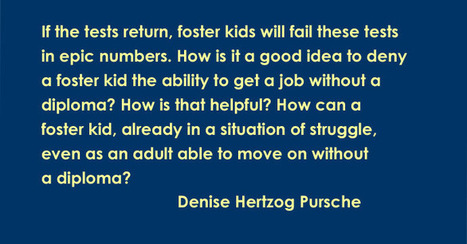
"Denise Hertzog Pursche draws on her own experience as a foster child to explain why the California high school exit exam should never return."...
http://www.livingindialogue.com/why-high-school-exit-exams-not-students-are-worthless-part-one/
|
Scoop.it!

By Anthony Cody (and Anonymous).
I received the following message from a reader this morning. With his permission, I am sharing it here, followed by my own thoughts:
I just applied to Downey Unified School District in Southern California and was referred to the Teachermatch website to take the “EPI” test to see if I was a good match. It was a bizarre, poorly-written test, that left me feeling angry that school districts are paying tens of thousands of dollars to this company for these bogus, meaningless assessments of candidates. It was an hour-and-a-half with timed questions on logic, analogies, math, theory, hypothetical situations, etc. All multiple choice. Several questions about education philosophy did not have any choices that represented my philosophy–but I had to choose one to move on to the next question. There was a question about multiplying fractions — not a word problem, but literally 3/5 X 2/3—without the correct answer, but with fractions followed by abbreviations I have never seen before (ie “3/4 nf” and “1/2 bd”). I attended UC San Diego (consistently rated as one of top universities in the world) and have a Masters Degree. I had no idea what those abbreviations meant. But you have to choose an answer to continue to the next question. And you have to choose it within 90 seconds or you will be marked “in violation.”
My understanding is that Teacher Match is an LLC started by a former police officer in Chicago because he is “very concerned about unqualified teachers” in the schools. So he decided to gather a secret group of investors/finance industry executives together to develop this test (since those are the people most knowledgeable and most concerned about the crisis with incompetent teachers ruining our education system!). They charge tens of thousands to schools/districts to use their system that they claim is proven effective by data that they can’t share. And they are presenters at conferences that cater to investors looking at how to get into lucrative public education markets.
When the test was finished I was prompted to give them my personal information,, complete a profile and purchase a membership so that potential employers could view my profile (which I suppose would include the results of this test, which I could not see– I have no idea what score I got). I was not given a score, nor was there any explanation of how it would be scored. Do you know anything about this? Does anyone have any thoughts?"...
For full post, visit: http://www.livingindialogue.com/future-teacher-hiring-screening-test-predicts-whose-students-will-get-best-test-scores/
Scoop.it!

"Remember that ominous threat from your childhood, “This will go down on your permanent record?” Well, your children’s permanent record is a whole lot bigger today and it may be permanent. Information about your children’s behavior and nearly everything else that a school or state agency knows about them is being tracked, profiled and potentially shared.
During a February 2015 congressional hearing on “How Emerging Technology Affects Student Privacy,” Rep. Glenn Grothman of Wisconsin asked the panel to “provide a summary of all the information collected by the time a student reaches graduate school.” Joel Reidenberg, director of the Center on Law & Information Policy at Fordham Law School, responded:
“Just think George Orwell, and take it to the nth degree. We’re in an environment of surveillance, essentially. It will be an extraordinarily rich data set of your life.”
Most student data is gathered at school via multiple routes; either through children’s online usage or information provided by parents, teachers or other school staff. A student’s education record generally includes demographic information, including race, ethnicity, and income level; discipline records, grades and test scores, disabilities and Individual Education Plans (IEPs), mental health and medical history, counseling records and much more."...
Scoop.it!
By Catherine Gewertz
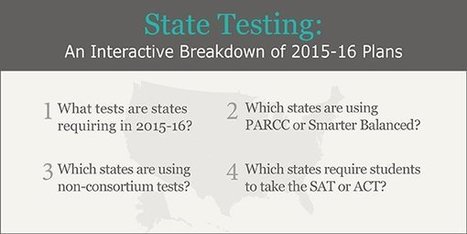
"Only 21 states still plan to use shared tests designed for the common core, a continued erosion of the unity that emerged six years ago, when 45 states embraced the standards and pledged to measure student learning with common assessments. The high school testing landscape is even more fragmented, as states increasingly choose the SAT or ACT college-entrance exam instead of common-core tests. An Education Week survey of states' testing plans in English/language arts and math—the two subjects covered by the common core—found that states have continued in 2015-16 to drift away from the Partnership for Assessment of Readiness for College and Careers, or PARCC, and Smarter Balanced tests."...
For full post, please see http://www.edweek.org/ew/articles/2016/03/23/state-solidarity-erodes-on-common-core-tests.html
Scoop.it!
"Superintendent of Schools for the Patchogue-Medford School District Dr. Michael Hynes and Pat-Med parent Ericka Carey discuss a parents right to opt out of NY State ELA/Math 3-8 testing." For full video, view here: https://www.youtube.com/watch?v=MhKAzaAUhkI
Scoop.it!

By Adolfo Guzman-Lopez "California education officials have made significant changes to the way hundreds of thousands of special education students take the state's standardized tests. But the modifications have some teachers and parents worried about whether they'll help students. “We found some areas that we wanted to improve,” said Keric Ashley, Deputy Superintendent at the California Department of Education.
The changes have to do with the more than two dozen tools available to educators to help special education students take the test. These tools include reading questions aloud, giving frequent breaks, and changing the color of the computer screen to allow a student to see the questions easier.
This year the Smarter Balanced test will allow students to control the volume and pitch on the computer program that reads a question to a student and that reads glossary words related to questions on the test. The test will also now provide Spanish language glossaries to help students who have a disability and who are classified as English Learners.
“What we learned is that accommodations may work for a vast majority of special education students,” Ashley said. “But, like we heard with the text-to-speech changes that we made for some special education students, things didn’t quite work as well as we might have hoped that they would.”
Special education students who take the Smarter Balanced tests typically have disabilities such as autism and other impairments that don’t severely effect a student’s ability to learn. Students with more severe disabilities take other standardized tests instead. Parents have the choice to opt out of the test taking, while the school staff that draws up a student’s Individualized Education Plan can also choose to exempt a student from taking standardized tests."...
For full post, click here: http://www.scpr.org/news/2016/03/28/58936/smarter-balanced-test-changes-affect-california-sp/
Scoop.it!

By Kevin Ohlandt "Since the Center for American Policy, Delaware Governor Jack Markell, and the President of the National PTA want to get 10,000 signatures on their Testing Bill of Rights within the next month, I think it is only fair parents who opt their children out of high-stakes assessments do the same. With that being said, this article needs 20,000 commenters, or official signatures, within the next month. We need to tell these corporate education reformers: NO MORE! If we get 50,000, even better.
Our parental bill of rights regarding opt out or refusing the test bill of rights will be a work in progress, morphing and changing based on the need. We will make sure every single legislator and decision-maker as it pertains to education in our country has a copy of this. Parents and guardians are the stewards of our children, not corporations and politicians. They are not “your” property. They are unique and individual. THE PARENTAL BILL OF RIGHTS FOR OUR CHILDREN IN EARLY EDUCATION, PRE-SCHOOL, ELEMENTARY AND SECONDARY EDUCATION CONCERNING HIGH-STAKES STANDARDIZED ASSESSMENTS, OUR RIGHT TO OPT OUT OR REFUSE OUR CHILD OUT OF THOSE ASSESSMENTS, THE COLLECTION OF STUDENT DATA, AND OUR RIGHT TO GATHER BE IT ENACTED BY THE PARENTS OF THE UNITED STATES OF AMERICA Definition of parent: any biological parent, or a parent through legal adoption, or foster parent, or guardian, or court-appointed guardian, for children through the ages of birth to 18 or 21 with guardianship through the end of an IEP, whichever is later. Whereas parents have been given the responsibility to raise a child and to help guide them to adulthood, as their primary caregiver, and
Whereas parents, through United States Supreme Court decisions and other laws, have the right to decide what is best for our children in education matters until they come to a legal age when they are able to make those decisions on their own, and
Whereas, we believe public education should be reserved for the public at large and not the corporations, be they profit or non-profit, and that decisions based on education are best made at the local level, and
Whereas, we believe any assessments given to our children should provide immediate feedback for the student, teacher, school, and parent as defined for the sole purpose of giving reasonable and interpretive analysis of academic progress for our child’s allotted grade.
Whereas, as the caretakers of our children, we demand that decisions regarding data and the collection of data are parental decisions and that we furthermore have the absolute, unconditional right and ability to consent or not consent to any sharing of said data
(1) As parents, we have the fundamental, moral, and constitutional right to make decisions on behalf of our children in regards to their education.
(a) This includes the type of school we decide they go to, whether it be in a traditional school district, public charter school, vocational school, or private school.
(b) This includes our ability to refuse or opt our children out of standardized assessments despite accountability measures placed upon a school.
(i) Once we have submitted our letter indicating our choice to refuse or opt out our child, we shall receive no verbal or written words meant to threaten, bully, or intimidate, in an effort, whether intentional or coincidental, to coerce us into changing our minds.
(ii) We expect our children to receive instruction while their peers take the state assessment that is of equal or greater value to the type of instruction they would receive prior to or after the administration of the state assessment.
(iii.) If our child is forced to take a test after we have already given our consent to refuse or opt out, we reserve the right to call the local police and press charges against the local education administration.
(iv.) If we witness parents who are bullied or intimidated, we will advocate on their behalf with their consent, if they feel they are unable to do so.
(2) We reserve the right, as dictated by United States of America Federal Law, Title 34, Subtitle A, Chapter 1, Part 99.32 (b), to request all personal identifiable information sent as data or official records to all parties indicated in the entirety of Title 34, Subtitle A, and to receive the entire list of all those who have disseminated, received, or researched said data, and to receive such record keeping as required by federal law, within the 30 day timeframe.
(a) Parents also reserve the right to have any aggregated data on our child, which could conceivably set up a pattern of identification based on our unique and individual child’s health records, social-emotional behavior, discipline, socio-economic, or any such identifiable trait or history of said traits, be banned from any education research organization, personalized learning computer system, or blending learning computer systems, standardized assessment(s), or any other form of educational environment practice or computer-based digital learning environment, whether it is through algorithms already built into a system or any other form of data collection that does not include the legal definition of personal identifiable information, at our request.
(i) This would also include any State Longitudinal Data System, or any Federal system, up to and including the Federal Learning Registry, a joint system shared by the United States Department of Education and the United States Department of Defense.
(ii.) Parents have the right to reject any “competency-based education” decisions for our children that we feel are not based on reasonable, valued, well-researched, or statistically-normed guidelines or analysis.
(iii.) Parents may freely reject any form of data collection, data-mining, or data sharing that would lead to our child having a pre-determined pathway to a career based on any such data unless we give consent for said behavior, before the actual data collection, data-mining, or data sharing by any education agency or institution, and as such, we reject and forbid any trajectory-based decisions for our child unless we have given complicit consent.
(3) For any education decisions regarding our children that we, as parents, feel is not safe, or is inadequate, or is unhealthy for our children, we hereby reserve the right to be able to give public comment to any governing body, without incident or refusal, based on compliance with existing, applicable, and reasonable rules of public meeting conduct, based on our First Amendment Rights.
(4) As parents, we reserve the right to gather, discuss, and give advice to other parents or concerned citizens, in any public meeting or gathering place or social gathering place, whether it is physical or on the internet, without censorship, removal, or banishment, based on existing, applicable, and reasonable rules of conduct set forth by the host of the public meeting place or social gathering place.
(5) Parents have the right to lobby elected officials or local school board officials or state board of education officials, regarding pending, suggested, or passed legislation or regulation, that parents deem harmful to their child or children in general, without cause or incident, based on existing, applicable, and reasonable law. (a) We expect our elected officials, based on their availability, to make every concerted effort to personally respond to our request(s) and to not send a generic form letter, but rather to constructively engage with parents to the same effort they would with any official registered lobbyist who is paid to do so.
(6) As parents, we reject the ability of corporations to “invest” or “hedge” in education with financial predictors of success, including social impact bonds, or any other type of investments where financial institutions or corporations would gain financial benefit or loss based on student outcomes, as we believe a child’s education should be based on the unique and individual talents and abilities of each child, not as a collective group or whole.
(7) As parents, we believe our child’s teacher(s) are the front line for their education, and therefore, have the most immediate ability and responsibility to guide our children towards academic success, and therefore, should have the most say in their instruction.
(a) Therefore, we believe no state assessment can give a clear picture of a teacher’s ability to instruct a student or group thereof, and therefore, we reject any evaluation methods for teachers based on high-stakes standardized testing.
(b) Therefore, we believe a teacher’s best efforts should remain at the local level, in the classroom, and not to conform to a state assessment or to guide instruction towards proficiency on a state assessment, but rather on the material and instruction present before the students based on the material and instruction they have learned before.
(8) We reject any basis of accountability or framework system meant to falsely label or demean any teacher, administrator, school staff, or school, based on students outcomes as it pertains to state or national standardized assessments.
(9) As parents, we are the primary stakeholders for our child’s education, and therefore demand representation on any group, committee, task force, commission, or any such gathering of stakeholders to determine educational decisions for children, be it at a local, state, or national level. (a) We demand equal or greater representation on any such group as that allotted to outside corporations.
Updated, 11:46am, EST: Apparently, Facebook does not like the idea of a Parent Bill of Rights for Education that touches upon an item concerning censorship of a parent’s First Amendment Rights to express their opinion that poses no physical harm or safety risk to any individual… [see link below]
For full post and to co-sign, please see: https://exceptionaldelaware.wordpress.com/2016/03/25/the-parent-bill-of-rights-for-education/
Scoop.it!

"Alaska officials have canceled the state’s computer-based standardized testing for the year, citing repeated technical problems that were interrupting students’ exams, throwing schools into chaos and threatening the validity of results.
“I don’t believe under the circumstances that the assessment we were administering was a valid assessment,” Susan McCauley, interim commissioner of the state education department, said in an interview Tuesday. “Validity relies on a standardized assessment condition, and things were anything but standardized in Alaska last week.”...
For full post, click on title above or here:
Scoop.it!

Exclusive: test paper and answers to spelling test for year 6 state pupils in England posted online by education department’s contractor
Scoop.it!

By Jesse Hagopian "Corporate education reformers who seek to reduce teaching and learning to a single score are beginning to realize they are losing the public relations battle. Hundreds of thousands of families across the country are opting out in what has become largest revolt against high-stakes testing in U.S. history.
Because most of their arguments are increasingly discredited because of this uprising, they are desperately attempting to cling to one last defense of the need to subject our students to a multibillion-dollar testing industry.
Charles F. Coleman, Jr. supported this last ditch effort for the “testocracy” when he took up former Secretary of Education Arne Duncan’s argument that opposition to standardized testing was only from out of touch “white suburban moms.” Coleman has in the past written pieces in support of making black lives matter, but in this careless piece he dismissed the opt out movement as a privileged white effort: Boycotting standardized tests may seem like a good idea, but hurts black learners most….White parents from well-funded and highly performing areas are participating in petulant, poorly conceived protests that are ultimately affecting inner-city blacks at schools that need the funding and measures of accountability to ensure any hope of progress in performance.
Here are six reasons why Coleman’s belief that opting out hurts students of color is fundamentally flawed and why his belief that accountability and academic success require high-stakes standardized testing is just plain old wrong.
1. Extreme over-testing disproportionately harms students of color. Coleman admits in his essay, “there should be concerns raised over excessive testing and devoting too much classroom instruction to test prep.” But he doesn’t acknowledge how destructive excessive testing has become (especially for children of color) or credit the opt out movement for revealing the outsized role that testing is playing in education. No one—certainly not the media—would even be talking about the excessive testing in schools if it wasn’t for the opt out movement. And the amount of testing in the public schools today isn’t just excessive—it’s extreme. The average student today is subjected to 112 standardized tests between preschool and high school graduation!
But the crux of the issue is that the highest concentration of these tests are in schools serving low-income students and students of color. Schools that serve more black and brown students have become test-prep factories rather than incubators of creativity and critical thinking. The corporate education reformers behind high stakes testing, like Bill Gates, Eli Broad, and the Walton family want their own kids to have the time and support to explore the arts, music, drama, athletics, debate and engage in a rich curriculum of problem solving and critical thinking. Rote memorization for the next standardized tests is good enough for the rest of us. 2. Communities of color are increasingly joining and leading the opt out movement. While it’s true that currently the students opting out are disproportionately white, to portray opting out as a white people thing is to make invisible the important leadership role that people of color have played around the country. Chicago Teachers Union president Karen Lewis, a black women, is one of the most important leaders in the country against corporate education reform, and she led the union in the “Let Us Teach!” campaign against high-stakes testing. The Black opt out rate reached 10 percent in Chicago last year. PTA co-chairs Đào X. Trần and Elexis Loubriel-Pujols at New York City’s Castlebridge Elementary School (comprising 72 percent students of color) led the opt out movement there. They gained national prominence and helped to ignite the opt out movement across the country in 2013 when more than 80 percent of families refused to allow their kids to take a standardized test. The school had to cancel the test altogether. One of the largest student protests against high-stakes testing in U.S. history occurred last spring when many hundreds of students in New Mexico—at schools that served 90% Latino students—walked out of school and refused to take the new Common Core exams. In Ohio, a recent study shows that communities of color and low-income communities opt out at nearly the same rates as whiter and wealthier ones. In my hometown, the Seattle/King County NAACP hosted a press conference last spring to encourage parents to opt out of the Common Core tests. As Seattle NAACP president Gerald Hankerson put it, “…the Opt Out movement is a vital component of the Black Lives Matter movement and other struggles for social justice in our region. Using standardized tests to label black people and immigrants ‘lesser,’ while systematically under-funding their schools, has a long and ugly history in this country.” Or check out the brilliant podcast, “These Tests Will Go,” The Opt-Out Movement in Urban Philadelphia, which documents the uprising of African American parents determined to make their kids more than a test score and fighting for the programs their kids deserve. 3. The federal government hasn’t punished schools for opting out. Coleman argues that if the number of students taking the required standardized tests drops below 95 percent, the government can cut funding to schools, and that will be most damaging to students of color. However, the federal government has never—not even once—cut funds to a school district for its high opt out numbers. While No Child Left Behind initially had a provision for penalties against large opt out numbers, which carried over to the new Every Student Succeeds Act, the “testocracy” seems to be too afraid to use this clause. Moreover, the opt out movement holds the potential to actually increase the amount of school funding. The many millions of dollars wasted on ranking and sorting our children with standardized tests every year could be spent on tutoring programs, counseling services, art teachers, nurses, librarians, music programs, ethnic studies classes, and many services our children deserve. 4.Test-and-Punish policies are cruel and inequitable. High-stakes tests are being used around the country to label children and schools as failing, to prevent kids from graduating, to fire teachers, and to close schools. Chicago Board of Education voted in 2013 to close some 49 of the city’s public schools—schools that served approximately 87 percent black students. In 71 percent of the schools had a majority of teachers and staff were African-Americans. The standardized tests the students take register racial and class bias, measure the lack of resources available to schools, and then provide cover for shutting them down. A review by the National Research Council concluded high school graduation tests have done nothing to lift student achievement, but they have raised the dropout rate. African American, Latino, American Indian and low-income students are far more likely to be denied a diploma for not passing a test. High stakes tests often inaccurately assess English language learners—measuring their understating of English and the dominant culture rather than the subject they are being tested in. Boston University economics professor Kevin Lang’s 2013 study, “The School to Prison Pipeline Exposed,” links increases in the use of high-stakes standardized high school exit exams to increased incarceration rates. 5) Standardized testing was invented by white supremacists and maintains institutional racism today. Once you know the history of standardized tests in public schools, you can never fall for Coleman’s absurd assertion that, “boycotting standardized tests may seem like a good idea, but hurts black learners most.” Standardized tests first entered American public schools in the 1920s, at the urging of eugenicists whose pseudoscience proclaimed that white males were naturally smarter. As Rethinking Schools editorialized, “high-stakes standardized tests have disguised class and race privilege as merit ever since. The consistent use of test scores to demonstrate first a ‘mental ability’ gap and now an ‘achievement’ gap exposes the intrinsic nature of these tests: They are built to maintain inequality, not to serve as an antidote to educational disparities.” One of these early eugenicists was Carl Brigham, a professor at Princeton University and author of the white supremacist manifesto, A Study of American Intelligence. Brigham developed the Scholastic Aptitude Test, known as the SAT. Some of the most important early voices in opposition to intelligence testing—especially in service of ranking the races—came from leading African American intellectuals such as W.E.B. Du Bois and Howard Long. Horace Mann Bond, in his work “Intelligence Tests and Propaganda,” noted in 1924 what today we call the “Zip Code Effect”—what standardized tests really measure is a student’s proximity to wealth and the dominant culture. 6. There are better ways than high stakes testing to improve education for children of color. Coleman asserts that, “Standardized testing, albeit imperfect, remains one of the best ways to ensure that teachers, schools, and school districts are held accountable for making sure children are succeeding.” A huge body of evidence contradicts this statement, and points to the power of an inquiry based pedagogy, coupled with authentic forms of assessment. Take, for example, the New York Consortium Schools for Performance Based Assessment. These fully public schools have a waiver from state tests and instead use performance-based assessments. Students work with a faculty mentor to develop an idea, conduct research, and then defend a body of work to a panel of experts—including school administration, other teachers, and outside experts and practitioners in the field of study. If the testocracy is right—if it’s true that high-stakes standardized testing is the key to improving accountability and performance—then these New York consortium schools that don’t give the state standardized test should be the very worst schools in New York City. However, comprehensives studies show Consortium Schools have higher graduation rates, better college attendance rates, and smaller gaps in outcomes between students of color and their white peers than the rest of New York’s public schools. Conclusion: Hold the system accountable Coleman’s arguments lamenting students of color score worse on the tests than their white peers—without acknowledging the ways in which systematic underfunding of schools, poverty, and institutional racism have disfigured our school system—end up pathologizing communities of color rather than supporting them. The U.S. school system is more segregated today than at any time since 1968. The majority of students attending public school in the U.S. today live in poverty. The school-to-prison-pipeline (including disproportionate suspension rates and the use of high-stakes testing) has contributed to the fact that there are now more black people behind bars, on probation, or on parole than were slaves on plantations in 1850. As education professor Pedro Noguera has said, “We’ve developed an accountability system that holds those with the most power the least accountable.”
Our task must be to build multiracial alliances in the opt out movement that can produce the kind of solidarity it will take to defeat a testing juggernaut that is particularly destructive to communities of color—while causing great damage to all of our schools. And while must begin by standing up to the multibillion dollar testing industry by opting out, we must also create a vision for an uprising that opts in to antiracist curriculum, ethnic studies programs, wrap around services to support the academic and social and emotional development of students, programs to recruit teachers of color, restorative justice programs that eliminate zero tolerance discipline practices, and beyond.
Now, back to writing that opt out letter for my son.
- See more at: http://www.progressive.org/pss/six-reasons-why-opt-out-movement-good-students-and-parents-color#sthash.WMYOhePi.dpuf
Scoop.it!

By Valerie Strauss
For years now, it is the second part of that definition that explains a different kind of pep rally, these aimed at getting kids excited to take high-standardized tests — as if that is any way possible. In fact, in this era of of test-based accountability for public schools, such rallies have become de rigueur in many schools, with cheerleaders — and chants such as “Ace the Test!” or “Rock the Test!” — bands, music, jokes, animals, etc. Principals have been known to promise to shave their heads or promise pizza parties or do other things that would presumably amuse students if they do well on the tests. And sometimes there is even more. The “more” at a testing pep rally this past Thursday at Atlantic Community High School in Delray Beach, Fla., included professional performers doing stunts with fire, according to multiple reports. But something went terribly wrong:"..
For full post, click on title above or here:
Scoop.it!

By Cheri Keisecker If you watched yesterday’s Congressional Hearing on Strengthening Education Research and Privacy Protections to Better Serve Students –you heard one parent ask for transparency on how student data is collected, shared and used. You also heard many extolling the need for student data–both Congressmen and a panel of chosen research experts stated that it was not a parent’s right to opt out of data collection (one panel expert said that by registering your child in a public school, you are agreeing to have your child’s data collected) and all were very concerned about the effects opt out has on data. During the hearing, you also heard one Congressman say parents don’t understand existing privacy laws, yet want more laws, you heard experts on the panel (excluding the parent) say things like SLDS student data collection somehow correlated to higher graduation rates, and parents love the SLDS data system, and one researcher on the panel claimed she literally has the data of millions of students and SLDS is a “goldmine“. Interestingly, all researchers on the panel were emphatic, and stated multiple times, they do not have access to, do not receive, NEVER get, do not want pii, (personally identifiable information). According to the expert Congressional panel (who were under oath), the information that researchers get is de-identified and/or aggregate. If this statement is true, which we cannot verify, then states and Congress, in an effort to quell opt out and to gain parents’ trust in the SLDS data base, should put this into law: researchers should have access to properly de-identified and aggregate data and researchers, auditors, community partners cannot have access to student personally identifiable information, without parental consent. Parents do wonder who has access to their child’s data and whether it is accurate. LAW allows you to see who has requested your child’s data.Luckily for parents, there is an existing code requiring education providers to keep very detailed records of data requests and disclosures and they must provide that information to parents.
Use this template letter , send to each education provider to see who has been given access to your child’s pii."...
|






