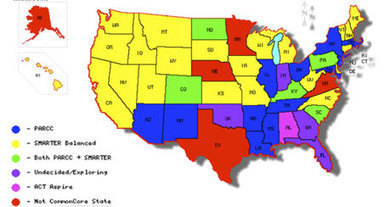
This collection has been gathered to raise awareness about concerns related to high-stakes standardized tests and related assessments and as a research tool to organize online content. There is a grey funnel shaped icon at the top right corner of the screen (in desktop view mode) where one can enter keyword searches of content (such as PARCC, SBAC, Smarter Balanced, CAASPP, SAT, Pearson, validity, etc.). The following is the link for the Smarter Balanced (SBAC) subset of posts: https://www.scoop.it/topic/testing-testing?q=SBAC. Readers are encouraged to explore related links within each post for additional information. Views provided here are for information only and do not necessarily constitute an official position of the curator nor her employer. For more updates, see Educator Resources tab at http://EduResearcher.com [Links to external site].
Anne Trafton, MIT News Office: "To evaluate school quality, states require students to take standardized tests; in many cases, passing those tests is necessary to receive a high-school diploma. These high-stakes tests have also been shown to predict students’ future educational attainment and adult employment and income.
"While the two state testing consortia are drafting or finalizing policies to safeguard student data, they are contending with a stumbling block created by the very entity that is paying for the development of those tests: the federal government.
The agreement that each consortium signed with the U.S. Department of Education is giving some parents, data-privacy advocates, and others cause for jitters, and handing critics ammunition in their attacks on the common-core project that is taking shape in millions of classrooms."
By Robert Kolker - "More than a year before 7-year-old Oscar Mata was scheduled to take his first major standardized test, his parents received word from his school that he was failing. The Department of Education calls it a Promotion in Doubt letter—a well-intentioned, if blunt, method used to get families to take notice of gaps in a student’s skills.
The letter arrived in 2011, around the time of Oscar’s second-grade winter break. Before then, he had been happy at the Twenty-First Century Academy for Community Leadership in West Harlem. His parents, Andrea and Juan, had been drawn to the dual-language school, where English and Spanish learners took field trips together for innovative social-studies projects. They say that Oscar is great at math and loved science, music, and art. He loved reading, too, until he started to get tested on it..." http://changethestakes.wordpress.com/2013/11/25/new-york-magazine-the-opt-outers/
By Wayne Au - "For well over 100 years educational leaders in the field of curriculum have gathered to try and figure out what children in the U.S. ought to be learning. In 1893, for instance, the Committee of Ten published its report on the organization of secondary education in the U.S. In 1895 the Committee of Fifteen was similarly formed to organize the elementary level curriculum. There was also the 1913-1918 Commission on the Reorganization of Secondary Education, as well as the 1931 Committee on the Relation of School and College, the 1934 Commission on the Social Studies in the Schools, and the 1945 Commission on the English Curriculum. Indeed, readers might recall the National Commission on Excellence in Education and their 1983 report, A Nation At Risk, which kicked off the modern era of high-stakes, standardized testing. The United States simply has a long history of relatively small groups of people influencing the direction and tenor of education policy and curriculum nationally."...
By Julian Vasquez Heilig: "I am not of the ilk that charters are all bad news (See all of Cloaking Inequity’s post on charter schools here). As I have mentioned previously, I am a charter school parent, currently serve on a charter school board, and was an instructor at an Aspire charter school. I realize that I have prominent friends and allies that are 100% anti-charter. I am okay with those feelings because I have serious concerns with equity in the charter movement.
Here in the Lone Star State I am unsure if there is a community more enamored with charters than San Antonio. This love affair has been spurred by millions of dollars in donations by the Brackenridge Foundation and other venture philanthropist involved in “Choose to Succeed.” Previously on Cloaking Inequity I have taken aim at corporate charter chains that are invading San Antonio and other communities because of my concerns with their equity for low-SES students (See Great Hearts, BASIS, and KIPP). In fact, I began Cloaking Inequity so that I could respond to a KIPP press release criticizing our peer-reviewed study about the attrition of African American students from charters in Texas (“Work Hard, Be Nice?”: A Response to KIPP).
"Value added measures sound fair, but they are not. In this video Prof. Daniel Willingham describes six problems (some conceptual, some statistical) with evaluating teachers by comparing student achievement in the fall and in the spring."
"Millions of teachers and thousands of districts in 45 states are currently undergoing a sea change in the way that they teach and assess students. The new Common Core Standards for learning have been phased into states and districts since 2010, and the digitized Common Core Assessments are scheduled to deploy in states that have adopted them as early as the 2014-2015 school year."... http://www.edutopia.org/blog/state-of-the-common-core-vanessa-vega
By Julian Vasquez Heilig: "I’ll admit it. When A Terrifying Report about Child Abuse in Texas Schools–and in Your State Too first ran about a month ago on Diane Ravitch’s blog— it flew under my radar. The post detailed the allegations of child abuse for the purposes of high-stakes testing at a high-minority, Title I East Austin elementary school near downtown. Then Angela Valenzuela, a UT-Austin Professor and longtime crusader against the abuses of high-stakes testing, brought it back into the public discourse via an public email recently (Check out her blog Educational Equity, Politics & Policy in Texas). So what has Austin ISD promoted as test preparation in many of its high-minority, Title I elementary schools? Here are some excerpts from Ravitch’s original blog:..." Full post at: http://nepc.colorado.edu/blog/children-psychologically-imprisoned ;
"Change the Stakes is a group of parents and educators who want the best education for all children. We are a growing group concerned with the harm high stakes-testing is doing to our children and schools. We oppose an over-emphasis on tests and misuse of the results for purposes they were never intended to serve. We believe high-stakes testing must be replaced by valid forms of student, teacher, and school assessment.
We are asking parents and community members like you from districts across the city to join hands to improve teaching and learning opportunities for all children. We believe a good education is the right of every child and a right that every parent should demand. It must never become a matter of luck, lottery or good fortune. And good education is not something that can be measured by a test score." http://changethestakes.wordpress.com/
By Bill Fitzgerald: "Update: I asked if anyone from Creative Commons could weigh in here. If I learn anything new, I'll update this post, and/or follow up with a new post containing the additional information. End update"
"New York State spent 28 million on the Common Core aligned curriculum currently available at the EngageNY site. This curriculum was funded via federal money that New York won as part of Race To The Top. Leaving aside the question of how that money could have been used to support local professional development, one of the bright sides of the NY State curriculum is that it is licensed under a Creative Commons Non-Commercial Attribution Share-Alike 3.0 license.
For example, the screenshot below is taken from page 13 of NY's Grade 2 Math Curriculum. The PDF from which the screenshot is replicated as a point of reference in Google drive."...
By Julian Vasquez Heilig, Ph.D. - Dec. 9, 2013 - "High school exit exam requirements are impacting a growing number of U.S. students, particularly low-income students and students of color. This peer-reviewed article examines policy and legal landscape of exit testing policy in order to shed light on some of the key issues facing local school leaders charged with implementing these policies. The article first analyzes federal and state-level court cases related to exit testing, and examines the conditions under which courts have permitted and bounded their use. The article then discuses the broader legal and legislative environment that has affected the ability of leaders to respond to exit testing requirements.
We conclude in the article that the persistent resource inequalities and growing segregation in many contexts means that the issue of “opportunity to learn” will remain a significant problem in the implementation of high-stakes exit testing. We proffer these problems will pose the most significant challenges to educators and leaders working in high poverty schools and school districts. In the paper High stakes decisions: The legal landscape of gatekeeping exit exams and the implications for schools and leaders, we propose several recommendations for state policymakers and educational leaders seeking to raise standards and improve outcomes for the most at-risk youth facing exams required for graduation." Full post at: http://cloakinginequity.com/2013/12/09/high-stakes-decisions-the-legal-landscape-of-exit-exams-required-to-graduate/
(Nov. 13th, 2013) "This morning, the law firm Pitta & Giblin LLP sued Commissioner King and the Board of Regents in NY State Supreme Court on behalf of twelve NYC parents, and asked for a restraining law to stop the unnecessary, unprecedented and illegal disclosure of the personal information of millions of New York State’s public school students to a corporation called inBloom Inc. In turn, the purpose of inBloom is to provide this information to for-profit vendors, so they can data-mine and develop their software products.
"Teachers at Maria Saucedo Scholastic Academy declared victory Tuesday, saying their protest of the state’s Illinois Standards Achievement Test is working. The teachers said they spent the first day of ISAT testing doing what they set out to—teaching.
A week ago, teachers at the Little Village school voted unanimously to refuse to give the exam, which normally carries high stakes in Chicago but is being phased out this year. The school district has said boycotting teachers could lose their jobs or even their teaching certificates."...
(By Diane Ravitch) - "When I worked in the U.S. Department of Education in the early 1990s, I was frequently reminded by colleagues and counsel that the Department was forbidden by law from interfering into what was taught in the schools. When the Department made grants to professional groups of teachers and scholars to create “voluntary national standards,” I made a point of never interfering in their work. I extolled the value of having standards that states, districts, and schools might find useful but made clear that the decision to use or not to use the standards was strictly voluntary. There was no thought that the Department could advocate for the standards or use money to bribe states to adopt them. That would have been illegal."... http://dianeravitch.net/2013/11/15/is-common-core-illegal-did-duncan-break-the-law/ ;
To get content containing either thought or leadership enter:
To get content containing both thought and leadership enter:
To get content containing the expression thought leadership enter:
You can enter several keywords and you can refine them whenever you want. Our suggestion engine uses more signals but entering a few keywords here will rapidly give you great content to curate.


 Your new post is loading...