This collection has been gathered to raise awareness about concerns related to high-stakes standardized tests and related assessments and as a research tool to organize online content. There is a grey funnel shaped icon at the top right corner of the screen (in desktop view mode) where one can enter keyword searches of content (such as PARCC, SBAC, Smarter Balanced, CAASPP, SAT, Pearson, validity, etc.). The following is the link for the Smarter Balanced (SBAC) subset of posts: https://www.scoop.it/topic/testing-testing?q=SBAC. Readers are encouraged to explore related links within each post for additional information. Views provided here are for information only and do not necessarily constitute an official position of the curator nor her employer. For more updates, see Educator Resources tab at http://EduResearcher.com [Links to external site].
"Integrity in Education is a project whose mission is to restore integrity to the conversation about public education. We believe that providing equal opportunity to all children is a moral imperative, not just an economic necessity. Supporting high-quality public schools that are open to all, regardless of background or identity, is an essential part of ensuring liberty and justice for all."
"The Alliance for Childhood promotes policies and practices that support children’s healthy development, love of learning, and joy in living. Our public education campaigns bring to light both the promise and the vulnerability of childhood. We act for the sake of the children themselves and for a more just, democratic, and ecologically responsible future. "
Jan. 18th, 2014 - Washington Post (Valerie Strauss post on Diane Ravitch's address to MLA on Jan. 11th) -
"The Common Core standards were developed in 2009 and released in 2010. Within a matter of months, they had been endorsed by 45 states and the District of Columbia. At present, publishers are aligning their materials with the Common Core, technology companies are creating software and curriculum aligned with the Common Core, and two federally-funded consortia have created online tests of the Common Core.
What are the Common Core standards? Who produced them? Why are they controversial? How did their adoption happen so quickly?"...
By Stan Karp - "The trouble with the Common Core is not primarily what is in these standards or what's been left out, although that's certainly at issue. The bigger problem is the role the Common Core State Standards (CCSS) are playing in the larger dynamics of current school reform and education politics.
Today everything about the Common Core, even the brand name—the Common Core State Standards—is contested because these standards were created as an instrument of contested policy. They have become part of a larger political project to remake public education in ways that go well beyond slogans about making sure every student graduates “college and career ready,” however that may be defined this year. We're talking about implementing new national standards and tests for every school and district in the country in the wake of dramatic changes in the national and state context for education reform"...
by Valerie Strauss - Washington Post - Jan. 3, 2014 "Privacy concerns have been growing over a $100 million student database – largely funded by the Bill & Melinda Gates Foundation and operated by a nonprofit organization, inBloom Inc. — that contains detailed information about millions of students. Most of the states that had signed up to participate in a pilot program have pulled back, and in New York, parents and educators have pushed back with protests and a lawsuit. The nonprofit Electronic Privacy Information Center has sued the U.S. Education Department over the database."
..."District leaders and school boards throughout the state are speaking out in protest, returning their Race to the Top funds, and refusing to sign up for the inBloom-linked dashboards. Superintendents from the Lower Hudson region have decided to send letters to inBloom, citing the provision in the state's contract allowing districts to opt out, and demanding that their student data be deleted.
They are also demanding that the corporation "immediately notify us so that we can consider next steps." South Orangetown Superintendent Kenneth Mitchell, president of the Lower Hudson Council of School Superintendents said, "Based on the contract, we believe we can do this." More and more, it seems inBloom's days are numbered. If the Gates Foundation is wise, they will drop this unethical data-mining privacy-violating project, before they are targeted with lawsuits and the ensuing controversy brings down the Common Core as well." http://nycpublicschoolparents.blogspot.com/2013/11/tuesdays-elections-disaster-for-inbloom.html
By Elaine Weiss & Thomas Payzant: "Every three years, American policymakers eagerly anticipate the release of scores for the Programme for International Student Assessment (PISA). While any single test, no matter how strong, can explain only a limited amount about our education system, PISA provides some unique insights, testing students' ability to apply knowledge and skills both in and out of school. It is taken only by 15-year-olds, making it a decent proxy for the "college-and-career readiness" that is the focus of current debates.
The 2013 headline is basically that the United States falls right in the middle of the pack, as it has for several decades. The U.S. Department of Education and its allies used those rankings to argue that U.S. schools are "stagnating" and to advance specific reforms it says will fix them. However, average scores may obscure and confuse more than they inform. Indeed, scores from individual states that have their own PISA rankings offer more policy-relevant insight than overall U.S. rankings. This makes sense -- U.S. education looks more like a diverse patchwork than a unified system. Public investments in schools, and in students and their families, vary greatly across states, as do other policies that may boost or depress scores. Luckily, this year, three states received individual PISA rankings -- as if they were independent countries. This can help us connect the dots between those disparities and scores."... For full post: http://www.huffingtonpost.com/elaine-weiss/pisa-implications_b_4441077.html
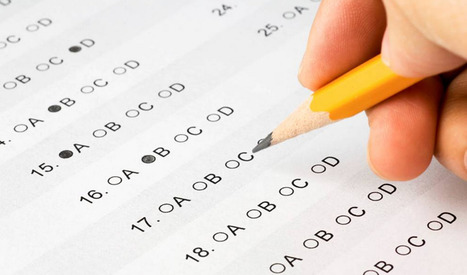
By Abigail Zuger, M.D. ..."In 2009, a Supreme Court decision upheld the validity of multiple-choice testing for evaluating firefighters for promotion, prompting a heated nationwide discussion. Critics pointed out that test-taking savvy may have little to do with job performance.
Medical educators have been contemplating this possibility for years. But the problem particular to medicine may be the sheer volume of these tests, and the standard hysterical preparation they engender, which constitute a form of training in itself. Educators may not actually teach to the test, but students think to the test, in linear multiple choice.
They learn to recognize key phrases (neck pain) and stock situations (older woman), and they live in dread of unlikely worst-case scenarios. (Dies from heart attack while buying new pillow. You are sued.) Sometimes the actual, three-dimensional patient is not real enough to eradicate all her paper iterations."...
By John Merrow - Nov. "When the scores on the 2013 National Assessment of Educational Progress (NAEP) were released, much was made of gains registered in Washington, DC, which led the nation in rate of improvement. Schools Chancellor Kaya Henderson called them “breakthrough gains” and attributed the increases to a stronger curriculum, better teachers, and the District’s ‘get tough’ approach to evaluating teachers. She told the New York Times, “When you raise expectations for students and teachers, they rise to the challenge and produce.” The Times noted that the “get tough” approach preceded Henderson’s tenure. “The district’s new policies, initiated by the former chancellor, Michelle A. Rhee, have come under criticism from teachers’ unions and others who say they put too much emphasis on test scores,” Motoko Rich wrote.
Teach for America issued a press release praising TFA alumna Henderson.[1] All in all, these NAEP improvements represented, much of the press and many politicians said or implied, the triumph of the no-nonsense, “get tough on teachers” approach begun by Rhee.
I understand spin and the desire of those responsible for current policies to want to make things look good, but the rest of us need to take a deep breath and a second look.
In fact, a closer look at the DC data reveals all sorts of contradictions. It raises the possibility that DC is celebrating prematurely. It could be that reports of the triumph of ‘get tough’ policies are misleading–and perhaps just plain wrong.
You know the old saw about “Lies, Damn Lies and Statistics,” of course. I offer a variation: “Lies, Damn Lies, and Headline Writers.” Take your pick, because the DC NAEP press reports could have been headlined “DC Achievement Gap Grows Wider.”...
"The Gates Foundation favors a charitable model known as a public-private partnership, which appears at first to be an enlightened model for corporate engagement. For-profit ventures are "partnered" with the government for funding, to drive positive social change.
The problem is that apparent charities are actually spending public funds, often without our knowledge or consent, and public private partnerships in education have shown themselves to be vulnerable to outright fraud as well as wasteful insider dealing. There's no open or democratic mechanism to determine public benefit, or regulation to protect public education funding from financial pillage for services it doesn't want or need.
Some for-profit corporations directly set up their own non-profit intermediary to divert government funding. For example, the Pearson Education Foundation is a philanthropy which is under investigation for its work as an intermediary on behalf of its parent corporation, global giantPearson Education, whose 2010 US sales totaled £2.6 billion (British pounds).
In April 2011, the Gates Foundation announced a partnership with the Pearson Foundation to produce resources for its Common Core State Standards project, and Pearson simultaneously announced it was developing a complete digital curriculum to support the proposed standards...."
"In a finding that should give pause to backers of standardized test-based school reform, a new study by neuroscientists at three major universities shows that students who achieved the highest gains on standardized tests did not show the same gains in the ability to analyze material and think logically."
Child clinical psychologist presents on how the Common Core Standards are developmentally inappropriate for young students at a conference held at Notre Dame...
'Building the Machine' introduces the public to the Common Core States Standards Initiative (CCSSI) and its effects on our children's education. The documentary compiles interviews from leading educational experts, including members of the Common Core Validation Committee. Parents, officials, and the American public should be involved in this national decision regardless of their political persuasion.
WHAT IS THE COMMON CORE? The Common Core is the largest systemic reform of American public education in recent history. What started as a collaboration between the National Governors Association and the Council of Chief State School Officers to reevaluate and nationalize America's education standards has become one of the most controversial—and yet, unheard of—issues in the American public.
In 2010, 45 states adopted the Common Core, but according to a May 2013 Gallup Poll, 62% of Americans said they had never heard of the Common Core. Prominent groups and public figures have broken traditional party lines over the issue, leaving many wondering where they should stand."...
"ALBANY—Senator Lee M. Zeldin (R-C-I, Shirley), Senator Greg Ball (R-Patterson), Assemblyman Al Graf (R,C,I –Holbrook) and Assemblyman Ed Ra (R-Franklin Square) introduced comprehensive legislation today to halt Common Core and its associated testing for three years.
In 2010, the State Education Department secured Race to the Top Funding from the U.S. Department of Education. In exchange for $700 Million in funding, the state education department made various commitments related to educational standards, testing, a teacher evaluation system, and data collection.
As part of this, the Common Core Standards were adopted—without legislative approval—and the implementation of such has been nothing short of a disaster.
The misguided transition to Common Core has resulted in an emphasis on developmentally inappropriate material and poor educational outcomes. Worse, the hasty implementation and lack of communication between NYSED and educators on the ground have created widespread problems for teachers and parents, resulting in poor outcomes for students."
"Bertis Downs is a parent who lives in Athens Ga., and the former legal counselor and manager of the band R.E.M. He wrote the following letter to President Obama, inviting the president to visit a high school in Athens to see the impact of his administration’s standardized test-based policies there.
'Dear President Obama,
Last month, you hosted Clarke Central High School’s college admissions advisor Lawrence Harris at the White House. You honored this exemplary educator at a forum on making college more attainable for low-income students, and our community celebrated his recognition. The C-SPAN clip of you telling how Mr. Harris was a first-generation college graduate and praising his commitment to give back through College Advising Corps went viral around Athens, Ga. We were genuinely grateful to see you acknowledge his vital and successful work.
But I wish you could also visit the school where Mr. Harris works, an urban high school with about 1,500 students in Athens. Clarke Central is diverse in every way. It serves students from all over the west side of our small city, students of many races, socio-economic levels, religions, ethnicities, and nationalities. The school has high needs, yet ensures that every student has the opportunity to achieve at the highest levels, and many do. Clarke Central has won state and national awards for progress in closing the achievement gap, sends graduates to the nation’s finest schools, and enrolls many upperclassmen in dual-credit programs with local universities. Clarke Central strives to educate any and every student within its community. By and large, it succeeds.'"...
The Kansas State Board of Education voted 8-2 to withdraw from the Smarter Balanced Assessment Consortium opting to commission the University of Kansas to develop a new test instead.
"Common Core is dramatically changing what standards students can be held to, what curriculum is used in the classroom, and ultimately how students may perform in the real world after they leave the campus. But what are students' perspectives of Common Core, and what role do they see themselves playing in its implementation?
Silicon Valley De-Bug asked students what changes, additions, or improvements were needed at their school for Common Core to achieve its goal of educational advancement. Their ideas, opinions, and visions resulted in a first of its' kind publication called "We Have the Power to Raise This Up or Shut It Down.""
"The American Evaluation Association describes standards and guiding principles for conducting evaluation research: The posts provided in this collection document the violations of these principles in the 2013 report on Teacher Preparation released by the NCTQ."
By Noah Zeichner, Education Week Teaching Ahead Blog: "When the PISA 2012 results were released on Dec. 3, renewed calls for reforming our public schools flooded the airwaves. U.S. Secretary of Education Arne Duncan called the scores a "wake-up call" in his remarks at the official PISA release event. (He made the same comment three years ago about PISA 2009 results).
What can we as a nation do to avoid yet another wakeup call three years from now when PISA 2015 results are released? One answer may be simpler than you think: fewer standardized tests.
There is no question that children in U.S. public schools are over-tested. My daughter, who is in kindergarten, is expected to take a computer-based standardized reading test this spring. She can barely operate a mouse. No Child Left Behind currently requires testing in multiple subjects almost every year of a child's education. As members of Congress debate proposals for a reauthorized Elementary and Secondary Education Act in 2014, they have an opportunity to "wake up" and shift the current test-based accountability paradigm.
Our overreliance on multiple-choice tests might make sense from an efficiency standpoint. They are easy to score and much cheaper than more meaningful assessments, such as student portfolios or teacher-scored performance tasks. But the costs to both teacher quality and student learning are high."...
By Ben Tankersley - "Faulty calculations of the “value” that D.C. teachers added to student achievement in the last school year resulted in erroneous performance evaluations for 44 teachers, including one who was fired because of a low rating, school officials disclosed Monday.
School officials described the errors as the most significant since the system launched a controversial initiative in 2009 to evaluate teachers in part on student test scores."
By Brent Duckor and Daniel Perlstein. Teacher's College Record 2014
"Background/Context: Educational researchers and policymakers have often lamented the failure of teachers to implement what they consider to be technically sound assessment procedures. In recent years, the belief that teachers are unwilling or unable to implement appropriate assessment procedures has contributed to the rapid expansion of high stakes, standardized testing in schools. Supporters of No Child Left Behind (NCLB) have contrasted teachers’ assessment practices with standardized testing, arguing that teacher-created classroom assessments lack the technical characteristics required to produce trustworthy measures of student learning or compare large populations of students.
Research Question/Focus of Study: Through a case study of New York City’s Central Park East Secondary School (CPESS), in the years when it served as a model for progressive American school reform, Duckor and Perlstein demonstrate the usefulness of an alternative to reliance on the technical characteristics of standardized tests for constructing and judging assessments: teachers’ self-conscious and reasoned articulation of their approaches to learning and assessment.
Research Design: In order to determine CPESS teachers’ assessment practices and the process through which they were developed, Duckor and Perlstein conducted semi-structured oral history interviews with a sample of CPESS teachers. They triangulated teachers’ recollections through a content analysis of course assignments, rubrics, grading reports, and other artifacts of assessment at CPESS. The sources of this data included published accounts of CPESS and primary sources provided by teachers or uncovered in archival research.
Conclusions/Recommendations: Duckor and Perlstein conclude that when teachers are given opportunities for genuine, shared reflection on teaching and learning and classroom practices are tied to this understanding, fidelity to what they call the logic of assessment offers a more promising framework for the improvement of schooling than current forms of high-stakes, standardized accountability. Thus, instead of expecting teachers to rely on data from standardized assessments or replicate features of standardized testing in their own assessment practices, researchers, policymakers and teacher educators should promote fidelity to the broader logic of assessment."
By Diane Ravitch, Dec. 15th, 2013 "In Kentucky and New York, the Common Core tests caused test scores to tumble by 30 points or more.
State officials assume–with no evidence–that the scores will go up every year. What if they don’t? What if they go up only by a small increment? What if 50-60% of students don’t pass?
In New York, the “passing” rate on the Common Core tests was 30% statewide. Only 3% of English learners passed, and only 5% of students with disabilities. The pass rate for African American and Hispanic students was 15-18%.
If the state continues to insist upon a wildly unrealistic passing mark, the percentage of students who do not graduate will soar.
To get content containing either thought or leadership enter:
To get content containing both thought and leadership enter:
To get content containing the expression thought leadership enter:
You can enter several keywords and you can refine them whenever you want. Our suggestion engine uses more signals but entering a few keywords here will rapidly give you great content to curate.


 Your new post is loading...