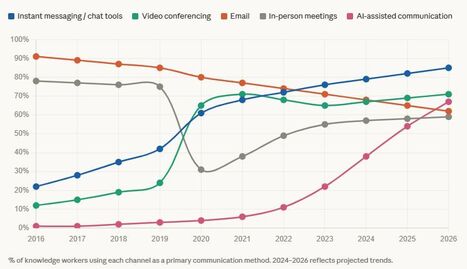

The chart captures structural shifts that explain why business communication courses—and the resources that support them—must evolve.
Email’s long decline is the first signal. Still the dominant channel in 2016 at roughly 91 percent, it steadily lost ground as workplace messaging platforms matured and reshaped expectations for speed, tone, and responsiveness. What once defined professional communication is now one part of a broader ecosystem.
The second turning point is the 2020 discontinuity. In-person meetings collapsed almost overnight, while video conferencing surged from a secondary channel to a daily necessity. Neither has returned to its pre-pandemic norm. That reality now defines how professionals collaborate—and how students must communicate across environments.
The third shift is structural dominance by chat-based communication. Instant messaging has moved from a supporting tool in 2016 (22 percent) to the projected primary channel by 2026 (85 percent). This transition justifies treating digital messaging as a core professional competency rather than a peripheral skill.
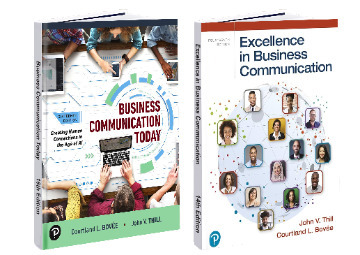
The most consequential development is the rise of AI-assisted communication. From virtually nonexistent adoption in 2016, AI tools for drafting, summarizing, translating, and scheduling are projected to reach roughly two-thirds of knowledge workers by 2026. No prior channel has scaled at this pace. That trajectory explains why Business Communication Today, 16th Edition approaches AI not as an add-on but as an integrated dimension of professional practice across the communication process. The text provides practical and ethical guidance while strengthening the human capabilities—empathy, judgment, credibility—that matter most in professional settings.
Seen through this lens, the design of the 16th edition becomes clear. Chapter 1’s focus on professional communication in the age of AI reflects a structural shift, not a temporary trend. Standalone chapters on digital and social media respond directly to messaging platforms and networked communication environments. Presentation coverage has likewise evolved toward virtual, screen-shared, and hybrid contexts—reinforced through contemporary cases and application-driven learning in Chapters 16 and 17, including updated guidance on slide design, collaboration tools, and AI-supported workflows.
For instructors, the takeaway is straightforward: the chart doesn’t simply describe change; it clarifies what students must master—and why a course built on integrated coverage is more effective than one assembled through supplements. The structure is already there. The assignments align with workplace realities. And instructors can teach the future without rebuilding their courses midstream.


 Your new post is loading...